
The story of Szécsény Synagogue
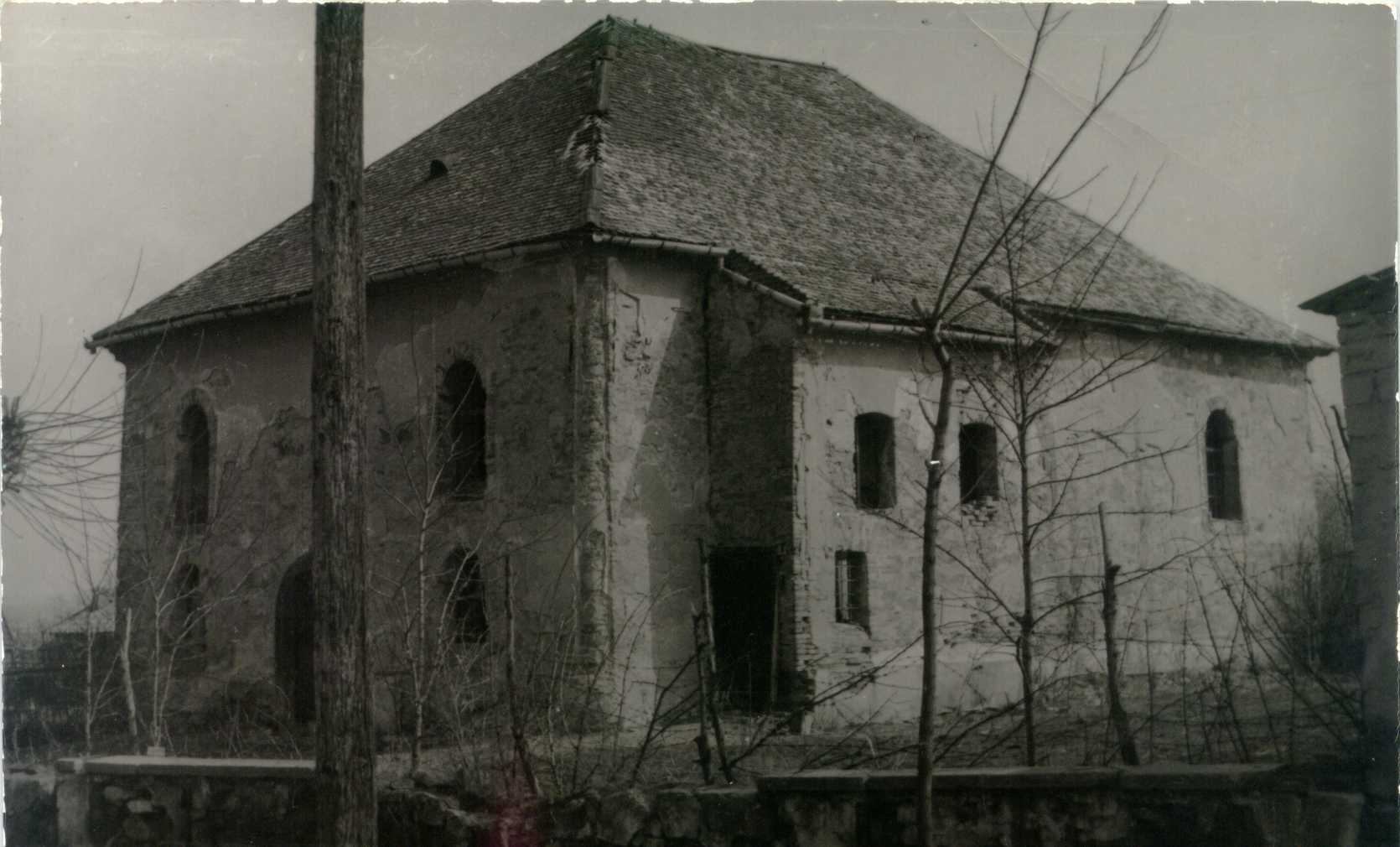
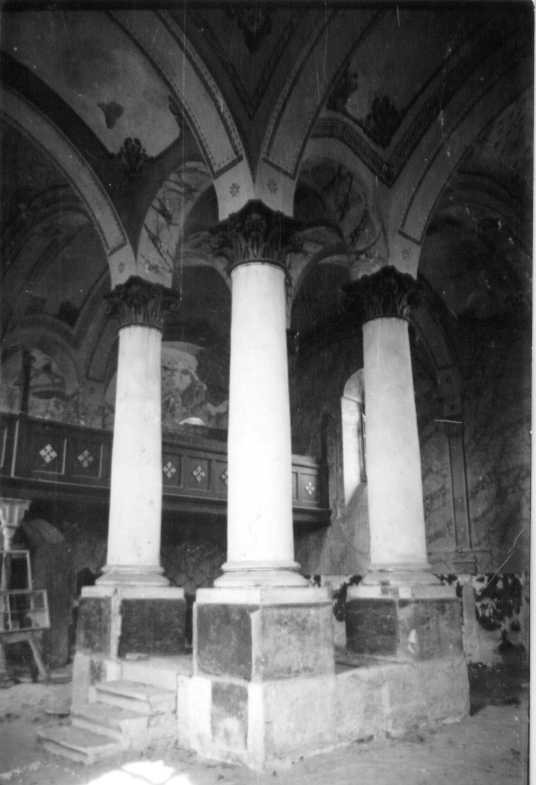
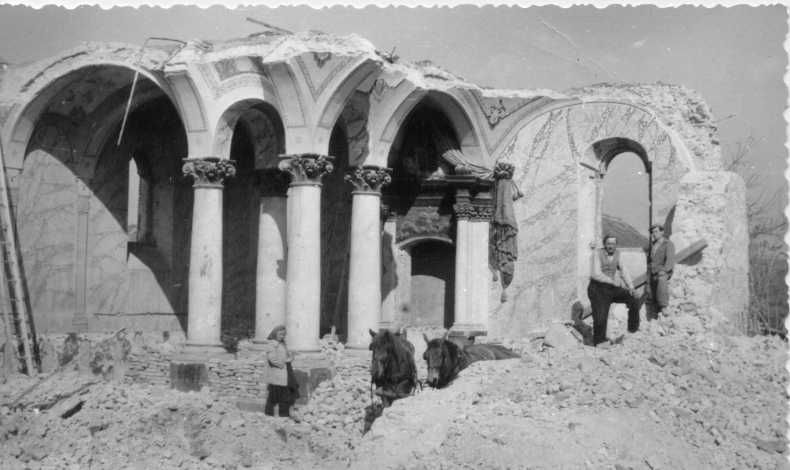
Szécsény, a market town near the river Ipoly in Nógrád county, had a Jewish congregation with its own rabbi from the early nineteenth century, and in 1910 its 456 Jews made up about a tenth of the inhabitants. Their synagogue is known today almost entirely from three photographs kept by the Hungarian Jewish Museum and Archives in Budapest. They show a plain rendered block under a tall hipped roof and, inside, a vaulted prayer hall whose reading platform stood between four columns in the middle of the room. When it was built, and by whom, has not been established; the Hungarian Jewish Lexicon of 1929 has no entry for the town. In the spring of 1944, under Nazi German occupation, Hungarian authorities confined the Jews of Szécsény and moved them to Balassagyarmat, from where they were deported in June. The building itself survived the war. Two of the museum's photographs, dated after 1944 and after 1945, show it still standing, emptied and neglected. A third, undated, shows it half pulled down, the painted vaults open to the sky and workmen standing in the rubble. The synagogue was demolished some time after 1945, and nothing of it is known to remain.
Where it stood
Historic: Szécsény, Nógrád county; street and house number not established. Today: Szécsény, Nógrád county, Hungary; exact site not identified.
Open larger map →The Jewish community
Rabbis are recorded in Szécsény from the first decades of the nineteenth century. Ezekiel Baneth, a Talmudist from Óbuda who had lost his fortune as a timber merchant, accepted the congregation's invitation to become its rabbi before moving on to Paks and Nyitra; his youngest son, Jerachmiel Bernhard, was born in 1815, in Szécsény according to the Hungarian Jewish Lexicon, although the Jewish Encyclopedia allows Paks as well. Falk (Fülöp) Büchler, previously rabbi of Szügy, also held the post, and David Schück, a pupil of Moses Sofer, served from 1852. The census of 1910 counted 456 Israelites among 4,245 inhabitants, beside 3,523 Roman Catholics and 213 Lutherans. The congregation kept its own cemetery, which still exists. The Hebrew Wikipedia article on the town refers to Shlomo Spitzer's survey of Hungary's Orthodox communities in 1944, which includes Szécsény. No source read for this entry says when the congregation was formally organised, when it acquired the synagogue plot, or how and when the building was paid for and put up.
Architecture and design
This description rests on the three museum photographs alone. Outside, the synagogue was a compact masonry block, rendered and almost without ornament, under a steep hipped roof of small tiles. Tall round-headed windows were set high in the walls, with further arched openings below them on one side. A lower wing with its own roof was attached to one face, with small windows on two levels and a doorway where it met the main block; it may have held the entrance and the stairs to the women's gallery, but that is not documented. Inside, four tall columns with foliate, Corinthian-style capitals rose from a stepped masonry platform, the bimah, in the centre of the hall. Arches sprang from the columns to the walls and divided the ceiling into vaulted bays, all painted with bands, rosettes and foliage. A women's gallery with a panelled wooden parapet ran along at least one wall. The demolition photograph shows the Torah ark still against its wall, an aedicule framed by columns beneath painted drapery. The four-pillar plan is familiar from Hungarian synagogues of the late eighteenth and early nineteenth centuries, but that comparison does not date this building.
Life inside the synagogue
Very little about the life of the synagogue could be documented from the sources available. The plan itself says something: a reading platform in the middle of the hall, enclosed by four columns, and a separate women's gallery belong to traditional practice. The rabbis known by name were Talmudic scholars. David Schück, who came to Szécsény in 1852, had studied under Moses Sofer in Pressburg and under Ezekiel Baneth in Nyitra, and he taught students of his own here: Kálmán Weisz, later chief rabbi of Sátoraljaújhely, studied with him in Szécsény. Schück's legal essays were published after his death as Imré Dóvid (Munkács, 1890). Baneth's son Jerachmiel Bernhard went on to lead a well-known yeshiva in Liptószentmiklós. The names of later rabbis, cantors and wardens, the congregation's school and charitable societies, and its formal affiliation after the split of Hungarian Jewry in 1868–69 were not found; one secondary reference places it among the Orthodox communities.
Destruction
The synagogue was not destroyed in the war. A photograph in the Hungarian Jewish Museum and Archives dated "after 1944" shows the exterior intact but shabby, its plaster flaking and its windows empty. Another, dated "after 1945", shows the interior stripped of its furnishings, with debris on the floor and stains on the painted vaults. Who emptied the building, and whether it was put to another use in the meantime, is not recorded in the sources read. A third photograph, catalogued as the demolition of the Szécsény synagogue, shows the roof gone and the vaults broken open, with two men, a woman and a pair of cart horses in the rubble and the ark still in place. It is undated. The museum's inventory numbers for the three prints begin with F70, which suggests that they entered the collection in 1970; if so, the building was demolished between 1945 and about 1970, in the post-war decades that were mostly under Communist rule. No source read names the year or the body that ordered the demolition, so responsibility cannot yet be assigned.
The community’s fate
After the Nazi German occupation of Hungary in March 1944, Hungarian authorities and gendarmerie carried out the ghettoisation and deportation of the provincial Jews. A ghetto in Szécsény is recorded in Yad Vashem's Encyclopedia of the Ghettos and in the United States Holocaust Memorial Museum's encyclopaedia of camps and ghettos. Randolph Braham lists Szécsény among the Nógrád localities whose Jews were concentrated in Balassagyarmat; shortly before deportation the people held there were moved to tobacco-drying barns at Illéspuszta, about five kilometres outside that town. Two trains left Balassagyarmat, on 12 and 14 June 1944, carrying 2,810 and 1,867 people. A notice for the town's commemoration in 2019 speaks of relatives taken to Auschwitz and Gunskirchen and killed there. The Federation of Hungarian Jewish Communities reported in 2026 that 301 local victims are remembered. How many survivors came back, and whether services were ever held again, is not known; in the 2022 census 0.1 per cent of the town's residents gave their religion as Israelite.
The site today
The exact site of the synagogue could not be established from the sources available for this entry, so what stands on the plot today cannot be stated; the map pin marks the centre of Szécsény only. No ruin or fragment of the building is known to survive, and the Hungarian Wikipedia list of synagogues records it simply as demolished. The Jewish cemetery of the town does survive: Anikó Gazda photographed it in 1976, with the Forgách mansion and the church towers in the distance. A memorial there carries the names of the Jews deported from Szécsény, and martyrs' commemorations are held in the cemetery, in June in both 2019 and 2026. Finding the synagogue plot will need the town's cadastral maps or local-history literature.
Notable names
Ezekiel Baneth
1773–1854Rabbi of Szécsény (early nineteenth century)Born in Óbuda, the son of a member of the local rabbinate, Baneth traded in timber until he lost his fortune and then accepted the invitation of the Szécsény congregation to serve as its rabbi. He later moved to Paks and finally to Nyitra, where he kept a large yeshiva and died in 1854. He is the earliest rabbi of Szécsény named in the sources read; whether the demolished synagogue already stood in his time is not known.
Biography or source →Falk (Fülöp) Büchler
UnknownRabbi of SzécsényBüchler was rabbi of Szügy, in the same county, and afterwards of Szécsény. The Hungarian Jewish Lexicon mentions him only through his family: his brother Áron Büchler was rabbi of Dunaszerdahely from 1816, and his son David, born in Szügy in 1815, served Pásztó for sixty-one years. The years of his service in Szécsény, and his relation to the synagogue building, are not recorded in the sources read.
Biography or source →David Schück
Unknown–1889Rabbi of Szécsény from 1852Born in Bresova, Schück studied under Moses Sofer in Pressburg and Ezekiel Baneth in Nyitra. He became rabbi of Szécsény in 1852 and taught students there, among them Kálmán Weisz, later chief rabbi of Sátoraljaújhely. He afterwards served in Varannó and then in Tokaj, where he died in 1889; the lexicon's dates for these moves contradict one another. His son Jakab published his halakhic essays as Imré Dóvid in Munkács in 1890.
Biography or source →Do you have something to contribute?
Photographs, documents, family stories or memories of this synagogue and its community help keep its history alive.
- Szécsényi zsinagóga épülete (photograph, after 1944), inv. F70.393
- Szécsényi zsinagóga bimája (photograph, after 1945), inv. F70.394
- Szécsényi zsinagóga bontása (photograph, undated), inv. F70.395
- Magyarországi zsinagógák listája (Nógrád county table: Szécsényi zsinagóga, 'Elbontották')
- List of synagogues in Hungary (Nógrád county table: Szécsény Synagogue, destroyed 'after 1945')
- A népirtás politikája: a holocaust Magyarországon, vol. 1, p. 661 (Balassagyarmat)
- A népirtás politikája: a holocaust Magyarországon, vol. 2, Appendix 6, pp. 1357–1358 (deportation trains)
- Schück Dávid (Magyar Zsidó Lexikon, 1929, p. 776)
- Baneth Ezekiel (text of Magyar Zsidó Lexikon pp. 83–84)
- Baneth Jerachmiel Bernhard (text of Magyar Zsidó Lexikon p. 84)
- Yerachmiel Dov Baneth (after the Jewish Encyclopedia, 1902)
- Büchler Dávid (text of Magyar Zsidó Lexikon p. 144)
- Büchler Áron (text of Magyar Zsidó Lexikon p. 144)
- Weisz Kálmán
- Szécsény
- סצ'ן (Szécsény)
- Szécsény Ghetto (Q30006284)
- Szolnok, Cegléd, Nagykőrös, Szécsény, Ópályi, Zsarolyán, Salgótarján – Vidéki közösségek emlékeztek a holokauszt mártírjaira (25 June 2026)
- Áldozatokra emlékeznek (17 June 2019)
- Szécsény, zsidó temető (1976), Fortepan no. 307882
- File:Friedhof, Mahnmal an die Opfer des Zweiten Weltkriegs, 2024 Szécsény.jpg (description quoting the town's war memorial)
- Nominatim search result for Szécsény, Hungary
Share a memory or thought
No comments yet. Be the first to add one.