
הסיפור של Szeghalom Synagogue
Szeghalom is a town in the Sárrét region of Békés county, in south-eastern Hungary. According to the Magyar Zsidó Lexikon of 1929, no Jews lived there until 1856, when a few families moved in from nearby Dévaványa and founded a community. It chose Adolf Meisels as its first rabbi, set up a burial society in 1867, and in 1889 built its synagogue and its school. The congregation followed the Congress (Neolog) line and stayed small: 168 people in 63 families in 1929, most of them shopkeepers and traders.
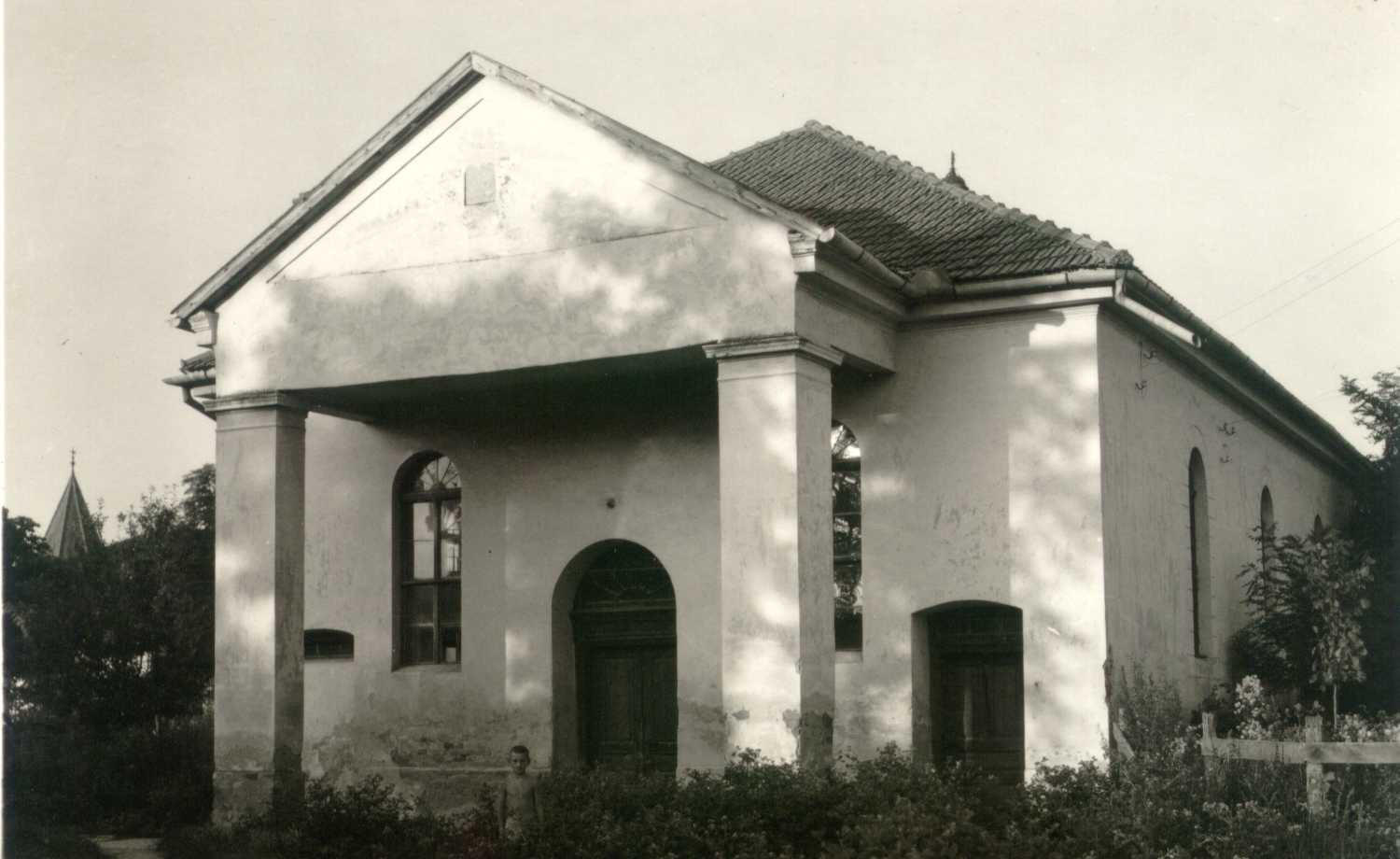
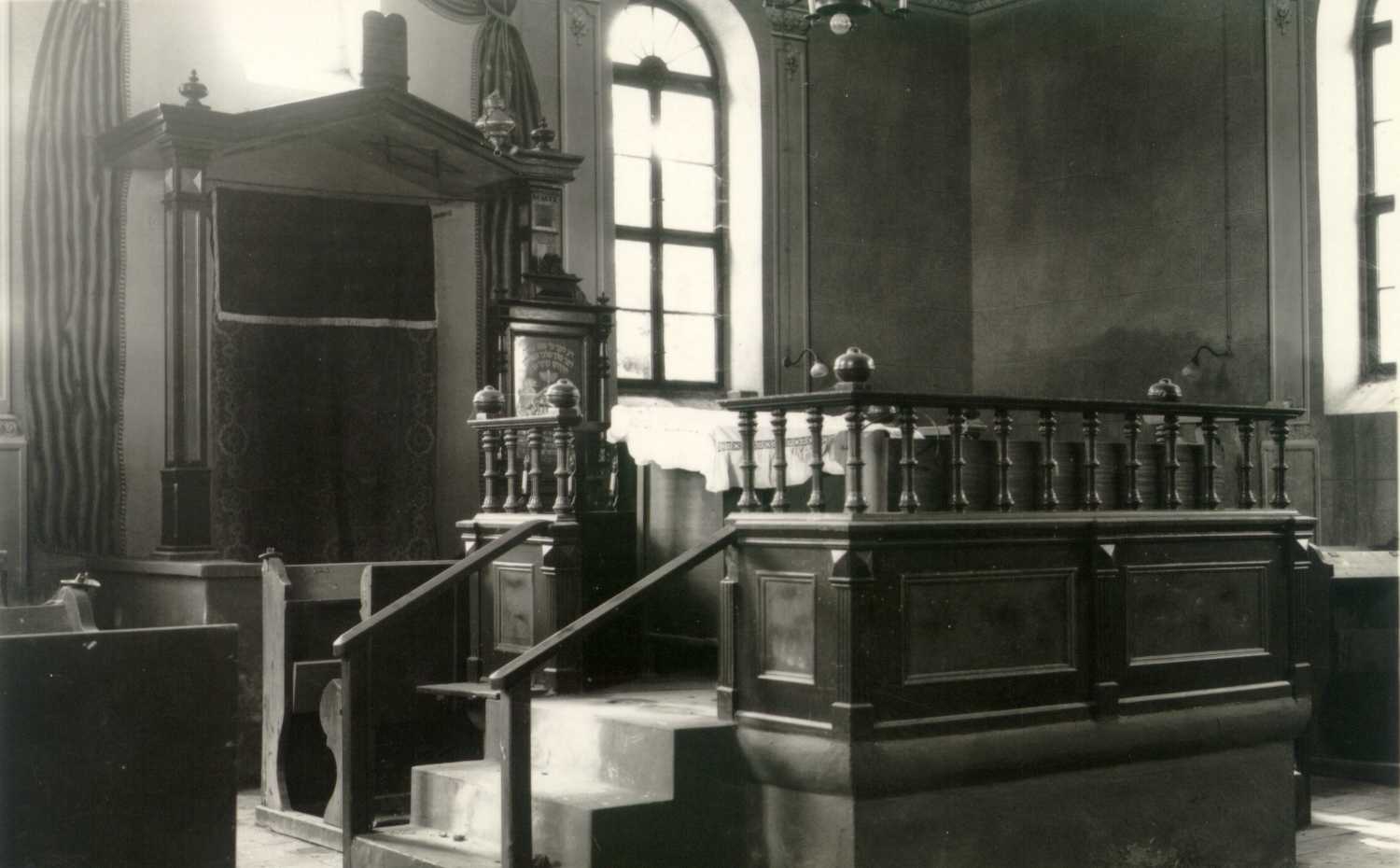
Three photographs in the Hungarian Jewish Museum and Archives are the only views found. They show a modest rendered hall with a tiled roof, entered through a deep porch whose gable rests on two heavy square piers, and an interior with a pedimented timber Ark and a railed reading platform.
In May 1944 the Jews of Szeghalom were shut into a ghetto set up around the synagogue. In June they were taken to Szolnok, where Jews from the region were held in the sugar factory before being deported to Auschwitz and to Strasshof in Austria.
The museum's prints came from the national Jewish office (MIOK) in 1954 and are catalogued under that year; they show the building still complete. Anikó Gazda, who surveyed Hungarian synagogue sites between 1980 and 1987, found it demolished. Who pulled it down, and exactly when, is not recorded in any source found.
Where it stood for nearly 85 years
Historic: Szeghalom, Békés county; street and house number unknown. Today: Unknown; placeholder pin at the centre of 5520 Szeghalom, Békés county (approximate).
פתיחת מפה גדולה ←הקהילה היהודית
The Magyar Zsidó Lexikon states that the Szeghalom community was founded in 1856 by a few Jewish families who had moved in from Dévaványa, and that no Jews had lived in the village before then. Its first rabbi was Adolf Meisels, who died in 1874. A Chevra Kadisha burial society was formed in 1867, the synagogue and school were built in 1889, and a women's association was founded in 1908 under Mrs Dezső Kohn. In 1929 the community counted 168 people in 63 families, with 60 taxpayers, in a village of 9,460 inhabitants. By occupation there were 50 merchants, five craftsmen, two farmers, two public officials, two labourers, a lawyer and a doctor. The annual budget was 4,000 pengő, of which 500 went to welfare. The Jews of Füzesgyarmat, Vésztő and Körösladány belonged to its registry district. Seventy members served in the First World War and three were killed. The officers in 1929 were Henrik Werner, president; Manó Schwarc, vice-president; Mátyás Weisz and Aladár Schillinger, wardens; and Miksa Farkas, treasurer. The lexicon also notes that the actor Jenő Ivánfi of the National Theatre began his career from Szeghalom.
אדריכלות ועיצוב
The description here rests on the three museum photographs; no plan or written account was found. The synagogue was a free-standing, single-storey rendered hall under a tiled roof with a small finial at the ridge. The entrance front had a deep open porch: a plain triangular gable, with a small rectangular tablet set in its centre, carried forward on two massive square piers with moulded capitals. Under the porch was a round-arched doorway with double timber doors, flanked by tall round-arched windows with fan-shaped glazing in their heads. A second, lower door opened to the right of the porch, and the long side wall had tall, narrow round-arched windows. A fenced garden with shrubs and flowers lay in front. Inside, the Ark was a timber cabinet framed by columns under a triangular pediment with urn finials, hung with a dark curtain, and above it stood what appear to be the Tablets of the Law. The wall around it was painted with draped curtains. Directly in front stood a raised reading platform reached by steps and enclosed by a panelled parapet with turned balusters. The architect, builder and seating capacity are unknown.
החיים בבית הכנסת
The lexicon says the congregation placed itself on the Congress (Neolog) basis at the time of the national Jewish congress, and the arrangement seen in the interior photograph, with the reading platform set immediately before the Ark and not in the middle of the hall, is consistent with that. The photograph shows the furniture of ordinary worship: plain timber pews, a reading table under a white embroidered cover, a small stand with a Hebrew-lettered panel beside the Ark, a hanging lamp and electric lamps on the platform rail. The synagogue and the community school were built in the same year, 1889, so from the start the building served a congregation that also taught its children. A burial society had existed since 1867, and from 1908 a women's association led by Mrs Dezső Kohn did charitable work. The Magyar Zsidó Lexikon remarks that for long decades nothing notable happened in the life of the community. Its rabbis after Adolf Meisels, who died in 1874, are not named in the sources read, and no cantor or teacher is recorded.
הרס
No source found records damage to the synagogue during the Second World War. In May 1944 the ghetto for the Jews of Szeghalom was set up around the building, and after their removal in June the congregation ceased to exist. Two photographs of the exterior and one of the interior are held by the Hungarian Jewish Museum and Archives; the catalogue records them as a gift of the MIOK, the national office of Hungarian Jews, in 1954 and dates them 1954. They show the synagogue roofed and glazed, with its Ark, curtain, reading platform and pews still in place. If the catalogue date is the date of the photographs, the building was still intact nine years after the war. Anikó Gazda, who surveyed synagogue sites across Hungary between 1980 and 1987, recorded the Szeghalom synagogue as demolished. The demolition therefore took place between about 1954 and the 1980s, under Communist rule. None of the sources read says who ordered or carried it out, whether the building had first been sold, or what became of its furnishings.
גורל הקהילה
After the Nazi German occupation of Hungary on 19 March 1944 the Jews of Szeghalom were forbidden to leave, and in May they were concentrated in a ghetto set up around the synagogue. In June they were taken by train to Szolnok; the date given is 26 June. Randolph Braham names Szeghalom among the places whose Jews were brought to the Szolnok sugar factory, where 4,666 people were held, about half of them from Szolnok itself, and where 29 died. He writes that they were deported in two transports, the first with almost 2,700 people on 25 June and the second due three days later, one sent to Strasshof in Austria and the other to Auschwitz. Which transport carried the Szeghalom Jews is not stated. English Wikipedia, citing the Museum of the Jewish People, says they were sent to Auschwitz and murdered. The number of victims and of survivors who returned is unknown. The Jewish cemetery on the Füzesgyarmat road has a gravestone as late as 1993, which suggests that a few Jews lived in the town after the war.
האתר כיום
The plot on which the synagogue stood has not been identified in any source read, so it is not possible to say what occupies it today. The photographs show a fenced garden in front of the building and the spire of a church in the distance, but name no street. The 1944 ghetto was laid out around the synagogue, which suggests it stood among houses in the built-up centre. No surviving fragment and no marker on the site is recorded in the sources found. The map pin for this entry is a placeholder at the centre of Szeghalom and should not be read as the synagogue's location. The Jewish cemetery survives beside the general cemetery on the road to Füzesgyarmat.
שמות בולטים
Adolf Meisels
died 1874First rabbi of the Szeghalom congregationMeisels was chosen as the first rabbi of the small community that Jewish families from Dévaványa founded at Szeghalom in 1856, and he served it until his death in 1874. The burial society was formed in 1867, during his time. He died fifteen years before the synagogue of 1889 was built, so he led services in whatever earlier prayer room the congregation used. No later rabbi of Szeghalom is named in the sources read.
ביוגרפיה או מקור ←Henrik Werner
UnknownPresident of the Szeghalom congregation, in office in 1929Werner is named in the Magyar Zsidó Lexikon as president of the Szeghalom Jewish community in 1929, with Manó Schwarc as vice-president, Mátyás Weisz and Aladár Schillinger as wardens and Miksa Farkas as treasurer. As lay head he was responsible for the synagogue, the school and a yearly budget of 4,000 pengő for 63 families. Nothing more about his life or fate was found.
ביוגרפיה או מקור ←Mrs Dezső Kohn (Kohn Dezsőné)
UnknownPresident of the Szeghalom Jewish Women's AssociationThe Magyar Zsidó Lexikon records that the community's women's association was founded in 1908 and that Mrs Dezső Kohn was its president when the lexicon was compiled in 1929. The association was the congregation's charitable arm alongside the burial society of 1867, in a community that spent 500 pengő a year on welfare. Her own given name, dates and fate are not recorded in the sources read.
ביוגרפיה או מקור ←יש לכם משהו לתרום?
תמונות, מסמכים, סיפורי משפחה וזיכרונות מבית הכנסת ומהקהילה שלו עוזרים לשמור על ההיסטוריה שלו בחיים.
- Szeghalom (entry in Magyar Zsidó Lexikon, 1929)
- Zsinagógák és zsidó községek Magyarországon (Békés county table)
- Szeghalmi zsinagóga (photograph, inv. F70.402)
- Szeghalmi zsinagóga belső tere (photograph, inv. F70.403)
- Szeghalom (photograph, inv. F16.089)
- A népirtás politikája: a Holocaust Magyarországon, vol. 2 (Zone IV: Szolnok)
- Szeghalom
- List of synagogues in Hungary (Békés county table)
- Szeghalom, Békés County (JewishGen Cemetery Discovery Project)
- Szeghalom (OpenStreetMap relation 1026158)
Share a memory or thought
No comments yet. Be the first to add one.