
История Szentgál Synagogue
Szentgál is a village in the Bakony hills of Veszprém county, west of the county town. Anikó Gazda's gazetteer of Hungarian synagogues dates its synagogue to 1897 and counts 105 Jews in the village in 1910 and 51 in 1941; it gives no figures for 1828 or 1851. The village website recalls that 22 Jewish families lived there until the Second World War. Jewish families were settled in Szentgál well before the synagogue was built: the philosopher and literary historian József Bánóczi was born there in 1849 and the dermatologist Adolf Havas in 1854.
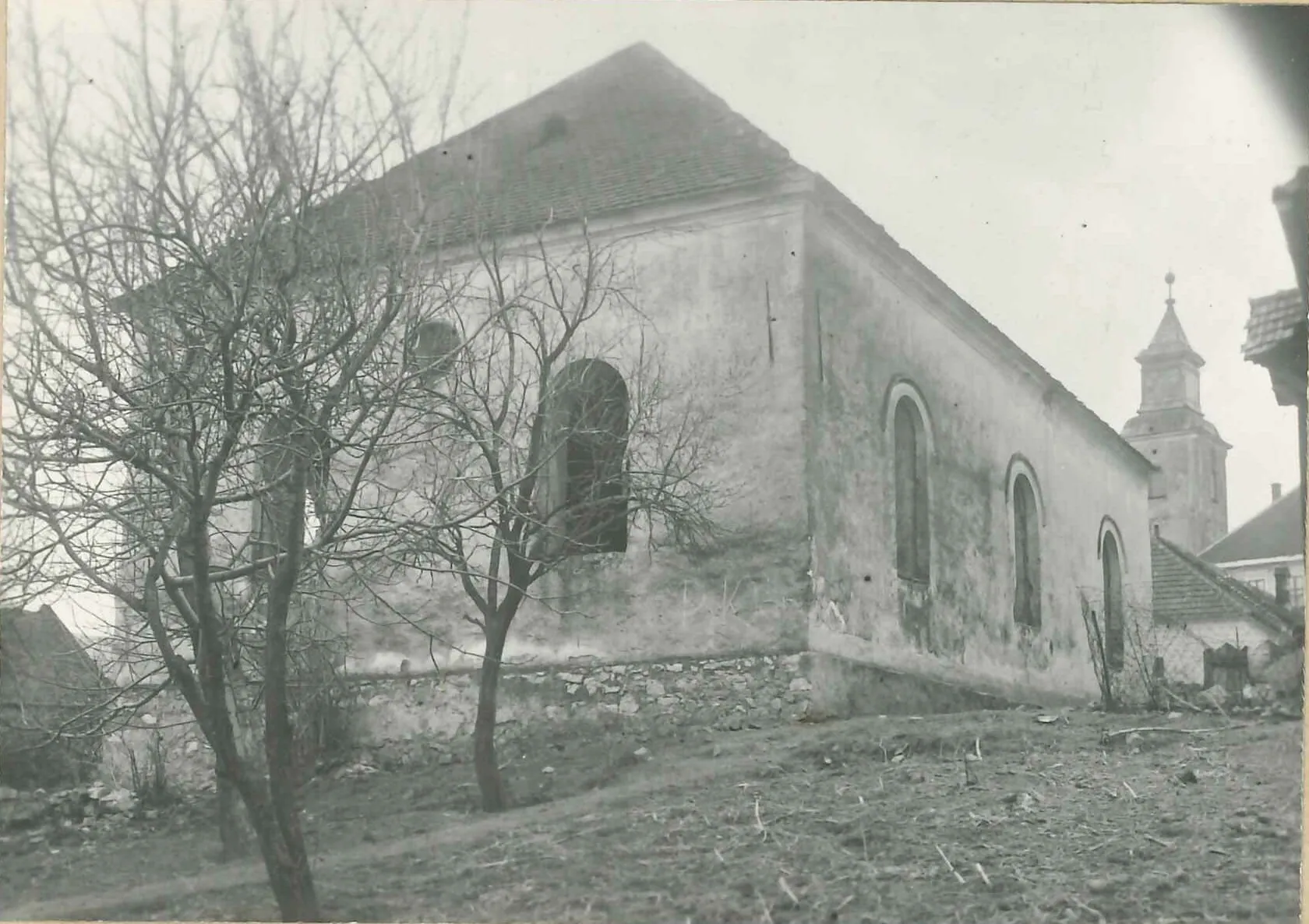
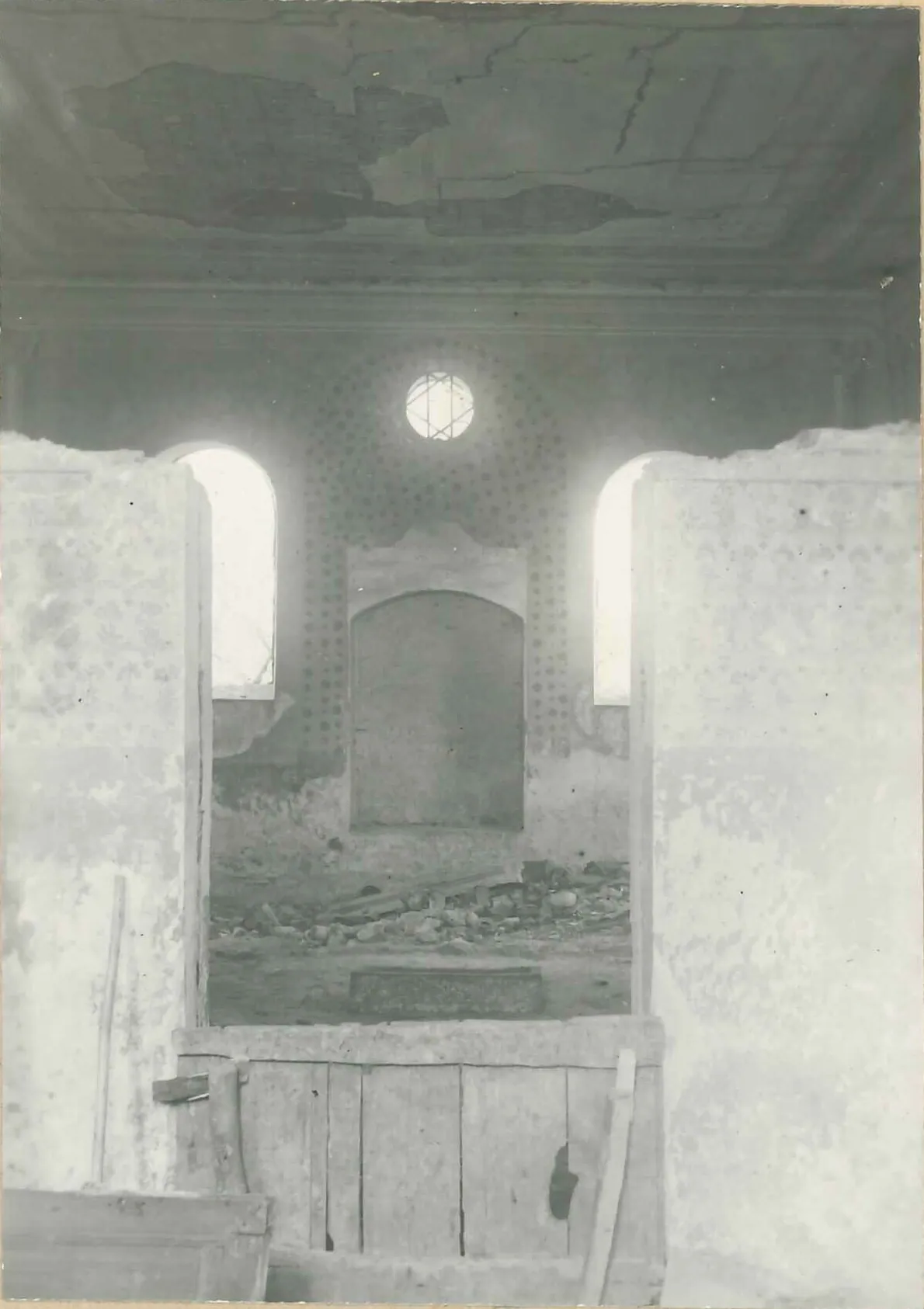
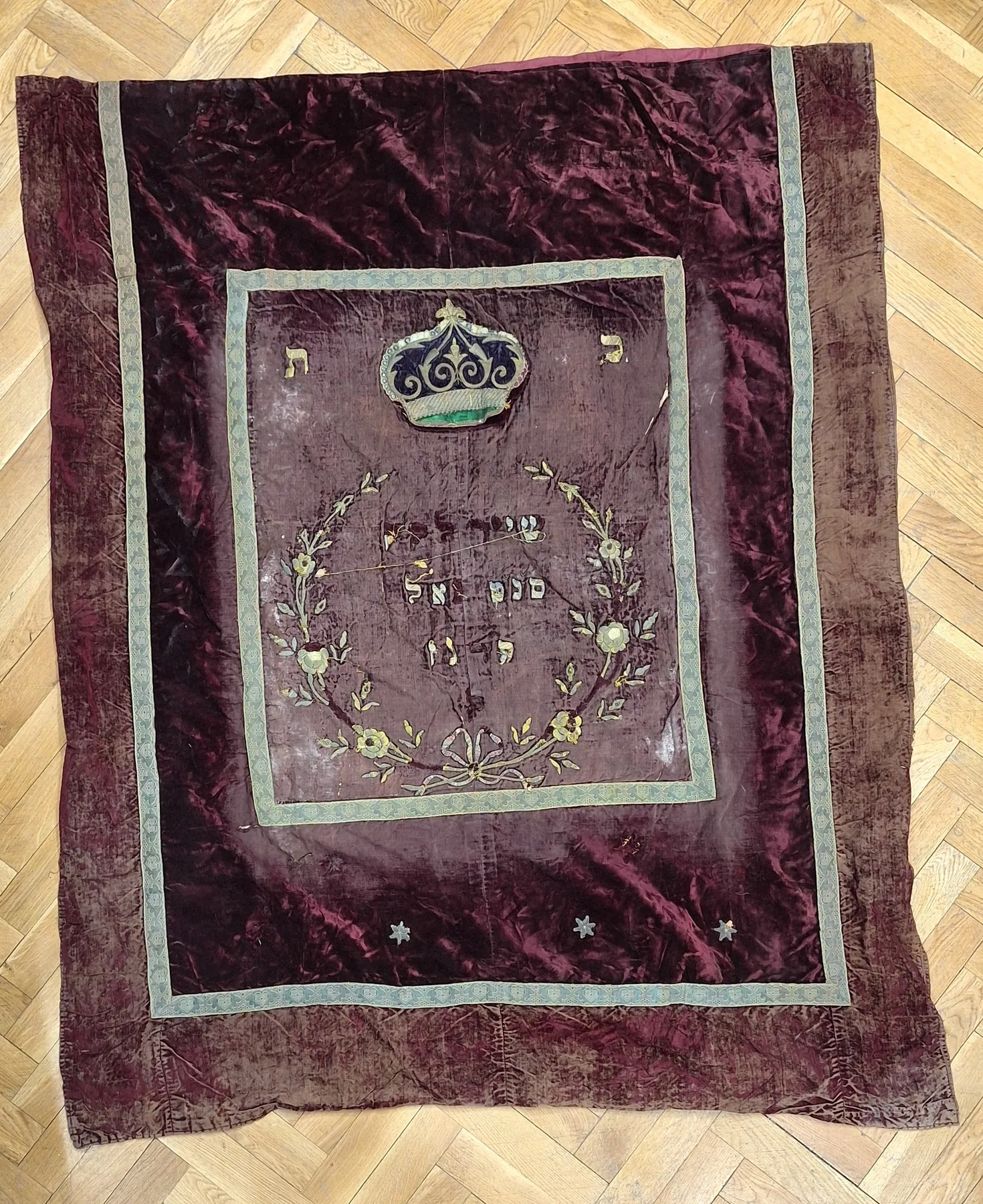
Two photographs in the Hungarian Jewish Museum and Archives, catalogued as taken after 1944 and after 1945, are the only views found. They show a rendered hall with a hipped tiled roof and tall round-arched windows, and an interior stripped of every fitting, with fallen ceiling plaster and rubble on the floor. A velvet Torah ark curtain embroidered with the community's name and the Hebrew year 5657 (1896-97) survived in the village and entered the museum in October 2025.
Gazda, who surveyed synagogue sites between 1980 and 1987, recorded the building as demolished. No source read for this entry gives the date of the demolition or names who carried it out, and the plot on which the synagogue stood has not been identified.
Where it stood for nearly 70 years
Historic: Szentgál, Veszprém county; street and house number unknown (the post-war photograph suggests a plot within sight of a church tower, probably the Reformed church on Fő utca). Today: Unknown; placeholder pin at the centre of 8444 Szentgál (approximate).
Открыть большую карту →Еврейская община
Very little has been found in print about the Jews of Szentgál. Gazda's tables give 105 Jews in 1910 and 51 in 1941, with no figures for 1828 or 1851, and the Magyar Zsidó Lexikon of 1929 has no entry for the village. The village's own history page says only that 22 Jewish families lived there until the Second World War and describes them as hard-working, honest people. Two well-known Hungarian scholars came from Jewish families of the village. József Bánóczi, born József Weisz in Szentgál on 4 July 1849, became a philosopher and literary historian, taught at the Budapest rabbinical seminary and from 1887 directed the national Israelite teachers' training institute. Adolf Havas, born Adolf Hamburger in Szentgál on 14 February 1854, became a dermatologist and university professor in Budapest and was active in Jewish public life. The embroidered curtain made for the Torah ark calls the congregation the holy community of Szentgál, the usual Hebrew style of an organised congregation. Whether it kept its own rabbi or belonged to a neighbouring rabbinate, and who its officers were, is unknown.
Архитектура и дизайн
The building is known only from the two photographs taken after the war. The exterior view shows a free-standing rectangular hall, rendered, raised on a plinth of rubble stone because the ground falls away at one end. The roof is tiled and hipped, with a moulded cornice under the eaves and a small vent near the ridge. The side wall has three tall round-arched windows with raised plaster surrounds. The end wall has a small round window high in the centre and a taller arched opening to one side of it; a matching opening on the other side is hidden by a tree. The interior view looks through a doorway to the same end wall, which was the ark wall: an arched niche for the Torah ark under a curved, shaped head, flanked by the two arched windows, with the round window above it glazed in the form of a six-pointed star. The wall around the niche is stencilled with a pattern of small rosettes. The ceiling is flat and plastered, with a deep moulded cornice. The architect, the builder and the seating capacity are unknown, and no women's gallery can be made out.
Жизнь в синагоге
No description of services, of a rabbi, cantor or teacher, or of a school has been found, and it is not known whether the congregation followed the Orthodox, Neolog or Status Quo rite. What survives is one object from the building. A Torah ark curtain of wine-red velvet, 155 by 155 centimetres, was found in the village and taken into the Hungarian Jewish Museum and Archives on 10 October 2025. It is edged with metallic braid and carries an applied crown between the Hebrew initials for 'Crown of Torah'. Below, a wreath of embroidered flowers tied with a bow encloses the words 'belonging to the holy community of Szentgál' and the Hebrew year 5657, which ran from autumn 1896 to autumn 1897. The museum catalogues the curtain under 1894. The embroidered year is the one Gazda gives for the building, so the curtain may have been made for the new synagogue, but that is an inference, not a documented fact. It would have hung before the ark niche that the post-war interior photograph shows empty.
Разрушение
No source read for this entry records what happened to the synagogue in 1944, when the village's Jews were taken away, or who emptied it. The evidence is the pair of photographs in the Hungarian Jewish Museum and Archives, which the museum dates after 1944 for the exterior and after 1945 for the interior, so the building was still standing after the war. It was already a shell. The windows have lost their glass and one opening in the end wall gapes. Inside there is no ark, no reading platform and no bench; large patches of ceiling plaster have fallen and bared the laths, rubble and loose timber lie on the floor, the walls beside the doorway are broken off at the top, and the doorway is barred with rough planks. Anikó Gazda, surveying synagogue sites between 1980 and 1987, recorded the Szentgál synagogue as demolished. The demolition therefore took place at some time between 1945 and 1987. Most of that span falls under Communist rule, but nothing read shows whether the building still stood after 1948, whether it had first been sold, or who pulled it down.
Судьба общины
Gazda counts 51 Jews in Szentgál in 1941, and the village website speaks of 22 Jewish families living there until the Second World War. Nazi Germany occupied Hungary on 19 March 1944. A history of the Veszprém Jewish community published for the city's cemetery memorial park says that the Jews of Veszprém and of part of the surrounding area were moved into the Veszprém ghetto and deported from there to Auschwitz in the summer of 1944; the Jewish Virtual Library article on Veszprém puts the number deported at about 880 and says that only a few returned. Szentgál lies in the Veszprém district, so its Jews were probably among those brought into that ghetto, but no source read for this entry names the village, and the date and the men who carried out the round-up in Szentgál are unknown. How many of the village's Jews were killed and how many came back is also unknown. No Jewish community is recorded in Szentgál after the war, and the village's own history refers to its Jewish families only in the past tense.
Место сегодня
The plot on which the synagogue stood has not been identified in any source read, so what occupies it today is unknown. The post-war exterior photograph shows the building on sloping ground among low tiled houses, with a church tower close behind it. That tower carries a ball finial and does not resemble the present tower of the Catholic church, so it is probably the Reformed church on Fő utca, which would put the synagogue in the middle of the village; this is an inference from the photograph. The map pin for this entry is a village-centre placeholder. No marker on the site is recorded in the sources read. The synagogue's ark curtain is now in the Hungarian Jewish Museum and Archives.
Вам есть чем поделиться?
Фотографии, документы, семейные истории и воспоминания об этой синагоге и её общине помогают сохранить её историю.
- Zsinagógák és zsidó községek Magyarországon (Veszprém county table)
- Szentgáli zsinagóga épülete (F70.415.1)
- Szentgáli zsinagóga belső tere (F70.415.2)
- Szentgál, zsinagóga (F16.092, album page)
- Szentgáli tóra függöny (2025.173)
- Szentgál története
- Bánóczi József
- Havas Adolf (orvos)
- Szél Street Israelite Cemetery Memorial Park
- Veszprém
- Pinkas Hakehillot Hungary: table of contents
- List of synagogues in Hungary
- File:Szentgál, római katolikus templom 2025 01.jpg
- Református templom, Fő utca, Szentgál (OpenStreetMap way 358346775)
- Szentgál (OpenStreetMap relation 1078431)
Share a memory or thought
No comments yet. Be the first to add one.