
История Orthodox Synagogue of Szerencs
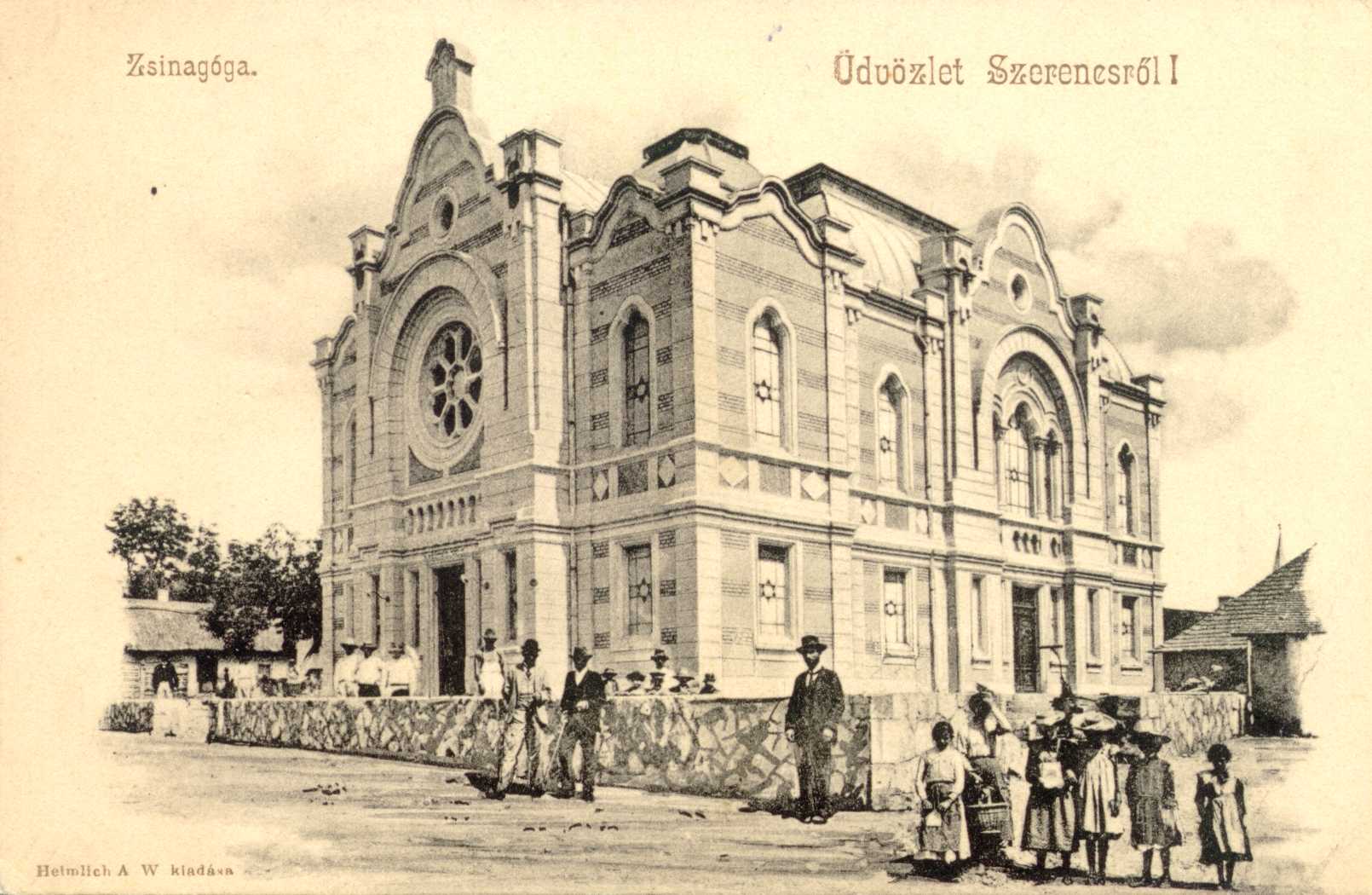
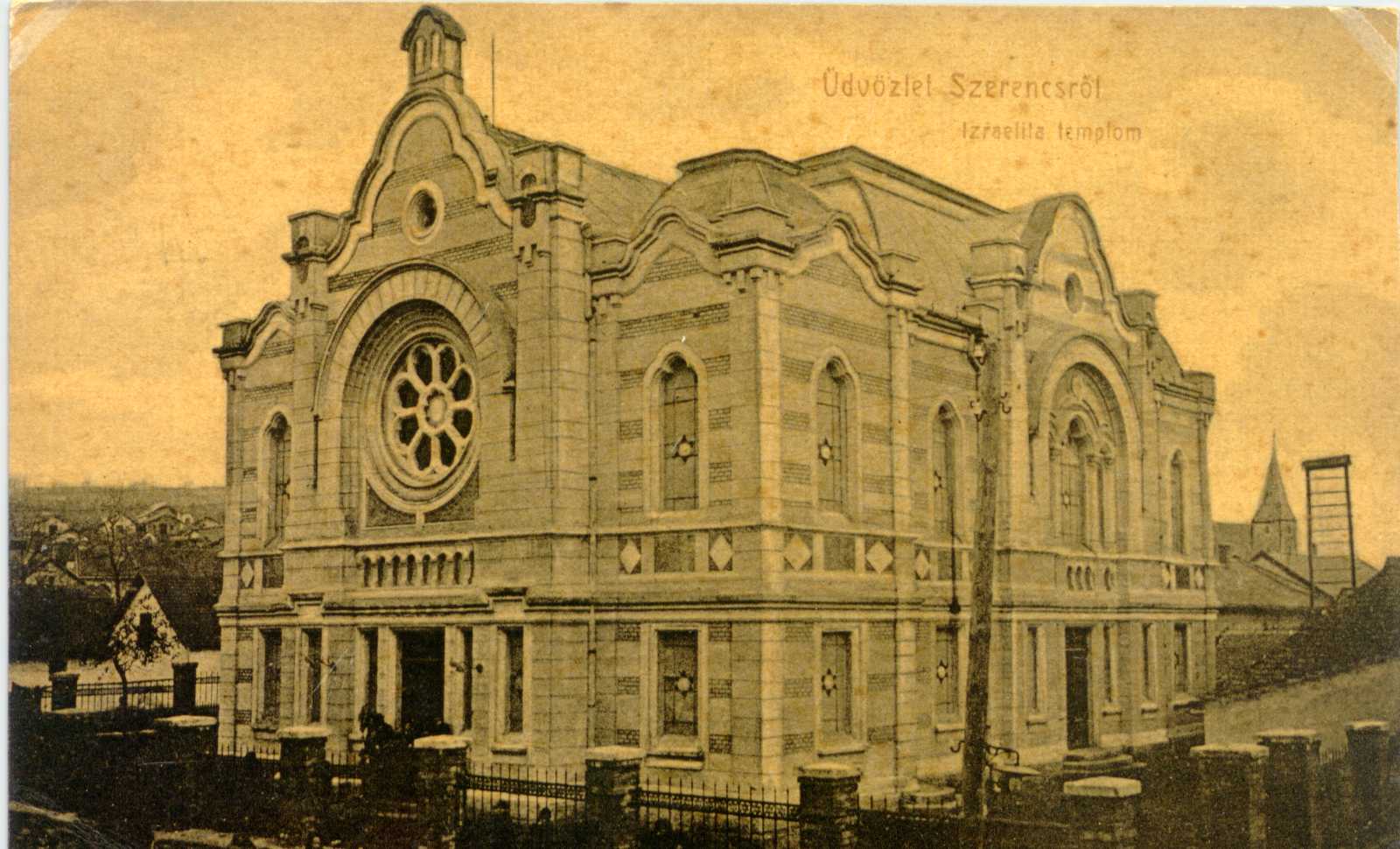
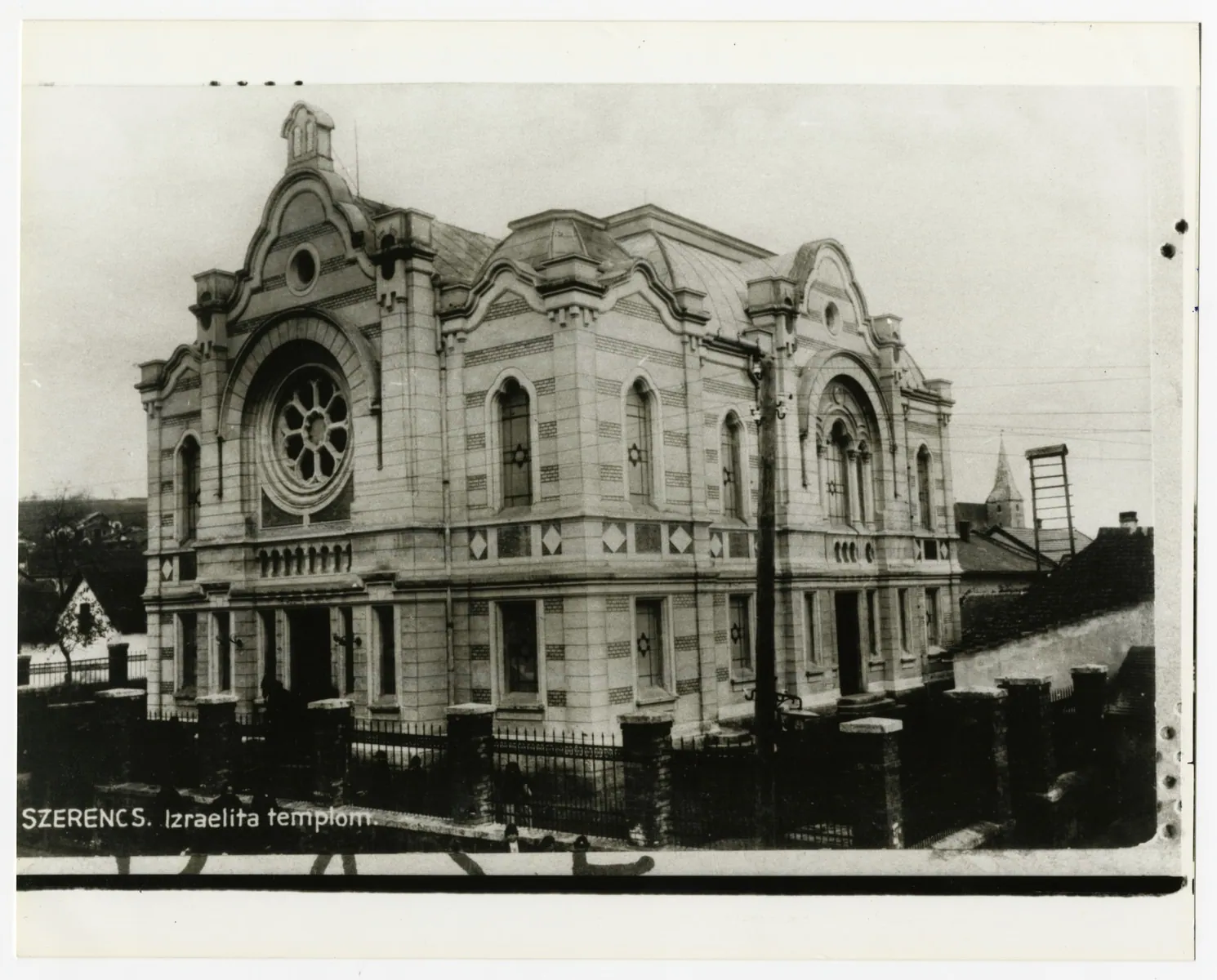
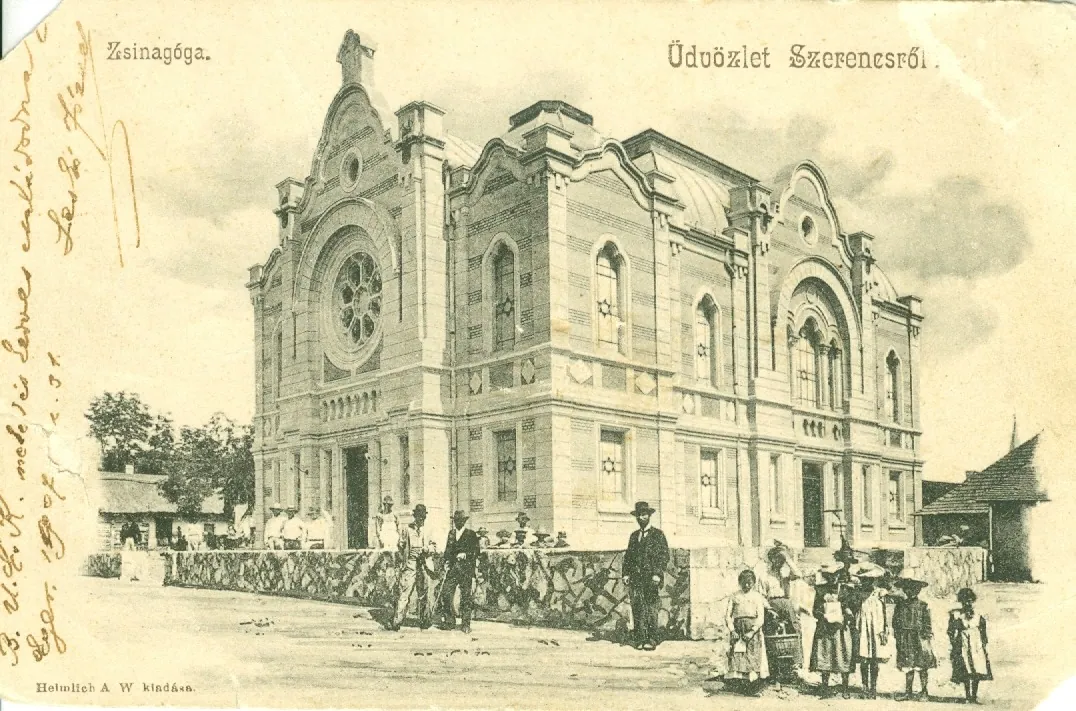
Szerencs, a market town at the south-western gateway of the Tokaj-Hegyalja wine region, had an organised Jewish congregation by the first years of the nineteenth century. Its archive preserved a subscription list of 1809 for building a temple, and by 1815 the community was working under Hebrew statutes. A century later the congregation had become one of the firm centres of Orthodoxy in Zemplén County, with a yeshiva, a Talmud Torah and a string of village communities attached to it. In 1903 the president, Kóbi Engel, launched the building of a new synagogue. The plans were drawn by Miksa Korach, an architect working in Miskolc, and the state supported the work with a loan of 40,000 koronas. Postcards show the finished building by 1909: a tall, banded block with curved gables and a great rose window, far larger than the congregation's single-storey prayer house. It served the congregation until 1944, when the Jews of Szerencs were removed to Miskolc and deported to Auschwitz. Survivors re-formed a community after the war, but it shrank quickly. Photographs taken in 1963 show the synagogue abandoned and decaying, and it was pulled down in the middle of the 1970s, one of many Hungarian synagogues cleared away under Communist rule.
Where it stood
Historic: Szerencs, Zemplén County; exact plot not confirmed, probably on or near Széchenyi utca, where the congregation's old prayer house stands at No. 50. Today: Széchenyi utca area, 3900 Szerencs, Borsod-Abaúj-Zemplén County.
Открыть большую карту →Еврейская община
Jews were living in Szerencs before 1809; a Hebrew-language community history counts 215 Jews in the town and its surroundings as early as 1770. The Magyar Zsidó Lexikon names the founders as the land-leaseholders Jakab Bilitzer, Márton Groszmann and Henrik Goldstein, the merchant József Engel and the Talmud scholar Sámuel Kornitzer, with Bilitzer as first president. The burial society dates from 1808. The first rabbi, Amram Billitzer, son of the rabbi of Nagyida, founded the yeshiva; a rabbinical biography dates his appointment to 1854 and his death to 1889. His son Pinkász followed him, and in 1912 Pinkász's son-in-law Emánuel Pollák was elected. Most members lived from trade, especially the wine trade, and from crafts. By the late 1920s the congregation, including its affiliated villages, counted about 1,400 people in 215 families. The decision of 1903 to build a large new synagogue came as the town itself was growing quickly: a sugar factory opened in 1889 and the population more than doubled between 1870 and 1900.
Архитектура и дизайн
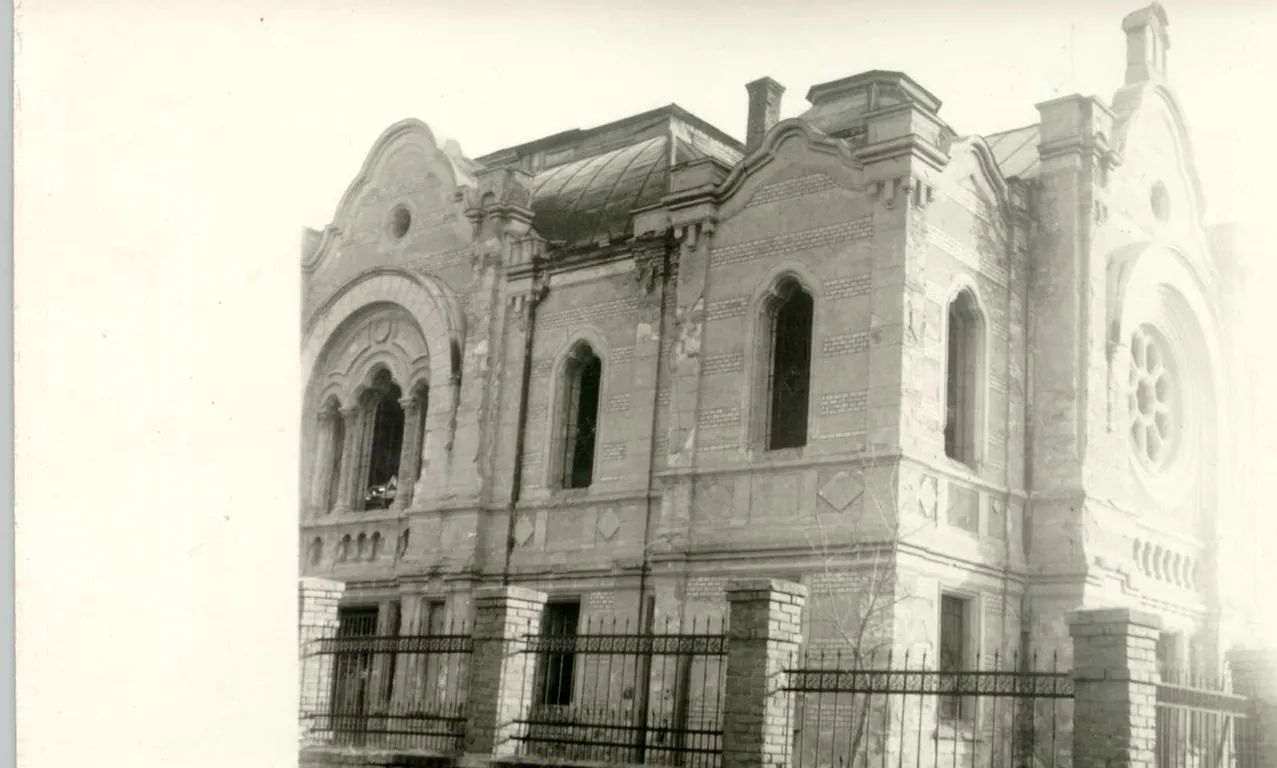
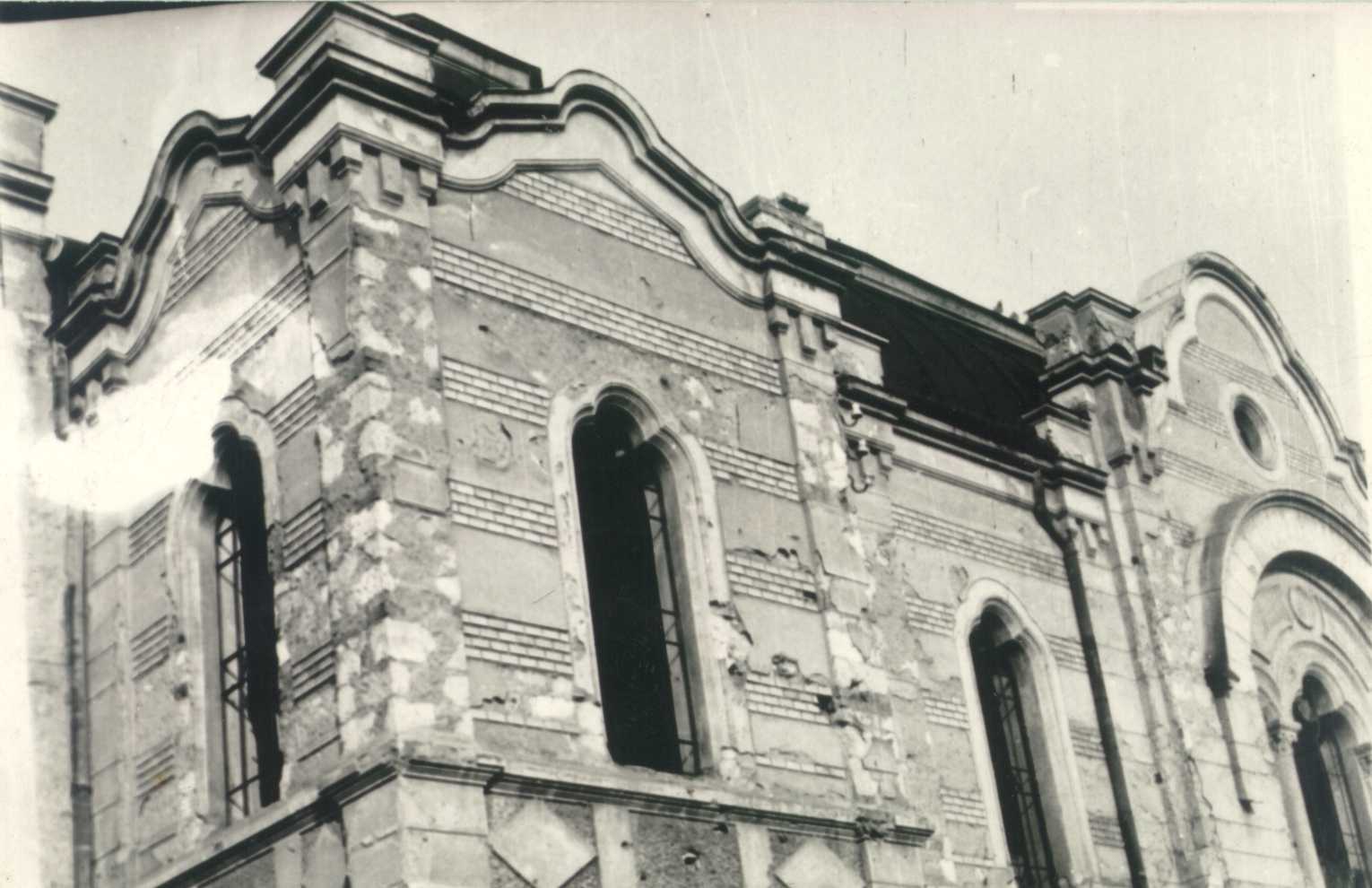
No plans or interior photographs were found, so the description rests on two early postcards and two photographs of 1963. The synagogue was a free-standing, two-storey rectangular block on sloping ground. Its walls were banded, with strips of exposed brick alternating with smooth render, and divided by piers that rose above the eaves as small stepped turrets. Each front ended in a curved, ogee-shaped gable pierced by a round window, a form close to Art Nouveau. The narrow entrance front carried a large rose window with eight-lobed tracery set in a deep round-arched recess, above a doorway and a row of small arched openings; the gable above was topped by a small aedicule. The long side had a central bay with a round-arched triple window under its own gable and a second doorway. Tall arched windows lit the upper level and square-headed ones the lower, several glazed with Stars of David. A band of lozenge panels separated the two storeys. The roof was of sheet metal, raised into low domed caps over the corner bays. The two tiers of windows suggest a women's gallery, but this is not confirmed.
Жизнь в синагоге
The congregation was Orthodox and, in the words of the 1929 Magyar Zsidó Lexikon, an important centre of uncompromising Orthodoxy that sought to preserve its inherited spirit. Around the synagogue stood the institutions of a traditional community: a burial society founded in 1808, a yeshiva with fifteen to twenty students in the 1920s (a later Hebrew account speaks of about sixty between the wars), a Talmud Torah with some fifty pupils, a free-loan society founded in 1899 and a godparents' society founded in 1903. A community elementary school had existed earlier but closed when the state school opened. Under the presidency of Jakab Kornitzer an ornate council hall was built beside the synagogue, and Salamon Kornitzer led the congregation for the two decades before 1929. Eighty-five members served in the First World War and nineteen fell. The rabbinate covered a wide rural district, including Bekecs, Legyesbénye, Taktaharkány, Tiszalúc, Megyaszó, Gesztely and Ond.
Разрушение
The synagogue was demolished by the Communists: it was pulled down in the mid-1970s, during the decades in which the Communist authorities and local councils cleared away dozens of disused Hungarian synagogues. The exact year, the body that ordered the work and the reason given are Unknown. The building had survived the war. According to a Hebrew-language community history, the Jews of Szerencs were assembled in it in spring 1944 before being taken to Miskolc; no account of looting or wartime damage was found. With most of the congregation murdered and the survivors leaving, the large building appears to have fallen out of use. Two photographs dated 1963 in the Hungarian Jewish Museum and Archives show it still standing but derelict: windows without glass, render fallen away from the brickwork, the masonry pitted and sheets missing from the roof. A 2010 survey article in the daily Népszabadság, republished by the Federation of Hungarian Jewish Communities, places the demolition in the middle of the 1970s.
Судьба общины
A Hebrew-language community history gives 955 Jews in Szerencs in 1930 and 767 in 1944. After the Nazi German occupation of Hungary in March 1944, the Hungarian authorities ghettoised the Jews of Zemplén County. Randolph Braham records that the Jews of Szerencs and of the Szerencs district were, for transport reasons, concentrated in the Miskolc ghetto rather than at Sátoraljaújhely, and lists Szerencs among the larger communities held at Miskolc before deportation. Those held at Miskolc were deported to Auschwitz in five transports between 12 and 15 June 1944, some loaded at Diósgyőr; the round-up and deportation were carried out by Hungarian officials and gendarmes under Nazi German occupation. Braham notes that the sources are not entirely clear about which neighbouring communities went to Miskolc and which to Sátoraljaújhely. Survivors returned and community life resumed: 147 Jews lived in the town in 1948, after which the number fell steadily. The last rabbi, Yehuda Leib Lemberger, survived and emigrated to the United States.
Место сегодня
The synagogue no longer exists, and the sources reached do not record what now occupies its plot. A survey for the JewishGen cemetery project, dated February 2009, reports the synagogue as demolished and notes that the congregation's old prayer house still stood at Széchenyi utca 50. The same survey describes the Jewish cemetery on the Árpád-hegy, reached from Széchenyi köz, as fenced. The Hungarian Jewish Museum and Archives holds a photograph of the single-storey prayer house as well as the postcards and the 1963 views of the synagogue. Whether any marker on the site recalls the synagogue could not be confirmed.
Значимые имена
Miksa Korach
UnknownArchitectKorach was an architect practising in Miskolc, about thirty kilometres from Szerencs, where he designed a shop building on the main street in 1905. The Magyar Zsidó Lexikon names him as the author of the plans for the new Szerencs synagogue, whose construction the congregation launched in 1903. The banded walls, curved gables and rose window seen on the postcards are therefore his design. No other synagogue by him was identified.
Биография или источник →Kóbi Engel
UnknownPresident of the congregation; initiator of the synagogueEngel followed Jakab Billitzer, Mór Eckstein, József Engel, Emánuel Stárk and S. Mór Stern in the line of presidents of the Szerencs congregation. As president he initiated the building of the new synagogue in 1903, the project for which the state granted a loan of 40,000 koronas and for which Miksa Korach supplied the plans. The Magyar Zsidó Lexikon credits him by name with the undertaking.
Биография или источник →Pinkász (Pinchas) Billitzer
Unknown (rabbi of Szerencs 1889–1912)Rabbi of SzerencsSon of the congregation's first rabbi, Amram Billitzer, whom he succeeded in 1889. He was the rabbi in office when the new synagogue was planned and built from 1903, and he is said to have continued his father's yeshiva. He is remembered as the author of the work Givat Pinchas. In 1912 the congregation elected his son-in-law Emánuel Pollák to follow him.
Биография или источник →Emánuel (Menachem) Pollák
c. 1890–1952 (birth year uncertain)Chief rabbi of Szerencs from 1912Son-in-law of Rabbi Pinkász Billitzer, Pollák was elected rabbi in 1912 and is named as chief rabbi in the 1929 Magyar Zsidó Lexikon, so he led worship in the new synagogue for most of its working life. He headed the yeshiva and published the rabbinical work Chelek Levi in Miskolc in 1933–34. According to a Hebrew account he later emigrated to New York, where a second work appeared about 1948.
Биография или источник →Yehuda Leib Lemberger
Unknown–1988Last rabbi of SzerencsSon-in-law of Rabbi Emánuel Pollák and son of Rabbi Menachem Mendel Lemberger, he is described as the last rabbi of Szerencs. He taught the yeshiva through the war years, giving a daily afternoon lesson and examining the students each week, and so was the congregation's rabbi when it was destroyed in 1944. He survived the Holocaust, emigrated to the United States and died there in 1988.
Биография или источник →Вам есть чем поделиться?
Фотографии, документы, семейные истории и воспоминания об этой синагоге и её общине помогают сохранить её историю.
- Szerencs (entry in Magyar Zsidó Lexikon, 1929, p. 844)
- A népirtás politikája: a holokauszt Magyarországon, vol. 1, pp. 569, 591 (note 78), 663–664
- Eldózerolt és megmentett zsinagógák
- Szerencs (cemetery and synagogue survey note, 2009)
- Szerencsi zsinagóga (postcard, Heimlich A. W. kiadása), F70.417
- Szerencsi zsinagóga (postcard written to Manó Herzog, 1909), F00.01
- Szerencsi zsinagóga épülete (photograph, 1963), F73.168
- Szerencsi zsinagóga oldala (photograph, 1963), F00.138
- Szerencsi imaterem épülete (photograph), F70.418
- קהילת יהודי סרנץ' (Jewish community of Szerencs)
- רבי עמרם ישי ביליצר (Rabbi Amram Yishai Bilitzer)
- Magyarországi zsinagógák listája
- Blumenstock-üzletház (Miskolc)
- Szerencs
- Széchenyi utca, Szerencs (OpenStreetMap way 225901822, via Nominatim)
Share a memory or thought
No comments yet. Be the first to add one.