



La storia di Tab Synagogue
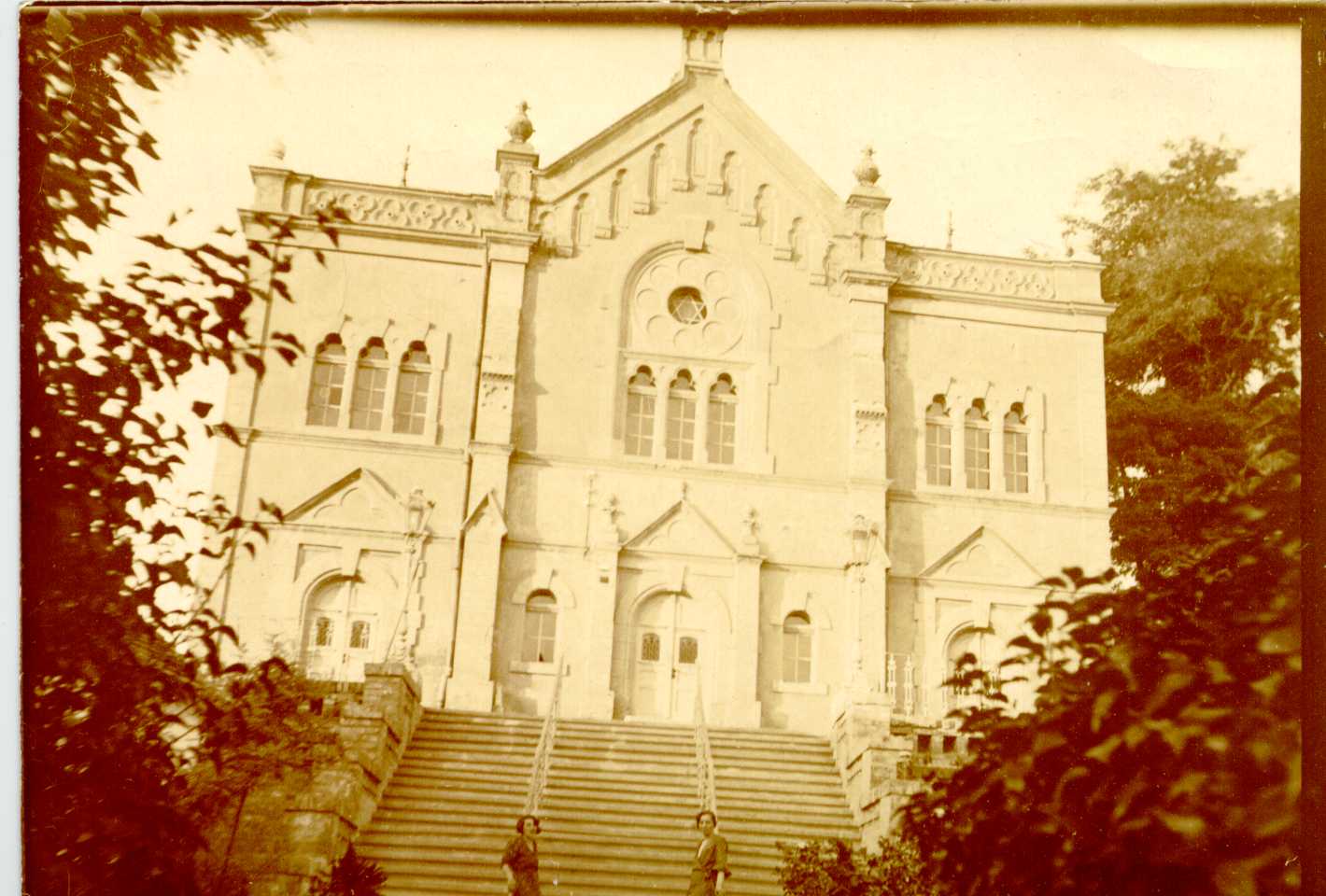
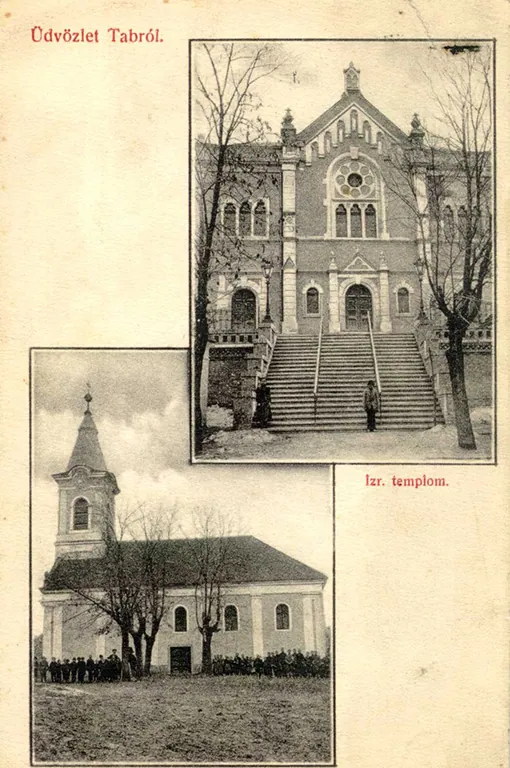
Tab, a small market town in the hills of Outer Somogy south of Lake Balaton, had one of the oldest and largest Jewish communities in the county. A prayer house is recorded there in 1762, described locally as the first in Somogy, and for more than a century worship continued in modest prayer rooms. In 1897 the Orthodox congregation finally built a proper synagogue, designed, according to the Magyar Zsidó Lexikon of 1929, by the architect Dezső Hönig, then a young engineer in the service of the Budapest municipality. Photographs and postcards in the Hungarian Jewish Museum and Archives show a tall, three-bay building with a gabled centre, a rose window and Moorish-flavoured details, raised on a terrace and reached by a wide stair of some two dozen steps. In the late 1920s it served a community of about 540 people under Rabbi Bernát Breuer. In May 1944 a ghetto was set up in Tab, and in early July its inmates, more than 1,200 people from the town and district, were deported to Auschwitz. Few returned. In 1954 the remaining community deposited two Torah ark curtains of 1858 with the Jewish Museum in Budapest, and a survey made in 1955 for Sándor Scheiber found that the synagogue had already disappeared. Later local writing wrongly attaches the date 1762 to pictures of the 1897 building.
Where it stood for 58 years
Historic: Tab, Somogy county (street and plot not identified in the sources). Today: 8660 Tab, Somogy county, Hungary; exact site Unknown.
Apri la mappa grande →La comunità ebraica
Jews settled in Tab from the early eighteenth century: a single family of eight is recorded in 1735 and about sixty people by 1754. The local historian Nándor Csizmadia counts 123 Jews in 1815, 484 in 1844 and 520 in 1881, when they made up almost 23 per cent of the town; most were traders and, by his account, they dominated its commerce. The Magyar Zsidó Lexikon traces the community back to the late seventeenth century but admits that its archive burned in the great fire of 1866, leaving only the old register of the burial society. The first rabbi known by name, Jomtov Ber Hakohen, died in Tab around 1770; his successor, Wolf Abelesz, was remembered on his gravestone as a great wonder-worker. The congregation was Orthodox. A one-teacher elementary school opened in 1862 and a Talmud Torah in 1886, in a house given by Mór Karpelesz. Only in 1897, after generations of worship in small prayer houses, did the community build its synagogue.
Architettura e design
No written description of the building has been found, so what follows is read from the surviving photographs. The synagogue stood on raised ground behind a terrace wall and was approached by a broad stair of roughly two dozen steps, divided by two iron handrails and flanked by lamp standards. The rendered façade had two storeys and three bays. The slightly projecting centre rose into a steep gable edged with a stepped frieze of small blind arches and crowned by a little aedicule; piers with bulbous finials framed it. Beneath the gable a large round-arched panel held a rose window, with a Star of David at its centre, above three narrow arched lights. The flat-topped side bays carried pierced parapets and triple windows with horseshoe-like heads, giving the otherwise Romanesque-revival design a Moorish accent. Three doors under triangular pediments opened from the terrace, the outer pair probably serving the stairs to the women's gallery. The interior, the seating capacity and the materials are not recorded in the sources consulted.
La vita nella sinagoga
The congregation was Orthodox, and Csizmadia notes that Tab was the only place in Somogy where services were held in the Orthodox manner. From 1894 its rabbi was Bernát Breuer, born in Rajka in 1860, the son and grandson of rabbis and a member of the Orthodox rabbinical Committee of One Hundred; he was still in office in 1929. Around the synagogue stood the usual institutions: a burial society (Chevra Kadisha) chaired by Mór Hercog senior, a women's association led by his wife, a youth association under Sámuel Hász, the elementary school, where Miksa Kuttner taught between the wars, and the Talmud Torah, revived in 1922 after a long gap. In 1929 the community counted 543 members in 125 families, with a budget of 13,500 pengő, and its registry district covered a dozen surrounding villages, including Karád, Kőröshegy and Balatonszárszó. Ninety-one members served in the First World War and sixteen fell; a tablet with Hungarian and Hebrew inscriptions inside the synagogue commemorated the Jewish soldiers of Tab.
Distruzione
The synagogue was still intact when it was photographed for a postcard dated 1937. In May 1944 the Jews of Tab and the surrounding district were confined in a ghetto and in July they were deported; what happened to the emptied building in the following months, when the front reached Tab (Soviet troops entered on 2 December 1944), is not recorded in the sources found. Nor is the date of its removal. In 1954 the remnant community deposited two Torah ark curtains with the Jewish Museum in Budapest, which suggests that the synagogue was being given up or had already gone. In 1955 István Löwinger and Kornél Schmelzer, surveying Jewish communal buildings in Transdanubia for Sándor Scheiber of the Rabbinical Seminary, listed Tab among eight places where the synagogue had already been made to disappear. It was therefore lost between 1944 and 1955, most probably pulled down in the early Communist years, but no source consulted names who demolished it or why. In 2002–2003 Csizmadia confirmed that neither the synagogue nor the Jewish school survives.
Il destino della comunità
According to the town's own published history, the first local consequence of the Second World War was the restriction of the livelihoods of some 670 Jewish residents. After the Nazi German occupation of Hungary in March 1944 a ghetto was set up in Tab on 20 May, and Jews from the town and the neighbouring villages were crowded into it. On 5 July 1944 the ghetto was emptied and its more than 1,200 inmates were loaded into freight wagons bound for Auschwitz; as elsewhere in Hungary, the round-up and deportation were carried out by Hungarian authorities and gendarmerie under Nazi German occupation. A deportation list drawn from Csizmadia's study and published by JewishGen also names men taken for forced labour service in 1942 and 1943 who never came back. The number of survivors who returned has not been found. By 1954 the remaining congregation was handing ritual textiles to the Jewish Museum, and around 2002 Csizmadia wrote that only a few people of Jewish origin still lived in Tab, none of them practising.
Il luogo oggi
The exact plot of the synagogue has not been identified in the sources consulted, so it is not possible to say what occupies it today; no street address is given in the Magyar Zsidó Lexikon, the museum records or the local history. The photographs show that it stood on a slope above a street, at the top of a wide stair between low houses, which should make the site recognisable to anyone with local knowledge or an old cadastral map. Nothing of the building is reported to survive. The victims of 1944 are commemorated by a memorial in Tab's Jewish cemetery. The map pin for this entry is placed at the town centre only as a stand-in.
Nomi importanti
Dezső Hönig (Hőnig)
1867–1927Architect of the synagogueBorn in Ozora and trained at the Budapest technical university, Hönig spent thirty-two years in the service of the Budapest municipality, rising to technical chief councillor and designing district offices, schools, hospitals and the Váci út disinfection institute. The Magyar Zsidó Lexikon credits him with the plans of the Tab synagogue of 1897, an early work from his thirtieth year and the only synagogue attributed to him in the sources consulted.
Biografia o fonte →Bernát Breuer
c. 1860 – after 1929Rabbi (chief rabbi) of Tab from 1894Born in Rajka, the son and grandson of rabbis, Breuer came to Tab in 1894, three years before the synagogue was built, and was still leading the congregation in 1929, when the Magyar Zsidó Lexikon described him as guiding it in a religious spirit after the example of his predecessors. He sat on the Orthodox rabbinical Committee of One Hundred. An interwar directory notes that his son Vilmos fought through the First World War.
Biografia o fonte →Mór Karpelesz
UnknownBenefactor of the congregationA member of the Tab community who gave it a building to house its Talmud Torah, which opened there in 1886, eleven years before the synagogue was built. The school taught for fifteen years, closed for want of pupils and was revived in 1922. The Magyar Zsidó Lexikon names him as the donor; nothing further about his life was found in the sources consulted.
Biografia o fonte →Hai qualcosa da condividere?
Fotografie, documenti, storie di famiglia o ricordi di questa sinagoga e della sua comunità aiutano a mantenerne viva la storia.
- Tab (entry in Magyar Zsidó Lexikon, 1929)
- A zsidó népesség szerepe Tab fejlődésében az 1700-as évektől a holocaustig (Tabi Kilátó 2002–2003)
- Eldózerolt és megmentett zsinagógák
- Tabi zsinagóga képeslapon (F70.423, 1937)
- Tabi zsinagóga épülete (F70.422)
- Tabi zsinagóga és református templom képeslapon (F78.66)
- Tabi zsinagóga bejárata (F01.379)
- Tab; Izraelita templom. Református templom (inv. 0221828)
- Tóraszekrény-függöny / Torah ark curtain, 1858 (64.1100)
- Tóraszekrény takaró, 1858 (64.1099)
- Tabi hősök emléktáblája a templomban (F66.187)
- Tabi emlékmű (F66.943, 1954)
- Tab – a két világháború között (Tabi Kilátó 2002–2003)
- Tab – Történelem
- The Jewish Population and the Development of Tab from the 1700s to the Holocaust: deportation list
- Hönig Dezső
- List of synagogues in Hungary
- Tab (Somogy)
- Nominatim search: Városháza, Tab
Share a memory or thought
No comments yet. Be the first to add one.