

הסיפור של Tábor Synagogue
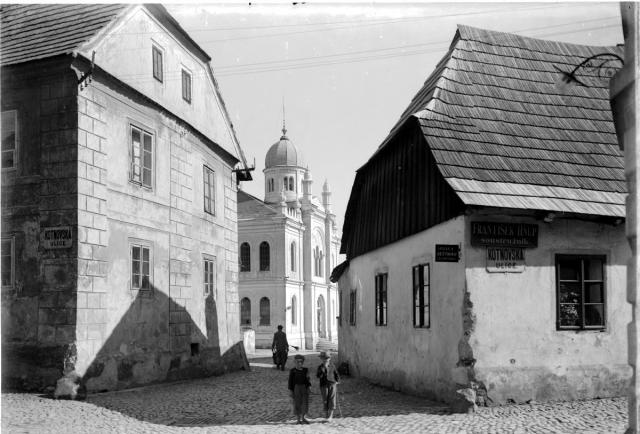
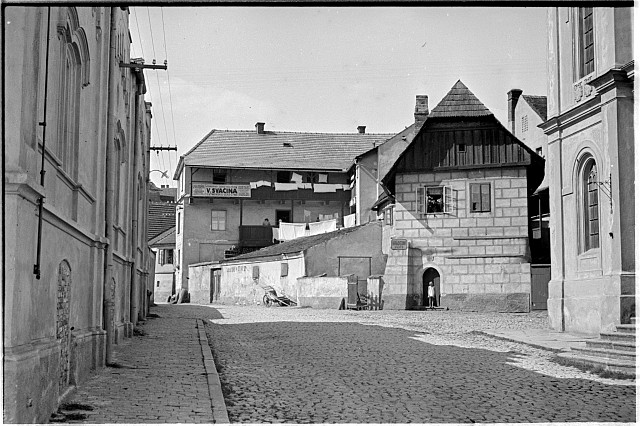
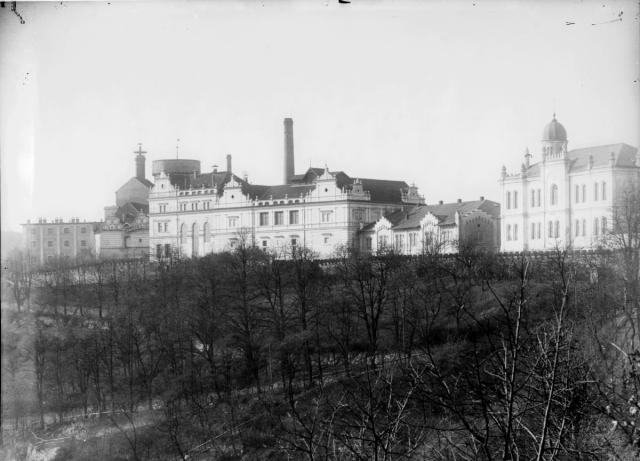
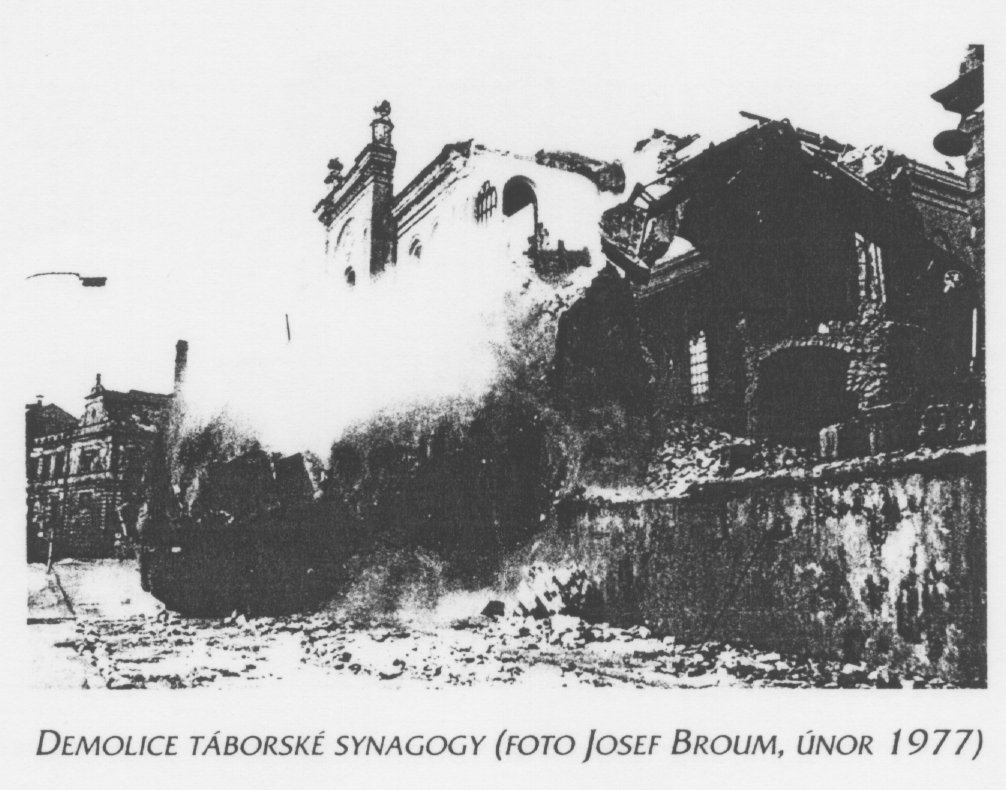
Tábor, the South Bohemian town founded by the Hussites in 1420, had a small Jewish community from the late sixteenth century, long held to a limit of eight families. For more than two centuries it prayed in rooms in private houses. When the community grew to several hundred members in the second half of the nineteenth century, it built a new synagogue between 1883 and 1885 on the site of several houses at Parkány, between today's Hradební and Na Parkánech streets, on the edge of the old town above the Lužnice valley. Built in an oriental, Moorish-inspired style with a central dome and many small turrets, it looked exotic in the panorama of the town, and the local photographers of the Šechtl & Voseček studio recorded it many times from the 1880s onwards. Its construction fell at the end of the long rabbinate of Gutmann Klemperer, who served Tábor from 1843 to 1884. Services were held in the building until the Nazi occupation; from then on it served as a warehouse, during the war and for decades afterwards, while the small postwar congregation used a prayer room. In February 1977 the building was demolished, and the site is now a car park in front of Hotel Dvořák.
Where it stood for 92 years
Historic: Parkány, Tábor, between today's Hradební and Na Parkánech streets, below Kotnovská street. Today: car park in front of Hotel Dvořák, Kotnovská, 390 01 Tábor (approximate).
פתיחת מפה גדולה ←הקהילה היהודית
Encyclopaedia Judaica places the first record of Jews in Tábor in 1572, when a Christian householder was punished for sheltering them; Fiedler's guide gives 1594 for the first resident family, and the Jüdische Gemeinden site says Jews were at first allowed in the town only by day. A cemetery plot was acquired in 1634 and a synagogue or prayer room is recorded from the mid-seventeenth century. The town council repeatedly tried to expel the Jews and limited them to eight families, a cap that held until the mid-eighteenth century: there were 8 families in 1653 and 1725 and 18 in 1769. Numbers then grew quickly, to 212 people in 1840, 455 in 1884 and 683 in 1893, a figure that included Jews living in 21 nearby localities. In this period the community built the new synagogue, opened a second cemetery in 1894 and ran its own elementary school. From the late nineteenth century families moved away to larger cities; the community counted about 400 members in 1921, 311 in 1930 and 265 in 1933, most of them adherents of the Czech-Jewish movement.
אדריכלות ועיצוב
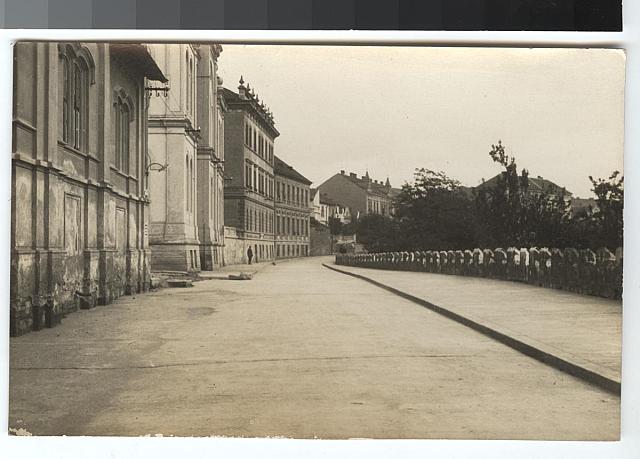
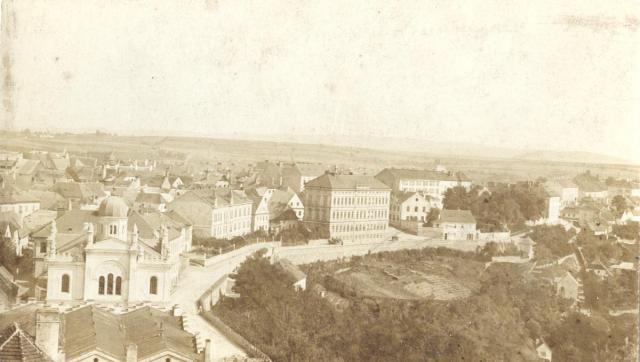
The Šechtl & Voseček glass negatives show a free-standing, rendered building of two storeys, oriented with its entrance front to a broad unpaved street. The front was a tall gabled block with a large round-arched portal at ground level, a triple group of narrow arched windows above it, and a band of round-headed arcading under the gable. Behind the gable rose an octagonal drum with arched windows, carrying a ribbed dome crowned by a finial. Small turrets with onion-like caps stood at the corners of the front and of the side elevation, and further pinnacles ran along the cornice. The long side wall had two tiers of tall round-arched windows divided by pilasters and a horizontal string course. In town panoramas the dome and turrets stand out above the surrounding roofs at the edge of the Parkány ramparts. The sources call the style oriental or Moorish; Encyclopaedia Judaica describes the building as a Reform-style synagogue. The architect, the builder, the seating capacity and the interior arrangement are unknown, and no interior photograph was found.
החיים בבית הכנסת
Few details of worship in the building have been found. The new synagogue replaced a prayer room in a private house that the community had used since the mid-seventeenth century, and it was planned during the last years of Rabbi Gutmann Klemperer, who served Tábor from 1843 until 1884; Encyclopaedia Judaica describes it as a Reform-style synagogue, but no source read describes its liturgy, music or seating. The congregation served not only the town but Jews scattered through about twenty villages of the district. At the same time the community maintained its own elementary school. In the twentieth century most members identified with the Czech-Jewish movement, which favoured Czech over German in communal life. Services continued in the synagogue until the Nazi occupation of Bohemia in 1939; the Jüdische Gemeinden site says it was closed in 1940. The names of rabbis, cantors and community presidents after Klemperer were not found in the sources consulted.
הרס
After services ended under the Nazi occupation, the synagogue was turned into a warehouse, and it remained one during and after the war; Encyclopaedia Judaica still records it as a storehouse around 1970, when only a small congregation remained in Tábor. No source found records damage to the building by the Nazis, who did destroy both Jewish cemeteries in 1941. The building stood abandoned and neglected for three decades of Communist rule. In 1977 it was pulled down: a photograph by Josef Broum dates the demolition to February 1977, and the Šechtl & Voseček archive says it was demolished because of its poor condition. A 2019 report by the Czech News Agency states that the representatives of the former Communist regime had the building demolished; whether the decision came from the town national committee or another state body is not stated in the sources read. A regional heritage guide calls the destruction needless.
גורל הקהילה
Tábor was briefly considered by the Nazi authorities in autumn 1941 as the site of a Jewish town for the Protectorate, before Terezín was chosen instead. In 1942 the Jews of the Tábor region were concentrated in the town; they were assembled in the girls' burgher school on Na Parkánech street, a few steps from the synagogue, where several hundred people slept on classroom and gymnasium floors. Two transports, designated Bz and Cb, left Tábor for Theresienstadt on 12 and 16 October 1942 with 1,271 people; according to the Jüdische Gemeinden site most were later sent on to Auschwitz-Birkenau. Only 73 of them lived to see liberation. About 200 Jews in mixed marriages remained in Tábor until late 1944. After the war a small congregation was re-established, dedicated a prayer room in 1954 and in 1955 unveiled a memorial to the victims on the site of the old cemetery. It still existed in 1970, and the Jüdische Gemeinden site says the association continued until the early 1970s.
האתר כיום
The synagogue stood between Hradební and Na Parkánech streets at Parkány, on the edge of the old town of Tábor. The plot has been a surface car park since the demolition, lying in front of Hotel Dvořák. A plaque on a neighbouring wall has marked the site since 1992. In 2019 the town announced plans for a multi-storey car park with about 200 spaces on the site, with an architectural competition to follow; the mayor said the design should respect the historic view and recall the synagogue. No part of the building is recorded as surviving.
שמות בולטים
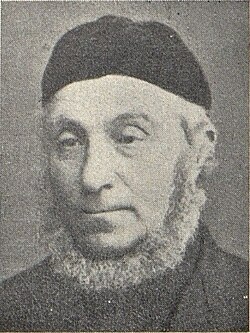
Gutmann Klemperer
UnknownRabbi of Tábor, 1843-1884Klemperer was rabbi of Tábor for more than forty years, from 1843 to 1884, the period in which the community grew from about 200 people to several hundred. Encyclopaedia Judaica credits his tenure with the building of the new Reform-style synagogue and the opening of the second cemetery; construction began in 1883, the year before his rabbinate ended, so the synagogue was planned under him though completed after he left office.
ביוגרפיה או מקור ←יש לכם משהו לתרום?
תמונות, מסמכים, סיפורי משפחה וזיכרונות מבית הכנסת ומהקהילה שלו עוזרים לשמור על ההיסטוריה שלו בחיים.
- Tabor (Böhmen)
- 40. Tábor (Jewish monuments in South Bohemia)
- Tábor plánuje v místech, kde byla synagoga, parkovací dům (19 March 2019)
- Synagogue from Parkány, 1885 (glass negative desky/deska8495)
- Synagogue (category listing)
- Staré město, Hradební ulice 181 (35mm/film35mm6895)
- Tabor
- Tábor (assembly point) - Cesty bez návratu
- Hotel Dvořák, Kotnovská, Tábor (OpenStreetMap way 29337837)
Share a memory or thought
No comments yet. Be the first to add one.