
Die Geschichte von Tachov Synagogue (1912)
Tachov, called Tachau in German, lies in western Bohemia close to the Bavarian border, and Jews are recorded there from the fifteenth century. The congregation's old synagogue stood in the Judengasse, the Jewish lane of the walled town. In 1906 the community founded a temple-building society to collect money for a larger and more representative house of worship, but in the spring of 1911 a fire that broke out near the castle spread into the Judengasse and gutted the old synagogue; only the Torah scrolls, a brass alms box and a stone washbasin were saved.
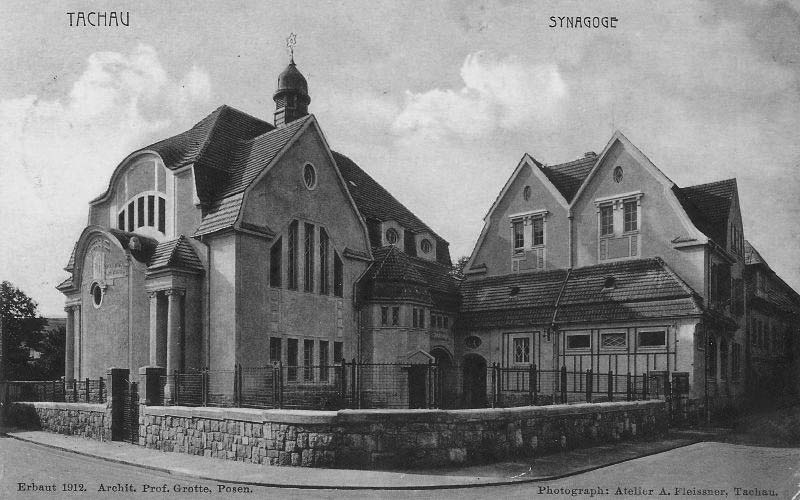
Under the community chairman Sigmund Strauss the congregation began building a new synagogue on 2 December 1911, less than eight months after the fire. The architect Alfred Grotte, whose mother was buried in Tachov, drew up all the plans free of charge. The new synagogue, with a rabbi's house joined to it at one corner, was dedicated on 9 September 1912. It stood on the street now called K. H. Borovského. It served the community for only twenty-six years. On 10 November 1938, during the November Pogrom, the Nazis looted it and set it on fire, and the ruin was demolished soon afterwards. The rabbi's house survives and has been a protected cultural monument since 2014, but the synagogue plot itself has never been built over.
Where it stood for nearly 30 years
Historic: Tachau, Judengasse quarter, synagogue with adjoining rabbi's house (house number unknown); during 1938 the street was named SA-Straße. Today: garden beside the former rabbi's house, ulice K. H. Borovského, 347 01 Tachov. Approximate.
Größere Karte öffnen →Die jüdische Gemeinde
Jews are mentioned in Tachov in fifteenth-century responsa and in records of 1464. Five Jewish families lived there in the mid-sixteenth century, fifteen by 1605, when a decree of 19 June formally regulated the community, and seventeen families in twelve houses in 1724. The Jewish quarter in the Judengasse burned repeatedly, in 1719, 1748 and 1818, and in 1749 the Jews formed their own fire-fighting unit. The wonder-working rabbi Nahum Sofer, who died in 1815, drew Hasidic pilgrims from Eastern Europe to his grave. In 1836 there were 266 Jews living in fifteen houses; in the nineteenth century Jewish entrepreneurs founded woodware, glass and mother-of-pearl factories, and a German-Hebrew school opened in 1858. The community counted 325 people in 1860 and about 310 to 320 around 1900, after neighbouring villages such as Schönwald, Langendörflas and Neu-Zedlisch were attached to it. Numbers then declined: 260 to 273 in 1921 and either 270 or 180 in 1930, about 2.5 per cent of the town. Its chairmen after 1896 included Sigmund Strauss (1906-1912), Dr Wilhelm Lurje (1914-1922), Sigmund Pollak (1922-1929) and Max Kohner (1930-1938).
Architektur und Gestaltung
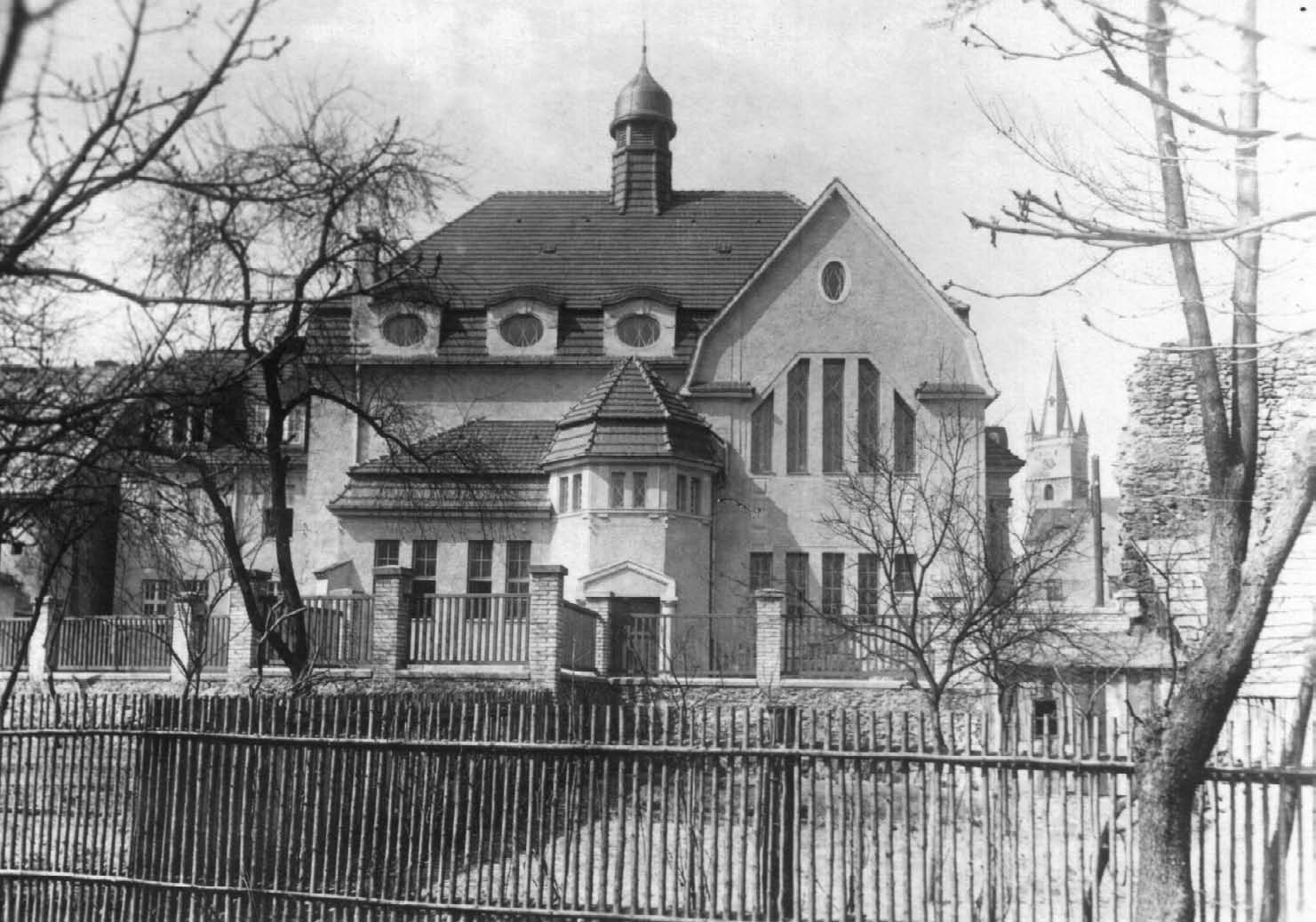
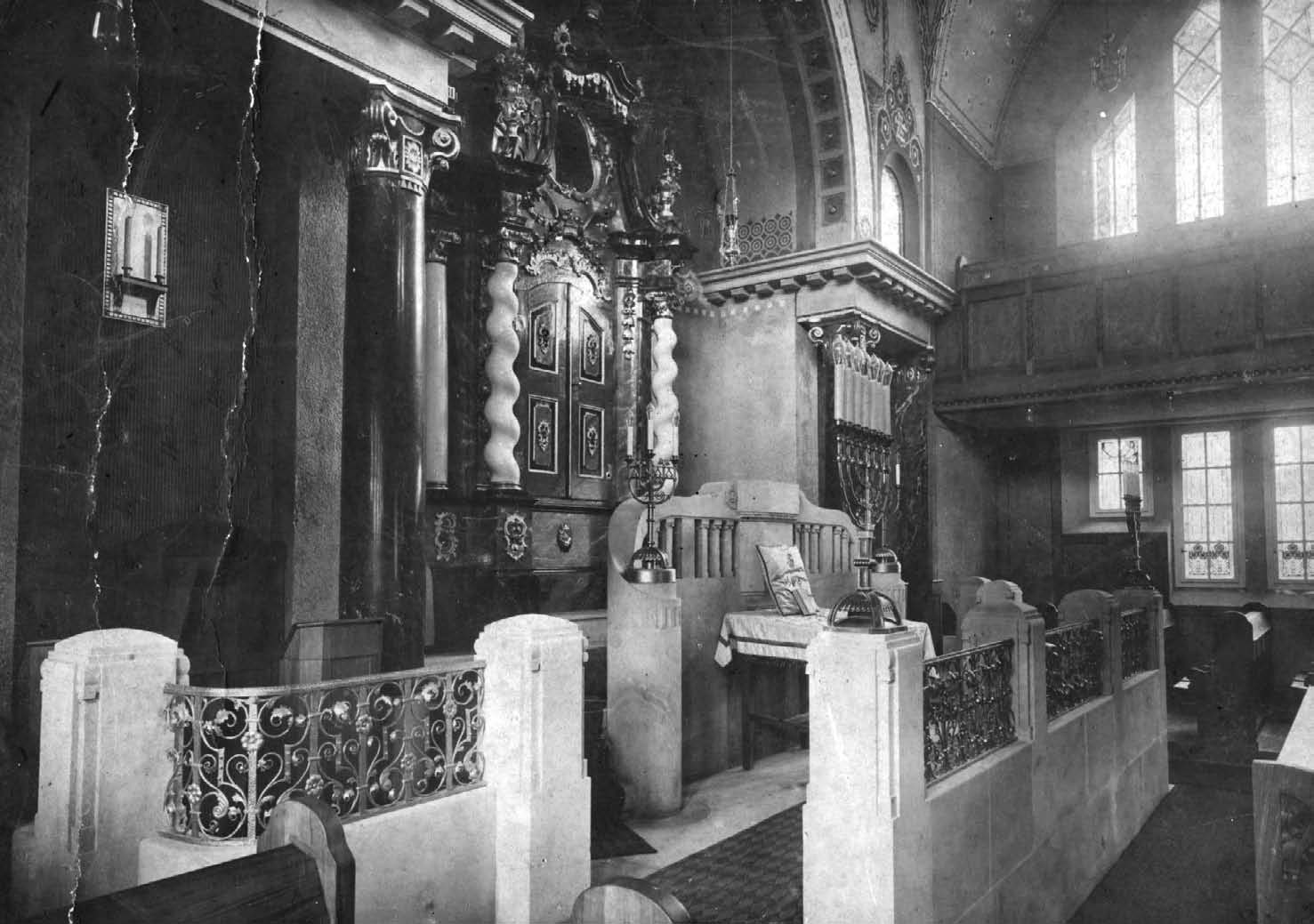
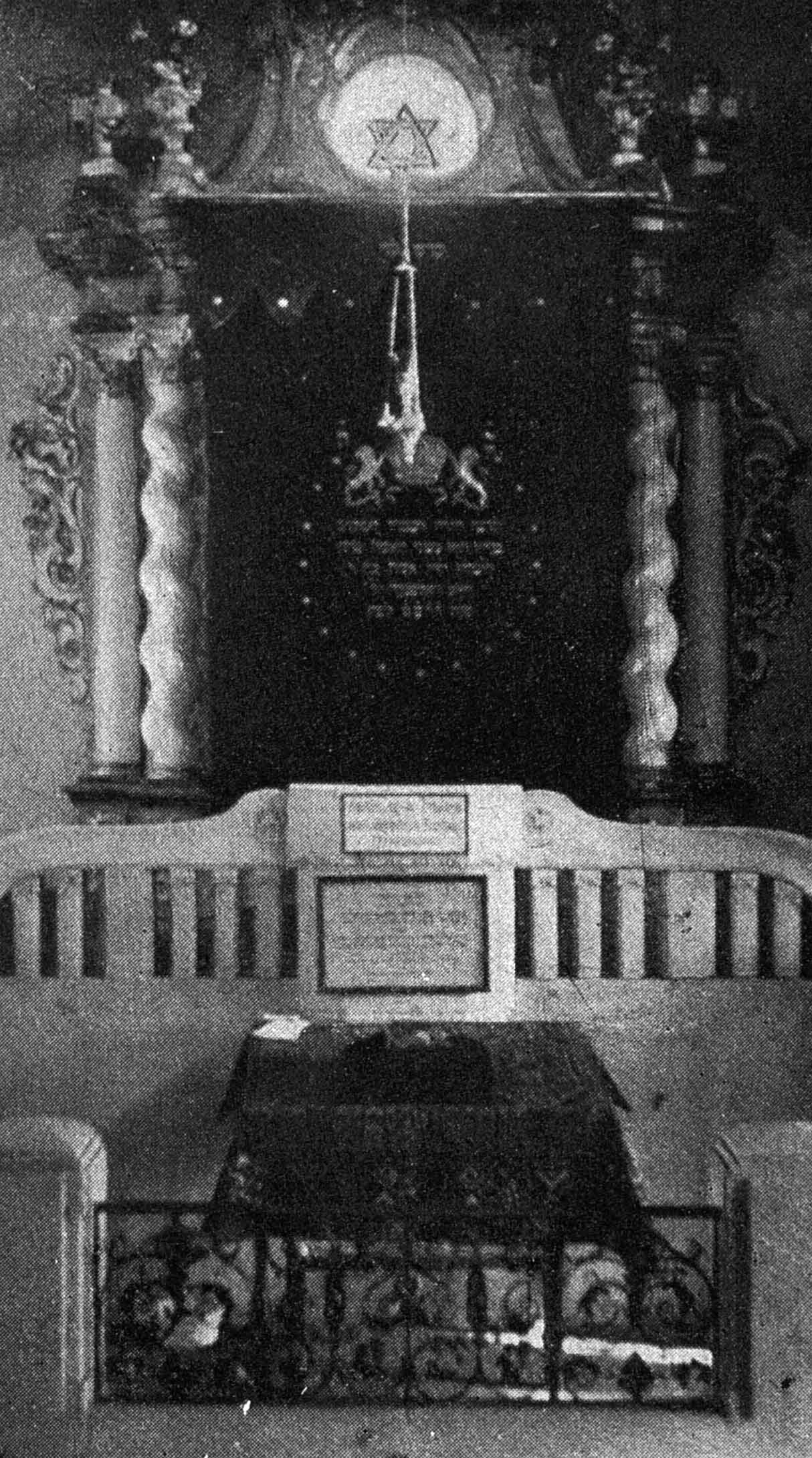
Grotte designed the synagogue and the adjoining rabbi's house as one ensemble in a modern style rooted in late Art Nouveau, with steep gables, a small domed lantern on the roof and a garden enclosed by a low stone wall with iron railings. Period photographs show a rendered hall with a tall gabled end pierced by narrow windows, a lower entrance wing, a row of oval dormer windows in the roof and the steep twin gables of the rabbi's house beside it. The main entrance lay on the north side and led into a vestibule with a marble tablet recording the stages of construction, and to a meeting room. The prayer hall was divided into a nave with four oak benches of ten seats and two aisles with seven benches of four. Women's galleries ran above the aisles and opposite the bima, giving over 186 seats in all. The stone bima, reached by three steps, was enclosed by wrought-iron railings, and the Torah ark, behind a stone balustrade that also served as a pulpit, stood four steps higher under three stained-glass windows. Grotte reused the ark and the railings from the old synagogue of Neu-Zedlisch.
Leben in der Synagoge
Little is recorded about worship in the new building beyond its fittings. Mosaics on either side of the bima at gallery height showed Moses with the tablets of the Law and Aaron with a censer, and two seats of honour for community officials stood on each side of the almemor. Electric lighting was installed from the start, with its switchboard in the meeting room. The baroque Torah ark brought from Neu-Zedlisch, a village community attached to Tachov that was dissolved in 1914, carried the memory of that older congregation into the new hall; an account quoted in a 2018 study remarks on how such isolated Bohemian communities borrowed Catholic church forms for their furnishings. From 1930 the chief cantor and teacher was Josef Schön, author of a history of the Jews of Tachau published in 1927, which is the main source for the building and the fire of 1911. The names of the rabbis who served in the new synagogue, and the dates of their service, were not found in the sources consulted.
Zerstörung
After the Munich Agreement of September 1938 Tachov, as part of the Sudetenland, was annexed by Nazi Germany. On the night of 9 to 10 November 1938, during the November Pogrom, the Nazis looted the synagogue and set it on fire; according to the 2018 study by Thomas Kügerl, the fire brigade was prevented from putting out the blaze. The town's own publications state that the synagogue was destroyed by the Nazis that night. The burnt-out building was pulled down soon afterwards. The exact date of the demolition, and who carried it out, are not recorded in the sources consulted. The street on which it stood was renamed SA-Straße at the end of 1938. The adjoining rabbi's house survived the fire and the demolition. The Nazis also desecrated the Jewish cemetery.
Das Schicksal der Gemeinde
Most of Tachov's Jews left the town during the Sudeten crisis of autumn 1938, before and immediately after the annexation,. Those who remained were sent to concentration camps. The town of Tachov's own account places them in the deportations from the Protectorate: in January 1942 the Jews of Plzeň were transported to Terezín, and from there transports left for the extermination camps in the east, where most Tachov Jews were murdered. Where each family had fled and when it was deported is unknown. The town has identified by name nearly 140 Jewish victims from Tachov. The cantor Josef Schön was murdered in Theresienstadt in 1943. No Jewish community was re-established in Tachov after the war. In 1945 the town lay on the route of death marches from the camps; more than 600 concentration camp prisoners were buried in a mass grave in the Jewish cemetery of the early 1930s, and a hilltop memorial commemorates death-march victims, including more than 100 Jewish women.
Der Ort heute
The synagogue stood on the street now called K. H. Borovského, below the main square, on ground that was part of the old Jewish quarter. The plot has never been built over and is now an empty garden beside the former rabbi's house, the only part of Grotte's ensemble to survive. The low stone wall with iron railings that Grotte designed around the plot also remains. The rabbi's house was declared a cultural monument in 2014 and awaits restoration; its owner is restoring the garden, and the civic association Synagoga Tachov plans to mark out the synagogue's floor plan. A bilingual plaque of 2006 honouring the murdered members of the community hangs in the Museum of the Bohemian Forest in Tachov.
Bedeutende Namen
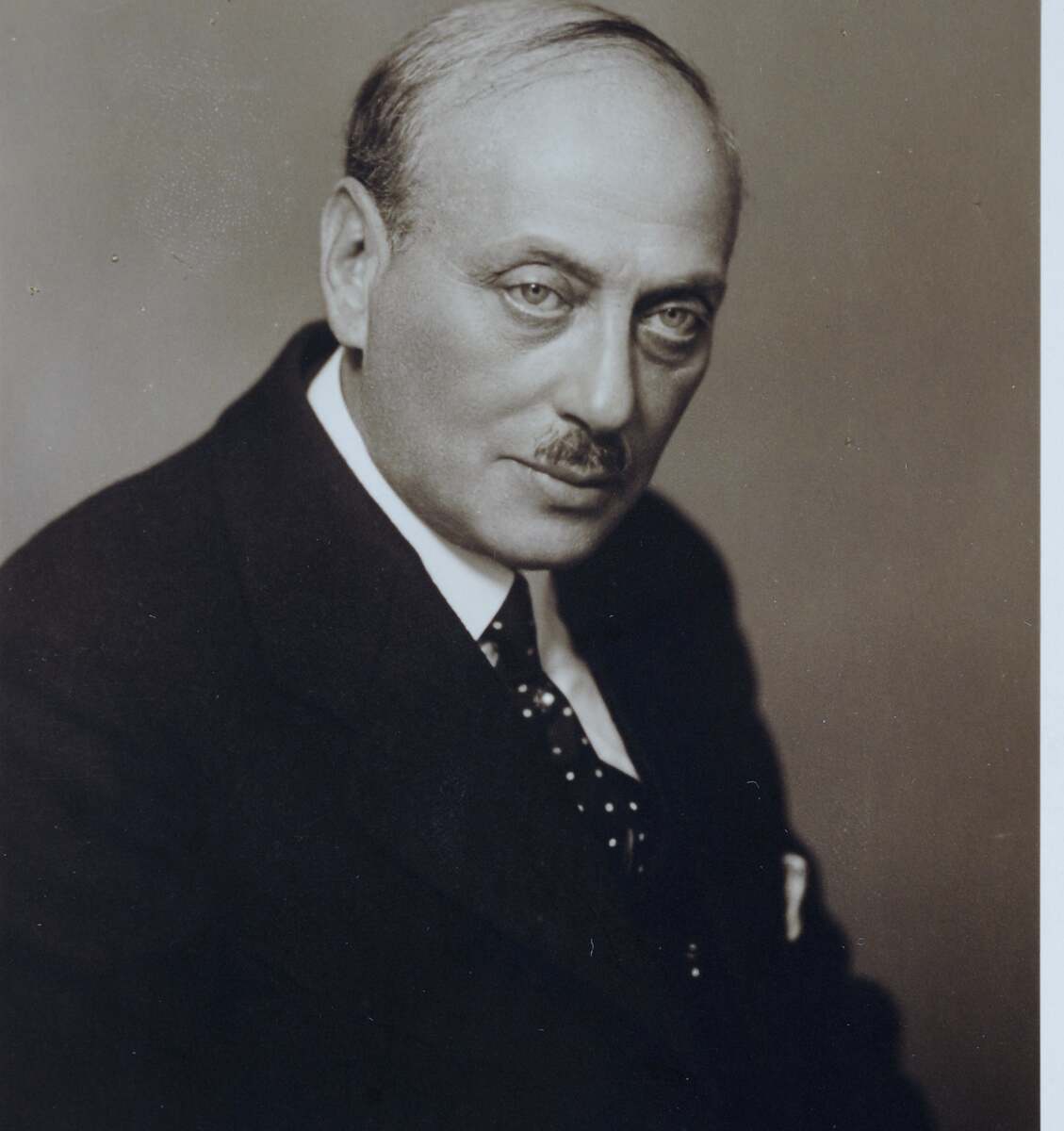
Alfred Grotte
1872-1943Architect of the synagogue and rabbi's house (1911-1912)Grotte, an architect and scholar of Central European synagogue architecture who restored the Maisel Synagogue in Prague and later worked in Breslau, designed the Tachov synagogue and the adjoining rabbi's house and gave all the planning work to the community free of charge. Members of his family lived in Tachau and his mother was buried there. In 1942 he and his wife Clara were deported to Terezín, where he died in June 1943.
Biografie oder Quelle →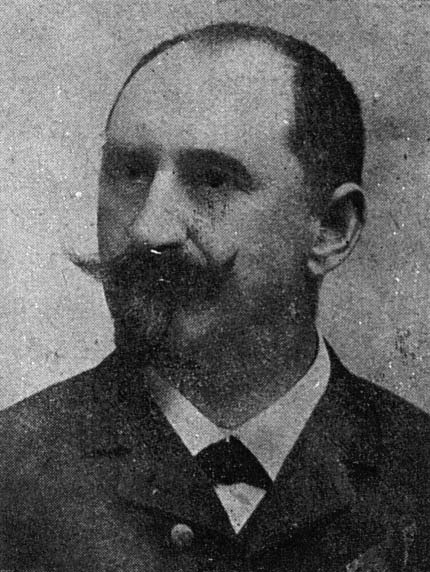
Sigmund Strauss
UnknownChairman of the Tachau Jewish community, 1906-1912Strauss chaired the community from 1906, the year the temple-building society was founded, until 1912. After the old synagogue burned in the spring of 1911, his drive is credited with getting construction of the new synagogue started on 2 December 1911, less than eight months later, so that it could be dedicated on 9 September 1912, at the end of his term. Nothing more about his life or fate was found.
Biografie oder Quelle →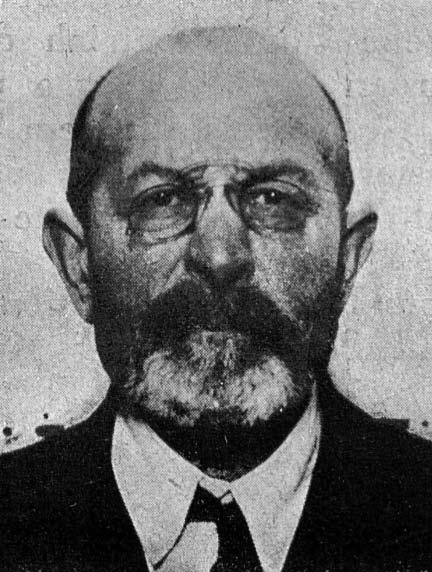
Josef Schön
1860-1943Chief cantor and teacher of the Tachau community from 1930; its historianSchön, orphaned at twelve, served several Bohemian congregations before becoming chief cantor and teacher at Tachau in 1930, so he led the singing in the 1912 synagogue during its last years. He witnessed the fire of 1911, which badly affected him, and wrote 'Die Geschichte der Juden in Tachau' (1927), the main account of the community and its synagogues. He was murdered in Theresienstadt in 1943.
Biografie oder Quelle →Max Kohner
UnknownChairman of the Tachau Jewish community, 1913-1914 and 1930-1938Kohner chaired the community twice, briefly in 1913-1914 just after the synagogue opened, and again from 1930 until 1938. He was therefore the community's head when Tachov was annexed by Nazi Germany and the synagogue was set on fire in November 1938. His later life and fate were not found in the sources consulted.
Biografie oder Quelle →Haben Sie etwas beizutragen?
Fotos, Dokumente, Familiengeschichten oder Erinnerungen an diese Synagoge und ihre Gemeinde halten ihre Geschichte lebendig.
- Tachau (Böhmen) / Tachov
- Virtuelle Rekonsktruktion der Synagoge Tachov (diploma thesis)
- Virtuelle Rekonsktruktion der Synagoge Tachov (PDF)
- The Rabbinical House in Tachov is a cultural monument, the site awaits renovation
- The Plzeň Region has four new cultural monuments, including the rabbi's house
- Tachovské noviny / town publication (rfile 38431)
- Tachov uctil památku zmizelých sousedů (rfile 62236)
- Town magazine article on Alfred Grotte (rfile 39114)
- Tachov
- Alfred Grotte
- Alfred Grotte portrait (JTA)
- K. H. Borovského, Tachov (OpenStreetMap way 36890591)
Share a memory or thought
No comments yet. Be the first to add one.