
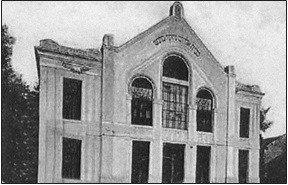
La storia di Tamási Synagogue
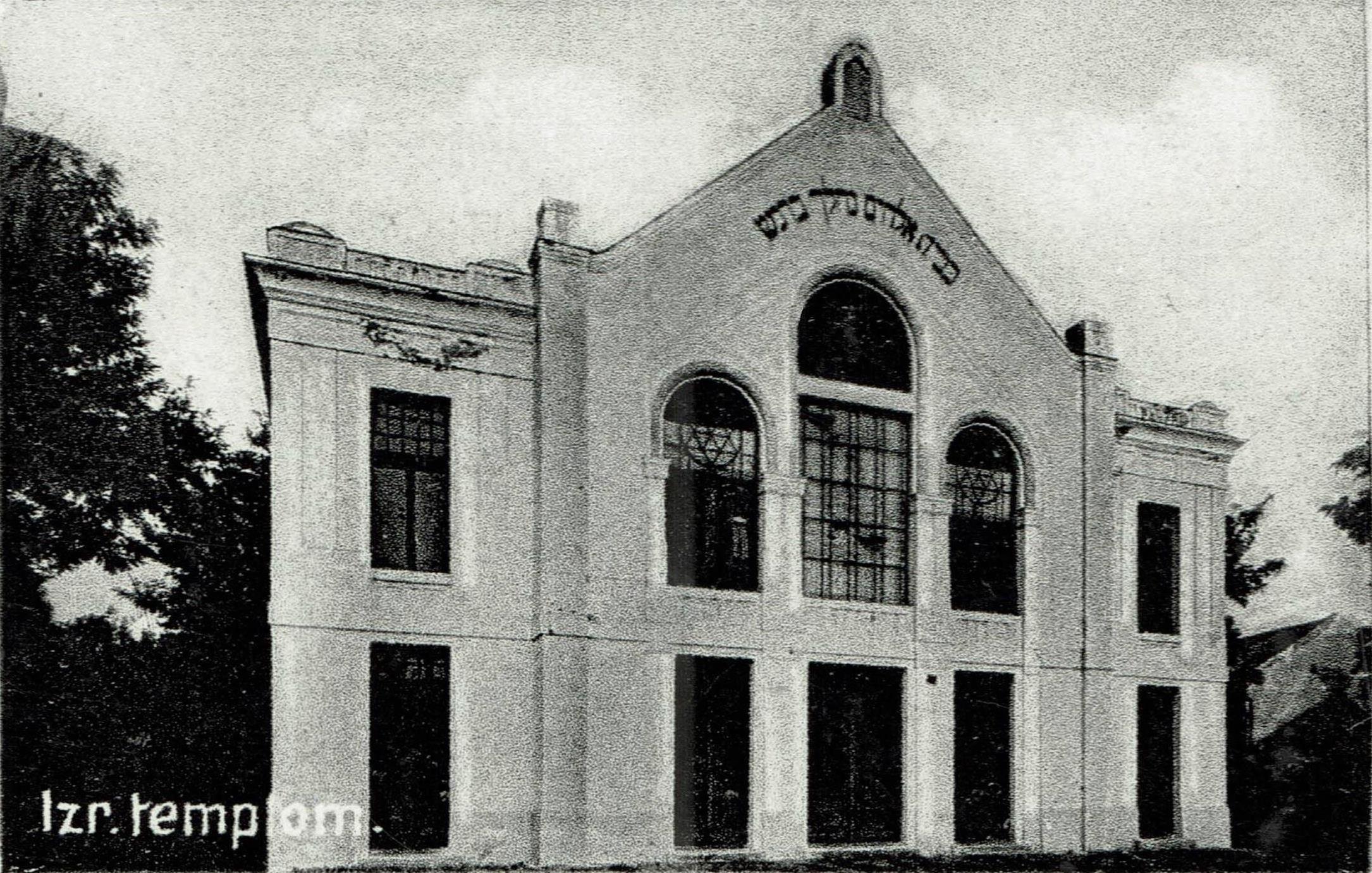
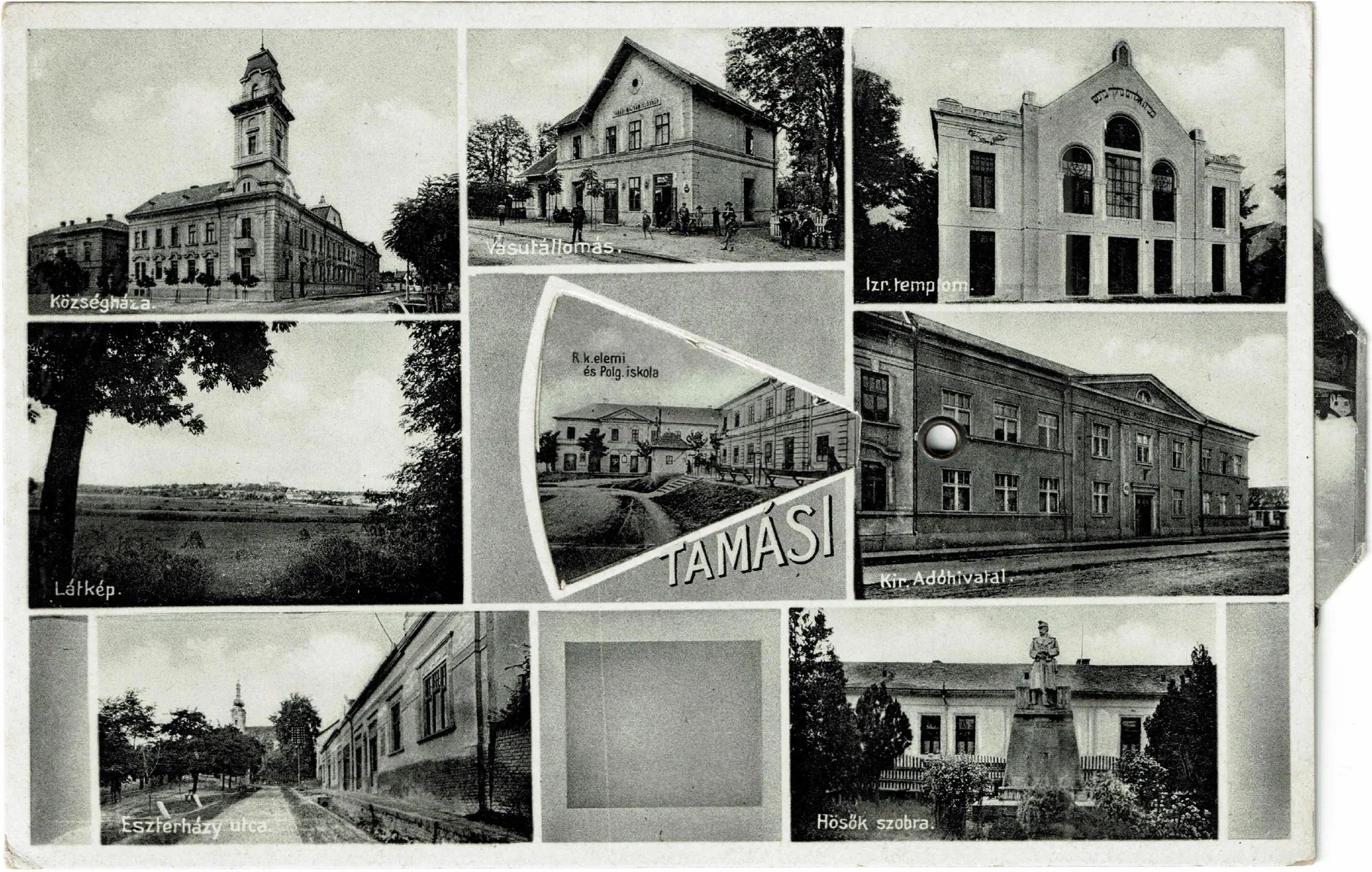
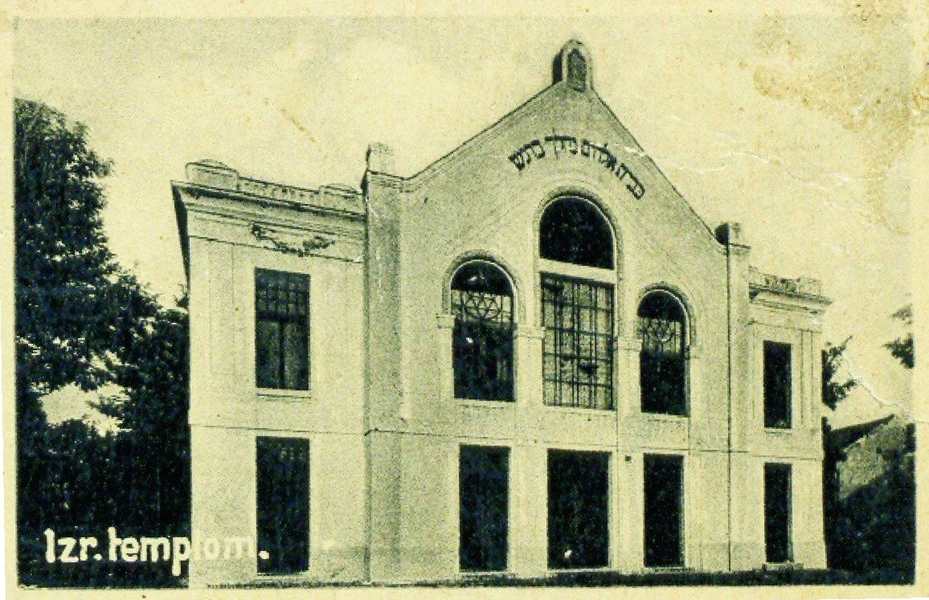
The synagogue of Tamási, a district seat in Tolna county, was the town's only purpose-built Jewish house of worship. Local historians date it to about 1872, when the community had grown to nearly two hundred people; no architect is recorded. It stood on a terraced hillside plot at the corner of today's Eötvös and Arany János streets, its gate opening towards the main square, Kossuth tér, with the community's school and council room close by. County newspapers show the congregation holding a ministry-approved lottery in 1891 to pay for work on the synagogue and school, resolving in 1892 to build a fence and a cantor's house, and inviting tenders in February 1913 for a remodelling budgeted at 15,064 korona. A postcard of 1934 shows a white, gabled, two-storey front with round-arched windows and a Hebrew inscription. A survivor remembered it as a landmark, the first building seen when approaching from Dombóvár. In 1944 the synagogue precinct became part of the Tamási ghetto and the building served as the last assembly point before deportation. Too few survivors returned to sustain a congregation, and in 1951 the National Office of Hungarian Israelites sold the empty building to a local resident, after which it was pulled down. The brick retaining wall, iron fence and gate are all that remain.
Where it stood for nearly 80 years
Historic: corner of today's Eötvös utca and Arany János utca, with the gate towards Kossuth (Lajos) tér, Tamási (Tolnatamási), Tolna county. Today: Eötvös József utca / Arany János utca corner, 7090 Tamási, Hungary (two private houses behind the old retaining wall).
Apri la mappa grande →La comunità ebraica
No Jews were recorded in Tamási in 1789, and only 17 among some 2,800 inhabitants in 1830. Numbers rose to 54 by 1848 and 193 in the 1870 census, reaching 390 in 1890 and a peak of 411 in 1900, before falling to 358 in 1910, 250 in 1930 and 187 in 1941. Members were shopkeepers, wholesalers, craftsmen, doctors, lawyers and tenants of the Esterházy estates around the town. The congregation dealt with the National Israelite Office in Budapest and was remembered by a survivor as Neolog, in contrast to the Orthodox communities of Paks, Hőgyész and Bonyhád. It never had its own rabbi: a cantor led services, and before 1895 births were registered by the rabbi of Pincehely, an arrangement the Tamási leadership contested in 1890 and 1891. The synagogue was built around 1872 as the community approached two hundred people. A community school existed by 1875; a women's association is recorded from 1885 and a burial society (Chevra Kadisha) from 1891. For some two decades from about 1890 the president was Ignác Hirsch, tenant of the Majsamiklósvár estate.
Architettura e design
The only detailed view found, a postcard panel of 1934, shows a rendered and white-painted two-storey front. A tall central bay rises into a steep gable crowned by a small round-headed finial, with a Hebrew inscription following the slope of the gable. Beneath it are three round-arched upper windows, the middle one taller, the outer two with Stars of David in their glazing, above three plain rectangular openings at ground level. Pilaster-like piers topped by small blocks frame this bay, and lower flat-roofed side bays with parapets and rectangular windows on both floors flank it. A survivor recalled in 2001 that the building had none of the oriental features common in synagogues and was painted white rather than faced in brick, and he judged its style to belong to the years around 1900, which fits the remodelling put out to tender in 1913. The synagogue stood on a hillside above a brick retaining wall with a wrought-iron fence and an ornate gate towards Kossuth tér. Nothing was found on the plan, the interior, the women's gallery or the number of seats.
La vita nella sinagoga
Services followed the Neolog rite and were led by a cantor, since Tamási had no rabbinate. County papers reported weddings in the 'Tamási Israelite temple' in 1903, 1907 and 1908, and on the king's birthday in August 1895 the staff of the district court attended a thanksgiving service at which József Lebovics, district rabbi of Mágocs, preached. During the millennium celebrations of May 1896 the building was the most brilliantly illuminated in the village; after a ceremony in the Jewish school opposite, the public crossed to the synagogue, where Lebovics gave a patriotic sermon later printed under the title Jóbél. The community elected wardens (gabbaim) each year, kept a four-grade elementary school with between 14 and 18 pupils and a council room, and its women's association held fund-raising balls. In June 1910 burglars who had robbed collection boxes in several Transdanubian synagogues broke in here too. Fifty-eight Jewish men from Tamási served in the First World War; a bronze tablet naming thirteen who fell hung on the synagogue wall between the wars.
Distruzione
The synagogue survived the war structurally. In May 1944, under Nazi German occupation, the Hungarian authorities set up a ghetto in Tamási that took in the Jewish school, the prayer room and neighbouring buildings. A survivor recalled that after two months all the inmates were herded into the synagogue, interrogated and beaten during the night and body-searched for valuables, then made to walk round the building several times before being marched to the railway station on 4 July 1944. After the war the building stood without a congregation. In 1951, in the Communist era, the National Office of Hungarian Israelites in Budapest sold it to a local resident, reportedly on condition that it would not be put to an unworthy use, and it was demolished; two family houses were built on the plot. A survivor said the decision was taken in Budapest without the involvement of local bodies, and the town's 2004 commemoration called it 'a bad decision'. Most accounts give 1951 for the demolition; others say only the early 1950s. The foundation, brick retaining wall, iron fence and gate were left standing.
Il destino della comunità
After Nazi Germany occupied Hungary in March 1944, gendarmes from outside the town arrived in Tamási and the Jews were forced to wear the yellow star. In mid-May the Hungarian authorities confined them in a ghetto: county records list 165 residents and 69 people brought in from the surrounding villages, and about fifty Jews from Szekszárd were sent there as well. Men of working age had already been taken for forced labour service. On 4 July 1944 the inmates were put into cattle wagons at Tamási station and taken to Kaposvár, from where, by local testimony, they were deported with other Jews of southern Transdanubia on 6 July to Auschwitz-Birkenau. According to figures given at the 2004 commemoration, 64 Jewish families, 184 people, lived in Tamási at the time; 152 were murdered and 32 survived. The cantor, his wife and five children were among the dead. A community still functioned in 1947 and counted 21 members in 1949, but it then ceased; survivors raised a memorial in the Jewish cemetery in 1948.
Il luogo oggi
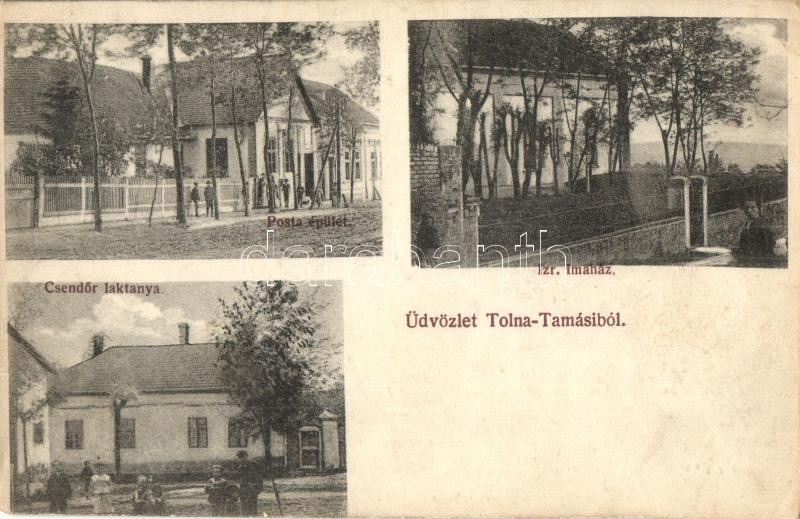
The plot at the corner of Eötvös (József) utca and Arany János utca, just off the western end of Kossuth tér, is occupied by two family houses, as reported in 2001. The synagogue's foundation, its brick retaining wall along the street, the wrought-iron fence and the gate that once opened towards the square survive. Next to the site the building that housed the Jewish school, prayer room and teacher's flat was still standing in 2001. Since 2004 a marble plaque on the retaining wall has commemorated the Jews deported from Tamási, and the town holds a remembrance there each July. The Jewish cemetery lies at the end of Aradi utca.
Nomi importanti
Ignác Hirsch (Hirsch Ignác)
UnknownPresident of the Tamási Jewish community, c. 1890–1910sTenant of the Majsamiklósvár estate and a member of the county assembly, Hirsch was elected president of the Tamási congregation on 31 December 1890 and re-elected by acclamation in 1892 and 1893; he still held the office in 1910. Under him the community ran the 1891 lottery for the synagogue and school and resolved in 1892 to build the synagogue fence and a cantor's house. His daughter Ilona was married in the synagogue in April 1908.
Biografia o fonte →Dr Salamon Gottlieb (Gottlieb Salamon)
UnknownVice-president of the community and chairman of its school board, 1890sGottlieb chaired the board of the community's elementary school by 1890 and was elected vice-president of the congregation at the general meetings of January 1892 and January 1893, serving alongside Ignác Hirsch in the years when the synagogue and school were renovated and the synagogue fence and cantor's house were decided on. He was still school-board chairman at the 1896 millennium celebrations.
Biografia o fonte →József Lebovics (Lebovics József)
UnknownDistrict rabbi of Mágocs; preacher at the Tamási synagogue, 1895–1896Tamási had no rabbi of its own. József Lebovics, district rabbi of Mágocs in neighbouring Baranya county, preached in the Tamási synagogue at the thanksgiving service for the king's birthday in August 1895 and again at the millennium service on 10 May 1896, when the county paper called his patriotic sermon the high point of the village's celebrations; it was later printed as Jóbél. Whether Tamási formally belonged to his district was not established.
Biografia o fonte →Hai qualcosa da condividere?
Fotografie, documenti, storie di famiglia o ricordi di questa sinagoga e della sua comunità aiutano a mantenerne viva la storia.
- Egy eltűnt zsinagóga: Tamási izraelita temploma (A disappeared synagogue: the Israelite temple of Tamási), Műemlékvédelem 54 (2010) 1, pp. 25–28
- 7090 Tamási II. (summarising K. Németh András, Tamási kalendárium 2006, and Hadviselt zsidók aranyalbuma 1940)
- Képtörténet a gettó előtti időkből. Nem maradt tíz férfi Auschwitz után, Tolnai Népújság, 13 October 2001, p. 9
- A holokausztra emlékeztek. Emléktábla a volt zsinagóga helyén, Tolnai Népújság, 5 July 2004, p. 4
- A Tolna megyei zsidók története 1868–1944, Tolna Megyei Levéltári Füzetek 2 (Szekszárd, 1991), population tables
- A Tolna megyei zsidók története 1868–1944, section on the 1944 ghettos
- A Tolna megyei zsidók története 1868–1944, Szekszárd deportation list and occupations
- Tolnavármegye, 18 January 1891: election of community officers
- Tolnavármegye, 13 September 1891: Sorsjáték (lottery)
- Tolnavármegye, 10 January 1892: Sorsolás; community general meeting
- Tolnamegyei Közlöny, 17 May 1896: millennium celebrations in Tamási
- A király születésnapja Tamásiban, Tolnamegyei Közlöny, 25 August 1895
- Tolnai Népújság, 10 May 2011: anniversaries column
- Versenytárgyalási hirdetmény (tender notice), Tolnavármegye és a Közérdek, 13 February 1913
- A zsidótemplomok betörői, Tolnavármegye és a Közérdek, 20 June 1910
- Esküvő notice, Tolnamegyei Közlöny, 23 April 1908
- Tolnamegyei Közlöny, 1 September 1910: Tamási gymnasium fund
- Az Országos Izraelita Iroda iktatónaplója 16001–18000 (1890–1892), entries 16387 and 17235
- Az Országos Izraelita Iroda iktatónaplója 2001–4000 (1874–1877), entry 2552
- Évszázadokon át. Tolna megye történetének olvasókönyve II (1983), list of associations
- Évszázadokon át III (1990), document XIV/48: report of teacher Márton Friedmann from the Tamási ghetto, 12 June 1944
- Family memoir of Klein Istvánné Spitzer Katalin, Tolnai Népújság, 11 November 1995
- Hozzájárultak a fejlődéshez, mégis deportálták őket, Tolnai Népújság, 5 July 2011
- A tamási zsidóság emlékét őrzik ma is a városban
- Tamási (town guide)
- A zsidó emlékek Tolna megyében. Bevezetés
- Tamási Táj, February 2024 (Kossuth tér renovation)
- A népirtás politikája, vol. 2, p. 721 (Zone V)
- Tamási, Cemetery Discovery Project
- Magyarországi zsinagógák listája (Tolna vármegye)
- File:Tamási, zsinagóga.jpg and File:Tamási, régi képek, zsinagóga.jpg
- OpenStreetMap / Nominatim: Eötvös József utca and Arany János utca, Tamási
Share a memory or thought
No comments yet. Be the first to add one.