
Historia Tápiógyörgye Synagogue
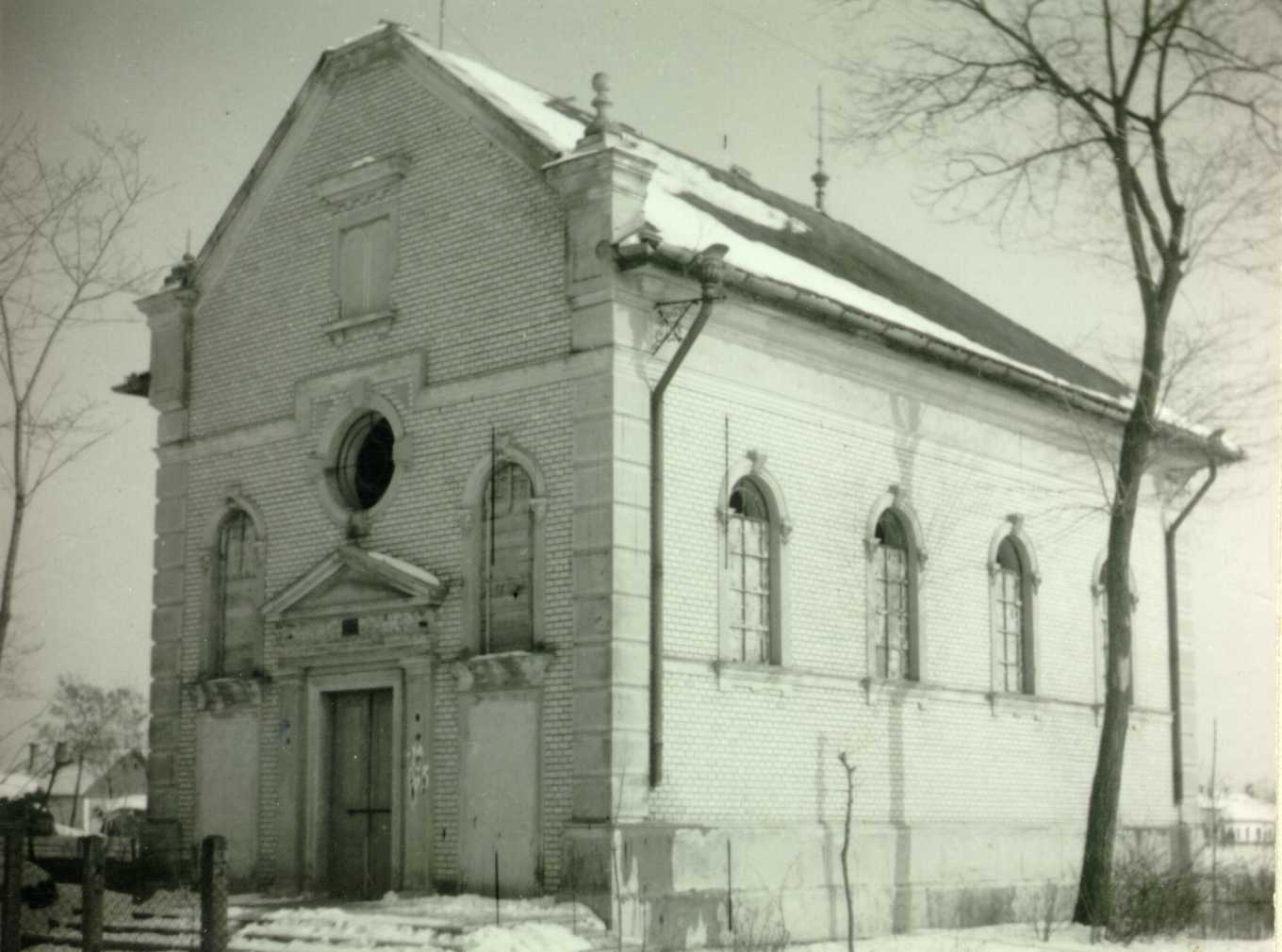
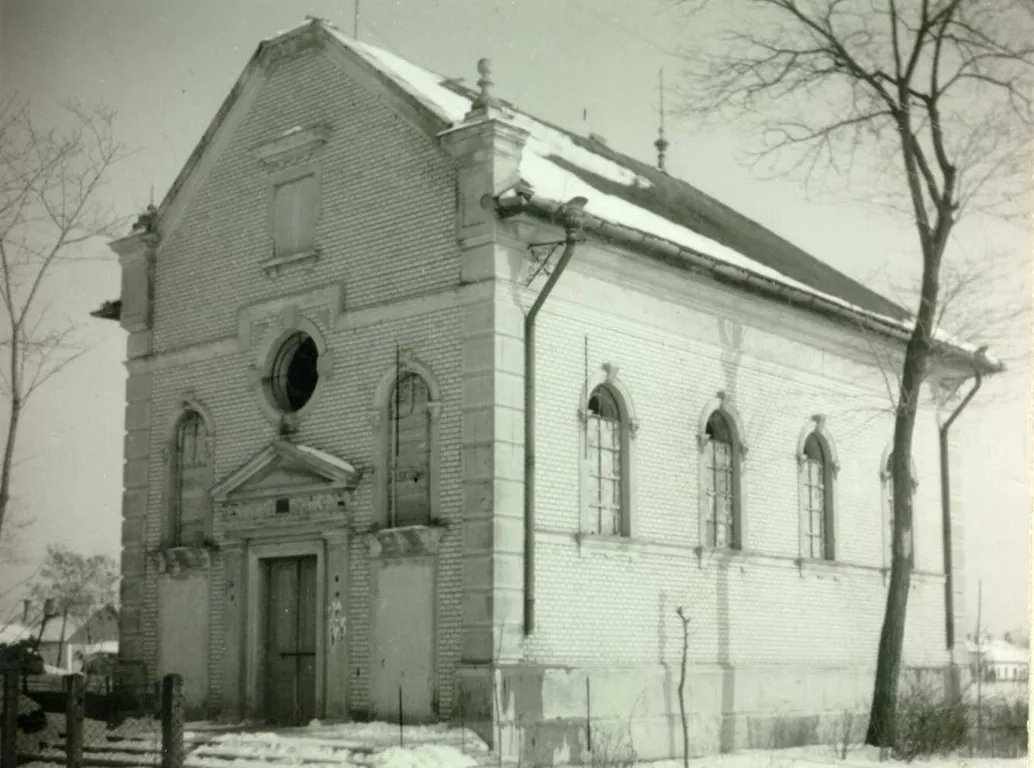
Tápiógyörgye lies on the Tápió stream in the Nagykáta district of Pest county, east of Budapest. Its synagogue is dated to 1896 and attributed to the Tafler-Györgyey family, the village's great landowners, who had bought the local estates in the 1860s and completed their mansion in 1892. It was a modest free-standing hall of pale brick with a gabled entrance front, a round window over the door and round-arched windows along the sides. The congregation followed the Congress (Neolog) rite and was always small: 110 Jews lived in the village in 1910, 41 in 1920 and 30 in 1941. It had a cantor and a ritual slaughterer but no rabbi of its own; the rabbi of Nagykáta kept its registers. In May 1944 the Jews of Tápiógyörgye were forced into the Nagykáta ghetto, taking the Torah scrolls and other ritual objects with them, and were deported to Auschwitz. The empty building survived the war. Under Communist rule it was used as a warehouse, fell into disrepair and was demolished as unsafe at a date that is not recorded; a field survey of 1980–87 lists it as gone. Three undated photographs in the Hungarian Jewish Museum and Archives show it shuttered and decaying, and no trace of it is reported in the village today.
Where it stood for 91 years
Tápiógyörgye, Nagykáta district, Pest county, Hungary (street address of the synagogue not recorded; pin at the village centre)
Otwórz większą mapę →Społeczność żydowska
Seventeen Jews were recorded in Tápiógyörgye in 1785. The community grew during the nineteenth century and numbered 110 in 1910. Its members included timber, grain and building-material merchants such as Manó Hirsch, born in the village in 1857, who founded his timber yard in 1905 and sat for fifteen years on the village council as one of its largest taxpayers. Fourteen Jewish men from the village were called up in the First World War and seven of them died. Afterwards the community shrank: the 1920 census counted 41 Jews among 6,750 inhabitants, and that of 1941 counted 30, with a further 12 Christians of Jewish descent. In April 1944 the Congress (Neolog) branch community had 27 members, ten taxpayers, one employee and no rabbi; its registers were kept by Rabbi Soma Breuer of Nagykáta. A burial society of 21 members owned the cemetery and an old hearse.
Architektura i projekt
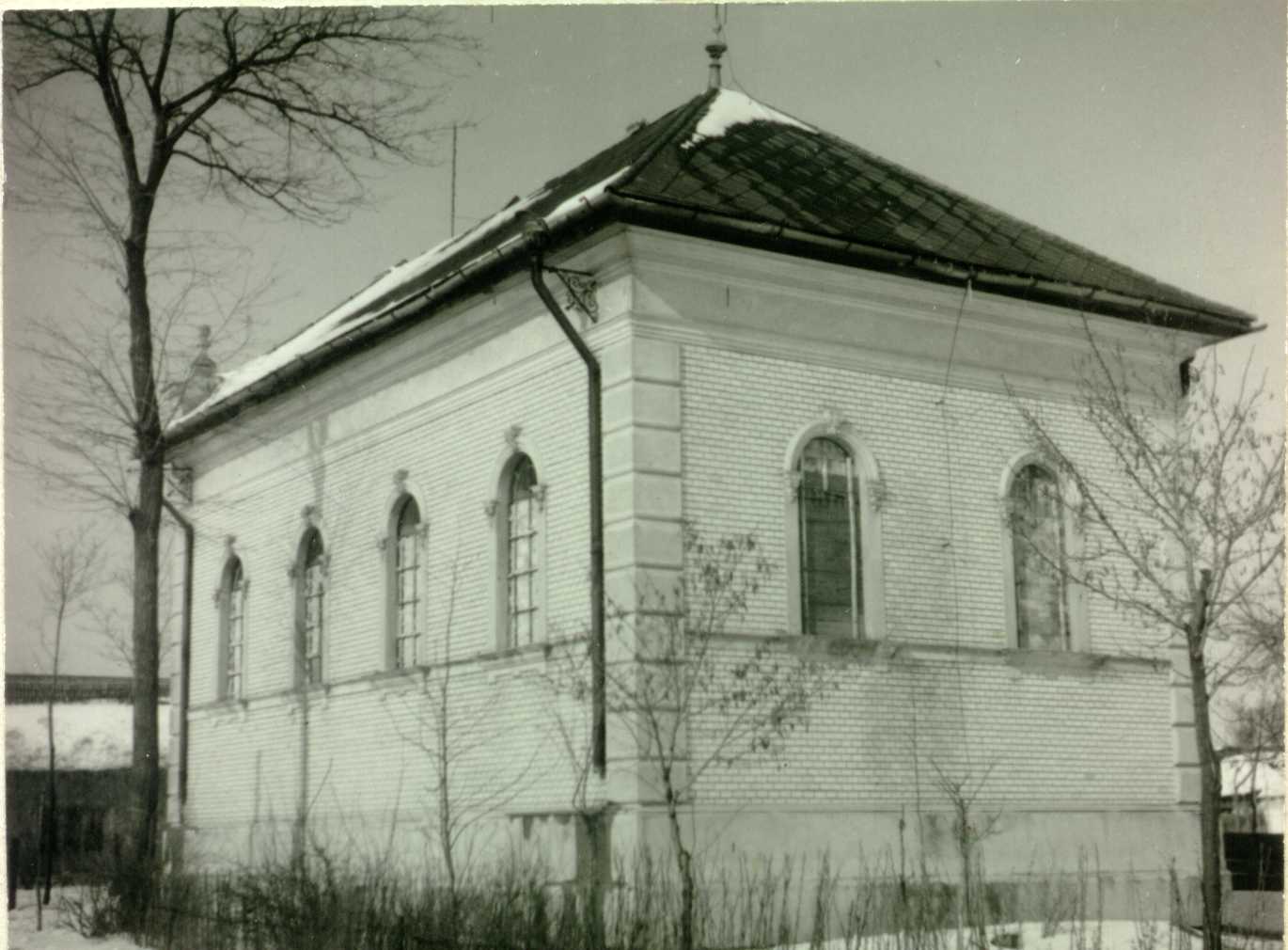
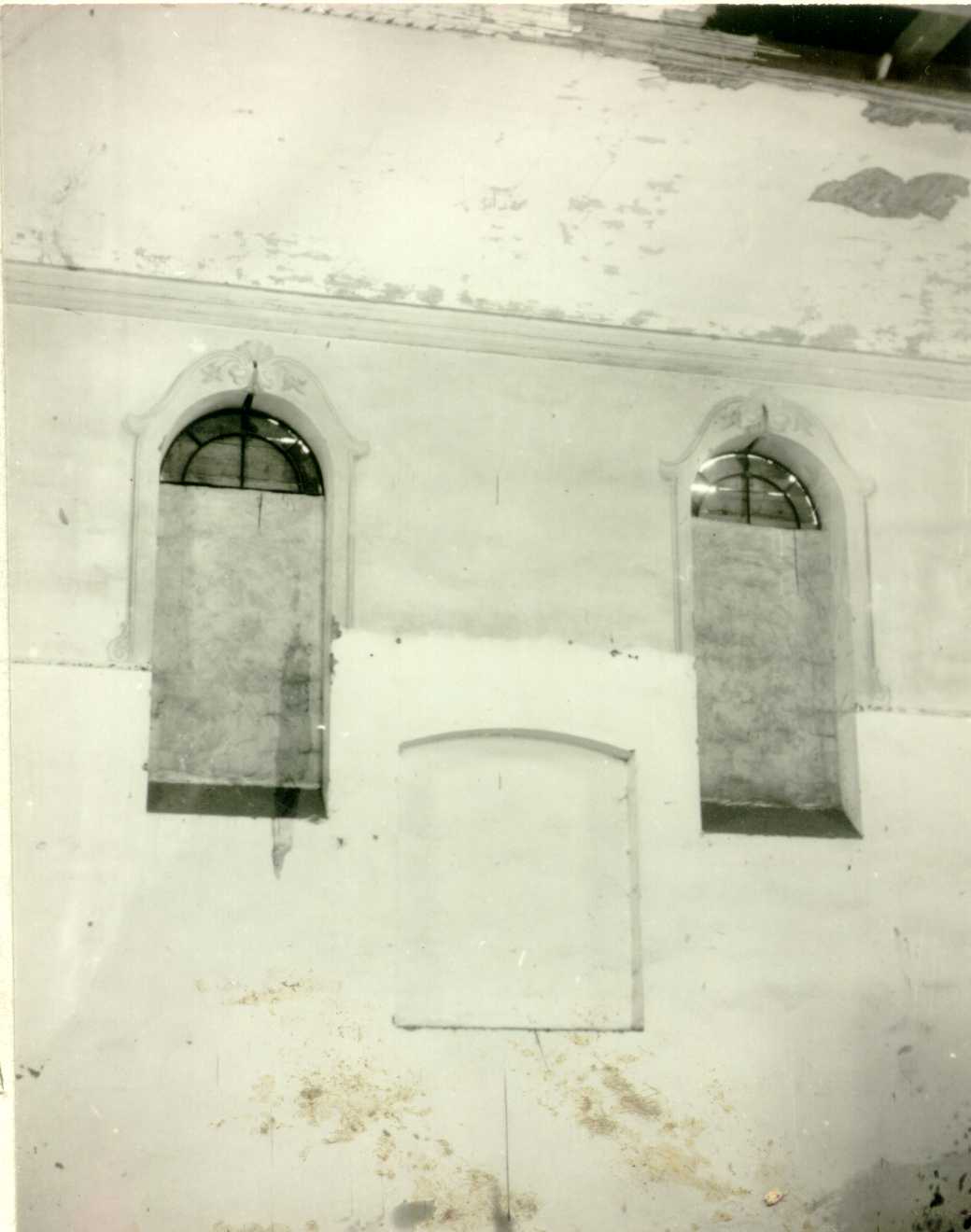
No plans or building accounts are known and the architect is unrecorded, so the description rests on three photographs. The synagogue was a free-standing rectangular hall under a pitched roof, gabled over the entrance front and hipped at the far end. The walls were of pale exposed brick, framed by rusticated corner piers and a moulded cornice. The entrance front had a central doorway under a triangular pediment with an inscription tablet, a large round window above it, and a tall round-arched window on either side set over blank panels. The corner piers ended in ball finials beside the gable, which held a small shuttered opening. Each long side had four tall round-arched windows with moulded surrounds and keystones on a continuous sill course. The rear wall had two similar windows, probably flanking the Torah ark. Inside, the windows had scrolled plaster hoods beneath a moulded cornice and a flat ceiling. The idiom is the restrained historicism common to Hungarian village synagogues of the 1890s.
Życie w synagodze
Services followed the Congress (Neolog) rite. The congregation was too small to keep a rabbi: in 1944 its registrar rabbi was Soma Breuer of Nagykáta, who had served that town since 1904 and also looked after the neighbouring branch communities. Day-to-day religious life depended on local officers. In December 1914 the National Israelite Office asked the ministry to exempt Hermann Frenkel, the community's ritual slaughterer, from military service. A county directory of 1931 names Manó Hirsch as president and Áron Guttmann as cantor. The same office's registers record the community writing in December 1938 for guidance on taxing members who had converted, and a tax dispute between the community and Bernát Lederer in 1940. Alongside the synagogue a burial society maintained the cemetery. When the Jews were driven out in 1944 the synagogue still held Torah scrolls and shofars, which they carried with them to Nagykáta.
Zniszczenie
The synagogue was not destroyed during the Second World War. When the Jews of Tápiógyörgye were moved to the Nagykáta ghetto in May 1944 they took the Torah scrolls, shofars and the burial society's equipment with them and handed them to the Nagykáta community; all of it disappeared there. The emptied building came through the fighting of November 1944, in which about 400 houses in the village were damaged. No congregation returned to it, and under Communist rule the synagogue was used as a warehouse. Undated photographs show windows boarded or broken, plaster falling from the ceiling and a walled-up recess between the rear windows. Having become unsafe, it was demolished during the Communist era. Neither the year nor the body that ordered or carried out the demolition is recorded in the sources found. Anikó Gazda's field survey of 1980–87 lists the Tápiógyörgye synagogue as demolished.
Los społeczności
After the German occupation of Hungary in March 1944 the Jews of the Nagykáta district were ordered by the Hungarian authorities into a ghetto in Nagykáta, set up in May 1944 in the streets around today's Ady Endre út and Damjanich utca. It held 628 people, about 200 of them from Nagykáta and the rest from surrounding villages including Tápiógyörgye; Rabbi Soma Breuer sat on its Jewish Council. The inmates were deported to Auschwitz-Birkenau in an operation carried out by the Hungarian gendarmerie under Nazi German direction, and most were murdered there, among them Rabbi Breuer and his wife. Accounts differ on the route: local historians place the transfer to the Monor entrainment centre in the first days of July 1944, while Randolph Braham has the ghetto moved to Kecskemét in early June. A questionnaire returned from Tápiógyörgye on 13 September 1945 answered a single question, noting that the cemetery had survived. How many of the village's Jews returned is not recorded in the sources consulted.
Miejsce dzisiaj
The site of the synagogue has not been identified: none of the sources consulted gives a street address, and no remains or marker are reported. The map pin therefore marks the centre of the village only. Nothing of the building is known to survive apart from three photographs in the Hungarian Jewish Museum and Archives in Budapest. The Jewish cemetery of Tápiógyörgye still exists; in 2009 it was reported to be in good condition, with a Holocaust memorial, and in the care of the mayor's office.
Ważne postacie
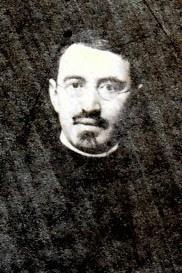
Soma Breuer
1880–1944Rabbi of Nagykáta from 1904; registrar rabbi for TápiógyörgyeSoma Breuer became rabbi of Nagykáta in 1904 and served there for forty years. Tápiógyörgye, a branch community with no rabbi of its own, came under him: the April 1944 census of Hungarian Jewish communities names him as its registrar rabbi. He sat on the Jewish Council of the Nagykáta ghetto, to which the Jews of Tápiógyörgye were taken, and was murdered at Auschwitz in 1944.
Biografia lub źródło →Manó Hirsch
1857–after 1939President of the Tápiógyörgye Israelite community (1931)Manó Hirsch was born in Tápiógyörgye in 1857, farmed his father's land and in 1905 founded the timber yard and shop he later ran with his sons. He sat for fifteen years on the village council as one of its largest taxpayers. The county directory of 1931 names him as president of the Israelite community, the body responsible for the synagogue.
Biografia lub źródło →Áron Guttmann
UnknownCantor (1931)Áron Guttmann is named as cantor of the Tápiógyörgye Israelite community in the Pest county directory of 1931, under the presidency of Manó Hirsch. As the congregation had no rabbi of its own, the cantor led the services in the synagogue. Nothing further about his life or fate was found in the sources consulted.
Biografia lub źródło →Hermann Frenkel
UnknownRitual slaughterer (shochet), 1914Hermann Frenkel served the Tápiógyörgye community as its ritual slaughterer. On 21 December 1914 the National Israelite Office in Budapest included him in a submission to the ministry asking that a group of community officials be exempted from wartime military service, which shows that the small congregation employed its own religious officer at that date.
Biografia lub źródło →Illés Györgyey
1859–before 1931Landowner; head of the Tafler-Györgyey familyIllés Györgyey, born in Budapest in 1859 and earlier known by the family name Tafler, managed the family's estate at Tápiógyörgye and was the eleventh-largest taxpayer of Pest county in 1893/94. The synagogue of 1896 is credited to the Tafler-Györgyey family, which he then headed; no source found states which member of the family commissioned it.
Biografia lub źródło →Czy masz coś do przekazania?
Zdjęcia, dokumenty, historie rodzinne lub wspomnienia o tej synagodze i jej społeczności pomagają zachować jej historię.
- List of synagogues in Hungary (row: Tápiógyörgye)
- Magyarországi zsinagógák listája (Pest vármegye: Tápiógyörgyei zsinagóga)
- Magyarországi Zsidó Hitközségek 1944. április: Tápiógyörgye fiókhitközség
- Zsinagógák és zsidó községek Magyarországon. Térképek, rajzok, adatok (1991), Pest county table
- Tápiógyörgyei zsinagóga (F70.429.1)
- Tápiógyörgyei zsinagóga (F70.429.2)
- Tápiógyörgyei zsinagóga belső: ablakok (F00.133)
- Zsinagógák a történelmi Magyarországon: Tápiógyörgye
- EmlékTér. Nagykáta zsidó közösségének hagyatéka (TDK thesis, 2018)
- Pest-Pilis-Solt-Kiskun vármegye általános ismertetője és címtára, ötödik körzet (1931): Tápiógyörgye
- Pest-Pilis-Solt-Kiskun vármegye és Kecskemét th. jogú város adattára (Pécs, 1939), part IV, p. 65
- A tápiószelei köznemesek társadalmi és gazdasági szerepvállalása a 18–19. században, Tisicum 12 (2001), p. 394
- Zsidó közösségek öröksége, Magyar Zsidó Levéltári Füzetek 7 (2010), pp. 55–56
- A népirtás politikája. A holokauszt Magyarországon, vol. 1, p. 680 (Zone IV)
- Tápiógyörgye
- Az Országos Izraelita Iroda iktatónaplója 33981–37275 (1914–1916), entry 35320
- Az Országos Izraelita Iroda iktatónaplója 68856–71355 (1938–1939), entry 70979
- TAPIOGYORGYE: Pest
- Tápiógyörgye (OpenStreetMap relation 1355332)
Share a memory or thought
No comments yet. Be the first to add one.