
Die Geschichte von Great Synagogue of Târgu Lăpuș
Târgu Lăpuș is a small market town in the Lăpuș valley of Maramureș county; under Hungarian rule it was called Magyarlápos. Jews were living in the district by the late eighteenth century, and a formal community of ten members was set up in 1820 under its first president, the landowner Ignác Hirsch. Services were first held in a temporary prayer house. In 1885, when the community had grown to about 80 families, it replaced this with a large synagogue paid for by the Hirsch Ignác Foundation. A beth hamidrash was added for the yeshiva of Rabbi Mose David Teitelbaum, who came to the town in 1882.
The congregation was Orthodox and, by the survivors' account, almost wholly observant. In 1923 it numbered about 170 families, or some 900 people. On 4 May 1944, after the town had returned to Hungary, the Jews of the surrounding villages were brought by cart to the synagogue courtyard and crowded inside the building overnight; the next day all were taken to the ghetto at Dés (Dej). More than 90 percent did not return. The memorial chapter written by survivors describes the synagogue as standing to that day. When and by whom it was later pulled down is unknown; Streja and Schwarz's survey of Romanian synagogues (2009) records it as disappeared.
Where it stood for nearly 110 years
Historic: Magyarlápos, Hungary (Romania 1920-1940); street and house number unknown. Today: unknown; placeholder pin at the centre of Târgu Lăpuș, Maramureș county, Romania (approximate).
Größere Karte öffnen →Die jüdische Gemeinde
The memorial chapter on Magyarlápos, compiled by the native Géza Nemes for the Dej memorial book, says Jews lived in the district by the early eighteenth century and cites a gravestone of a woman who died in 1799. It suggests the first settlers were of Moravian and German origin, followed later by migrants from Russian Poland. The community was formally founded in 1820 with ten members. By 1885 it had about 80 families, 400 to 500 people, and by 1923 about 170 families, roughly 900 people; the Cemetery Discovery Project records 425 Jews in 1891. A survivor interviewed by Centropa estimated that Jews were 18 to 20 percent of the town and that all but two or three were religious. The community kept a burial society founded by 1848, a Talmud Torah, a yeshiva, several charitable societies including a women's association, and a ritual bath built in 1905. Jewish merchants included three wholesalers who supplied the countryside, and members founded three local banks. Presidents included Ignác Hirsch, David Friedlander, József Loger, Izrael Joel, Mihály Markovits and Károly Lázár.
Architektur und Gestaltung
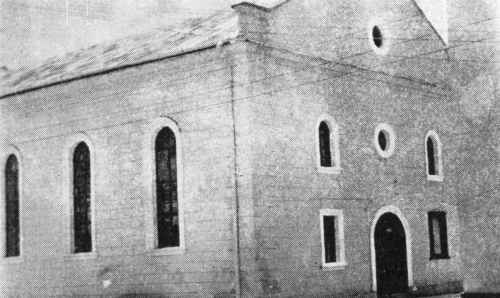
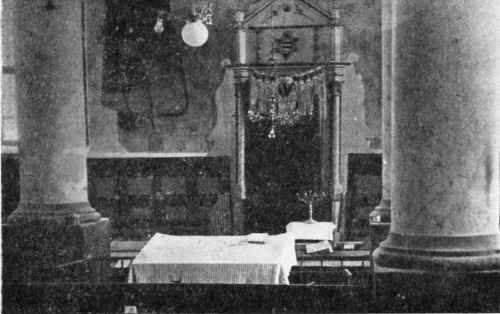
The memorial chapter calls it 'the large imposing synagogue' and says it was built in 1885 to replace a temporary prayer house, with funds from the Hirsch Ignác Foundation. Its photograph, captioned 'The Synagogue of Magyarlapos (built in 1885)', shows a plain, rendered, free-standing hall with a pitched roof, seen from the corner. The gabled entrance front has a round-arched door flanked by two small round windows, a tall round-arched window above the door and a round opening high in the gable; the long side wall has a row of tall round-arched windows. Corner pilasters and a cornice are the only ornament. A second photograph shows the interior: two massive round columns, probably supporting a gallery, frame the Torah ark, an aedicule of thin columns carrying a crowned pediment, with a curtain, steps and a lamp. The courtyard was large enough to hold the carts of the village Jews in 1944. The architect, builder, seating capacity and exact plot are unknown.
Leben in der Synagoge
The synagogue was the centre of an Orthodox community shaped for more than half a century by Rabbi Mose David Teitelbaum, son of the rabbi of Gorlice and grandson of a famous chief rabbi of Sátoraljaújhely, who arrived in 1882 and died suddenly in 1935. His yeshiva began with 90 students and grew to between 180 and 200 after the First World War, which is why a beth hamidrash was needed beside the new synagogue. His son-in-law Aharon Gross was elected chief rabbi in 1935 and served until the deportation. A survivor recalled that the men went to the synagogue every morning, every evening and on the Sabbath. Ritual slaughterers attached to the congregation included Feisch Weiss, Jidl Werzberger and Arje Katz. The burial society, the Talmud Torah and the charitable associations Gemilat Chesed and Poale Cedek were run by members of the congregation, and the villages of Oláhlápos, Domokos and Felsőszőcs, which had their own small prayer houses, looked to the Magyarlápos rabbinate.
Zerstörung
No source read in this research records damage to the synagogue during the Second World War. Its last use as a Jewish building was as a holding place: on 4 May 1944 the Jews of the villages were brought by cart to the synagogue courtyard, and by evening everyone was crowded inside the building. The next morning they were driven to the Dés ghetto. The memorial chapter on Magyarlápos, written by survivors about twenty-five years after the deportations, says the synagogue 'stands to this day', so it survived the war and was still standing around 1970, under Communist rule, probably empty, since more than 90 percent of the community did not return. Aristide Streja and Lucian Schwarz, in their 2009 survey of the synagogues of Romania, mark the Târgu Lăpuș synagogue as disappeared, one of only three such entries in their list. No source found gives the year of demolition, says whether the building was sold, or names who ordered or carried out the demolition.
Das Schicksal der Gemeinde
After the Second Vienna Award of 1940 returned northern Transylvania to Hungary, anti-Jewish laws were applied in Magyarlápos, and from 20 June 1942 Jewish men were called up to Hungarian forced labour unit 110/34 and sent to Ukraine. After the Nazi German occupation of Hungary on 19 March 1944, Jews had to wear the yellow star from 5 April and their shops were closed. On 4 May the Jews of the town and its villages were concentrated in the synagogue and on 5 May taken by cart to the ghetto set up in the Bungur woods outside Dés. There Hungarian gendarmes beat Dr Samu Bíró to death with rifle butts. From Dés the Jews were deported; Dr Miksa Salamon was murdered in Auschwitz with his wife and son, and Rabbi Aharon Gross was deported with his family, none of whom survived. More than 90 percent did not return. A few, among them Samu Dub and Hanni Marmor with her three children, survived hidden in the forest. No organised community was rebuilt; the last burial in the Jewish cemetery took place in 1972.
Der Ort heute
The plot on which the synagogue stood has not been identified in any source consulted, so it is not possible to say what occupies it today, and no surviving fragment of the building is recorded. The map pin for this entry is a placeholder at the centre of Târgu Lăpuș and should not be read as the synagogue's location. The Jewish cemetery survives at Strada Mihai Eminescu 6, with about 470 gravestones, a fence and gate put up in 1990 and an ohel over the graves of two rabbis rebuilt in 1999; it belongs to the national Jewish community. Fixing the synagogue's address will need old cadastral maps or local memory in the town.
Bedeutende Namen
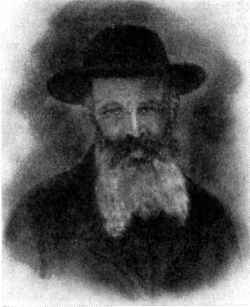
Mose David Teitelbaum
died 1935Chief rabbi of Magyarlápos, 1882-1935Son of the rabbi of Gorlice and grandson of a famous chief rabbi of Sátoraljaújhely, Teitelbaum came to Magyarlápos as chief rabbi in 1882, three years before the synagogue was built, and served for over half a century. He founded the yeshiva for which a beth hamidrash was built beside the new synagogue; it grew from 90 to as many as 200 students. He died suddenly in 1935 while attending a convention in Dés.
Biografie oder Quelle →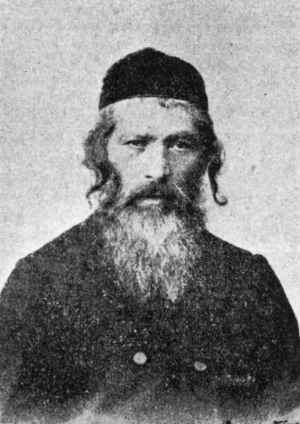
David Friedlander
UnknownPresident of the Magyarlápos Jewish communityThe memorial chapter on Magyarlápos lists David Friedlander among the presidents of the Jewish community, after its founder Ignác Hirsch, and reproduces his photograph with the caption 'David Friedlander in Magyarlapos'. As a lay head of the congregation he shared responsibility for the synagogue and its institutions. The years of his presidency and his dates of birth and death are not given in the chapter.
Biografie oder Quelle →Ignác Hirsch
UnknownFounder and first president of the Magyarlápos Jewish community (1820); benefactor of the synagogueA wealthy landowner described as a prominent personality of the whole district, Hirsch was the first president of the ten-member community founded in 1820. The 1885 synagogue that replaced the community's temporary prayer house was built with money from the Hirsch Ignác Foundation, so the building owed its existence to him or to the fund set up in his name. His birth and death dates are not given in the memorial chapter.
Biografie oder Quelle →Aharon Gross
died 1944Chief rabbi of Magyarlápos, 1935-1944Gross, the son-in-law of Rabbi Teitelbaum, was elected chief rabbi of Magyarlápos in 1935 and was the last rabbi of the synagogue. In May 1944 he was taken with his community from the synagogue courtyard to the Dés ghetto and deported. According to the memorial chapter no member of his family survived.
Biografie oder Quelle →Haben Sie etwas beizutragen?
Fotos, Dokumente, Familiengeschichten oder Erinnerungen an diese Synagoge und ihre Gemeinde halten ihre Geschichte lebendig.
- Dej, Romania: The Jews of Magyarlápos and surroundings, their life and their destruction (memorial book pp. 337-366, English translation)
- Synagogues in Romania: past, present, future (review of Streja & Schwarz, Sinagogi din România, 2009)
- Târgu Lăpuș Jewish cemetery (ROCE-0377)
- Bernat Sauber interview (tagged text: synagogue/house of prayer)
- Târgu Lăpuș (OpenStreetMap relation 10744452)
Share a memory or thought
No comments yet. Be the first to add one.