

La historia de Tass Synagogue
Tass is a village on the Danube near Kunszentmiklós, in what was Pest-Pilis-Solt-Kiskun county and is now Bács-Kiskun. Local historians describe its Jewish community as one of the oldest in the district, and Anikó Gazda's gazetteer counts 101 Jews there in 1828 and 188 in 1851. A county directory of 1844 recorded 135 Jews and noted that they had a synagogue. The Bács-Kiskun county website says that the last synagogue of the community was built in 1834; an earlier prayer house is implied but not described.
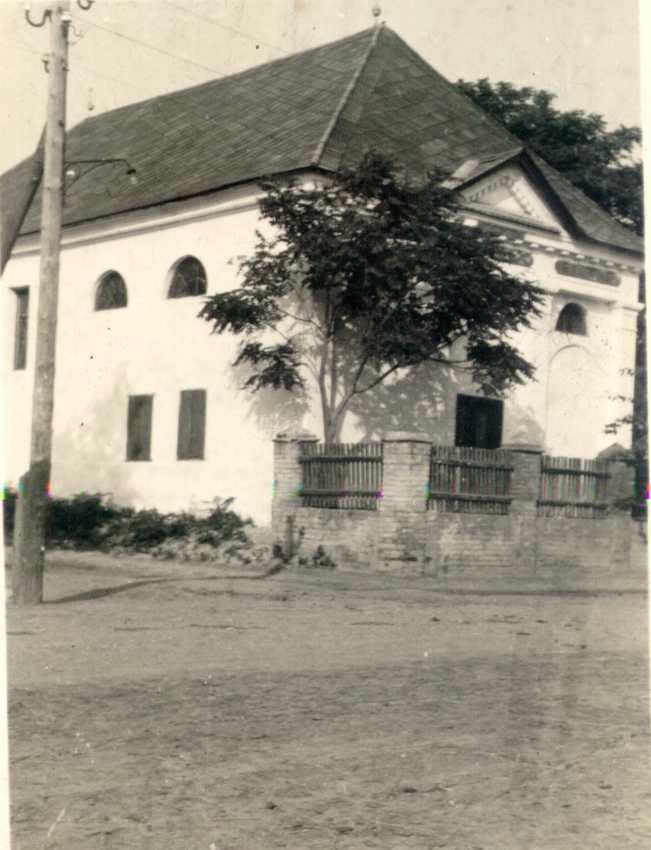
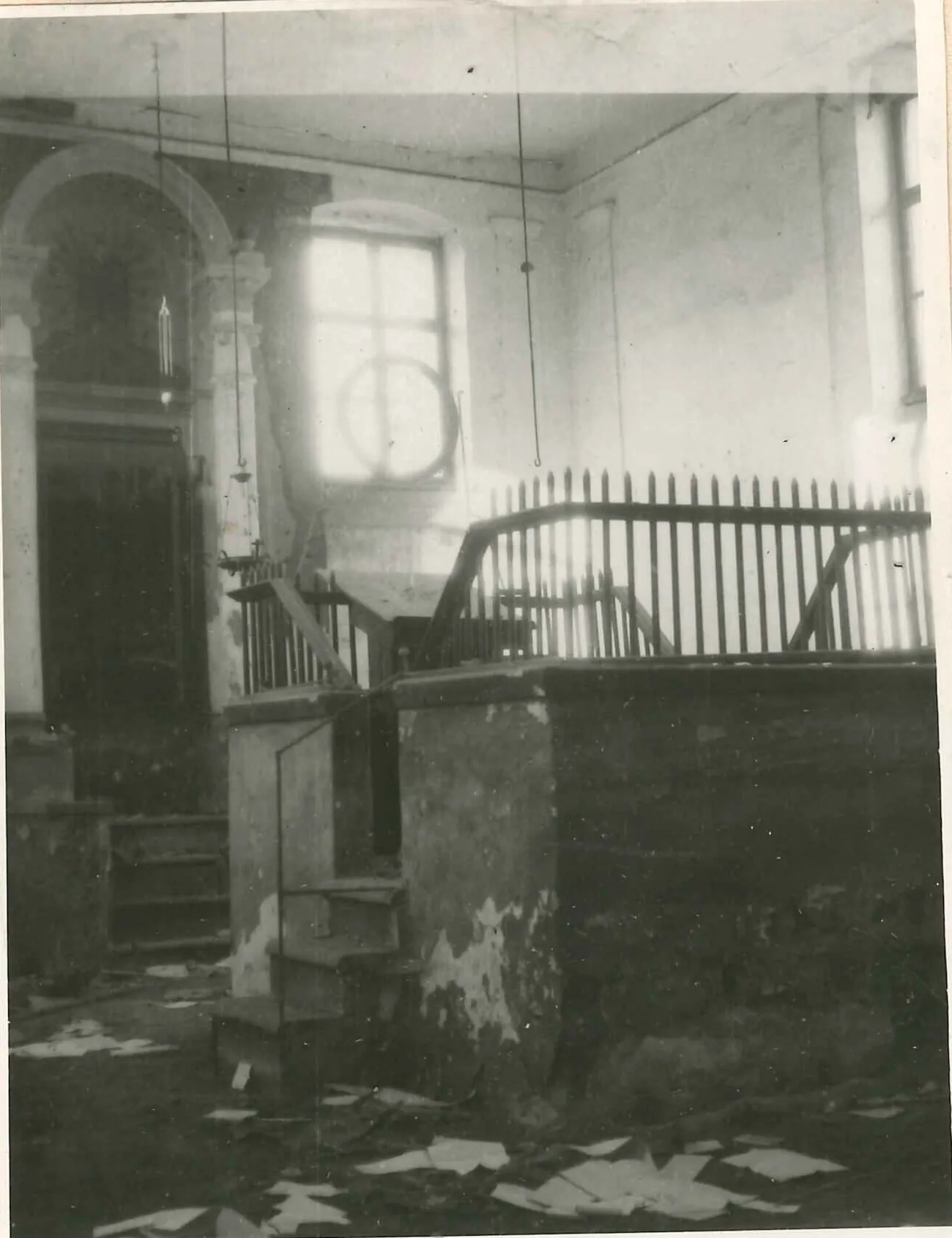
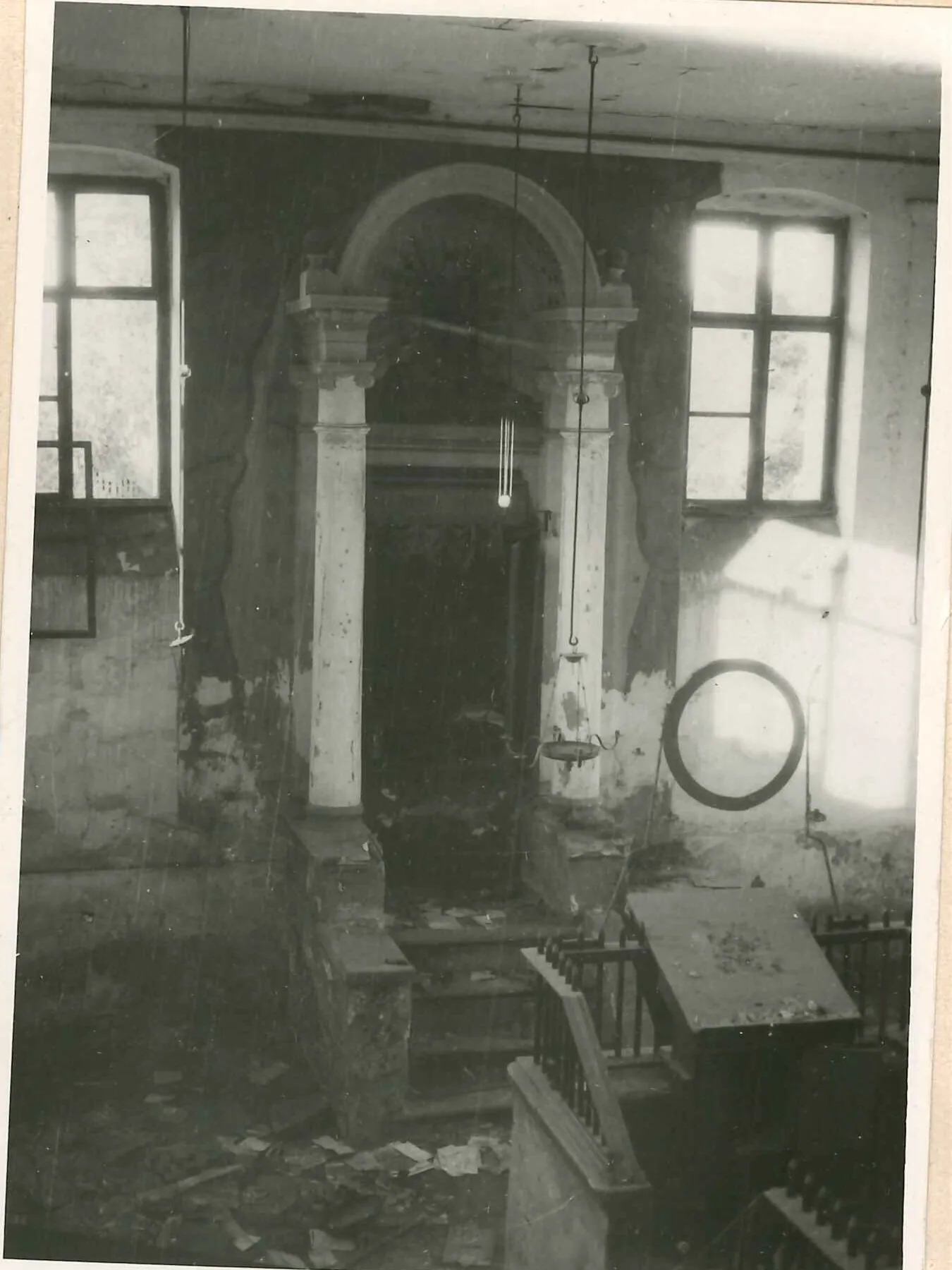
Two sets of photographs in the Hungarian Jewish Museum and Archives show the building. One, dated 1935, shows a whitewashed hall with a hipped roof and a pedimented front behind a brick and picket fence. The others, on an album page labelled 'Tass templom 1949', show the same exterior with flaking render and an interior with an empty Torah ark, a railed bimah and papers scattered across the floor.
Only 27 Jews were counted in Tass in 1941. The community was officially declared defunct in 1947 and its burial society was dissolved in 1948. When Gazda surveyed Hungarian synagogue sites between 1980 and 1987 she recorded the Tass synagogue as demolished. The date of the demolition and the person or body responsible are unknown.
Where it stood for nearly 140 years
Historic: Tass, Dunavecse district, Pest-Pilis-Solt-Kiskun county; street and house number unknown. Today: Unknown; placeholder pin at the centre of 6098 Tass, Bács-Kiskun county (approximate).
Abrir mapa ampliado →La comunidad judía
The Tass local history society, citing Lajos Horváth's 1973 village history, writes that Jews lived in Tass as early as the sixteenth century and that the community was one of the oldest in the district. The surviving cemetery on Kossuth körút is at least the second the community used and has gravestones from the mid 1790s. A Chevra Kadisha burial and charitable society was founded in 1806. Gazda's gazetteer gives 101 Jews in 1828, 188 in 1851, 118 in 1910 and 27 in 1941; Ferenc Őrkényi's county directory of 1844 gives 135. On these figures the community peaked around the middle of the nineteenth century and shrank steadily afterwards. The Magyar Zsidó Lexikon of 1929 has no entry for Tass, so the officers, budget and religious affiliation of the congregation between the wars are unknown. A rabbi named J. M. Fried was in office in 1916. The poet and journalist Simon Kemény, whom the Encyclopaedia Judaica describes as a converted Jew, was born in Tass in 1882.
Arquitectura y diseño
The 1935 and 1949 photographs show a free-standing, single-storey rendered hall on a street corner, under a steep hipped roof with ball finials at both ends of the ridge. The entrance front is divided by flat pilasters into three bays. The middle bay projects slightly and is crowned by a small triangular pediment with a dentil moulding, set against the slope of the roof. Each bay has a blind round-arched panel; the doorway sits in the middle one, and the side bays have semicircular windows above. Recessed oblong panels run across the frieze. The long side wall has two semicircular upper windows near the front and tall rectangular windows further back. A fence of brick piers and wooden pickets enclosed the forecourt. Inside, the hall had plastered walls and a flat ceiling. The Torah ark stood between two rectangular windows in a frame of two columns on pedestals carrying a round arch with urn finials, with painted drapery on the wall around it and steps leading up. In front of it stood a raised masonry bimah with a wooden railing. The architect and builder are unknown.
La vida dentro de la sinagoga
Very little is recorded about worship in the building. The 1949 interior photographs show a raised bimah standing in the body of the hall in front of the ark. Two painted linen textiles from Tass are in the Hungarian Jewish Museum in Budapest, both given in 1916 by J. M. Fried, rabbi of Tass: a cover dated 1760 bearing the blessings the mohel recites at a circumcision, and a Torah ark curtain for circumcision ceremonies dated 1813. Both are older than the 1834 building, so the congregation evidently carried them over from an earlier prayer house and used them for generations. The Chevra Kadisha founded in 1806 buried the dead and, according to Horváth's village history, supported poor members of the community. The cemetery on Kossuth körút had its own mortuary building. Whether the community kept a school, who its cantors and teachers were, and which rabbis served before and after Fried are unknown. The 1935 photograph shows the synagogue whitewashed, fenced and in good repair.
Destrucción
No source found reports damage to the synagogue in the Second World War; the local history society says Soviet troops entered Tass without fighting on the night of 3 to 4 November 1944. What happened to the building in 1944 and 1945 is not recorded. Photographs dated 1949 in the Hungarian Jewish Museum and Archives show it still roofed, but with render falling from the walls and the interior stripped: the ark is empty, plaster is peeling and loose papers cover the floor. By then the Ministry of Religion and Education had declared the Tass community defunct, in 1947. What happened next is not documented in the sources consulted. Anikó Gazda, who surveyed Hungarian synagogue sites between 1980 and 1987, recorded the Tass synagogue as demolished. It was therefore pulled down at some time between 1949 and the 1980s, under Communist rule, but the year is unknown and so is the actor: no source found says whether the village council demolished it or whether it was first sold and taken down for its materials. The cemetery mortuary, a separate building, was demolished in the 1980s because it had become dangerous.
El destino de la comunidad
Gazda's gazetteer records 27 Jews in Tass in 1941. No source found describes what happened to them in 1944 in detail. Tass is listed in the Dunavecse district in Borovszky's county monograph, and Randolph Braham writes that the Jews of some villages of that district were held in the ghetto in Tomori and Híd streets in Kalocsa, which contained 617 people and whose inmates were taken to an assembly camp on 18 June 1944. Whether the Jews of Tass were among them is not confirmed. The ghettos of this region were set up by the Hungarian authorities after the Nazi German occupation of Hungary in March 1944. Simon Kemény, the poet born in Tass, was killed by Arrow Cross men in Budapest in January 1945. The local history society states that there were no burials in the Jewish cemetery after 1945. In 1947 the ministry declared the Tass Israelite community defunct, and on 9 November 1948 the interior minister dissolved the Chevra Kadisha because it could no longer function. On 28 July 1949 the land registry transferred the cemetery to the National Office of Hungarian Israelites.
El lugar hoy
The plot on which the synagogue stood has not been identified in any source consulted, so what occupies it today is unknown. The photographs show a corner site on an unpaved street, enclosed by a brick and picket fence, but give no street name. No marker on the site is recorded. The map pin for this entry is a placeholder at the centre of Tass and should not be read as the synagogue's location. The Jewish cemetery on Kossuth körút still exists; the local history society says the municipality had it cleared of overgrowth after 1990 and has maintained it since. Fixing the synagogue's address will need a cadastral map or Lajos Horváth's 1973 village history.
Nombres destacados
J. M. Fried
UnknownRabbi of Tass, in office in 1916Fried is the only rabbi of the Tass congregation named in the sources found. The inventory of the Hungarian Jewish Museum records that in 1916 'J. M. Fried, rabbi of Tass' gave the museum two painted linen textiles from the village: a circumcision cover dated 1760 and a Torah ark curtain for circumcision ceremonies dated 1813. His full first names, his dates, and how long he served the synagogue are unknown.
Biografía o fuente →¿Tiene algo que aportar?
Fotografías, documentos, historias familiares o recuerdos de esta sinagoga y su comunidad ayudan a mantener viva su historia.
- Zsinagógák és zsidó községek Magyarországon (Bács-Kiskun county table, row for Tass)
- Tass, zsinagóga (photograph album page, inventory F16.096, dated 1949)
- Tassi zsinagóga (photograph, inventory F71.116, dated 1935)
- Tóraszekrény takaró körülmetélések alkalmához (inventory 64.1541)
- Brit milá takaró (inventory 64.1542)
- Temetők és temetkezési egyletek (section on the Jewish cemetery and the Chevra Kadisha)
- 1844 (entry for Tass from Őrkényi Ferenc József's Pest-Pilis-Solt county directory, Buda 1844)
- Tass (settlement page)
- Tass története 1945-ig
- Pest-Pilis-Solt-Kiskun vármegye községei (Magyarország vármegyéi és városai)
- A népirtás politikája: a Holocaust Magyarországon, vol. 2 (Zone IV: Kalocsa)
- Kemény Simon
- Kemény, Simon
- List of synagogues in Hungary
- Tass (OpenStreetMap relation 1130388)
Share a memory or thought
No comments yet. Be the first to add one.