
История Great Synagogue of Tekovské Lužany
Tekovské Lužany, called Nagysalló in Hungarian and Tekovské Šarluhy in Slovak before 1945, is a small town in the Levice district of the Nitra region. Jews were barred from the Tekov region until the 1830s, and the first families came mostly from the Nitra area. The community, which defined itself as Orthodox, first prayed in a room in a private house that was later used as a house of study. According to Pinkas Hakehillot, the community built a synagogue and opened a primary school at the beginning of the twentieth century. The municipal history calls this building the great synagogue and places it directly on the boundary between Tekovské Lužany and Tekovské Lužianky (Kissalló), on the bank of the Lužianka stream, which also fed the ritual bath behind the Jewish school opposite. A small prayer house stood next to it. The town was annexed to Hungary in November 1938. During the war Nazi German forces took the building apart for its timber, and what was left of the walls was demolished after the war. The small prayer house beside it survives and has housed a museum of the Jewish community since 2009 or 2011.
Where it stood
Historic: Nagysalló / Tekovské Šarluhy, on the boundary with Kissalló (Malé Šarlužky), bank of the Lužianka stream, beside the small prayer house; street and number unknown. Today: next to the Jewish museum (former prayer house), western part of Tekovské Lužany, 935 41, Levice district. Approximate.
Открыть большую карту →Еврейская община
Jews were forbidden to live anywhere in the Tekov region until the ban was lifted in the 1830s. A list of the Jews of Tekov county from 1841 records fifteen families, about 66 people, in Tekovské Lužianky; in 1854 there were 80 Jews there and 4 in Tekovské Lužany. Pinkas Hakehillot counts 64 Jews in Tekovské Šarluhy in 1880, 113 in 1910, 124 in 1921 and a peak of 180 in 1930, falling to 154 in 1941. The municipal history gives 145 for Lužianky and 108 for Lužany in 1914. The congregation was Orthodox and served Jews from fourteen nearby settlements; some institutions were shared with the separate small community of Malé Šarlužky (Lužianky), which had its own synagogue, cemetery and ritual bath. In 1922 the community employed a rabbi, a shochet who was also prayer leader, and two teachers. Most Jews were merchants: in 1921 they ran grocery and textile shops, two taverns, timber and fuel yards, two butcher shops and a bakery, and the town doctor, Samuel Bass, was Jewish. Zionist groups were active, and the Jewish party won two council seats in 1928.
Архитектура и дизайн
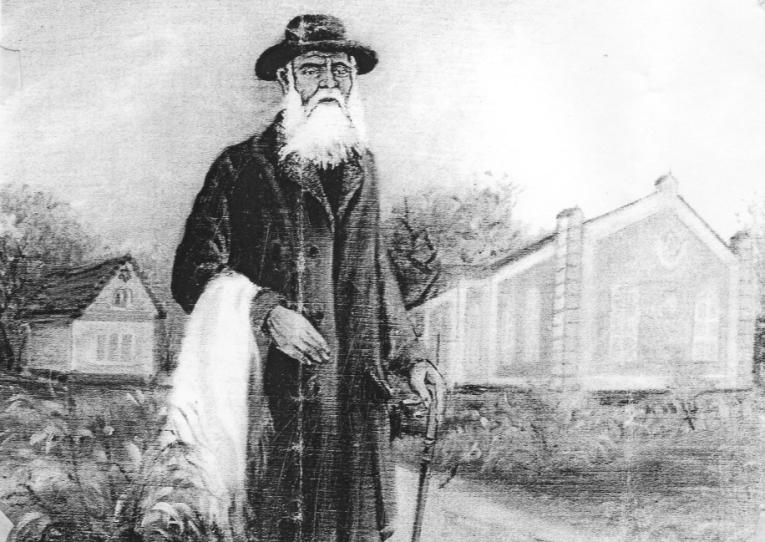
No photograph of the building was found. Its appearance is known from two images published by the municipality. The first is a painting by an unknown artist showing an old bearded Jew in front of a long, light-coloured building with a gabled front, pilasters and a row of tall round-headed windows. The second is a measured-style sketch drawn from the recollections of Ladislav Neumann. Seen from the street, it shows a rendered hall whose gable end was shaped with stepped shoulders and a small raised top, crowned by a Star of David, with three round-headed windows and a small round opening between them. A lower wing with a tiled roof and one round-headed window adjoined it. Seen from the courtyard, the long side had a tiled roof, four round-headed windows and a central gabled porch with a door. To the left of the street view the sketch shows the small prayer house, a gabled cottage with a Star of David and a window of three panes. The builder, the date of completion, the size and the seating capacity are unknown, and no interior view has been found.
Жизнь в синагоге
The congregation followed Orthodox practice. Late in the nineteenth century its rabbi was Yehoshua Falik HaLevi Jungreis, who kept a small yeshiva of about twenty students before moving to the larger community of Santov in Hungary. He was followed by Rabbi Yosef Abeles, who led the community until 1944. In 1922 the community also employed a shochet who served as prayer leader. Beside the synagogue stood the community's elementary school, which by the 1930s had four grades taught in Hungarian and Slovak and 38 pupils, some from nearby villages, and behind the school a ritual bath fed by the stream. A burial society, a Jewish women's organisation and a society for visiting the sick were active, and the Bnei Akiva movement later ran a pioneer training group. At the start of 1944 the community still had 198 members in 41 families, with Rabbi Abeles, three other employees and 35 schoolchildren; its head was a man named Hass. Nothing is recorded about the synagogue's furnishings, its Torah ark or the order of services.
Разрушение
The synagogue stood empty after the middle of May 1944, when the Hungarian authorities briefly used it and several nearby buildings to hold the town's Jews. Its later fate is known only from local sources. According to the history published by the municipality of Tekovské Lužany, Nazi German forces dismantled the Great Synagogue during the war together with other empty Jewish houses, and used its wooden beams to strengthen their shelters and bunkers. The source does not give a date; the reference to bunkers suggests the period when the front stood in the area, but this is an inference. The walls that remained standing were demolished after the war. Who carried out the postwar demolition, and in which year, is not recorded in the sources found. The small prayer house next to the synagogue was not demolished, and Pinkas Hakehillot notes that some former communal buildings were still standing when it was written.
Судьба общины
After the annexation to Hungary in November 1938, Jews without Hungarian citizenship were expelled to Slovakia, and local residents pressed the authorities to close Jewish businesses. Many shops were shut in 1940, and in 1940 and 1941 Jewish men were drafted into Hungarian army labour units and sent to camps in Ukraine and Russia. After the Nazi German occupation of Hungary in March 1944, the community came under the Jewish council of Levice. In mid-May 1944 about 110 Jews of the town were assembled in the synagogue and nearby buildings and taken to the Levice ghetto; the Jews of neighbouring Malé Šarlužky followed at the beginning of June. Pinkas Hakehillot records that they were deported from there to Auschwitz, those of Malé Šarlužky on 15 June. Rabbi Yosef Abeles was murdered in 1944. A few escaped and joined the Czechoslovak army in exile or Slovak partisans. About 30 survivors returned and briefly restored communal life; the municipality counts 58 returnees from both villages. Thirty-four Jews lived in the town in 1949, and most later emigrated to Israel.
Место сегодня
The synagogue stood in the western part of the village, directly on the boundary between Tekovské Lužany and Tekovské Lužianky, on the bank of the Lužianka stream. The exact plot has not been identified, and nothing of the building is known to survive above ground. The small prayer house that stood beside it still stands, with a Star of David visible on its gable, and is not on the Slovak monument register. It has housed a museum of the local Jewish community, founded by Štefan Šebo, which presents Jewish life in the village up to 1944; the municipality dates the opening to 2011, a fundraising page to 13 September 2009. A memorial to the Holocaust victims was set up in the larger Jewish cemetery in 2005.
Значимые имена
Yosef Abeles
died 1944Rabbi of Tekovské Šarluhy (Nagysalló), from before 1922 until 1944Abeles succeeded Rabbi Jungreis as rabbi of the Orthodox community of Tekovské Šarluhy and is named in Pinkas Hakehillot as one of its four employees in 1922. He was still in office at the start of 1944, when the community had 198 members, and so led worship in the Great Synagogue through its last decades of use. He was deported in 1944 with his congregation by way of the Levice ghetto and perished in the Holocaust.
Биография или источник →Yehoshua Falik HaLevi Jungreis
UnknownRabbi of Tekovské Šarluhy (Nagysalló), late 19th centuryAccording to Pinkas Hakehillot, Jungreis became rabbi of the Tekovské Šarluhy community after it grew at the end of the nineteenth century and kept a small yeshiva of about twenty students there. He later left for the larger community of Santov in Hungary. His term may have preceded the building of the Great Synagogue at the beginning of the twentieth century, when the congregation still prayed in a converted room, so his tie is to the congregation rather than the building.
Биография или источник →Hass
UnknownHead of the Jewish community of Tekovské Šarluhy in 1944Pinkas Hakehillot names Hass, whose first name is not given, as head of the community at the beginning of 1944, when it had 198 members in 41 families, a rabbi, three other employees and a school of 35 pupils. As lay leader he was responsible for the synagogue in its last months of use, before the town's Jews were assembled in it in May 1944 and sent to the Levice ghetto. Nothing more about him was found.
Биография или источник →Вам есть чем поделиться?
Фотографии, документы, семейные истории и воспоминания об этой синагоге и её общине помогают сохранить её историю.
Share a memory or thought
No comments yet. Be the first to add one.