
La historia de Tel Rechesh Synagogue
Tel Rechesh (Tel Rekhesh, in Arabic Tell el-Mukharkhash) is a mound of about eleven acres in the Nahal Tavor nature reserve, about eight kilometres south-east of Mount Tabor and seventeen kilometres east of Nazareth. It was a town in the Bronze and Iron Ages, identified by Yohanan Aharoni with biblical Anaharath, and an Israeli-Japanese expedition has dug there since 2006. On the highest part of the mound the expedition uncovered a large farmstead of the first and second centuries CE, a walled rectangle of about 70 by 45 metres whose finds, among them chalk vessels and the absence of pig bones, show that its people were Jews.
In August 2016 the team working under Mordechai Aviam of Kinneret College found, some ten centimetres below the surface, a room of about nine by nine metres set into the estate's western side. A bench of dressed limestone ran along its walls, a doorway opened on the north, and two bases carried the posts of a flat roof. The excavators published it in 2019 as an 'assembly room (synagogue?)', possibly a private prayer hall for the estate, and Aviam has called it the first rural synagogue of the first century found in the Galilee. He put its building at about 20 to 40 CE. Coins and pottery show that the farm was given up in the mid-second century CE, around the time of the Bar Kokhba revolt; no later pottery was found, and no destruction is reported.
Where it stood
Tel Rechesh (Tel Rekhesh / Tell el-Mukharkhash), Nahal Tavor nature reserve, eastern Lower Galilee, Israel; an archaeological mound with no street address. Approximate.
Abrir mapa ampliado →La comunidad judía
Nothing is known of the people who used the room except what the ground gave up: no inscription or text names them, and the ancient name of the estate is unknown. The excavators describe a single large farmstead rather than a village, though press reports of 2016 also speak of a Jewish village. Aviam suggested that the owner of the estate built the hall for his own family and for the dozens of labourers who worked the land, because the nearest known synagogue lay about four kilometres away. That the household was Jewish is argued from about twenty fragments of chalk vessels, mostly lathe-turned cups, a material that Jewish law held could not become ritually impure; from the absence of pig bones; and from knife-pared 'Herodian' oil lamps, one of which petrographic analysis showed to have been made in Jerusalem. Fragments of painted plaster and moulded stucco from other rooms show that the owners were people of some means. The published report concludes that the complex stood for only a few generations.
Arquitectura y diseño
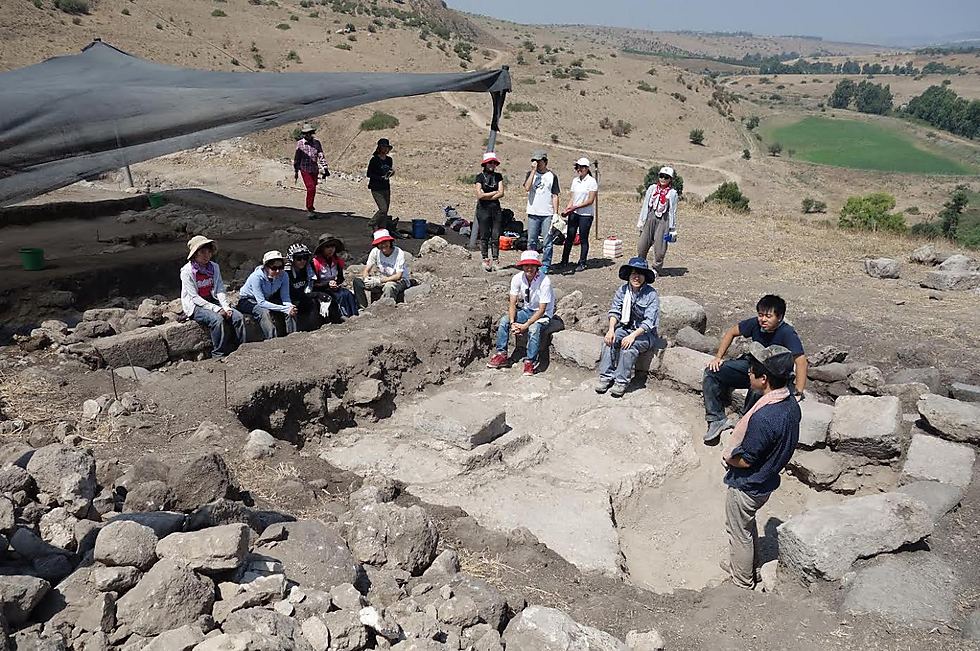
The room measures about nine by nine metres on the outside; press reports of 2016 gave 8.8 by 7.92 metres. Its walls are of fieldstones, and against them ran a single bench, 0.4 metres wide, of neatly cut white limestone ashlars. The entrance, about one metre wide, was on the north. Two bases stood inside the room, probably for wooden posts carrying a flat roof: the western one was a platform of two by two metres cut from the bedrock, with a limestone block of 1.1 by 0.8 metres set into a cut frame, and the eastern one a limestone block half a metre square. The floor was most likely packed soil, with one small patch of soft plaster. A news report of 2016 adds that two large basalt stones along the north wall had come from a Canaanite altar some 1,500 years older. The hall lies on the western fringe of the farmstead, its eastern wall built into the perimeter wall of the complex. The excavators think that the hall and the perimeter wall may have been added in a second building stage.
La vida dentro de la sinagoga
What went on in the room is inferred from its plan. The bench around the walls seated people facing the middle of the floor, where, Aviam said, a reader would have stood; unlike later synagogues, the hall was not laid out to face Jerusalem. The excavators place Tel Rechesh in the small group of halls of the late Second Temple period in the Land of Israel that are identified as synagogues, of which one report of 2016 counted eight. They were cautious in print: the 2019 report is titled 'Assembly Room (Synagogue?)' and proposes that it may have been a private prayer hall belonging to the estate. The room has no independent date; it is dated by the pottery, lamps and coins of the complex as a whole, which the report says was founded in the first century CE, before the fall of Jerusalem. Aviam also pointed out that the site lies in the district where the Gospels place Jesus's preaching in Galilean synagogues, although the New Testament does not mention this settlement. Who led the readings here, and how many people attended, is unknown.
Destrucción
The building was not destroyed in any recorded event. The excavators found no stratified layers and almost no rebuilding in the complex, and concluded that it stood for only a few generations. Three coins were found: one of Tiberias struck under Herod Antipas or Agrippa II, one of Tiberias under Trajan, and one of Tyre dated 120/121 CE. With the pottery they indicate that the farmstead was abandoned in the mid-second century CE, which the excavators connect with the events of the Second Jewish Revolt against Rome, the Bar Kokhba revolt. They note that the battles of that revolt were not fought in the Galilee, though other scholars have suggested that some violence did occur in the north. Aviam told reporters that the family simply left, for reasons that are not clear. No burnt layer and no evidence of fighting is reported, and no pottery of later periods was found, so the hall was not reused. When it was found in 2016 its remains lay only about ten centimetres below the surface of the mound.
El destino de la comunidad
What became of the people of the estate is unknown. The evidence ends in the mid-second century CE: the latest of the three coins is dated 120/121 CE, and the published report records no pottery of later periods at the site. Aviam contrasted Tel Rechesh with Judea, where the Bar Kokhba revolt was mainly fought and which was destroyed; in the Galilee, he said, there were only sporadic incidents, when the Romans suspected families of stockpiling weapons. In his view the estate was probably abandoned because of the revolt without being attacked, and this quiet departure is why its remains survived. Where the family and its workers went, whether any of them were caught up in the revolt, and whether they settled in another Jewish village of the Galilee, no source read for this entry says.
El lugar hoy
Tel Rechesh is an archaeological mound in the Nahal Tavor nature reserve, away from any modern settlement. The remains of the hall, namely the stone bench, the bases of the walls and the two bases for roof posts, were exposed in the 2016 and 2017 excavation seasons. In photographs of 2016 published by the press the bench and the wall behind it stand only a course or two high, low enough for the excavators to sit on; the published report gives no height for the hall's walls, although rooms in another part of the same farmstead are preserved to about two metres. In 2016 the site was closed to visitors and hard to reach, and Aviam hoped it would become a tourist site once the work was finished. Whether the remains have since been conserved, left open or covered again could not be established.
¿Tiene algo que aportar?
Fotografías, documentos, historias familiares o recuerdos de esta sinagoga y su comunidad ayudan a mantener viva su historia.
- A 1st–2nd Century CE Assembly Room (Synagogue?) in a Jewish Estate at Tel Rekhesh, Lower Galilee, Tel Aviv 46/1 (2019), pp. 128–142 (DOI 10.1080/03344355.2019.1587227)
- A 1st–2nd Century CE Assembly Room (Synagogue?) in a Jewish Estate at Tel Rekhesh, Lower Galilee (publication record and abstract)
- Ancient synagogue discovered in the Galilee (14 August 2016)
- Archaeologists in Galilee unearth synagogue from Jesus's time (19 August 2016)
- Second Temple-Era Synagogue Unearthed in Northern Israel (15 August 2016)
- First-Century Synagogue Discovered in Galilean Village (15 August 2016)
- Second Temple-era synagogue unearthed in northern Israel (17 August 2016)
- תל רכש (OpenStreetMap node 10685550023)
Share a memory or thought
No comments yet. Be the first to add one.