
История Ter Apel Synagogue
Ter Apel lies in the south-east of the province of Groningen, close to the German border, in what is now the municipality of Westerwolde. Jews settled in the area from the early nineteenth century, and an organised Jewish community took shape around 1875; it was recognised as an independent congregation in 1885. Services were first held in a rented room on the Boetseweg in nearby Roswinkel. In 1881 Ter Apel became the centre of Jewish life for the surrounding villages, among them Roswinkel, Sellingen and Munnikemoer, and two years later, in 1883, the congregation inaugurated its own synagogue in Ter Apel.
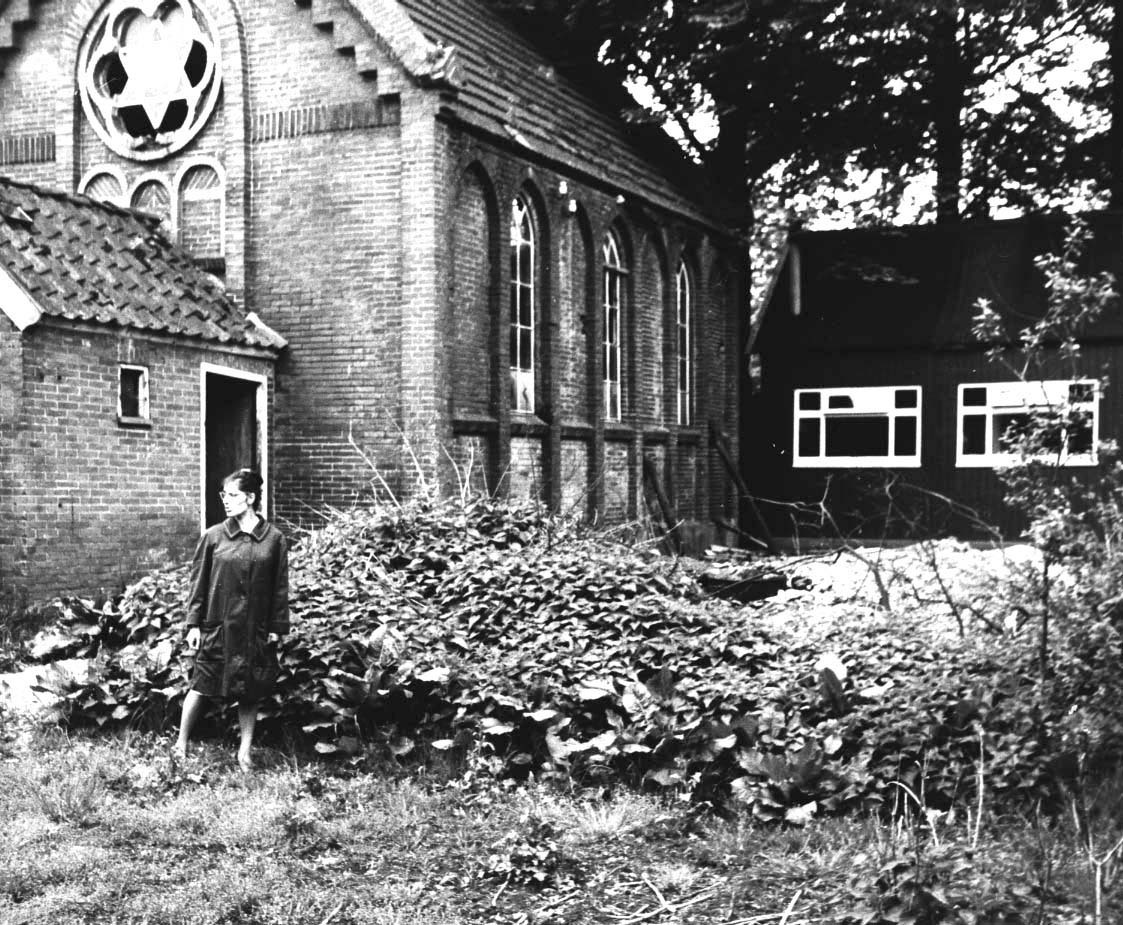
The building stood on the Oosterstraat. A local-history site describes a complex rather than a single hall: a room for religious lessons and other meetings at the front, a separate structure behind the synagogue that housed the ritual bath, and a small house beside it where the rabbi lived. The community was always small, with 71 Jews in Ter Apel and its surroundings in 1911. The synagogue was looted during the war, and in 1948 the much reduced congregation was dissolved and joined to Stadskanaal. In 1949 the building was sold to the municipality of Vlagtwedde. A photograph dated about 1960 shows it still standing, overgrown and disused; it was demolished at some later date.
Where it stood for nearly 80 years
Historic: Oosterstraat, Ter Apel, corner of the Schotslaan (house number unknown). Today: site of the Joods Monument (2004), Oosterstraat at the Schotslaan, 9561 PH Ter Apel, Westerwolde (approximate: memorial position).
Открыть большую карту →Еврейская община
According to the community encyclopedia of the Jewish Cultural Quarter, Jews lived in Ter Apel from the early nineteenth century, but in small numbers: five were counted in 1849. The population grew with the development of the peat colonies in the second half of the century. An organised community existed from about 1875, and a local-history site gives its life span as 1875 to 1942. It became an independent congregation in 1885, after services had for some years been held in a rented room on the Boetseweg in Roswinkel, just across the provincial border in Drenthe. From 1881 Ter Apel was the centre for the Jews of Roswinkel, Sellingen and Munnikemoer. The congregation was run by a board of three members and employed a religious teacher for the children. A burial society was founded in 1902; besides burials it visited the sick and organised lecture evenings. In 1911 Ter Apel and its surroundings counted 71 Jews and in 1924 60. Three Jewish cemeteries served the region: one on the Roswinkelstraatweg in Roswinkel, used until 1886; one at De Maten, used until 1870; and the Ter Apel cemetery, opened in 1886.
Архитектура и дизайн
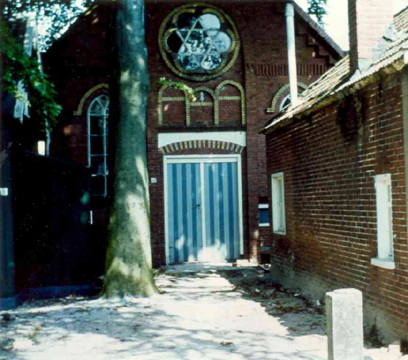
No plans or building records were found, and the architect, builder and seating capacity are unknown. Two photographs show the building. It was a modest rectangular hall of brick under a pitched tiled roof. The entrance gable carried a large round window filled with tracery forming a six-pointed Star of David, set in a moulded brick surround. Below it ran a row of small round-arched blind niches or windows, and below those a pair of panelled double doors under a flat lintel with a brick relieving arch. The gable edges were stepped in the brickwork. Along the side wall tall, narrow round-arched windows with small-paned glazing were set between shallow pilaster strips, and a moulded brick cornice ran under the eaves. A lower brick annex with a tiled roof and its own doorway stood against the gable; the local-history site identifies a room for religious lessons and meetings at the front, a separate building behind the synagogue for the ritual bath, and a small house next to it where the rabbi lived. The style is a plain round-arched brick idiom typical of small Dutch provincial synagogues of the period.
Жизнь в синагоге
Little is recorded about worship in the building. The congregation followed the pattern of the small Dutch provincial communities: a board of three members administered the synagogue, and a religious teacher gave the children their Jewish instruction, probably in the lesson room that the local-history site places at the front of the complex. The same site says that a separate building behind the synagogue held the ritual bath, and that a small house beside it was the home of the rabbi; it names one of them, Van Thijn, and adds that substitute rabbis also served. In a congregation of this size the rabbi was most likely a religious teacher who also led services, but the sources do not give his exact title or dates. The burial society, founded in 1902, also visited the sick and held lecture evenings, which gave the community a social and educational life beyond the services. The synagogue served Jews from Ter Apel and from the surrounding villages of Roswinkel, Sellingen and Munnikemoer, who had no synagogues of their own.
Разрушение
The community encyclopedia of the Jewish Cultural Quarter records that the synagogue was looted during the war; it does not say who carried out the looting, and no other source read names the looters. After the deportations the building stood empty. In 1948 the Jewish community of Ter Apel was formally dissolved and merged with the congregation of Stadskanaal, and in 1949 the synagogue was sold to the municipality of Vlagtwedde, to which Ter Apel then belonged. The encyclopedia says only that it was later demolished. A photograph published with that entry and dated about 1960 shows the building still standing, with its windows intact but the ground in front overgrown with weeds and brambles, so the demolition took place after about 1960. The exact year, the reason, and whether the municipality itself carried out the demolition or sold the building on are not recorded in the sources consulted; the sale to the municipality makes municipal demolition likely, but this is not documented.
Судьба общины
Under the Nazi German occupation the Jews of Ter Apel were registered, stripped of their rights and then deported. The Jewish Cultural Quarter states that nearly all of them were deported and murdered, and that a few survived by going into hiding. The Digital Jewish Monument lists the households living in Ter Apel in February 1941: at Oosterstraat 16, the street of the synagogue, lived Levie Jacobson, his wife Grietje Lea Jacobson-Hartog, Saartje Mathilda Jacobson and Schoontje Jacobson, all of whom died in 1942; at Hoofdstraat 84 lived Lina de Jonge-Katz and four members of the De Jonge family, who also died in 1942. In 1942 the Nazi occupiers also set up a Jewish labour camp at Sellingerbeetse near Sellingen; about 300 Jewish forced labourers were held there in September 1942 and were later deported via Westerbork to the extermination camps. After the war too few Jews remained to sustain a congregation, and in 1948 the community was dissolved and merged with Stadskanaal. A monument names 49 Jews of Ter Apel who were killed.
Место сегодня
The synagogue stood on the Oosterstraat in Ter Apel, at its corner with the Schotslaan, in the part of the village known as 't Schot. Nothing of the building, its lesson room, ritual bath or the rabbi's house is recorded as surviving. In 2004 a monument to the 49 Jews of Ter Apel killed in the Second World War was unveiled at the corner of the Oosterstraat and Schotslaan, where the synagogue had stood. The present use of the plot beyond the monument was not established. The Jewish cemetery of Ter Apel, opened in 1886, survives and is maintained by the municipality.
Значимые имена
Van Thijn (first name unknown)
UnknownRabbi of the Ter Apel congregation, dates unknownA caption on the Oud Ter Apel local-history website, describing a photograph of the synagogue front, says that the small house to the right of the building was where the rabbi lived and names Van Thijn among the rabbis who served the congregation, adding that substitute rabbis also served. No first name, dates or further details were found, and in a congregation of this size he was probably a religious teacher who also led services.
Биография или источник →Вам есть чем поделиться?
Фотографии, документы, семейные истории и воспоминания об этой синагоге и её общине помогают сохранить её историю.
Share a memory or thought
No comments yet. Be the first to add one.