
The story of Terborg Synagogue (Silvoldseweg)
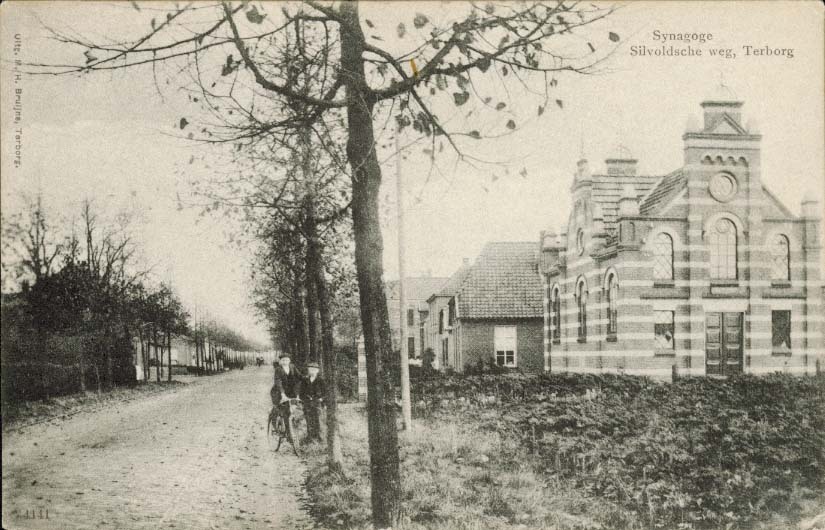
Terborg is a small town on the Oude IJssel in the Gelderland Achterhoek, south-east of Doetinchem, and today part of the municipality of Oude IJsselstreek. Jews may have lived there in the Middle Ages, but the continuous community dates from the early eighteenth century, and by the second half of that century it had become an organised congregation, at first attached to Doetinchem. Its places of worship followed its growth. From 1808 services were held in a private house on the Hoofdstraat; in 1840 the congregation opened a synagogue on the Dorpsstraat; and in 1901, when the Jewish population of Terborg and its surroundings had passed one hundred, it replaced that building with a larger synagogue on the Silvoldseweg, the road leading west out of the town towards Silvolde. The same road already held the community's old cemetery, the Jodenberg, and from 1928 a second cemetery across the street. A postcard of about 1903 shows the new building standing on a tree-lined, unpaved stretch of the road beside a row of small houses. The synagogue served the congregation for about four decades. During the occupation its interior was plundered, and in 1945 it was heavily damaged in a bombing; it was later pulled down. In 2018 descendants of Jews from the Arnhem region inaugurated a replica of it at Mevo Horon in Israel, built from its rediscovered plans.
Where it stood for 44 years
Historic: Silvoldsche weg (Silvoldseweg), Terborg, municipality of Wisch, Gelderland; house number unknown. Today: Silvoldseweg, 7061 Terborg, municipality of Oude IJsselstreek; exact plot unknown (approximate).
Open larger map →The Jewish community
The Jewish population of Terborg and its surroundings was 20 in 1806, 41 in 1809, 51 in 1840, 79 in 1869 and 102 in 1899, its peak, which explains the decision to build a larger synagogue in 1901. By 1930 it had fallen to 66. Terborg became an independent congregation a few years after 1840, having earlier belonged to Doetinchem. It was run by a board of three members and had a study society and a women's association. The Jews of nearby Varsseveld, present from the second half of the eighteenth century, prayed in a room in a private house there around 1800 and had their own cemetery on the Spiekersweg from about 1830. Terborg's own burial ground on the Silvoldseweg, known as the Jodenberg after the drifting sand dune on which it lies, is recorded as 'Judenberg' on a survey of 1723 and is now a national monument; a second cemetery was opened opposite it in 1928. Before the Second World War a member of the congregation sat for several years on the council of the municipality of Wisch, to which Terborg then belonged.
Architecture and design
The only view found is a postcard of about 1903 captioned 'Synagoge Silvoldsche weg, Terborg', published in Terborg. It shows a free-standing brick hall set back behind a low hedge on the right of a tree-lined road. The walls are banded in alternating dark and light courses, a polychrome treatment common in Dutch buildings of the period. The entrance front facing the viewer has a tall central bay ending in a stepped gable crowned by a small aedicule, with a round window high up and a large round-arched window, divided by tracery, above a pair of panelled doors. Slender turrets with small domed caps rise at the corners and at the junction with the roof. The long side wall has a row of tall round-arched windows, and the roof is pitched and tiled. A lower annexe or house with a separate entrance appears at the rear left. The design mixes Romanesque arches with an oriental flavour in the turrets, but the architect, the builder, the seating capacity and the arrangement of the interior are unknown. Plans of the building survived and were later used for a replica in Israel.
Life inside the synagogue
The sources consulted say little directly about worship in the Silvoldseweg synagogue, but they describe the institutions that gathered around it. The congregation had a three-member board responsible for the building and the services, a study society for the learning of religious texts, and a women's association. The synagogue served not only Terborg but the Jews of the surrounding villages, which were counted together with the town in the population figures. The names of the cantors, religious teachers and board members who served here have not been found. The Torah scrolls of the synagogue were sent to Amsterdam for safe keeping before the building was plundered during the occupation, and some of them survived the war. According to a 2018 report, the surviving scrolls were brought to Israel in the 1980s by Frank Levy, a Jew born in Arnhem, and were carried by horse-drawn cart, following a custom of the Jews of the Arnhem region, into the replica synagogue at Mevo Horon when it was dedicated.
Destruction
The building stood empty of its congregation from 1942-1943. During the occupation its interior was plundered; the source does not say by whom. The Torah scrolls had already been taken to Amsterdam and so escaped. In 1945, in the last months of the war in the Achterhoek, the synagogue was heavily damaged in a bombing ('tijdens een bombardement zwaar beschadigd'). Neither the Dutch nor the English text of the community history says who carried out the bombing or gives its exact date; no other account of an air raid on Terborg was found in this research, so the attacker is unknown. The damaged building was not restored. The community history says only that it was later demolished ('later afgebroken'); the year of demolition and who ordered or carried it out are not recorded in the sources consulted. The surviving congregation did not rebuild on the site: in 1959 it opened a community centre in Terborg that also served as its synagogue.
The community’s fate
In September 1941 the Jewish children of Terborg were expelled from the public schools under the Nazi occupation's anti-Jewish measures and had to attend a separate Jewish school in Doetinchem. Most of the Jews of Terborg were arrested and deported by the Nazis in 1942 and 1943 and murdered; the community history does not give a total. Around forty Jews, from Terborg and from elsewhere, survived in hiding in the area. In Varsseveld a few Jews also survived in hiding, while the rest were deported and murdered. After the liberation some survivors returned, and the population of Terborg and surroundings was 31 in 1951 and 18 in 1971. In 1959 the community opened a combined community centre and synagogue and unveiled a memorial to the murdered Jews at the entrance of the new cemetery on the Silvoldseweg. In 1987-1988 Terborg and Doetinchem lost their status as independent congregations, a step that caused serious conflict, and were merged into the NIG-Achterhoek. In 2002 the municipality of Wisch took over the care of the new cemetery.
The site today
The house number of the synagogue on the Silvoldseweg has not been found, so the exact plot and what stands on it today could not be established. The Silvoldseweg still runs west from the centre of Terborg towards Silvolde, and the community's two cemeteries survive on it: the old Jodenberg in the garden of Silvoldseweg 17, a national monument since 2000, and the cemetery of 1928 opposite, where a memorial to the murdered Jews stands at the entrance. No remains of the synagogue are recorded. A replica of the building, built from its plans, was dedicated in 2018 as the Chasdei Enosh synagogue in Mevo Horon, Israel. The map pin marks the eastern section of the Silvoldseweg nearest the town and is approximate.
Do you have something to contribute?
Photographs, documents, family stories or memories of this synagogue and its community help keep its history alive.
- Terborg (Joodse gemeenten)
- Terborg (Jewish communities, English version)
- Voormalige Israëlitische begraafplaats, Terborg (monument 515462)
- Report on the replica of the Terborg synagogue inaugurated at Mevo Horon (June 2018)
- Jewish Memorial Jewish Cemetery Terborg
- Silvoldseweg, Terborg (OpenStreetMap way 6784166)
Share a memory or thought
No comments yet. Be the first to add one.