
Die Geschichte von Synagogue of Theodotus, Jerusalem
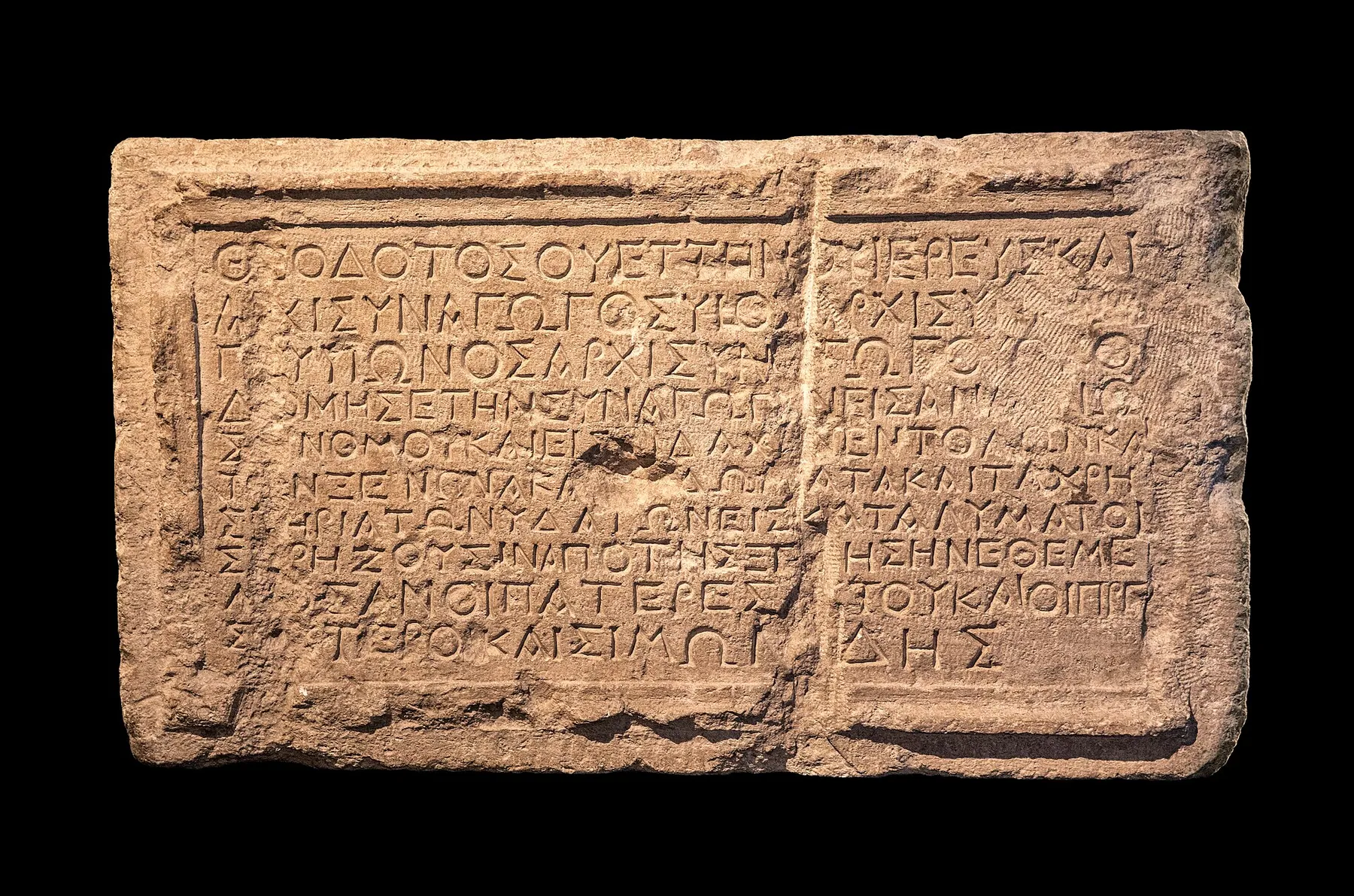
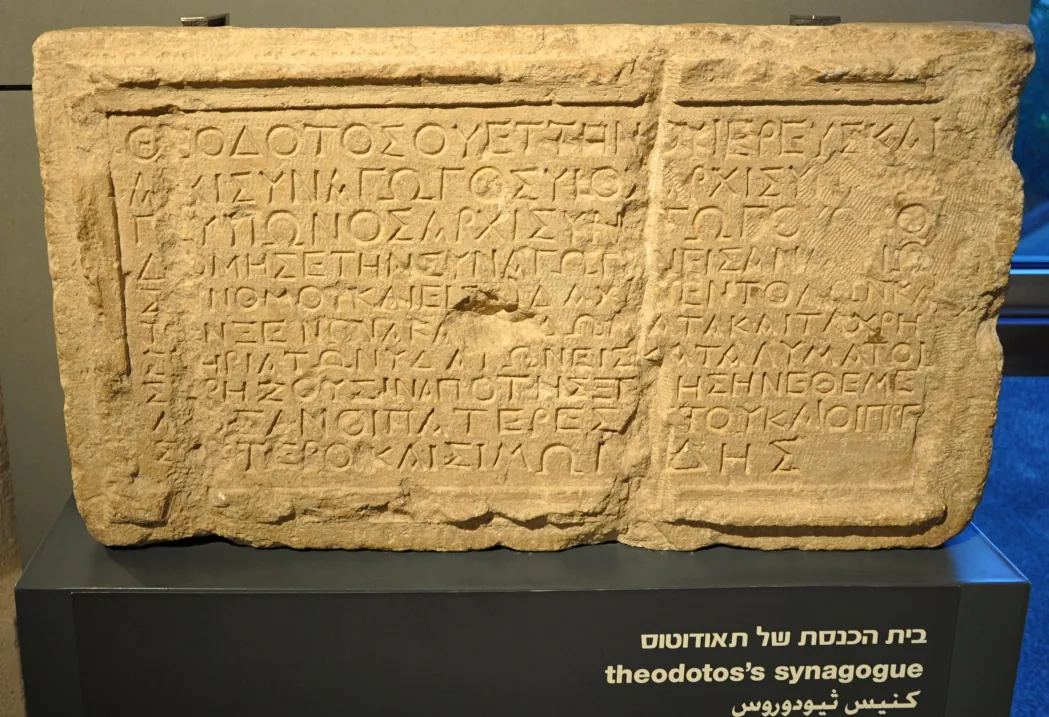
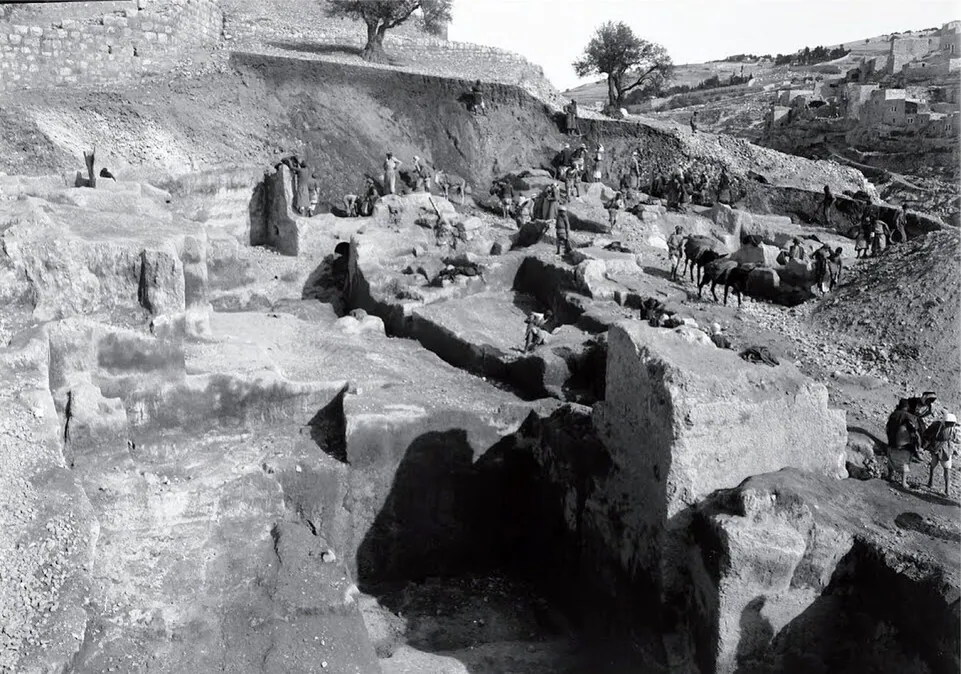
In the winter of 1913-14 the French archaeologist Raymond Weill, sent by Baron Rothschild to dig on the southern part of Jerusalem's south-eastern hill, cleared part of a rock-cut cistern that had been packed with the stones of a demolished building. Among the ashlars, column sections and carved blocks lay a limestone slab, 75 by 41 centimetres, bearing ten lines of Greek. It says that Theodotus son of Vettenus, priest and archisynagogos (head of the synagogue), son and grandson of men who held the same office, built the synagogue for the reading of the Law and the teaching of the commandments, together with a guest-house, rooms and water installations for visitors from abroad, and that his fathers, the elders and Simonides had founded it.
No wall of the synagogue has been securely identified. Weill wrote that later quarrying had left nothing of the buildings standing; what he uncovered around the cistern were rock-cut pools and cisterns, which he took for the bathing installation named in the text. The date rests on the lettering, the find-spot and the history of the hill. Most scholars place the inscription before the Roman destruction of Jerusalem in 70 CE; Howard Clark Kee argued for a date between the second and fourth centuries, and John Kloppenborg answered him in 2000. The end of the building is likewise inferred, not recorded. The stone, Israel Antiquities Authority no. S 842, was long kept in the Rockefeller Museum and is now shown in the Israel Museum.
Where it stood
Historic: cistern C2 at the western edge of Raymond Weill's 1913-14 excavation on the south-eastern hill of Jerusalem (Ophel / City of David; the hill Weill calls Ed Dahoura). Today: southern part of the City of David ridge, Wadi Hilweh, Jerusalem. Approximate.
Größere Karte öffnen →Die jüdische Gemeinde
Nothing is known of this congregation beyond the ten lines of the inscription. It was led by one family: Theodotus was a priest and archisynagogos, and so, the text says, were his father and grandfather, which carries the community back at least two generations before the stone was cut. The synagogue is said to have been founded by his fathers, the elders and Simonides, wording that points to a communal body with elders and not to one man's private foundation. Theodotus has a Greek name, his father's name Vettenus is a Latin family name, and the text is in Greek. Together with the guest-house for those 'from abroad', this has led scholars to suggest a congregation of Jews with roots in the Diaspora, possibly Italy or Rome, who received pilgrims; the inference is uncertain. Weill thought Theodotus was either the client of a Roman Vettenus or the descendant of one who had returned from Rome, and wondered whether this was the 'synagogue of the Freedmen' named in Acts 6:9. That identification remains a conjecture. The size of the congregation and the names of its other members are unknown.
Architektur und Gestaltung
The building has not been found, so its plan, size and appearance are unknown. What survives is the dedication stone and a few architectural pieces from the same cistern fill. Weill described the stone as a limestone slab 0.75 m long, 0.41 m high and 0.20 m thick, with its edges and back left rough, from which he concluded that it had been set into the face of a wall. The front has a plain raised frame around ten lines of incised Greek capitals. With it lay squared ashlars, large rubble, sections of columns, a block whose thick painted plaster kept part of a band of many-coloured flowers, and four blocks carved in sunk relief with rosettes and flower patterns, two of them projecting corner blocks, which Weill assigned to a crowning band on the outside of a building. He supposed the synagogue to have been carefully built, with decorated parts and small colonnades. The inscription adds a guest-house, rooms and 'installations of the waters'. Weill linked the last with the rock-cut cisterns and pools around the find-spot, and later writers note two stepped ritual baths within metres of it. None of this fixes where the hall stood.
Leben in der Synagoge
The inscription states what the synagogue was for: 'the reading of the Law and the teaching of the commandments' (Raymond Weill's rendering of 1920, translated here from his French). If the usual dating is right, it is the only archaeological object that directly attests a synagogue in Jerusalem while the Temple still stood. Communal prayer is not mentioned. Margaret Williams has suggested that in Jerusalem that need was presumably met by the Temple, while other scholars think prayer may have taken place there all the same. The second purpose was hospitality: the guest-house, the rooms and the water installations were, the text says, for lodging those from abroad who needed them, generally understood as Jewish pilgrims and visitors. Whether the water installations were ritual baths, cisterns or washing basins is debated, since the Greek expression is not specific. The head of the synagogue bore the title archisynagogos, and this stone is regarded as the earliest securely datable Jewish use of that title. Nothing else is known of its services, scrolls, furnishings or the people who attended.
Zerstörung
No ancient text mentions this synagogue, and no source records the date or the manner of its end. What is known comes from the ground. Weill found the dedication stone and other pieces of the building stacked in order in cistern C2, not thrown in, and noted that a chisel had already begun to cut the inscribed slab into three before it was put there. He concluded that the synagogue had been taken down deliberately and methodically. He asked whether it lasted until 'the destructions that followed the disaster of 70' or sixty years longer, until the repression of the year 130, and wrote that the mind turns by preference to the events of 70-72. He also thought it very probable that the dismantling itself was the work of the quarrymen who then cut away the whole surface of the hill; Kathleen Kenyon later dated that quarrying to the early second century. Modern writers generally say the complex was destroyed when the Roman army took and razed Jerusalem in 70 CE. That is an inference from the fate of the city and the condition of the find, not a recorded event for this building.
Das Schicksal der Gemeinde
The fate of the people who used this synagogue is not recorded. If the building stood until 70 CE, as most scholars hold, its congregation shared the fate of Jerusalem when the Roman army captured and destroyed the city in that year; Kloppenborg points to Josephus's description of the devastation and to the legionary camp of the Tenth Legion Fretensis that followed. Weill observed that the careful burial of the stones in the cistern implies that some Jewish authority was still present when the building was taken down. He found no trace of houses, floors or mosaics over the abandoned quarries and concluded that no urban settlement returned to this part of the hill in the later Roman period. Kloppenborg likewise argues that the Ophel stayed unoccupied until the Byzantine period, which is one of his reasons for rejecting a date after 70 CE for the inscription. Whether Theodotus or his descendants were alive in 70 CE is unknown, because the stone cannot be dated to a year.
Der Ort heute
The find-spot lies on the southern part of the City of David ridge, south of the Temple Mount, in the area where Weill dug in 1913-14 and again in 1923-24. Weill left the quarried rock surface exposed, with its cut-down rock-hewn chambers, cisterns and pools. He reported that cistern C2 lay at the far western edge of his excavation, half under the embankment of the road along the top of the hill, and that it had not been completely emptied. No building of the synagogue complex stands or has been securely identified there. The inscribed stone is in Jerusalem: long exhibited in the Rockefeller Museum, it is now displayed in the Israel Museum and carries the Israel Antiquities Authority inventory number S 842.
Bedeutende Namen
Theodotus son of Vettenus
1st century BCE or 1st century CE; exact dates unknownPriest and archisynagogos (head of the synagogue); builder of the synagogueTheodotus is named in the dedication as a priest and archisynagogos, the son and grandson of men who held the same office. The stone credits him with building the synagogue for the reading of the Law and the teaching of the commandments, and with the guest-house, rooms and water installations for visitors from abroad. His father's name, Vettenus, is a Latin family name, which has led scholars to suggest that the family came from the Diaspora, possibly Italy or Rome. Nothing is known of him outside this inscription.
Biografie oder Quelle →Simonides
UnknownNamed in the dedication as one of the founders of the synagogueThe last line of the inscription says the synagogue was founded by the fathers of Theodotus, the elders and Simonides. Raymond Weill remarked in 1920 that Simonides must have been known to everyone, since the text gives him no title or description. He understood the founders as those who ordered and paid for the work that Theodotus carried out. Nothing else is known about him, and he appears in no other source.
Biografie oder Quelle →Haben Sie etwas beizutragen?
Fotos, Dokumente, Familiengeschichten oder Erinnerungen an diese Synagoge und ihre Gemeinde halten ihre Geschichte lebendig.
- La Cité de David: compte rendu des fouilles exécutées à Jérusalem, sur le site de la ville primitive, campagne de 1913-1914 (text volume, pp. 99-101, 183-194)
- Theodotos inscription
- Dating Theodotos (CIJ II 1404), Journal of Jewish Studies 51 (2000), pp. 243-280
- The Theodotus Inscription
- Acts 6: Photo Illustrations
- The Theodotos Synagogue Inscription in Jerusalem
- Raymond Weill
- The Transformation of the Synagogue after 70 C.E.: Its Import for Early Christianity, New Testament Studies 36 (1990), pp. 1-24
- City of David (OpenStreetMap way 227363188)
- File:8V2A3067 (47715698331).jpg
- File:Fouilles Raymond Weill Jerusalem.jpg
Share a memory or thought
No comments yet. Be the first to add one.