
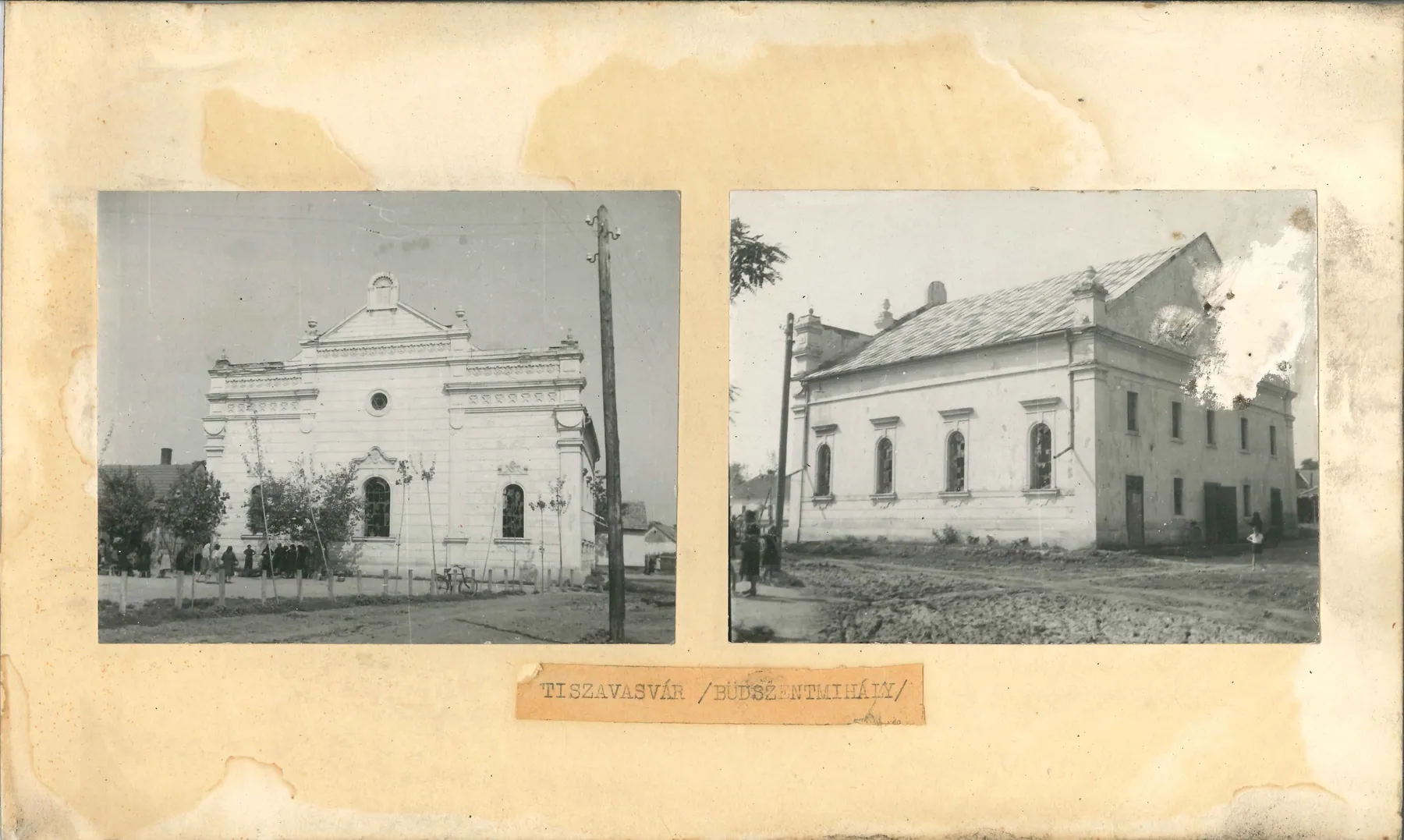
The story of Tiszavasvári (Büdszentmihály) Synagogue
Tiszavasvári in Szabolcs-Szatmár-Bereg county, historically known as Büdszentmihály, had a Jewish community from the late eighteenth century. The community grew mainly from the second half of the nineteenth. In 1840 it was organised as a formal congregation, with a burial society, a women's society and a first synagogue. As numbers rose, from 104 in 1828 to 732 by 1930, the congregation built a new and much larger synagogue, completed in 1903 according to both the European Jewish cemetery survey and Anikó Gazda's gazetteer of Hungarian synagogues.
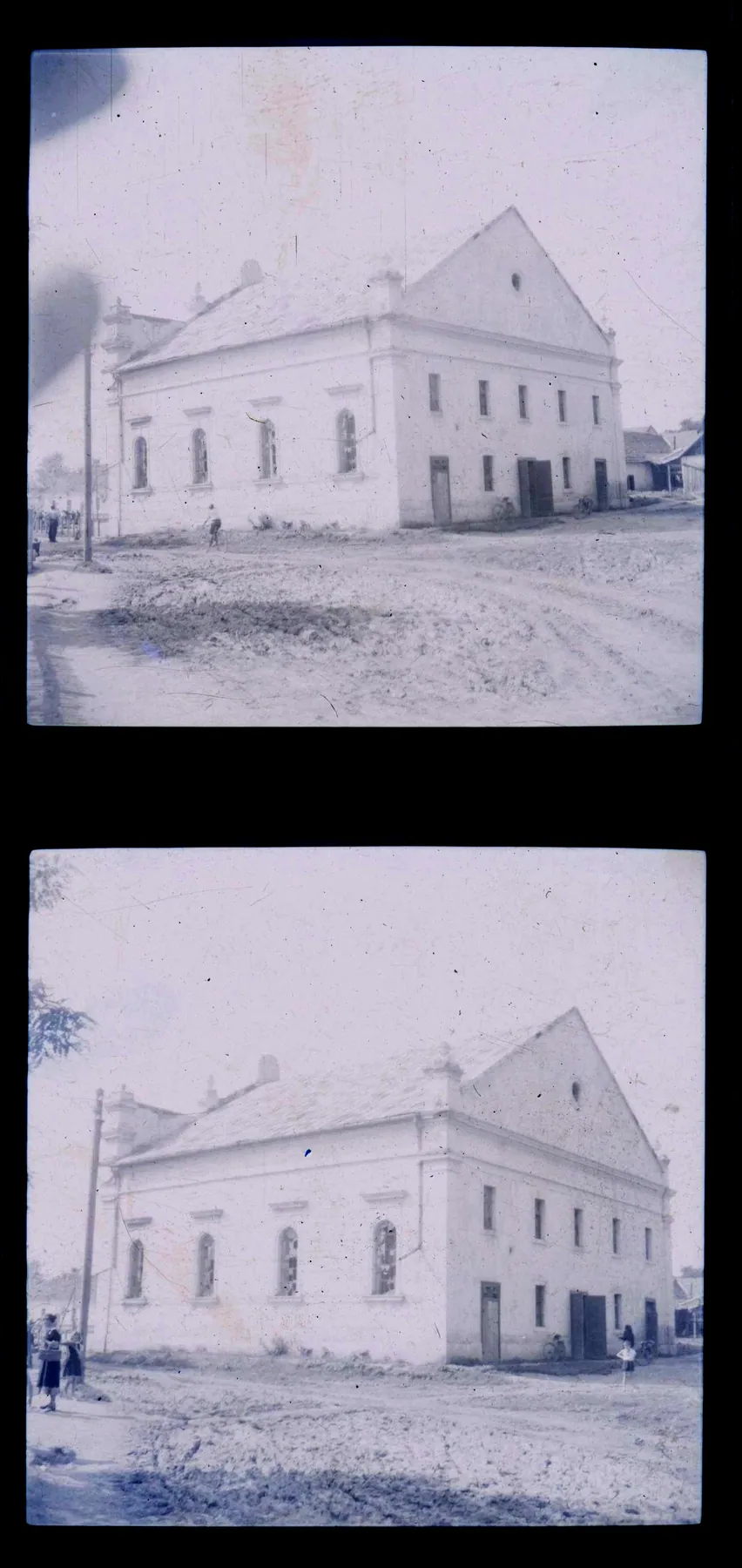
Two groups of photographs in the Hungarian Jewish Museum and Archives show the building: an album page captioned 'Tiszavasvár /Büdszentmihály/' with a front and a side view, and a negative strip dated only 'after 1945'. They show a large rendered hall with an ornamented street front and a plain tiled roof, standing on an unpaved street among low houses. The building outlived the war and, according to the cemetery survey, was demolished by the local authorities afterwards; Gazda recorded it as gone during her survey of 1980 to 1987. Nothing of it is known to survive.
Where it stood for nearly 65 years
Historic: Büdszentmihály, Szabolcs county; street and house number unknown. Today: unknown site in 4440 Tiszavasvári, Szabolcs-Szatmár-Bereg county; placeholder pin at the town centre (approximate).
Open larger map →The Jewish community
Jews are first recorded at Büdszentmihály in the late 1700s, and the European Jewish Cemetery Initiative (ESJF) survey gives 104 Jewish residents in 1828. The community grew considerably from the middle of the nineteenth century. In 1840 it established itself as a formal congregation and founded a Chevra Kadisha burial society, a women's society and its first synagogue. By 1930 it numbered 732 people, a sizeable rural congregation, and the need for the large synagogue of 1903 reflects this growth. The territory of present-day Tiszavasvári contained two Jewish cemeteries; the one surveyed by ESJF served the Jews of Büd. A group photograph of the Jews of Büdszentmihály in a cemetery is also held by the Hungarian Jewish Museum and Archives. The congregation's religious orientation, its rabbis, its lay leaders and the occupations of its members were not found in the sources read for this entry, because the Magyar Zsidó Lexikon of 1929, which usually lists them, could not be consulted.
Architecture and design
The album page in the Hungarian Jewish Museum and Archives shows the synagogue from the front and from the side. The street front was the showpiece: a rendered facade with a raised central section between two lower side wings, all crowned by bands of moulded decoration. The central bay ends in a small pediment topped by a semicircular element, perhaps for the tablets of the Law, and has a round window above a tall arched window framed by an ornamental surround. The side wings each carry a tall arched window and decorative finials at the corners. The side view and the negative show the long body of the hall behind this front: a plain rendered block with two rows of windows, arched below and rectangular above, under a steep tiled roof ending at the rear in a tall bare gable with a small round opening. Doors open in the side wall at ground level. The two rows of windows suggest a women's gallery inside. The style is a late historicist one with Baroque-like ornament on the front only. The architect, builder, capacity and interior are unknown.
Life inside the synagogue
Very little is recorded about worship in the building. The sources read do not name the rabbis who served it, its cantors or shochetim, or whether the congregation was Orthodox, as most in this part of north-eastern Hungary were, or Neolog. The two rows of windows along the side wall suggest that the hall had a women's gallery above the main floor. The front photograph shows a group of people gathered on the pavement before the entrance and saplings planted along the fence, which suggests the building was still in use or being looked after when it was taken, in a period the archive dates only as after 1945. After the war roughly seventy survivors returned, revived the congregation and, according to ESJF, repaired the synagogue; the survey does not say whether this was the 1903 building or an older prayer house. Communal life ended when the last Jews left the town during the Hungarian Revolution of 1956.
Destruction
No source read records damage to the synagogue during the Second World War or in the deportations of 1944, and the photographs dated after 1945 show the building standing with its roof, windows and ornament intact. The European Jewish Cemetery Initiative survey states that the new synagogue completed in 1903 was destroyed by the local authorities after the war. It gives no year. Since the last Jews left Tiszavasvári in 1956, the building may have stood empty for some time before it was pulled down, but that is an inference, not a documented fact. Whether it was first sold by the national Jewish office, as happened with many village synagogues, is unknown, and so is the name of the council body that ordered the demolition. Anikó Gazda, whose team surveyed Hungarian synagogue sites between 1980 and 1987, recorded the building as demolished, so it was gone by then at the latest.
The community’s fate
In 1942 most Jewish men of the town were called up for forced labour service in the Hungarian army. After the Nazi German occupation of Hungary in March 1944, on the day after Passover, the Hungarian authorities forced all the Jews of the town into the school building. A few days later they were taken to the ghetto in Nyíregyháza, where the Jews of the district were concentrated, and from there they were deported to Auschwitz. According to the ESJF survey, 557 Jews of the town were murdered in the Holocaust. After the war about fifty survivors of Auschwitz and twenty men who had survived labour service returned. They revived the congregation for a short time, but the community dwindled, and the last Jews left Tiszavasvári during the Hungarian Revolution of 1956.
The site today
The street and plot on which the synagogue stood were not identified in any source read for this entry, so it is not possible to say what occupies the site today. The photographs show the building on a broad unpaved street among single-storey houses, near a telegraph pole, but name no street. No surviving fragment is recorded. The map pin is a placeholder at the centre of Tiszavasvári and does not mark the synagogue's location. The Jewish cemetery of Büd survives on the far side of the river, reached by way of Déryné Street. Locating the plot will need old cadastral maps or local-history collections in the town.
Do you have something to contribute?
Photographs, documents, family stories or memories of this synagogue and its community help keep its history alive.
Share a memory or thought
No comments yet. Be the first to add one.