


Die Geschichte von Tolcsva Synagogue
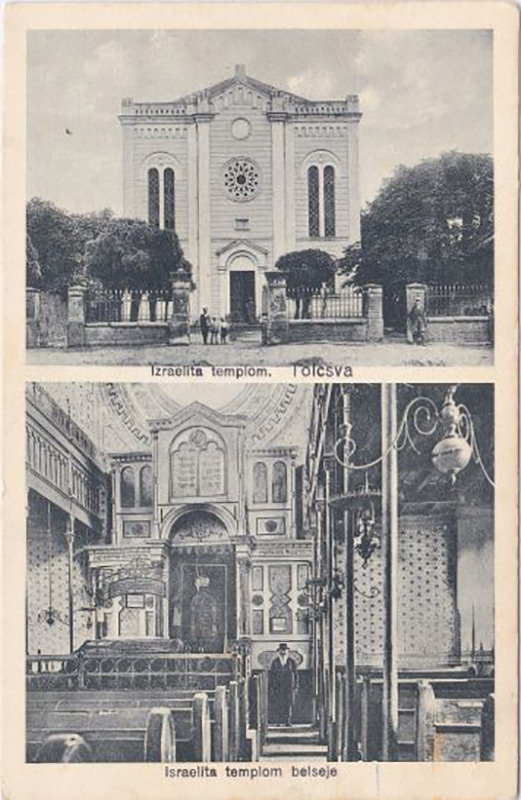
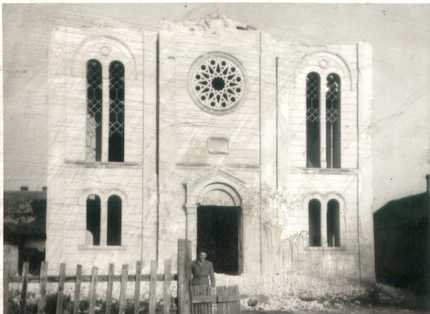
Tolcsva is a wine village in the Tokaj-Hegyalja region of Zemplén, north of Tokaj. Jews settled here in the 1720s, when the estate owners allowed seven families to lease vineyards, and by 1890 the community numbered 929 people. Its synagogue stood on the main square, at what is now Szabadság tér 8. Sources differ slightly on its origins. Pinkas Hakehillot says a synagogue built around 1860 burned in 1864, and that its replacement also caught fire but was restored; the Jewish heritage website of the Zemplén region says the first prayer house burned and the synagogue rose on its ruins in 1865; Anikó Gazda's gazetteer gives 1860. Postcards published in the village show the result: a tall hall with a striped, three-part front, paired round-arched windows, a rose window and a battlemented parapet, and a richly stencilled interior with galleries on both sides.
The congregation was Orthodox and kept a yeshiva under Rabbi Ábrahám Izsák Glück, who served for half a century. In spring 1944 the Hungarian authorities, working with the Nazi German occupiers, crowded nearly 300 Tolcsva Jews into the synagogue and nearby buildings, moved them to the Sátoraljaújhely ghetto and deported them to Auschwitz. About 40 people returned. They found the building standing, re-formed the community and then, as most left for Israel, sold the synagogue. It was pulled down in the mid-twentieth century; photographs in the Hungarian Jewish Museum and Archives show it being dismantled.
Where it stood for nearly 85 years
Historic and present-day address: Szabadság tér 8, 3934 Tolcsva, Borsod-Abaúj-Zemplén county (historically Zemplén county), as given by the Zemplén Jewish heritage website; building gone. Pin is approximate: estimated position of no. 8 on the east side of the square.
Größere Karte öffnen →Die jüdische Gemeinde
The first record of Jews in Tolcsva dates from 1723, when the owners of the estate let seven families settle as lessees of vineyards; Pinkas Hakehillot says they came from Homonna and neighbouring communities. It counts 24 Jews in 1723-24, 43 in 1735, 54 families in 1771, 929 people in 1890 and 363 in 1941, when the village had 2,845 inhabitants. The regional heritage website adds that in 1736 Tolcsva had more Jews than any other place in Zemplén county and that around 1880 nearly a third of the village was Jewish. Most made their living from wine, as growers and merchants; others were craftsmen or professionals. A burial society, the Chevra Kadisha, existed by 1770, and the community later had a charity called Poel Tzedek and a women's association. After the split in Hungarian Jewry it declared itself Orthodox, and smaller settlements nearby came under its supervision. A Jewish elementary school at Kossuth út 37, endowed by Fischl (Ephraim) Rosenvald, who died in 1871, gave free teaching and was known as the Ephraim house. William Fox, founder of the Fox Film Corporation, was born in Tolcsva in 1879.
Architektur und Gestaltung
No architect or builder is named in the sources found, and the seating capacity is unknown. The photographs show a tall, free-standing hall set back from the square behind a fence of stone pillars and iron railings. Its entrance front was divided by pilaster strips into three bays, the middle one rising into a low gable. The walls were finished in horizontal bands, which on the early postcard appear in two alternating tones. Each side bay had a pair of tall round-arched windows under a single arch, above a smaller pair at ground level; the centre held a rose window with star-shaped tracery over a pedimented, round-arched doorway, with a small tablet between them. A frieze of little arches ran under the cornice, and the parapet was battlemented, with small turrets at the corners. Calling this round-arched Romantic is a description of the photographs, not a documented attribution. Inside, galleries on slender posts ran along both long walls, the walls were covered with stencilled patterns, and the ceiling carried a large painted medallion ringed by a Hebrew inscription, with further medallions containing six-pointed stars. The Ark was a two-storey architectural structure crowned by the Tablets of the Law.
Leben in der Synagoge
The congregation followed Orthodox practice. Pinkas Hakehillot records that until 1865 the community ran a six-class school with four teachers; under the influence of the rabbi of nearby Szikszó secular subjects were dropped, the school became a cheder, and a yeshiva was set up beside it. Rabbi Ábrahám Izsák Glück, who led the community from about 1858 until his death in 1909, devoted himself to that yeshiva and wrote the responsa Yad Yitzchak and the work Be'er Yitzchak. He was followed by Sámuel Gottlieb, who left for Pápa in 1925, and by Akiva Kornitzer, the last rabbi. According to the regional heritage website Kornitzer sought contact with the Christian churches, meeting Cardinal Jusztinián Serédi in October 1938, and opposed the Arrow Cross. Between the wars the community also had a cultural centre that staged plays, and Zionist groups were active. The synagogue held twenty Torah scrolls before 1944. One of the two postcards shows a man in a hat standing in the aisle between the pews, below hanging lamps with glass globes. A house with a tiled ritual bath, photographed in 1985, outlasted the community.
Zerstörung
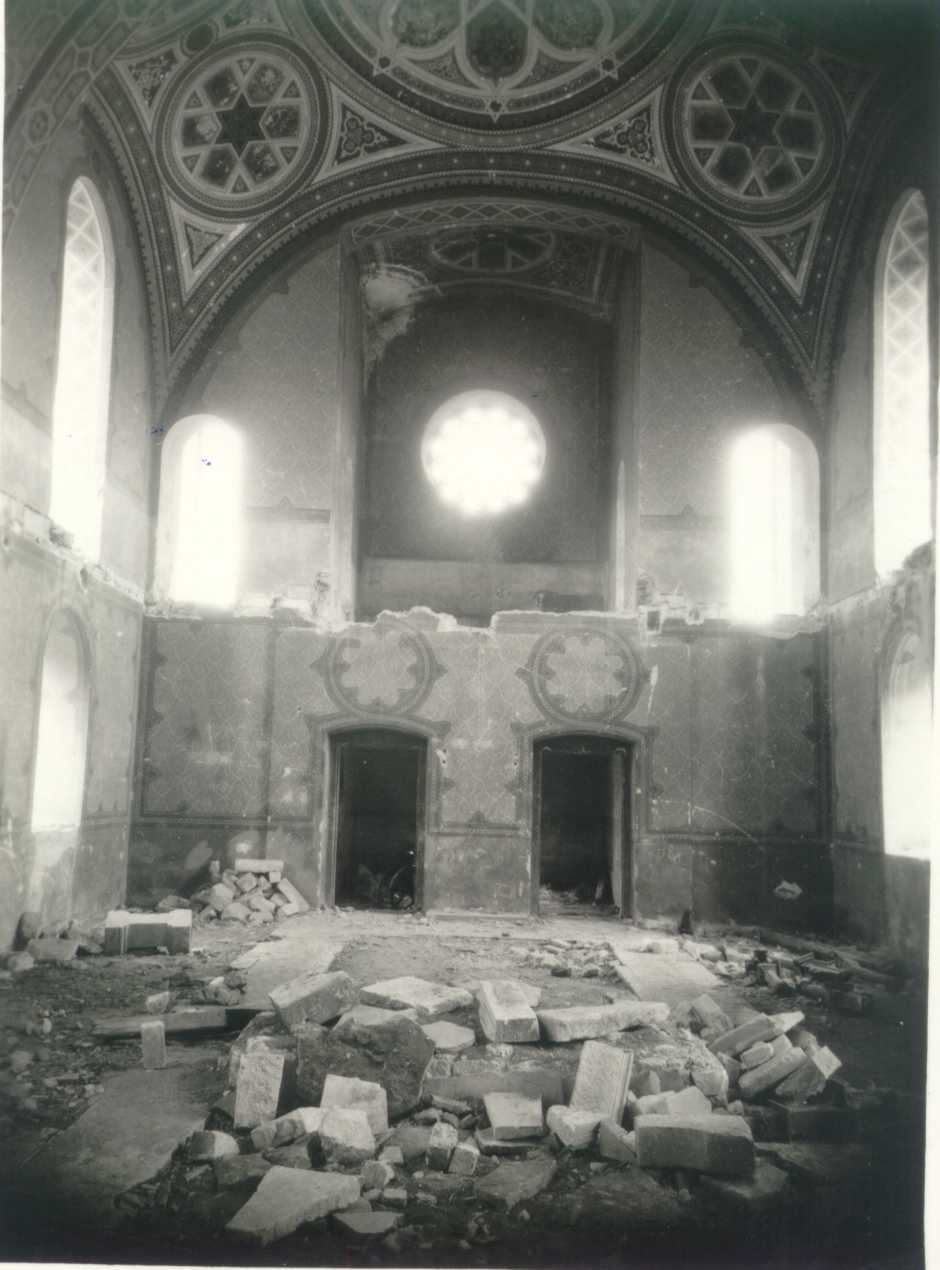
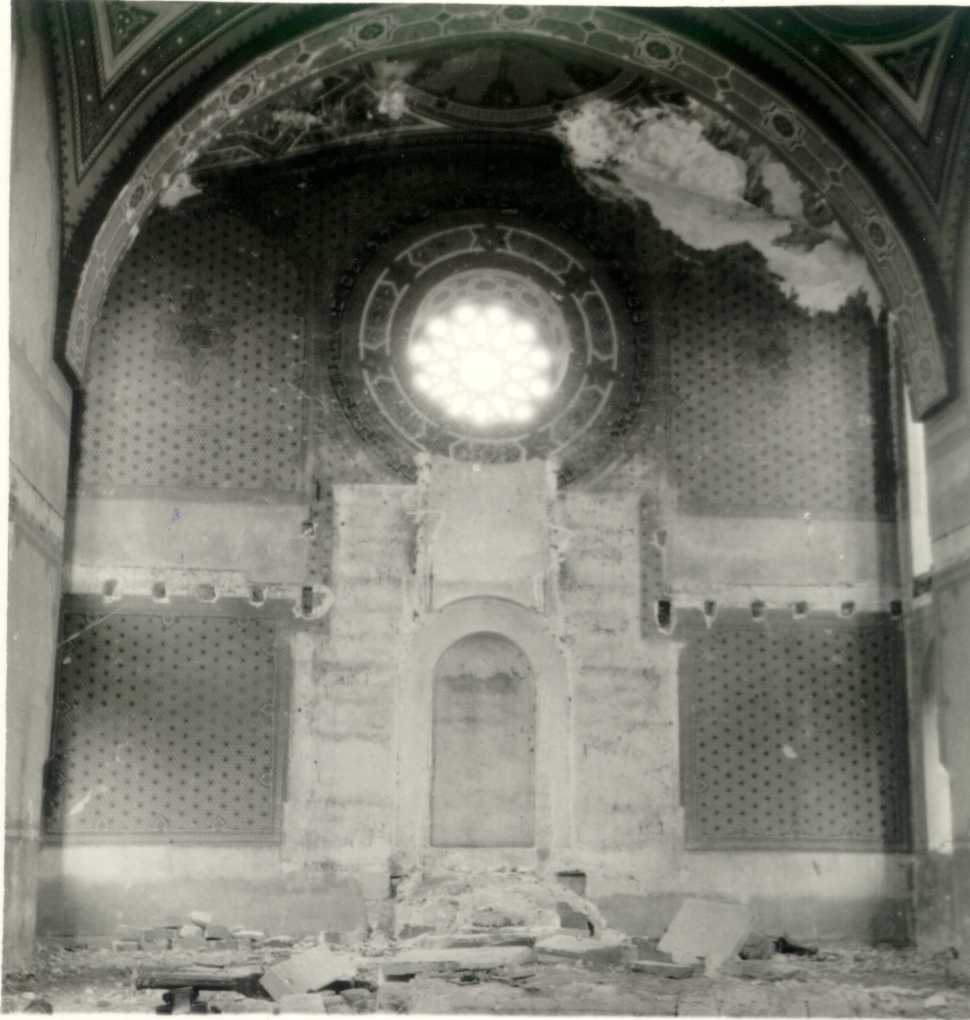
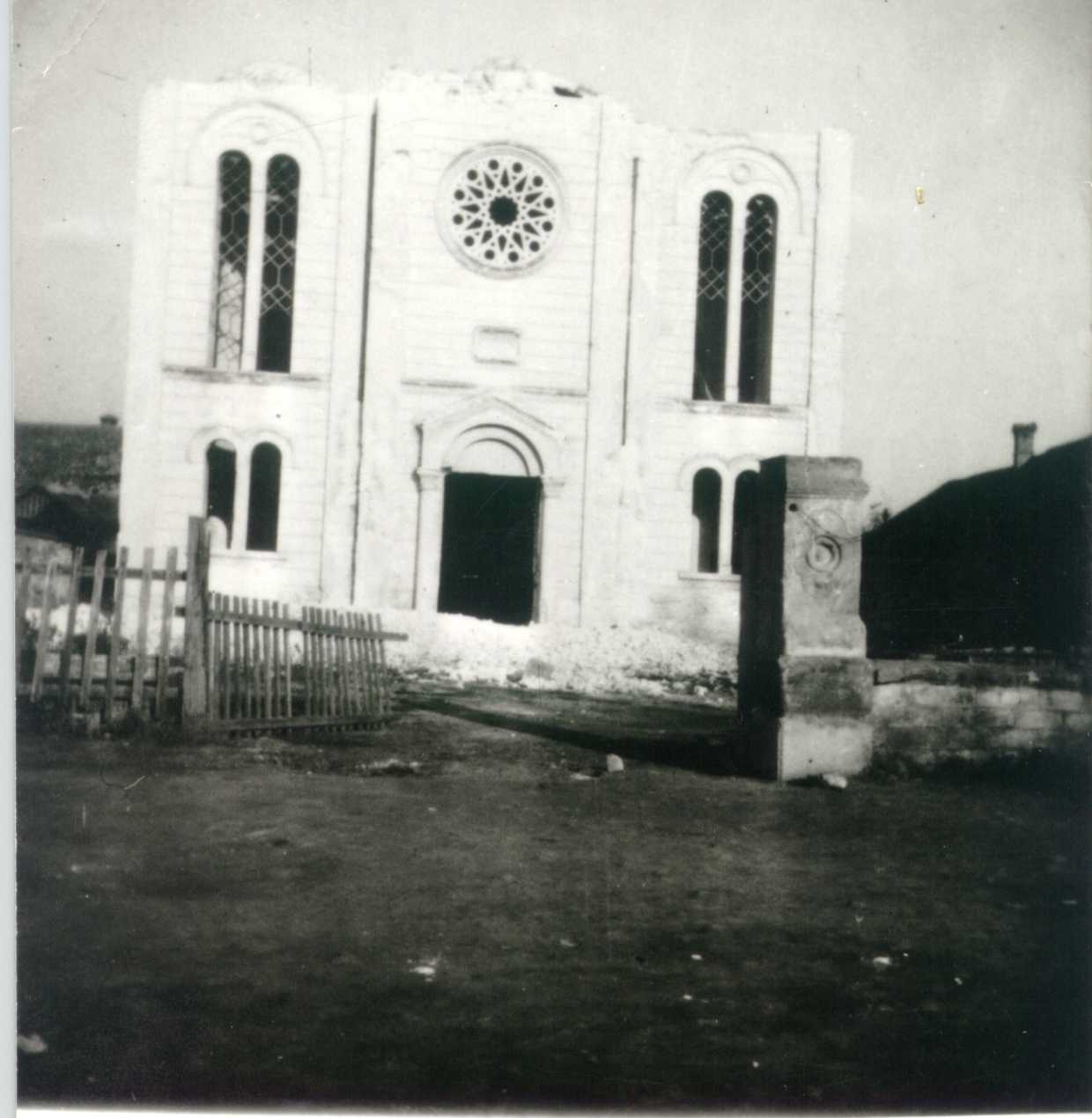
The war itself did not destroy the synagogue. In spring 1944 it was used as a holding place: the regional heritage website says the Hungarian authorities, cooperating with the Nazi Germans, crammed nearly 300 Jews into the synagogue and the buildings around it before taking them to Sátoraljaújhely. Pinkas Hakehillot states that the roughly 40 survivors who came back found the building still in good condition, although none of its twenty Torah scrolls remained. The community was re-established and numbered about 50 in 1949, but most members emigrated to Israel and the synagogue was sold. To whom and when is not stated. The heritage website says only that the building was dismantled in the middle of the twentieth century. Photographs in the Hungarian Jewish Museum and Archives document the process: the gutted interior, with the Ark and galleries torn out and cut stone piled on the floor, and the front with its gable and parapet already taken down and rubble at its foot. The museum dates one of these views to 1945, which conflicts with the Pinkas account. Anikó Gazda recorded the synagogue as demolished in her survey of 1980-87. Who carried out the demolition is unknown.
Das Schicksal der Gemeinde
After the anti-Jewish laws of 1938 the Jews of Tolcsva lost their vineyards, property and, step by step, their businesses; the village's own website records that their associations and school were closed and shop stocks confiscated. In 1941 several families who had no citizenship papers were arrested, deported to Kamenets-Podolsk and shot there. From 1942 the young men were sent to forced labour in Ukraine, where most died. After the Nazi German occupation of Hungary on 19 March 1944 the Hungarian authorities concentrated the Jews of Zemplén county in the Sátoraljaújhely ghetto, where ghettoisation began on 15 and 16 April and 13,000 to 15,000 people were held; about a month later they were deported to Auschwitz. Nearly 300 Jews were taken from Tolcsva. About 40 returned, half from forced labour and half, mainly women, from Auschwitz. The community counted 52 people in 1946 and about 50 in 1949. Emigration, mostly to Israel and again around the 1956 revolution, ended it by the mid-1950s; in 1970 one Jewish family remained. Rabbi Akiva Kornitzer died in the Flossenbürg camp on 22 March 1945.
Der Ort heute
The Jewish heritage website of the Zemplén region gives the synagogue's address as Szabadság tér 8 and notes that the building no longer exists. Szabadság tér is the long central square of Tolcsva, where the village hall (no. 16) and the post office (no. 22) stand today. What now occupies the synagogue plot could not be established from the sources consulted, and no marker on the site is recorded in them. The map pin is an estimate of where no. 8 lies on the east side of the square, worked out from the house numbers mapped in OpenStreetMap; it is not a surveyed footprint. Elsewhere in the village the Jewish cemetery survives, with an ohel sheltering three tombstones, and the former Jewish school at Kossuth út 37 now houses the village primary school.
Bedeutende Namen
Sámuel Gottlieb
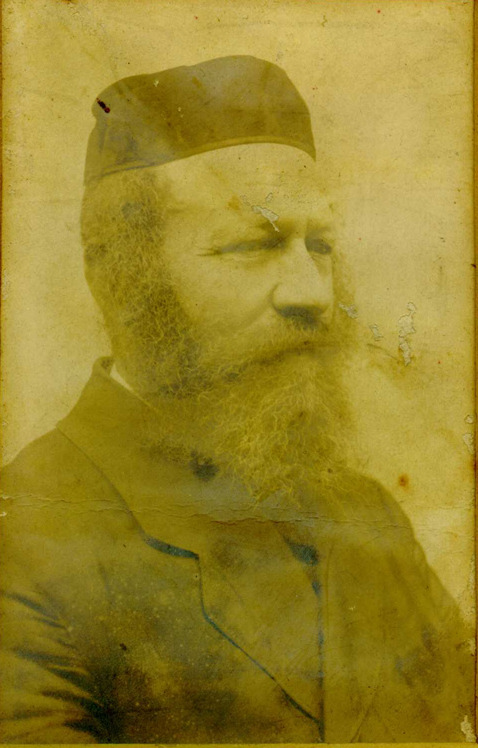
UnknownRabbi of Tolcsva until 1925, afterwards rabbi of PápaGottlieb served as rabbi of the Tolcsva congregation in this synagogue. Pinkas Hakehillot lists him after Rabbi Glück, who died in 1909, and records that he moved to Pápa in 1925; the Hungarian Jewish Museum and Archives holds his photograph under the description 'rabbi of Tolcsva and Pápa'. His dates of birth and death, and the year he came to Tolcsva, were not found.
Biografie oder Quelle →Ábrahám Izsák Glück (Avraham Yitzchak Glück)
1826-1909Chief rabbi of Tolcsva, c. 1858-1909Glück was rabbi of Tolcsva for about fifty years, from 1858 or 1859 until his death in 1909, so he led the congregation through almost the whole life of the rebuilt synagogue. The regional heritage website describes him as modest and devoted, giving himself entirely to the yeshiva he set up and ran in the village. He wrote the responsa Yad Yitzchak and the work Be'er Yitzchak. Pinkas Hakehillot describes him as a well-known scholar.
Biografie oder Quelle →Akiva (Pinchas) Kornitzer
1892-1945Last rabbi of Tolcsva, until 1944Kornitzer was the last rabbi of the Tolcsva congregation; Pinkas Hakehillot dates his service from 1928 to 1944. The regional heritage website says he worked for dialogue with the Christian churches, met Cardinal Jusztinián Serédi in October 1938, and opposed the Arrow Cross movement. He was killed in the Holocaust. KehilaLinks gives his birth as 13 March 1892 and his death as 22 March 1945 in the Flossenbürg camp in Germany.
Biografie oder Quelle →Aharon Grünberg (Grünberger)
1811-1893Rabbi of Tolcsva before 1858, later rabbi of NagymihályGrünberg followed Moshe David Ashkenazi as rabbi of Tolcsva and served the congregation in the years before the synagogue of the 1860s was built. KehilaLinks records that he was later called to the rabbinate of Nagymihály and that he wrote a work titled Da'at Sofer. Rabbi Glück took over the Tolcsva pulpit in 1858.
Biografie oder Quelle →Moshe David Ashkenazi
born 1774First known rabbi of Tolcsva, 1803-1843Ashkenazi is believed to have been the first rabbi of Tolcsva. KehilaLinks gives his birth as 1774 and his years in office as 1803 to 1843, after which he settled in Safed; his works include Toledot Adam and Be'er Sheva. He led the congregation in its earlier prayer house, before the synagogue of the 1860s, and Pinkas Hakehillot lists him first among the community's rabbis.
Biografie oder Quelle →Fischl (Ephraim) Rosenvald
c. 1793-1871Benefactor; founder of the congregation's Beit Ephraim schoolRosenvald endowed the Jewish elementary school of Tolcsva, known as Beit Ephraim or the Ephraim house, which stood at Kossuth út 37 and taught Torah and Hebrew free of charge alongside the synagogue. KehilaLinks records that he died on 4 August 1871 aged 78 and that a plaque with his name remains on the school wall; the heritage website dates the foundation to 1871. The building now houses the village primary school.
Biografie oder Quelle →Haben Sie etwas beizutragen?
Fotos, Dokumente, Familiengeschichten oder Erinnerungen an diese Synagoge und ihre Gemeinde halten ihre Geschichte lebendig.
- Tolcsva (A zempléni zsidóság honlapja)
- Tolcsva (Pinkas Hakehillot Hungary: Encyclopedia of Jewish Communities, Hungary, pp. 308-309)
- Zsinagógák és zsidó községek Magyarországon (county tables)
- Tolcsvai zsinagóga külső és belső képe (F01.386)
- Tolcsvai zsinagóga (F70.443)
- Tolcsvai zsinagóga romos állapotban (F01.387)
- Tolcsvai zsinagóga belső tere romos állapotban (F70.444.1)
- Tolcsvai zsinagóga belső tere romos állapotban (F70.444.2)
- Tolcsvai zsinagóga bontása (F01.409)
- Gottlieb Sámuel fényképe (98.157)
- Tolcsva, Hungary (KehilaLinks home page)
- Tolcsva: Religious (KehilaLinks)
- Tolcsva: Holocaust (KehilaLinks)
- Sátoraljaújhely (A zempléni zsidóság honlapja)
- Tolcsva történelme
- Tolcsva
- List of synagogues in Hungary
- Tolcsva.jpg (synagogue picture linked from the Wikipedia list)
- Szabadság tér 16, Polgármesteri Hivatal, Tolcsva (OpenStreetMap way 895892054)
- Szabadság tér 2, Tolcsva (OpenStreetMap node 11416004655)
Share a memory or thought
No comments yet. Be the first to add one.