
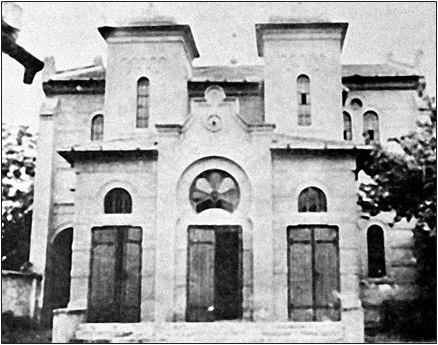
The story of Tolna Synagogue
The synagogue of Tolna, a market town on the Danube a few kilometres north of Szekszárd, was the only purpose-built house of worship of a small Status Quo Ante congregation. The community organised itself formally in January 1861 and prayed for decades in a modest prayer house before it could afford a synagogue. The building belonged to the early twentieth century: the Magyar Zsidó Lexikon of 1929 says it was built in 1914, the memorial database of the Stiftung Denkmal gives 1906, and local writers say only that it dated from the beginning of the century. It stood at the rear of the plot at Deák Ferenc utca 7, behind the congregation's school and ritual bath and a short walk from the main square. The one photograph traced shows a symmetrical façade with two low towers and round-arched openings. The congregation was never large, with 212 members in 1929 and 205 Jews in the town in 1941. In 1944 the Jews of Tolna and the surrounding villages were confined in the town, moved to Paks and deported to Auschwitz-Birkenau. A re-founded community had 38 members in 1949 and faded away under Communism. The synagogue was pulled down in 1959. No architect, builder or seating capacity has been found in the sources consulted, which makes it one of the least documented lost synagogues of Tolna county.
Where it stood for 53 years
Historic: rear of the Jewish community plot (school and ritual bath), Deák Ferenc utca 7, Tolna. Today: Deák Ferenc utca 7, 7130 Tolna, Hungary.
Open larger map →The Jewish community
Jews are recorded as living in Tolna by 1735. According to the Magyar Zsidó Lexikon little is known of the congregation's early history; its first rabbi, Joel Ungár, served in the first half of the nineteenth century but was at the same time rabbi of nearby Paks, so Tolna was not yet an independent community. The first surviving minutes date from 12 January 1861, when the congregation was constituted and Lipót Hofbauer, Mór Stern, József Eisler, Adolf Weisz and Jakab Wieser were elected its first leaders. A burial society (Chevra Kadisha) followed in 1862 and a school in 1870. After the split in Hungarian Jewry the congregation adhered to neither the Neolog nor the Orthodox organisation and remained Status Quo Ante. Services were held for decades in a small prayer house until the synagogue was built. In 1929 the lexicon counted 212 members in 78 families, 68 of them taxpayers, in a town of 8,239 people; most were merchants and craftsmen, and a few ran large farms.
Architecture and design
No plan, description or architect's name has been found, so what follows rests on the single known photograph of the main front. It shows a rendered, symmetrical, two-storey façade reached by a short flight of steps. A slightly projecting centre contains three tall doorways with wooden double doors; above the middle door a large round window with cusped, flower-like tracery sits inside a round arch, and semicircular windows light the bays over the side doors. Above this the centre rises to a low gable with a small circular opening. It is flanked by two square, tower-like corner blocks, each with a narrow round-arched window, a strong projecting cornice and a low pyramidal roof. Further round-arched windows are visible on two levels along the sides, and the rendering appears to be banded to imitate stonework. The vocabulary is the round-arched, Romanesque-derived eclecticism common in provincial Hungarian synagogues around 1900. The interior, the Ark, the seating and the building materials are Unknown. The synagogue stood back from the street at the rear of the community plot.
Life inside the synagogue
The synagogue served a Status Quo Ante congregation, the smallest of the three organised currents of Hungarian Jewry, and shared its plot at Deák Ferenc utca 7 with the community school and the ritual bath. The school, opened in 1870, closed in 1924 for want of pupils and reopened in 1928. In 1929 the Chevra Kadisha, founded in 1862, was headed by Lajos Steiner and the women's association by Mrs Miksa Stern; the congregation's annual budget was 5,800 pengő, with small sums set aside for charity. The Magyar Zsidó Lexikon lists a lay leadership under the president Simon Adler but names no serving rabbi in that year, and no later rabbi or cantor has been identified. Thirty-seven members had served in the First World War and eight were killed. Several members were known beyond the congregation as farmers: Mrs Károly Kunffy ran a 650-hold model farm, Lajos Papp farmed 600 hold and Imre Heisler 400. Details of the consecration and of services in the building are Unknown.
Destruction
No source found reports that the synagogue was damaged or burned during the Second World War, and how it was used during the ghetto weeks of 1944 and immediately afterwards is Unknown. It appears to have outlived the war as the property of a congregation that numbered only 38 people in 1949. The memorial database of the Stiftung Denkmal states that the synagogue was torn down in 1959, during the Communist period. A local inventory of Tolna's buildings compiled by György Freund says that the synagogue at the back of the plot was dismantled in the 1950s by the members of the community themselves, and a local-history blog likewise says it was demolished in the 1950s. None of these accounts mentions an order of the local council or of another Communist authority, a sale, or what became of the materials and furnishings. On present evidence the building was therefore demolished in 1959 under Communist rule, apparently by the depleted congregation that could no longer maintain it; any part played by the Communist authorities is not documented in the sources consulted.
The community’s fate
In 1941 there were 205 Jews in Tolna, about 2.5 per cent of the population. After the Nazi German occupation of Hungary in March 1944, ghettoisation in Tolna county began under a decree of the deputy county head dated 11 May 1944, which named Tolna among the eight places where Jews were to be concentrated. According to the Stiftung Denkmal, the local authorities set up three small ghettos holding about 400 Jews from the town and nearby villages; on 29 June 1944 they were taken to Paks and at the beginning of July deported to Auschwitz-Birkenau. A county overview based on Braham's encyclopaedia says the county's Jews were deported through the Kaposvár entrainment centre and that the 4,790 people deported from Tolna county reached Auschwitz on 9 July, where most were murdered. The round-ups and deportation were carried out by Hungarian authorities and gendarmerie under Nazi German occupation. The exact number of victims from Tolna is not known. A congregation was re-founded in 1947 and had 38 members in 1949; under Communist rule it dissolved and many survivors emigrated.
The site today
The synagogue stood at the rear of the plot at Deák Ferenc utca 7, on the north side of the town's main street, a few doors west of Szentháromság tér. A local inventory of the town's buildings still lists No. 7 as the former Jewish school and ritual bath and notes the vanished synagogue behind it. What occupies the rear of the plot today is Unknown; no trace of the building is reported and no marker is known on the plot itself. A Holocaust memorial was dedicated in 2002 on the main square nearby (sources name either Szentháromság tér or the adjoining Szent István tér). The Jewish cemetery of Tolna survives and is reported to be maintained.
Notable names
Simon Adler
UnknownPresident of the Tolna Jewish congregation (recorded 1929)Simon Adler is named by the Magyar Zsidó Lexikon as president of the Status Quo congregation of Tolna in 1929, when the synagogue had been in use for one or two decades. He headed a lay board that ran the synagogue, the school reopened in 1928 and a budget of 5,800 pengő, at a time when the congregation had no rabbi listed among its officers.
Biography or source →Lajos Steiner
UnknownVice-president of the congregation and head of the Chevra Kadisha (recorded 1929)Lajos Steiner appears in the Magyar Zsidó Lexikon of 1929 both as vice-president of the Tolna congregation and as head of its burial society, the Chevra Kadisha founded in 1862. He was thus one of the two leading lay officers responsible for the synagogue and its institutions in the inter-war years.
Biography or source →Do you have something to contribute?
Photographs, documents, family stories or memories of this synagogue and its community help keep its history alive.
- Tolna (headword), Magyar Zsidó Lexikon
- Memorial to the Jewish Martyrs of the Holocaust, Tolna
- Tolna épületei és műemlékei (in: Tolna – Műemlékeink)
- A zsidó emlékek Tolna megyében. Bevezetés
- Tolna vármegye
- Magyarországi zsinagógák listája
- Tolna (International Jewish Cemetery Project)
- Pinkas Hakehillot Hungary: table of contents (Tolna, p. 307, not translated)
- A népirtás politikája: a holocaust Magyarországon
- OpenStreetMap: Deák Ferenc utca 6, Tolna (node 11350894525) and neighbouring address points
Share a memory or thought
No comments yet. Be the first to add one.