

Die Geschichte von Trenčianske Teplice Synagogue
Trenčianske Teplice, known in Hungarian as Trencsénteplic and in German as Trentschin-Teplitz, lies in a side valley east of Trenčín. Its warm springs made it one of the most important spa towns in Slovakia in the second half of the nineteenth century. Maroš Borský's survey of Slovak synagogue architecture links the growth of the local Jewish community to this boom: the spa created new business and professional openings, and Jewish families settled to take them up.
The community built its synagogue in the centre of the town, beside the spa compound. Borský dates it only to the second half of the nineteenth century; a published list of Slovak synagogues and the caption of a postcard collection give 1866. The same postcard collection records that in 1906 the building was reconstructed and extended by a master builder named Rein from Dubnica. Two early twentieth-century postcards show the result: a tall round-arched street front with a rose window and small domed turrets, and a richly decorated interior focused on the Torah ark.
Borský lists the building among the demolished synagogues of the Trenčín region, stating that it was pulled down after the Second World War. No source consulted gives the exact year or names who demolished it. The congregation's later history, and the exact plot on which the synagogue stood, remain poorly documented.
Where it stood for 79 years
Historic: Trencsénteplic (Trencsén-Teplicz fürdő), town centre next to the spa compound; street and house number unknown. Today: Trenčianske Teplice, Trenčín District; exact site unknown; pin at the gazetteer point in the town centre (approximate).
Größere Karte öffnen →Die jüdische Gemeinde
Little has been published about the Jews of Trenčianske Teplice. The village belonged to the Trenčín estate, which passed from the Illésházy family to the Sina family in 1835; according to the municipal history, the new owner built part of the spa. The village was still small then, with 545 inhabitants in 1828. Borský writes that the town grew rapidly in the second half of the nineteenth century as it became one of the leading spa centres in Slovakia, and that the Jewish community grew with it because the spa industry created new business and professional opportunities. Its size, its religious affiliation (Orthodox, Neolog or status quo) and the names of its rabbis and officers were not found in any source read. The community kept a cemetery on a hillside in the town, where the JewishGen Cemetery Discovery Project records up to twenty marble and sandstone gravestones of the nineteenth and twentieth centuries with Hebrew inscriptions. The Pinkas Hakehillot volume on Slovakia has an entry for the town, but it is not available in translation online.
Architektur und Gestaltung
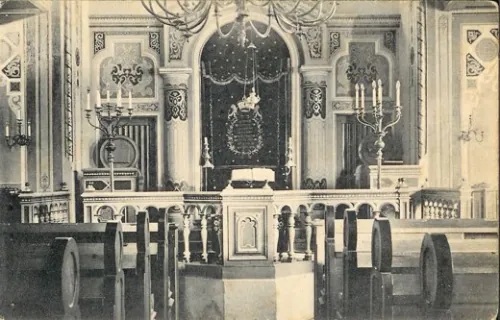
Borský describes the synagogue as a building of mundane appearance: a tripartite front with a higher central section, decorated with the usual repertoire of the Rundbogenstil, the round-arched style common in Central European synagogues of the period. A postcard captioned 'Izr. templom - Isr. Tempel, Trencsén-Teplicz fürdő' shows the building from a corner after its 1906 enlargement. The front has a tall central bay with a large round window above a round-arched entrance, framed by narrower side bays that end in small turrets with domed caps. The long side wall, two storeys high, is divided by cornices and pierced by rows of round-arched windows, which suggests a women's gallery inside. A low fence with gates and lamp posts closes off the forecourt from an unpaved street. A second postcard shows the interior looking towards the Torah ark. The ark stands in a tall round-arched niche hung with a curtain, framed by columns and painted ornament, with a crown and tablets above it. In front of it are a balustraded platform, two large candelabra and a chandelier, and rows of wooden pews. The architect of the original building is unknown.
Leben in der Synagoge
No account of services, rabbis or communal life in the synagogue was found. The interior postcard shows a congregation that could afford rich decoration: painted ornament on the walls and ark surround, a draped ark under a crown, brass candelabra and a hanging chandelier, and fixed wooden pews facing the ark. The rows of windows on the side wall suggest that women sat in a gallery above the main hall. The postcard of the exterior is labelled in Hungarian and German and was sold as a view of the spa, which shows that the synagogue was counted among the sights of the resort. The 1906 reconstruction and extension by the Dubnica master builder Rein indicates that the congregation was still growing, or at least prosperous, in the early twentieth century. Its religious orientation, its rabbis and cantors, and the number of seats are unknown.
Zerstörung
No source read describes damage to the building during the Second World War, and none says what became of it immediately after the deportations of its congregation. Borský's catalogue of demolished synagogues states that the synagogue of Trenčianske Teplice was demolished after World War II, and the Slovak heritage gazetteer Pamiatky na Slovensku, citing Borský, repeats this. The postcard collection on judaica.cz likewise gives 'demolished after 1945'. A published list of Slovak synagogues gives the year 1950, but that figure is unreferenced and may be a round placeholder. Taken together, the sources show that the building survived the war and was pulled down some time afterwards, but no document of the demolition was found. Who demolished it, in what year and for what purpose is not recorded in any source consulted.
Das Schicksal der Gemeinde
No record specific to the Jews of Trenčianske Teplice during the Holocaust was found. They shared the fate of the Jews of the wartime Slovak State, whose Ľudák regime carried its anti-Jewish policy to the mass deportations of 1942. According to the historian Ján Hlavinka, about 57,700 Jews were deported from Slovakia between 25 March and 20 October 1942: about 39,000 to the Lublin district of occupied Poland, where the Nazi German extermination programme known as Operation Reinhard had begun, and about 18,700 to Auschwitz. The Jewish Virtual Library records about 2,500 Jews in Trenčín and its surroundings on the eve of the deportations and states that most of them perished in the Nazi extermination camps in Poland; by 1947 only 228 Jews lived in Trenčín itself. How many Jews lived in Trenčianske Teplice in 1942, how many were deported or survived, and whether any returned to the town after the war is unknown. No organised community is recorded there after 1945.
Der Ort heute
The exact plot of the synagogue has not been identified. Borský places it in the centre of the town next to the spa compound, but no street name or house number was found, and the postcard shows only an unpaved street with a fenced forecourt. What stands on the site today is therefore unknown. The map pin for this entry follows the point given by the Pamiatky na Slovensku gazetteer, which lies in the town centre, and should be read as approximate. The Jewish cemetery survives on a hillside in the town; the JewishGen survey describes it as enclosed by a masonry wall with an unlocked gate and holding up to twenty gravestones with Hebrew inscriptions. Locating the synagogue would require old cadastral maps or the archive of the Trenčianske Teplice spa.
Bedeutende Namen
Rein
UnknownMaster builder from Dubnica; reconstructed and extended the synagogue in 1906A master builder named Rein from Dubnica, a town in the Váh valley north of Trenčín, is recorded in the caption of the judaica.cz postcard collection as the man who reconstructed and extended the Trenčianske Teplice synagogue in 1906. The tall front with its rose window and domed corner turrets seen on the surviving postcard probably dates from this work. His first name, his dates and the source of the information are not given.
Biografie oder Quelle →Haben Sie etwas beizutragen?
Fotos, Dokumente, Familiengeschichten oder Erinnerungen an diese Synagoge und ihre Gemeinde halten ihre Geschichte lebendig.
- Synagogue Architecture in Slovakia: Towards Creating a Memorial Landscape of Lost Community (PhD dissertation, 2005), catalogue entry Trenčianske Teplice S0L1601, pp. 189-190
- Trenčianske Teplice - synagóga
- List of synagogues in Slovakia
- Slovakia synagogues part 3 (Jewish postcards gallery, items 1377 and 1373)
- Trenčianske Teplice (Cemetery Discovery Project)
- Trenčianske Teplice - história
- Deportácie židovského obyvateľstva zo Slovenska v roku 1942: organizácia, priebeh, dôsledky (Slovenský národopis 70/1, 2022, pp. 31-47)
- Trencin
- Trenčianske Teplice (OpenStreetMap relation 1791766)
Share a memory or thought
No comments yet. Be the first to add one.