
La historia de Ashkenazi Synagogue of Tuzla (the 'Templ')
Tuzla, the salt-mining town of north-eastern Bosnia, grew quickly after the Austro-Hungarian occupation of 1878, and with it a Jewish population that was unusual in Bosnia in being mostly Ashkenazi. Incomers from Central Europe outnumbered the small Sephardic group already there, and in 1885 they founded their own congregation. Tuzla thus had two Jewish communities, each with its own house of prayer, but one shared cemetery.
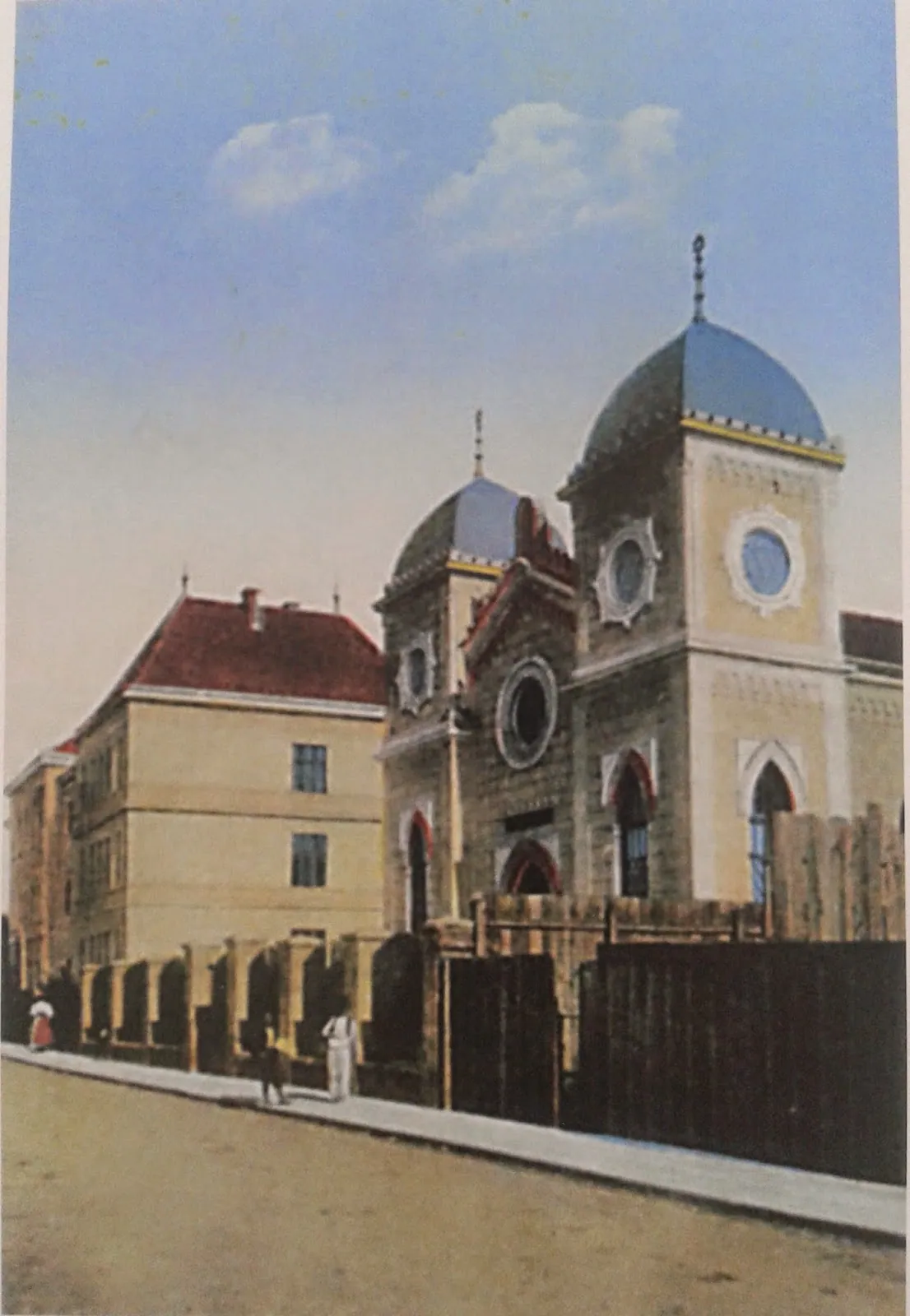
The Ashkenazi synagogue was built in what is now Klosterska ulica, at number 12, between the convent school known locally as the Kloster and the Turalibeg mosque. Tuzla people called it the Templ, from the German Tempel. Its building date is given variously: Croatian Wikipedia says work began in 1901 and ended in 1904, the same encyclopaedia's Tuzla article gives both 1902 and 1906, Samuel Gruber's 2011 survey says 1902, and a Sarajevo Jewish chronology and the 2019 Baština article give 1906. Old photographs show an ornate twin-towered building with blue domes.
The synagogue did not survive the Second World War. Local accounts describe a mob attacking, burning and razing it in October 1941; Croatian Wikipedia instead says the Nazis burned it in 1942; Gruber gives demolition in 1955. A soup kitchen, the Narodna kuhinja Imaret, now stands on the site.
Where it stood for 39 years
Historic: Klosterska ulica 12, Donja Tuzla, between the Kloster and the Turalibeg mosque. Today: Klosterska 12, 75000 Tuzla (site of the Narodna kuhinja Imaret); approximate.
Abrir mapa ampliado →La comunidad judía
In 1879, a year after the Austro-Hungarian occupation, Tuzla had 17 Jews, all Sephardim, with their own congregation and prayer house. Ashkenazi Jews from elsewhere in the monarchy then arrived in such numbers that by 1885 they had their own congregation, and the census figures quoted by Kovačević and Žiško rise to 134 Jews in 1885, 360 in 1895, 470 in 1921, 330 in 1931 and 321 in 1941. During the First World War the Ashkenazi congregation had 400 members and the Sephardic one 120. The Croatian Wikipedia history of Tuzla credits Jewish entrepreneurs with modern salt works, a spirits refinery, coal mines, pharmacies, sawmills, bookshops and hotels; the timber merchant Moritz Lisska employed 593 workers in 1911 and sat on the town council from 1900, as later did the lawyer Maks Laufer. The community supported a youth society, a charity, a gymnastics club, a reading room, the football club Makabi and a Jewish bank. Which of these men belonged to the Ashkenazi congregation is not stated.
Arquitectura y diseño
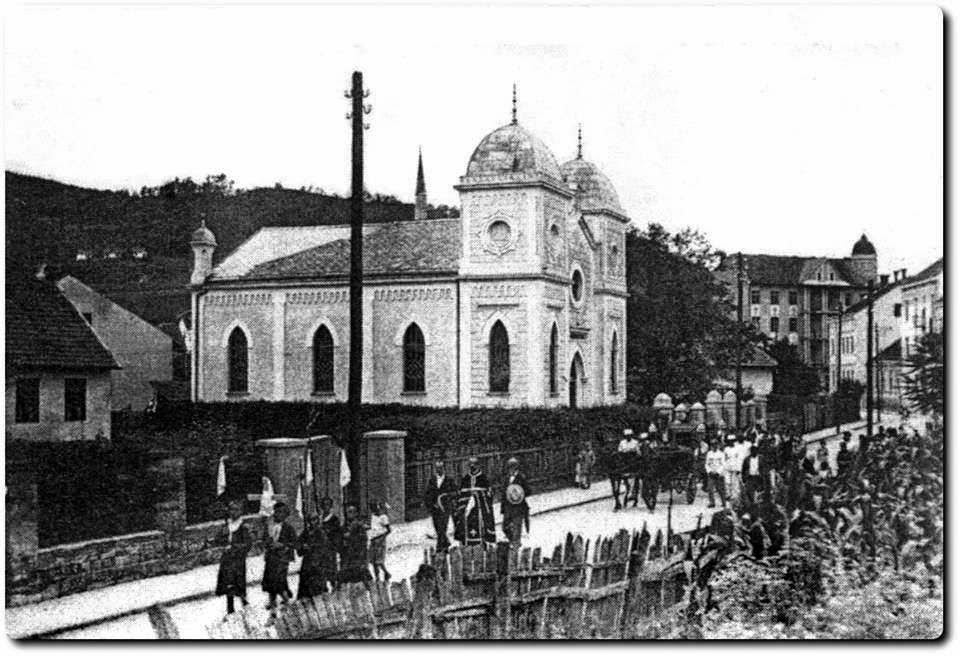
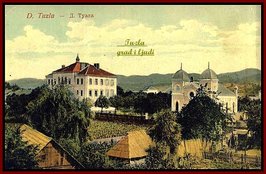
No plans, description or architect's name were found; what is known comes from three old views. A coloured street view, reproduced in the 2019 Baština article from a monograph on Tuzla and on Ivana Jurić's blog, shows the entrance front: two towers of unequal height flanking a central gable, each crowned by a ribbed blue dome with a finial, the taller tower on the right. The front is articulated in two colours, with pointed horseshoe-shaped door and window openings, a large round rose window in the central gable and smaller round windows in the towers. A black-and-white photograph taken from the side shows a long, rendered hall with tall pointed windows behind the domed front, set back from the street behind a fence of masonry piers. A postcard of Donja Tuzla shows the two domes beside the three-storey Kloster. The Moorish Revival label is drawn from these photographs; no source names the style. Capacity and the interior arrangement are unknown, and no interior view was found.
La vida dentro de la sinagoga
Very little is recorded about worship in the Templ. The congregation that built it was Ashkenazi and was organised separately from the Sephardic community, which kept its own synagogue and rabbinate in Jevrejska (Židovska) ulica; the two communities shared only the cemetery founded in 1900. Ivana Jurić's local-history blog says that, besides the synagogue, the community used a smaller hall on the ground floor of the 'Ferajna' (from the German Verein, association) for weddings. The many Jewish societies of interwar Tuzla, from the reading room to the gymnastics club and the Makabi football club, show a confident, largely German-speaking middle-class community, of which the Templ with its domes beside the convent school was the most visible landmark. The names of the rabbis, cantors and presidents of the Ashkenazi congregation have not been found in any source read for this entry, and nothing is known of the order of service, the language of sermons or whether the congregation leaned towards the Neolog or Orthodox rite.
Destrucción
German troops entered Tuzla on 15 April 1941 and the town became part of the Ustaše-ruled Independent State of Croatia. The accounts of the synagogue's end disagree. The Croatian Wikipedia article on Tuzla, citing a local-history Facebook page, says that after the Nazi propaganda film Jud Süß was shown in Tuzla in October 1941, a group of about 80 townspeople, inflamed by chauvinist passion, attacked the synagogue, wrecked it, set it on fire and then razed it to the foundations. Ivana Jurić's blog gives the same sequence, wrecked, burned and razed, as Tuzla's belated Kristallnacht, without naming the attackers, and the Sarajevo Jewish chronology on elmundosefarad says the synagogue was destroyed in 1941. The Croatian Wikipedia article on the synagogue itself instead says that the Nazis set it on fire in 1942 and pulled it down afterwards. Samuel Gruber's 2011 survey for the US Commission for the Preservation of America's Heritage Abroad says only that it was demolished in 1955, which may refer to the clearing of the ruin. No document naming those responsible was read.
El destino de la comunidad
According to Marina Rajner, president of the Jewish community of Tuzla, quoted by Radio Free Europe in 2013, 273 Jews were taken from Tuzla railway station, where the Suza monument now stands, to the Ustaše camps of Jasenovac and Stara Gradiška, and never returned. The same report gives 347 Jews in Tuzla before the war and 19 in the 1949 census. Ivana Jurić's blog puts the transport at about 300 people in the year after the synagogue was attacked, of whom about twenty came back. Kovačević and Žiško write that most of Tuzla's Jews were taken away and killed in the camps and that the few survivors joined the Partisans. Some lives were saved: the prosecutor Ratimir Deletis, recognised as Righteous Among the Nations, and the physician Mustafa Mujbegović, who invented an epidemic of endemic syphilis to bring Jewish doctors and their families from Zagreb to Tuzla, are credited with rescuing many. A united Jewish community survives in Tuzla with about 130 members, but it has no synagogue.
El lugar hoy
Croatian Wikipedia says that part of the synagogue plot was nationalised after the war and that an express restaurant was built on the site, followed by the public soup kitchen Narodna kuhinja Imaret, which Ivana Jurić photographed there in 2015. She noted that nothing on the site marked the synagogue at that time. The address is Klosterska ulica 12, in the Goli brijeg neighbourhood of central Tuzla; the Kloster, the convent school of the Queen of the Holy Rosary, and the Turalibeg mosque still frame the plot. The Sephardic synagogue building in Jevrejska ulica survives in other use, and the shared Jewish cemetery on the hillside above Slana Banja remains.
¿Tiene algo que aportar?
Fotografías, documentos, historias familiares o recuerdos de esta sinagoga y su comunidad ayudan a mantener viva su historia.
- Aškenaška sinagoga u Tuzli
- Tuzla (history: Austria-Hungary and Second World War)
- Jewish Heritage Sites of Bosnia-Herzegovina (Tuzla, p. 9)
- Jevrejsko groblje u Tuzli (Baština sjeveroistočne Bosne 11, pp. 329-348)
- Jevrejska sinagoga u Tuzli
- Dan sjećanja na žrtve holokausta obilježen u Tuzli
- Sarajevski pinkas (chronology)
- Datoteka:Donja Tuzla - Zavod Kraljice sv. Krunice i sinagoga.jpg
- Klosterska 12, Tuzla (OpenStreetMap way 407763757)
Share a memory or thought
No comments yet. Be the first to add one.