
Die Geschichte von Uithoorn Synagogue (1900)
Uithoorn lies on the river Amstel south of Amsterdam, on the border between the provinces of Noord-Holland and Utrecht. Jews settled here in the late eighteenth century, when the area still formed the single municipality of Thamen; after it was split in 1818 into Uithoorn and Mijdrecht, the Jews of both places stayed closely tied to one congregation. Their first synagogue was a former Mennonite church bought in 1803 by five Amsterdam Jews and given to the community, which reopened it as a synagogue in 1805.
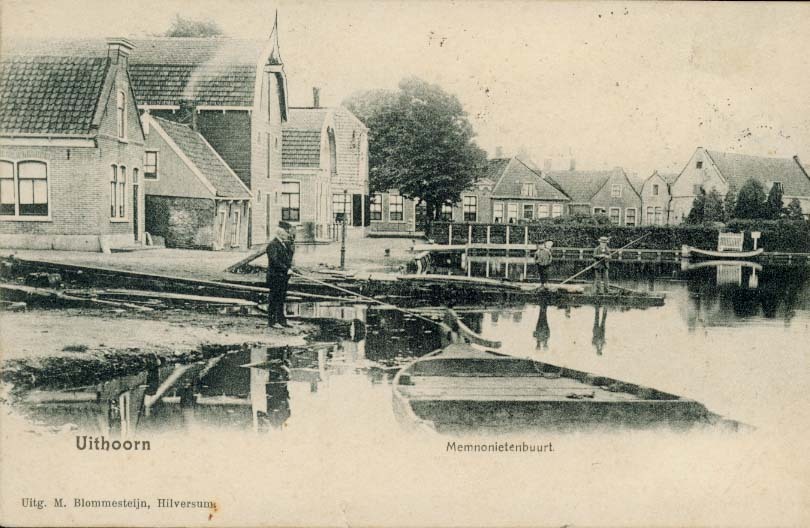
By about 1900 that building was in such poor condition that it was demolished and replaced by a new one, the subject of this entry. The congregation that used it was small and shrinking: 48 Jews were counted in 1899 and only 29 in 1930. The new synagogue in its turn decayed during the 1930s, was no longer used from 1938, and its furnishings were sold in 1939. Its only known image is a postcard of about 1904 of the Mennonietenbuurt, a waterside street named after the Mennonites, in which the synagogue stands at the far right.
Where it stood for nearly 45 years
Historic: Mennonietenbuurt, Uithoorn/Thamen (house number unknown), per a c. 1904 postcard. Today: Mennonietenbuurt, 1427 Amstelhoek, De Ronde Venen, Utrecht; exact plot unknown (approximate).
Größere Karte öffnen →Die jüdische Gemeinde
Jews settled in Thamen, on the border of Noord-Holland and Utrecht, in the late eighteenth century. Most earned a living as butchers and pedlars. In 1809 the Jews of Uithoorn and its surroundings numbered 96, and in 1840 still 99, but numbers then fell steadily as families moved to the cities: 49 in 1869, 48 in 1899 and 29 in 1930. When Thamen was divided in 1818, separate Jewish communities formed in Uithoorn and Mijdrecht. Uithoorn became an independent ring synagogue (Ringsynagoge) in 1821, while Mijdrecht at first belonged to the ring of Maarssen, was independent from 1835 to 1906, and remained closely linked to Uithoorn throughout. The congregation was run by a board (kerkbestuur) and had its own poor-relief board. Two societies cared for the upkeep of the synagogue and for burials. The community never had a cemetery of its own and buried its dead at Alphen aan den Rijn. One religious teacher served the children of both Uithoorn and Mijdrecht. No rabbi, cantor or board member is named in the sources consulted.
Architektur und Gestaltung
Almost nothing is recorded about the building's architecture. The sources give no architect, builder, dimensions, seating capacity or description of the interior, and no plan or interior photograph was found. The one known view is a postcard of about 1904, published by M. Blommesteijn of Hilversum, captioned 'Uithoorn, Mennonietenbuurt'. The Joods Cultureel Kwartier, which holds the card, states that the synagogue is the building at the far right. The picture shows a row of modest brick houses with steep tiled roofs along the water's edge, with boats and men with punting poles in the foreground; the building at the extreme right is seen at a distance and appears as a small gabled brick structure of the same domestic scale as its neighbours, without any visible tower, dome or other feature marking it as a synagogue. This fits a village congregation of under fifty people. Because the building is so small and distant in the image, its doors, windows and any inscription cannot be made out, and the style is recorded here as unknown.
Leben in der Synagoge
The synagogue served a congregation that was already small when it opened: 48 Jews lived in Uithoorn and the surrounding area in 1899, fewer than needed for comfortable regular services in the long run. Worship and community life were organised by the board, while one society maintained the synagogue building and another took care of burials, which had to be carried out at the Jewish cemetery of Alphen aan den Rijn. A single religious teacher gave Jewish instruction to the children of Uithoorn and Mijdrecht. As families left for Amsterdam and other cities, the congregation dwindled to 29 people by 1930. During that decade the building itself fell into disrepair, and from 1938 it was no longer used for services. In 1939 the community sold the synagogue's inventory. No names of officiants, readers or teachers, and no descriptions of particular services or festivals held in the building, were found in the sources consulted.
Zerstörung
The synagogue had already been out of use since 1938 and its inventory had been sold in 1939, so when the Nazi German occupation of the Netherlands began in May 1940 it stood empty and dilapidated. According to the Joods Cultureel Kwartier, during the war years the Jewish inhabitants of Uithoorn decided to pull down their dilapidated synagogue themselves, to prevent it from being looted. The English version of the same encyclopedia says they razed it with their own hands rather than let it be vandalised or desecrated by the Nazi occupiers and their Dutch collaborators. The remaining valuables were taken to Amsterdam. No source names any outside party who damaged or demolished the building: the demolition was carried out by the Jews of Uithoorn themselves. The exact year of the demolition within 1940-1945, who led it, and what became of the materials and the plot are not recorded in the sources consulted.
Das Schicksal der Gemeinde
When the Nazi occupation began in 1940 only a few dozen Jews lived in Uithoorn and Mijdrecht; 29 had been counted in 1930. Like Jews across the Netherlands they were registered, isolated and then deported under the measures of the Nazi German occupiers. According to the Joods Cultureel Kwartier, most of the Jewish inhabitants of Uithoorn were deported through the transit camp of Westerbork to the east, where they were murdered in the camps. Five local Jews survived the war in hiding. The names of the victims and the exact number deported from Uithoorn were not established in this research; the Joods Monument records individual victims by place of residence and would allow the list to be compiled. After the war no congregation was re-formed. In 1947 the Jewish community of Uithoorn was formally dissolved and its area was added to the Jewish community of Amsterdam.
Der Ort heute
The exact plot of the synagogue has not been identified. The only locating evidence is the postcard of about 1904 showing it in the Mennonietenbuurt, a street that today lies in Amstelhoek, in the municipality of De Ronde Venen (Utrecht), on the opposite bank of the Amstel from the centre of Uithoorn, although the card itself is captioned Uithoorn. The street's name and the fact that the first synagogue was a former Mennonite church suggest that the 1900 building may have stood on or near the site of its predecessor, but no source confirms this. What stands on the plot now is unknown, and no marker or memorial at the site was found. The map pin marks the Mennonietenbuurt street and is approximate.
Haben Sie etwas beizutragen?
Fotos, Dokumente, Familiengeschichten oder Erinnerungen an diese Synagoge und ihre Gemeinde halten ihre Geschichte lebendig.
Share a memory or thought
No comments yet. Be the first to add one.