
La storia di Ústí nad Labem Synagogue
Ústí nad Labem, known in German as Aussig, is an industrial river port on the Elbe in northern Bohemia. Jews settled there only in the mid-nineteenth century: none lived in the town around 1845, there were 37 in 1872 and 295 in 1880. A religious association formed in 1863 bought an old house on the Kleine Wallgasse (Malá Hradební) in 1866 with the aim of building a temple there, and the community received its statutes in 1869.
Construction began on 1 April 1880, when about thirty Jewish families lived in the town. The building was designed by Alwin Köhler and cost 26,000 florins, raised by the members themselves. It was consecrated on 29 August 1880 by the rabbi of Teplitz, with the choir of the Raudnitz congregation and the local choir singing, and the Aussiger Anzeiger called it a lasting monument for eternal times. The congregation grew with the town's industry to nearly a thousand people by 1910, and the synagogue remained its religious centre for fifty-eight years.
After the Munich Agreement placed Aussig in Nazi Germany, the synagogue survived the November pogrom of 1938 but was looted and set on fire on 31 December 1938. Its remains and the rabbi's house were sold in 1940 to the butcher's firm Houdek, which built a factory on the site. The plot lies in the centre of the modern city.
Where it stood for nearly 60 years
Historic: Kleine Wallgasse (Wallstrasse), Aussig an der Elbe. Today: Malá Hradební, Ústí nad Labem-centrum; approximate position on the street from the coordinates in de.wikipedia.
Apri la mappa grande →La comunità ebraica
Aussig had no Jewish residents around 1845; families arrived as the town grew into an industrial centre. A religious association (Kultusverein) was founded in 1863, a cemetery on the Kleische Strasse was consecrated on 5 November 1866, and the statutes of the Israelitische Kultusgemeinde Aussig were confirmed on 18 October 1869. The Jewish population rose from 37 in 1872 to 295 in 1880, 479 in 1890, 840 in 1900 and 984 in 1910, and stayed close to that figure until 1939, about two and a half per cent of the town. The community's presidents were Dr. Angelus Bauer (1869-1892), Dr. Jakob Mendl, Siegfried Mahler, Wilhelm Wittenberg, Oskar Pick, Moritz Glauber (1919-1932) and Dr. Hugo Písek from 1932. Its associations included a burial society founded in 1872, a women's association (1878), a temple choir (1901), a Zionist society named after Theodor Herzl (1911), the Maccabi sports club (1919), a WIZO branch and a B'nai B'rith lodge. The coal and banking families Petschek and Weinmann were among its best-known members.
Architettura e design
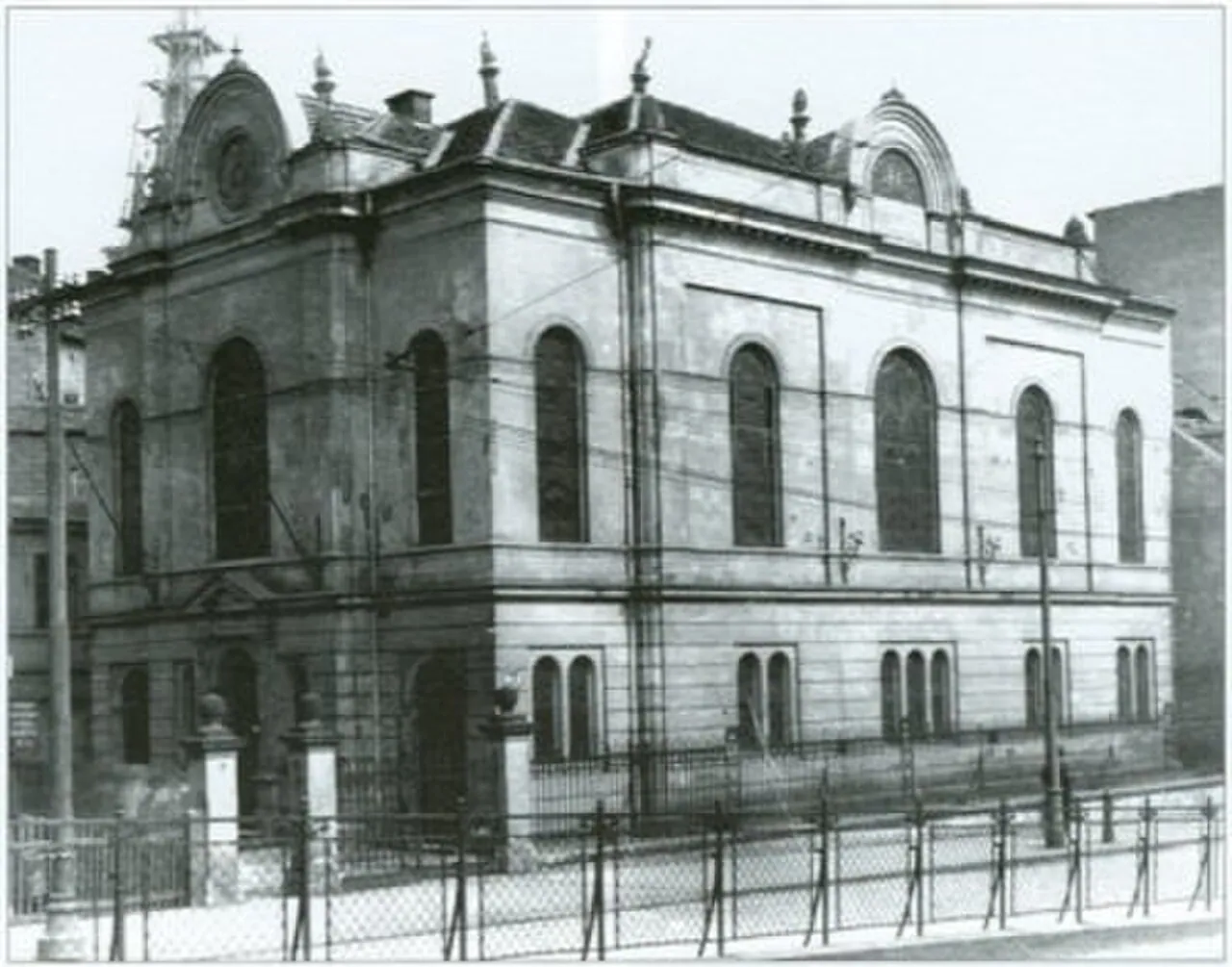
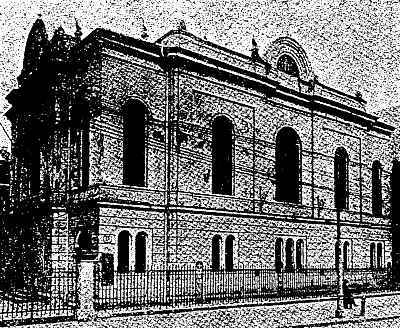
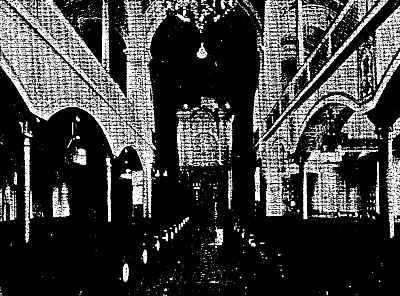
Rabbi Stössler's history of 1934 and the German-language encyclopaedic sources give the architect as Alwin Köhler but do not describe the design, and no plans were found. The photographs show a free-standing two-storey hall on a corner, behind a low wall with railings and stone gate piers. The walls were rendered and articulated with pilasters and a strong cornice. Tall round-arched windows lit the main storey and smaller paired round-arched windows the ground floor, which suggests women's galleries above a lower aisle. On the roof line stood ornate curved gables with round openings, one with a tall finial on the entrance front, and small pinnacles at the corners. An interior photograph published in 1934 looks down the nave towards the ark: it shows arcaded galleries on slender columns along both sides, rows of benches, hanging lamps and a richly framed ark under an arch at the east end. The capacity is unknown. Stössler mentions that around 1930 the temple and a separate winter temple were renovated under Semin Katz, and that the community also had a community house.
La vita nella sinagoga
Until 1888 the congregation had no rabbi of its own: services and teaching were led by cantor-teachers, Lippmann Deller from Soborten until 1879, then Löwi Winterberg from Jungbunzlau. Salomon Bass from Nikolsburg served from 1888 to 1910 and was officially allowed to perform rabbinical functions. Dr. Arthur Rosenzweig, born in Teplitz, was rabbi from 1909 to 1919, and Dr. J. Stössler from 1 September 1921 until the Munich crisis. Samuel Borodkin was chief cantor; a recording of his voice made in 1914 survives. A temple choir founded in 1901 sang at services and was chaired by the rabbi. In 1892, during the High Holidays, when gatherings were restricted because of a cholera epidemic, thieves broke in, tore the ark curtain, pulled down the eternal light, stole silver and gilt objects from the ark and left three Torah scrolls stripped on the floor. The building also housed a winter prayer room, renovated around 1930 with money and work organised by the synagogue's representative Semin Katz.
Distruzione
Aussig was annexed to Nazi Germany after the Munich Agreement of September 1938, and most Jews fled to the interior of Czechoslovakia; the Petschek and Weinmann families had left that summer. The synagogue was not attacked in the November pogrom. On the evening of 31 December 1938, apparently as part of New Year's celebrations, the Nazis looted the building and set it on fire. A report of the district governor described the damage as done 'spontaneously by the population'. The part of the building that remained undamaged was taken over by a local butcher for his business. In 1940 the butcher's firm Houdek bought the remains of the synagogue and the rabbi's house and built a meat-processing plant with a butchers' training school on the site, so the burnt shell was cleared or absorbed into the new building by then; exactly how much of the old structure was reused is unknown. The factory building was damaged in the Allied bombing of Ústí in April 1945.
Il destino della comunità
By the census of 1939 most of the community had already left Aussig for the interior of Czechoslovakia or abroad. Those still in the town in late 1941 and early 1942, including Jews in mixed marriages, were moved in groups to an internment camp in the castle of Schönwald (Krásný Les) in the Ore Mountains, where they did forced labour; according to one account the women were later returned to Ústí and the men sent to Oranienburg. From there they were deported to Theresienstadt and on to the extermination camps in occupied Poland. Rabbi Stössler had gone back to Třebíč; in May 1942 he was deported with his orphaned nephew to Terezín and then to Auschwitz-Birkenau, where he was murdered in the gas chambers on arrival. Of about 1,250 members of the community before the deportations, only just under 200 survived, almost all in emigration. After the war about 800 Jews, many from Subcarpathian Ruthenia, settled in Ústí and formed a new community with its own prayer house.
Il luogo oggi
According to eyewitnesses cited by the USC Shoah Foundation's walking tour, public toilets were built on the site in the 1950s, some of them in the synagogue's surviving cellar, probably to serve a bus station laid out on the bombed part of the city centre. The site lies on Malá Hradební in the centre of Ústí nad Labem; the de.wikipedia article places it at about 50.6583 N, 14.0389 E. No part of the synagogue is visible above ground. Ústí has a Holocaust memorial elsewhere in the city. The postwar community uses a different building.
Nomi importanti
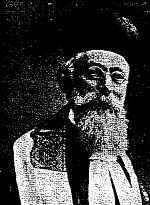
Salomon Bass
died 1930Cantor and teacher, with rabbinical functions, 1888-1910Bass came to Aussig from Nikolsburg in 1888 as cantor and religious teacher and received official dispensation to perform rabbinical functions, effectively serving as the congregation's first spiritual leader in the new synagogue. He held the post for twenty-two years until 1910. He died in Vienna in 1930. His portrait, captioned 'Rb. Salomon Bass', appears in the 1934 community history.
Biografia o fonte →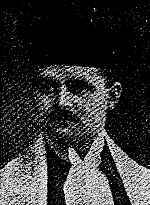
Dr. Arthur Rosenzweig
born 1883Rabbi of Aussig, 1909-1919Born in Teplitz on 27 March 1883, Rosenzweig was rabbi of the Aussig congregation from 1909 to 1919,. He then moved to Stuttgart in 1920 and to Schneidemühl in 1926. Some sources say he consecrated the synagogue in 1880, which his birth date rules out; the consecrating rabbi was a Teplitz rabbi with the same initial.
Biografia o fonte →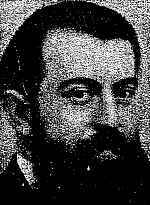
Dr. Johan (J.) Stössler
died 1942Rabbi of Aussig, 1921-1938Stössler, born in Malý Ořechov near Bzenec and trained in Vienna, came to Aussig from Třebíč and took office on 1 September 1921. He chaired the temple choir and wrote the community's history for Hugo Gold's 1934 volume. He was the synagogue's last rabbi. After the annexation of the border region he returned to Třebíč, and in May 1942 he was deported via Terezín to Auschwitz-Birkenau and murdered on arrival.
Biografia o fonte →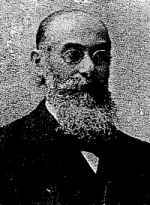
Dr. Jakob Mendl
UnknownPresident of the community, 1892-1903Mendl succeeded Angelus Bauer as president of the Aussig Jewish community in 1892 and led it until 1903, the period in which its numbers almost doubled, from 479 in 1890 to 840 in 1900, and the synagogue became the centre of a sizeable congregation. His portrait, captioned 'Dr. Jakob Mendl', appears in the 1934 community history.
Biografia o fonte →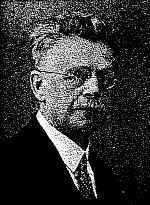
Moritz Glauber
died 13 November 1932President of the community, 1919-1932Glauber was president of the Aussig Jewish community from 1919 until his death on 13 November 1932, the longest term after Angelus Bauer's. A foundation for Jewish students named after him was chartered by the burial society. He led the community during the renovation of the temple and winter temple around 1930. His portrait appears in the 1934 community history.
Biografia o fonte →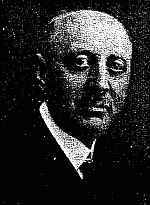
Semin Katz
UnknownSynagogue representative from 1924; honorary chairman from 1930Katz, a manufacturer and son of Joachim Katz, rabbi in Seltschan, became the synagogue committee's representative in 1924 after Michael Kohn. In 1930 he was made honorary chairman in recognition of his great service in the renovation of the temple and the winter temple and the decoration of the community house. His portrait appears in the 1934 community history.
Biografia o fonte →Alwin Köhler
UnknownArchitect of the synagogue (1880)Köhler is named as the architect of the Aussig synagogue in the German Wikipedia article, which draws on Klaus-Dieter Alicke's lexicon of Jewish communities. The building was put up between April and August 1880 for about thirty Jewish families and cost 26,000 florins. Nothing further about Köhler, his training or his other buildings was found in the sources read.
Biografia o fonte →Dr. Angelus Bauer
UnknownFirst president of the Aussig Jewish community, 1869-1892Bauer led the Israelitische Kultusgemeinde from the confirmation of its statutes in 1869 until 1892, according to Rabbi Stössler's 1934 history. He was therefore president when the community raised 26,000 florins and built and consecrated the synagogue in 1880, and during the burglary of 1892. No portrait of him appears in the 1934 history and none was found elsewhere.
Biografia o fonte →Samuel Borodkin
UnknownChief cantor of the Aussig synagogueBorodkin is named by the USC Shoah Foundation's Ústí walking tour as chief cantor of the synagogue. A recording of his voice made in 1914, in which he sings Tzadik Katomor in Louis Lewandowski's setting of Psalm 92:13, survives in the Mayrent Yiddish Recordings at the University of Wisconsin. The dates of his service in Aussig are unknown.
Biografia o fonte →Hai qualcosa da condividere?
Fotografie, documenti, storie di famiglia o ricordi di questa sinagoga e della sua comunità aiutano a mantenerne viva la storia.
- Aussig (Böhmen)
- Synagoge (Ústí nad Labem)
- The History of the Jews in Aussig a. d. Elbe (in: Hugo Gold, Die Juden und Judengemeinden Böhmens in Vergangenheit und Gegenwart, 1934, pp. 19-22; English translation)
- In the footsteps of the Jewish inhabitants of Ústí nad Labem, Stop 1: Synagogue (chapters 1, 10-14)
- IWalk Ústí nad Labem, Chapter 11: Butcher Houdek
- IWalk Ústí nad Labem, Chapter 12: Toilets in the basement
- IWalk Ústí nad Labem, Chapter 13: Today
- IWalk Ústí nad Labem, Chapter 14: Synagogue singer
- IWalk Ústí nad Labem, Chapter 1: Jewish prayerhouse
- Ústí nad Labem (Communities Database)
- History of the Jews in Ústí nad Labem
- File:Synagoga v Ústí nad Labem.jpg
- Malá hradební, Ústí nad Labem (OpenStreetMap way 52015778)
Share a memory or thought
No comments yet. Be the first to add one.