
La historia de Valašské Meziříčí Synagogue
Valašské Meziříčí lies on the Bečva river in eastern Moravia. Its synagogue actually stood in Krásno nad Bečvou, the neighbouring town on the far bank, which was merged into Valašské Meziříčí only in 1924. Jews had lived in the area briefly in the late seventeenth century, but a lasting community formed only from the middle of the nineteenth, and at first it prayed in a private house. The synagogue was then built on what is now Vodní Street, about 100 metres from the parish church of the Assumption. A heritage inventory of the Czech Academy of Sciences dates it to 1864 and names the Frenštát architect Ambrož Zapletal; a 2020 thesis on the town's Jews gives 1867 and says the building passed to the Jewish religious society in 1870. Its prominence close to the church was read, according to that thesis, both as a provocation and as a sign of the community's self-confidence. The building survived a flood in 1880, an anti-Jewish riot in 1899 and the Nazi occupation, though its interior was stripped in 1942. Four years after the war the town authorities claimed it, and it was pulled down to make room for a fire station that was never built.
Where it stood for nearly 90 years
Historic: Krásno nad Bečvou (Krasna), now Vodní Street, Krásno nad Bečvou, 757 01 Valašské Meziříčí; about 100 m from the parish church of the Assumption. Today: site of the Holocaust memorial on Vodní Street (approximate; no house number given).
Abrir mapa ampliado →La comunidad judía
A Jewish community of real size grew in Valašské Meziříčí and Krásno only after the restrictions on Jewish settlement in Moravia were lifted in the mid-nineteenth century; JewishGen dates the community's founding to 1867, and the cemetery, bought across the river in Krásno in the late 1860s, was opened about 1870. By the end of the century Jews made up roughly four per cent of the population. An earlier Jewish religious society, chaired until its dissolution in 1894 by Alois Reich, was replaced in the early 1890s by a formally constituted Israelite religious community, which formed a rabbinical district with the Jews of Hranice (Mährisch-Weißkirchen). Around 1920 the community counted more than 700 members, including families from Velké Karlovice, Halenkov and Nové Zubří, and the Jews of nearby Rožnov pod Radhoštěm also used its synagogue. In 1930 about 135 to 150 Jews lived in the town itself. Its last head was the lawyer Karel Heller, who led the joint community of Valašské Meziříčí and Vsetín.
Arquitectura y diseño
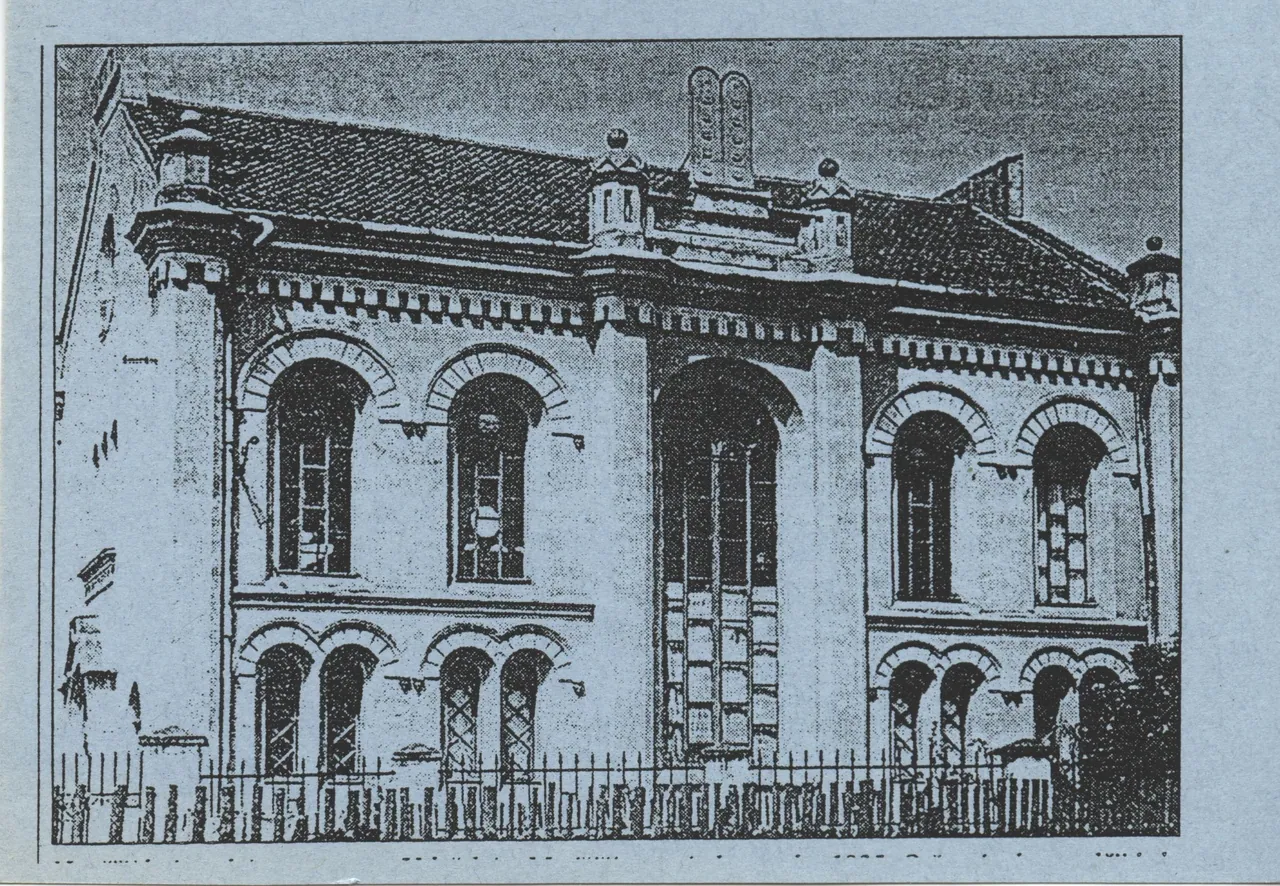
The only view found is a historical photograph, reproduced in poor quality from a printed source, captioned on the Jüdische Gemeinden site as the synagogue of Wallachisch-Meseritsch. It shows a two-storey rendered building behind a railing, its street front divided into three bays by flat pilasters. The wider central bay holds one tall round-arched opening running up through both storeys, filled with a grid of glazing. The side bays have pairs of small round-arched windows below and pairs of larger round-arched windows above, all under raised arched hood mouldings. A corbelled frieze of small arches runs beneath the eaves, small turrets with ball finials crown the pilasters, and the twin tablets of the Law stand above the centre of the tiled hipped roof. This matches the heritage inventory's description of the building as Neo-Romanesque. According to the 2020 thesis the synagogue faced east, was rebuilt inside in 1921 without any change to its exterior, and afterwards held up to 180 worshippers. The plan, the gallery arrangement and the interior fittings are unknown.
La vida dentro de la sinagoga
The congregation's first rabbi after the new community was formed was Dr. Adolf Leimdorfer, who served from 1892 to 1894, and he was followed by Dr. Jacob Rabbinowitz; later rabbis are not named in the sources read. The 2020 thesis records the building's troubled history. In 1880 the Bečva flood filled it to a depth of about a metre and it could not be used for some years. In 1899, during the anti-Jewish riots that followed the Hilsner blood-libel affair, a crowd in Krásno broke into the synagogue and wrecked whatever it could, but the ritual objects had been hidden in advance and survived. The synagogue came through the First World War and the unrest of 1918 unharmed. After its rebuilding in 1921 it could seat up to 180 people. In 1933 thieves stole silver ritual objects worth 16,000 crowns from it. Services continued until the community was deported in 1942.
Destrucción
The synagogue was not burned in March 1939, when the Nazis set fire to the synagogue of nearby Vsetín. In 1940 the town tried to buy it from the Jewish community but no agreement was reached. In 1941 an official statement declared that synagogues were gathering places for illegal propaganda and should all be demolished; the building nevertheless survived, but its interior was dismantled, and in November 1942 its ritual objects were sent to Prague. It stood empty after the deportations, and after liberation on 6 May 1945 it was listed among 33 severely damaged buildings in the town. On 28 January 1949, under the Communist regime, the town's national committee decided to take the synagogue over for the volunteer fire brigade. Faced with expropriation, the small postwar Jewish community sold it. The building was then demolished, in 1950 according to the Czech Academy of Sciences inventory and in 1949 according to other accounts, to make room for a fire station that was never built for the town's fire brigade. Who carried out the demolition is not named in the sources read.
El destino de la comunidad
Very few of the town's Jews managed to emigrate before the war. In September 1942 the Jews of Valašské Meziříčí were deported by the Nazis via Ostrava to the Theresienstadt ghetto; the community head Karel Heller was among those taken on 14 September 1942. From Theresienstadt most were sent on to Auschwitz-Birkenau and Treblinka and murdered there. The 2020 thesis counts 174 Jews from the district who died, 84 men, 73 women and 17 children, and says that more than 150 were from Valašské Meziříčí itself; Heller's list of the community's members originally held 157 names. It gives the number of survivors as five in one place and eleven in another. The survivors joined those of Vsetín to form a new community, but it lasted only a few years, and by the early 1950s most of its members had emigrated. Under Communist rule the Jewish cemetery in Krásno was largely cleared and many gravestones were reused; only a few remain.
El lugar hoy
The synagogue stood on Vodní Street in Krásno nad Bečvou, part of Valašské Meziříčí since 1924, close to the Rožnovská Bečva river and about 100 metres from the parish church of the Assumption. The fire station for which it was demolished was never built. A black stone Holocaust memorial bearing the names of about 150 victims was set up on or beside the site in the 2000s at the suggestion of survivors. Nothing of the synagogue itself is known to survive above ground. Remnants of the Jewish cemetery, with a few surviving gravestones, still exist in Krásno.
Nombres destacados
Ambrož Zapletal
UnknownArchitect of the synagogueZapletal, an architect from Frenštát pod Radhoštěm, is named by the Czech Academy of Sciences monument inventory as the designer of the Neo-Romanesque synagogue built in Krásno in 1864. The inventory records nothing further about the commission, and no other source read in this research names him or gives his dates, so his wider career and other buildings are unknown.
Biografía o fuente →Adolf Leimdorfer
UnknownRabbi of Valašské Meziříčí, 1892-1894Leimdorfer (spelled Leindörfer by Jüdische Gemeinden) was the first rabbi of the Israelite religious community formed in the early 1890s, which joined the Jews of Valašské Meziříčí and Hranice in one rabbinical district. He served in the synagogue from 1892 to 1894. JewishGen also lists him as a nineteenth-century rabbi of the town. His later career is unknown.
Biografía o fuente →Jacob Rabbinowitz
UnknownRabbi of Valašské Meziříčí, from 1894Dr. Jacob Rabbinowitz succeeded Adolf Leimdorfer as rabbi of the Valašské Meziříčí community, which formed one rabbinical district with Hranice, and so officiated in the synagogue from the mid-1890s. That included the period of the 1899 riots, when the building was wrecked inside. How long he served and what became of him are unknown.
Biografía o fuente →Karel Heller
UnknownChairman of the Jewish religious community; last head of the joint community of Valašské Meziříčí and VsetínHeller, a lawyer (JUDr.), was chairman of the Jewish community by 1905, when he applied to build a chapel at the cemetery, and was its last head, described as the community's mayor. He compiled a list of its members, originally of 157 names. He was deported to the Theresienstadt ghetto with other members on 14 September 1942.
Biografía o fuente →¿Tiene algo que aportar?
Fotografías, documentos, historias familiares o recuerdos de esta sinagoga y su comunidad ayudan a mantener viva su historia.
- Wallachisch-Meseritsch (Mähren) / Valašské Meziříčí
- Socioekonomické motivy holokaustu ve Valašském Meziříčí (The Socioeconomic Motives behind the Holocaust in Valašské Meziříčí), thesis 2020
- Memorial to the Victims of the Holocaust in Valašské Meziříčí (Krásno nad Bečvou)
- Valašské Meziříčí
- Valašské Meziříčí (Cemetery Discovery Project)
- Vodní, Krásno nad Bečvou, Valašské Meziříčí (OpenStreetMap way 293999294)
Share a memory or thought
No comments yet. Be the first to add one.