
הסיפור של Vasvár Synagogue
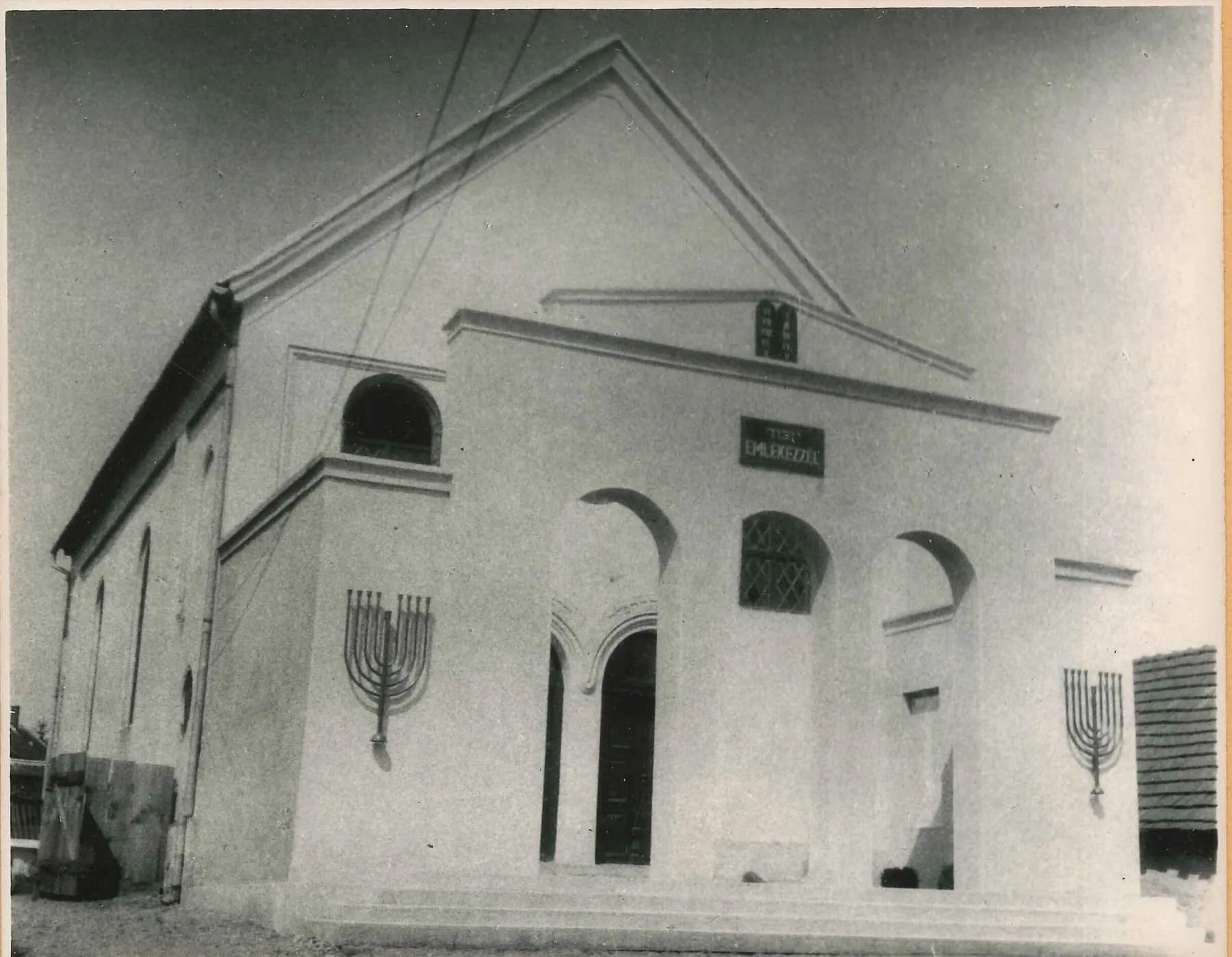
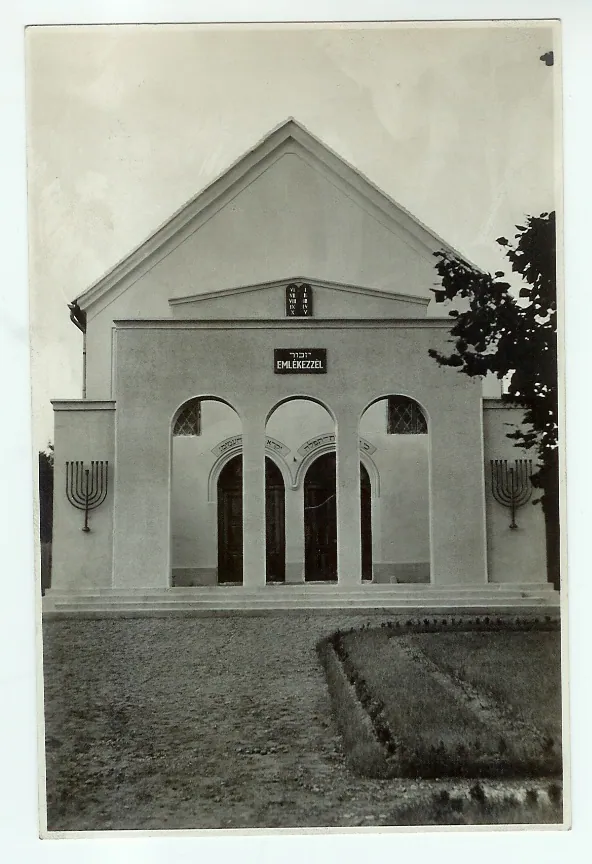
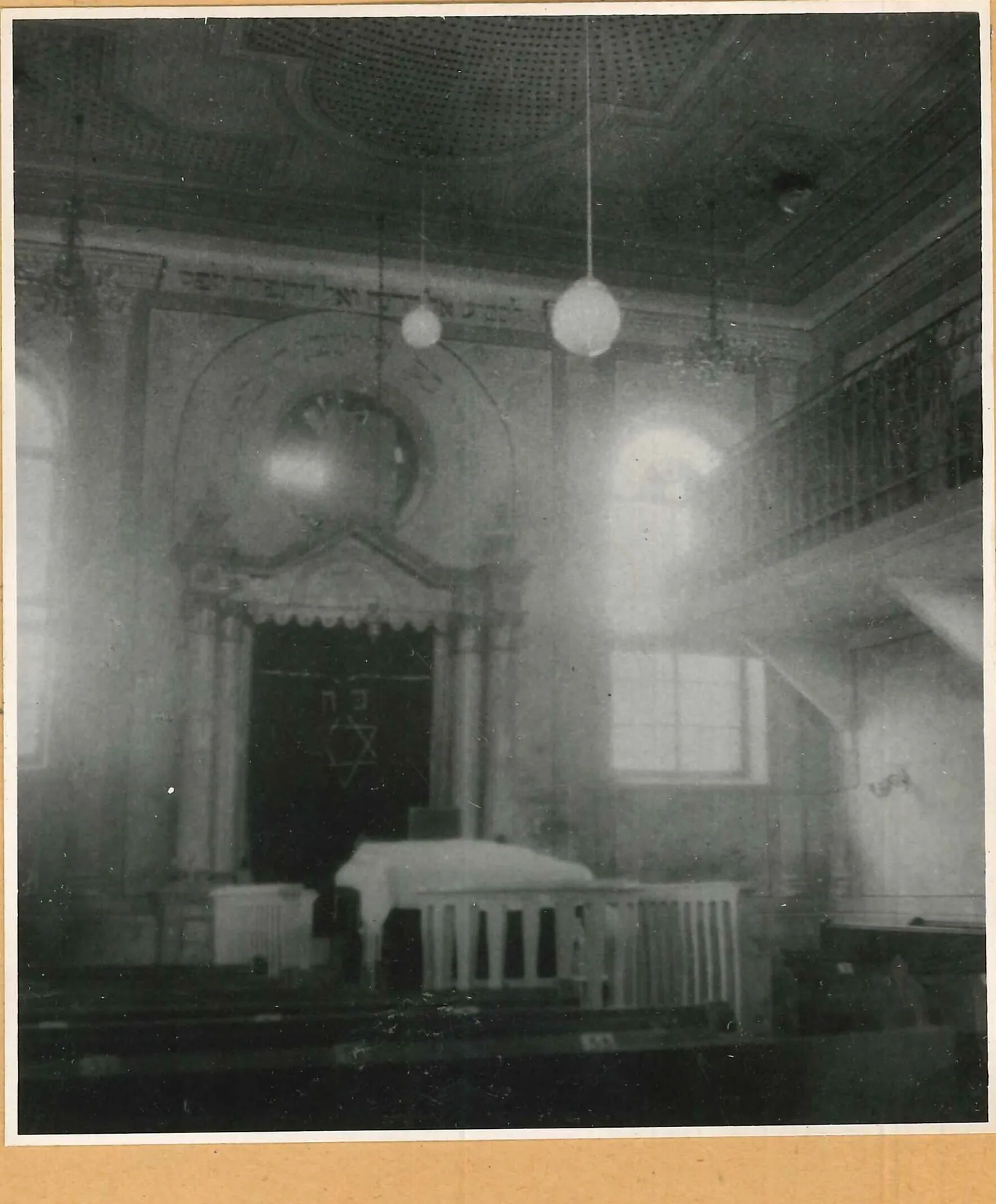
Vasvár is a small town in Vas county in western Hungary, south-east of Szombathely. The Magyar Zsidó Lexikon of 1929 says its Jewish community built the synagogue in 1865 from members' donations; Gazda's survey of 1980-87 gives the same date. Photographs kept by the Hungarian Jewish Museum and Archives show a free-standing rendered hall with a pitched roof and a lower entrance block in front, opened by three round arches, with large seven-branched candlesticks mounted on the wall on either side and tablets of the Law at the top. Inside, a classical Torah ark stood beneath a large round window, with a railed bimah in front and a gallery along the side wall.
After the war the few survivors made the building the town's Holocaust memorial. A photograph taken in 1956 for the Paris memorial to the unknown Jewish martyr, at the request of the national Jewish office, shows the synagogue front with the word 'Emlékezzél' (Remember) over the entrance and records the memorial's dedication on 21 August 1949. The building therefore still stood in the mid-1950s. Gazda's survey of 1980-87 found it demolished. No source read gives the date of demolition, the plot on which it stood, or who demolished it.
Where it stood for nearly 110 years
Historic: Vasvár, Vas county; street and house number unknown. Today: unknown; placeholder pin at the centre of 9800 Vasvár (approximate).
פתיחת מפה גדולה ←הקהילה היהודית
According to the Magyar Zsidó Lexikon of 1929, Jews certainly lived in Vasvár by the end of the seventeenth century, though for decades they had to bury their dead at Nemeskolta, 12 km away. They were allowed to settle only in the village of Zsidóföld, which later merged into the town as Zsidóföldi utca; the Rágendorfer and Rosenberger families are named as the first settlers. In 1815 the community bought a cemetery from Count Festetich, and its burial society dates from the same year. A one-teacher school, teaching in Hungarian, opened in 1860, and a women's association in 1886. The lexicon counts 217 members in 69 families, with about 250 more Jews in the district, most of them merchants. It was a Congress (Neolog) community led by Lipót Gottlieb, with Károly Pártos as teacher and notary. Gazda's survey of 1980-87 records 62 Jews in 1828, 55 in 1851, 230 in 1910 and 184 in 1941.
אדריכלות ועיצוב
The building is known from three photographs. The largest shows a long, plain rendered hall with a steep pitched roof and a gable end facing the street. In front of the gable stands a lower, flat-topped entrance block, slightly wider than the hall's front wall, with a stepped cornice. Its face is opened by three tall round arches on square piers forming a shallow porch; the central doorway has a moulded round-arched frame, and above it a round-headed window with diamond glazing. Over the porch is a small panel with an inscription and, at the top of the gable of the front block, a pair of tablets of the Law. A large seven-branched candlestick in relief is fixed to the wall on each side of the porch. The side walls have tall round-headed windows and a round window. Inside, the ark was framed by columns and a curved pediment beneath a large round window in the east wall; Hebrew inscriptions ran along the cornice, the ceiling was coffered and painted, and a gallery with a railing ran along the side wall. The architect and capacity are unknown.
החיים בבית הכנסת
Almost nothing about worship in the Vasvár synagogue was found. The interior photograph shows the arrangement of a typical Hungarian small-town synagogue of the period: rows of wooden pews facing east, a raised bimah enclosed by white railings and covered with a cloth placed in front of the ark, hanging globe lamps and chandeliers, and a women's gallery on the side. A curtain bearing a Star of David hung before the ark, and a Hebrew inscription ran across the wall above it. The Vas county memorial book records Dr. Mór Dénes as leader of the congregation and Károly Pártos as teacher at the time of the deportations; the names of the rabbis who served here, if the community had its own rabbi, are unknown. After 1949 the building served the small surviving community as a memorial to the deported, with the inscription 'Remember' set over the entrance; whether services continued inside is unknown.
הרס
No source read records damage to the synagogue during the Second World War or in the 1944 deportations, and no account of looting was found. The building survived the war. On 21 August 1949 the survivors dedicated it as the town's memorial to the victims of the Holocaust, and a photograph of its front, taken in 1956 by the Vasvár photographer Imre Jakab for the national Jewish office, shows it intact and well kept, with a lawn laid out in front. Nothing more is known until Anikó Gazda surveyed Hungary's synagogues between 1980 and 1987 and recorded the Vasvár building as demolished. It was therefore pulled down sometime between 1956 and the mid-1980s, under Communist rule, but no source read gives the year, says whether it had first been sold by the dwindling community or by the national Jewish office, or names who ordered or carried out the demolition.
גורל הקהילה
After the Nazi German occupation of Hungary in March 1944, the Jews of Vasvár and the surrounding villages were deported in 1944; the ghetto, the route and the dates of their deportation were not documented in the sources read for this entry. The Memorial Book of Vas County lists roughly 288 victims from Vasvár and its vicinity, among them the congregation leader Dr. Mór Dénes and the teacher Károly Pártos. Their names were inscribed on three tablets set up after the war, photographed in 1956. A small number of survivors returned and in 1949 dedicated the synagogue as a memorial to the murdered. How many survivors there were and how long an organised community lasted is unknown.
האתר כיום
The site of the synagogue has not been identified in any source read, so it is not possible to say what stands on the plot today. The 1956 photograph shows the building set back behind a lawn and a gravel path, with a tree to one side, but no street name is given. No surviving fragment is recorded. The memorial tablets with the names of Vasvár's victims are known from a 1956 photograph; where they are today was not established. The map pin for this entry is a placeholder at the centre of Vasvár and does not mark the synagogue's location. Finding the plot will need old cadastral maps or the local-history collections of Vasvár.
שמות בולטים
Mór Dénes
UnknownLeader of the Vasvár Jewish congregation, 1944Dr. Mór Dénes is listed in the necrology of the Memorial Book of Vas County, under 'Vasvar and vicinity', with the description 'congregation leader'. He was thus the lay head of the Vasvár community responsible for the synagogue at the time of the 1944 deportations, and he is counted among the community's victims. His name also appears on the postwar memorial tablets. Nothing more about his life was found.
ביוגרפיה או מקור ←Károly Pártos
UnknownTeacher of the Vasvár Jewish community, 1944Károly Pártos is listed as 'teacher' among the Vasvár victims in the necrology of the Memorial Book of Vas County. He was the community's teacher, responsible for the religious or elementary education of its children, in the years before the deportations of 1944, and he was killed with the congregation. No further details about him were found.
ביוגרפיה או מקור ←יש לכם משהו לתרום?
תמונות, מסמכים, סיפורי משפחה וזיכרונות מבית הכנסת ומהקהילה שלו עוזרים לשמור על ההיסטוריה שלו בחיים.
- Vasvár, zsinagóga (album page F16.106: exterior, memorial tablet and interior)
- Vasvár (Magyar Zsidó Lexikon, 1929, p. 941)
- Fénykép: a holokauszt áldozatainak emlékműve Vasváron (F14.136)
- Vasvári áldozatok emléktáblája
- Memorial Book of Vas County (Sefer zikaron mehoz Vas), table of contents
- Memorial Book of Vas County: necrology, Vasvar and vicinity (pp. 164-166)
- Zsinagógák és zsidó községek Magyarországon (Vas county table)
- Vasvár (OpenStreetMap relation 1131419)
Share a memory or thought
No comments yet. Be the first to add one.