
The story of Veendam Synagogue
Veendam and neighbouring Wildervank, peat-digging colonies in the east of the province of Groningen, had Jewish residents from the last quarter of the seventeenth century. According to the Jewish Cultural Quarter's community encyclopedia, a Jew of Veendam built a house on the Midden-Verlaat in 1738 to serve as a synagogue, and in 1745 services moved to another private house on the same street. In the 1790s the congregation bought that building, and it was officially consecrated as a synagogue in 1798. It served the Jews of Veendam, Wildervank and, for a time, Muntendam for almost a century and a half.
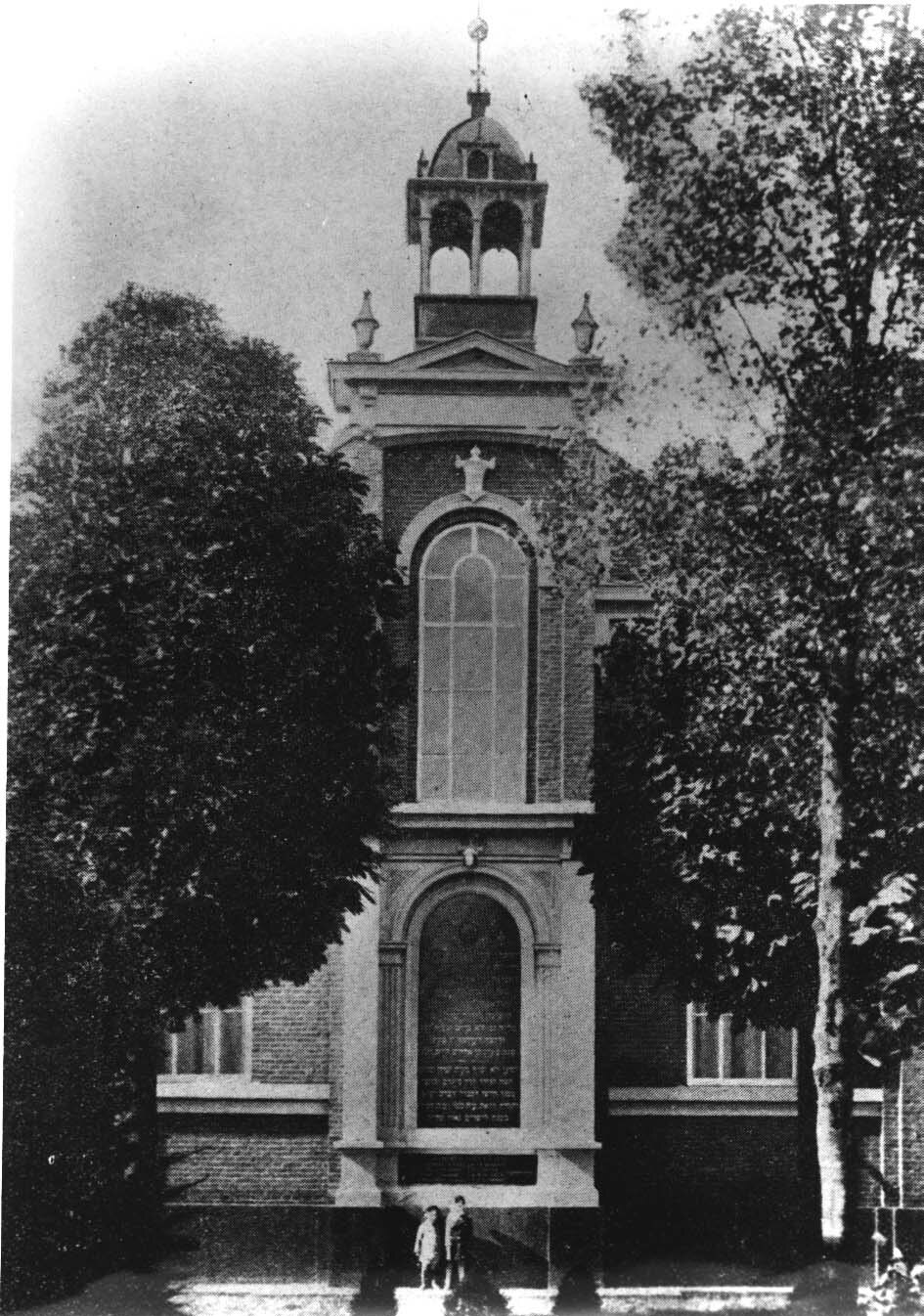
In 1892 the old building was fully renovated. The only photograph found shows the result: a brick hall behind a tall, narrow street front with a stone-framed arched niche, a large round-headed window and a lantern tower with a small dome. A tourist site describes the 1892 work as a new synagogue built because the old one had fallen into disrepair; the encyclopedia calls it a renovation.
The community, which numbered 520 in 1899, shrank in the twentieth century. During the Nazi German occupation the building fell out of use. The synagogue was sold shortly after the war and demolished in 1947, and the community was merged into that of Stadskanaal in 1948.
Where it stood for 202 years
Historic: Midden-Verlaat, Veendam (JCK), on the Joodse Steeg off the Bendiksstraat (Stichting Historie Veendam-Wildervank). Today: site marked by the Jewish monument on the Prins Bernhardlaan near no. 87, 9641 Veendam (approximate).
Open larger map →The Jewish community
Jews lived in Veendam and Wildervank from the last quarter of the seventeenth century. A cemetery on the Jagtveensloot was laid out around 1750 and enlarged in 1779 and 1902. The congregation first came under the main synagogue of Meppel; around 1810 two serious internal conflicts needed intervention from outside, and in 1821 Veendam became a ring synagogue under the main synagogue of Groningen. Through the nineteenth century a board of seven governed the community, and it kept its own school for Jewish children in Veendam, which was at its largest around 1860. The Jewish population grew steadily: 174 in 1778, 251 in 1809, 365 in 1840, 502 in 1869 and 520 in 1899. Jews from nearby Muntendam also belonged to the congregation in the nineteenth and early twentieth centuries. In the twentieth century numbers fell, to 283 in 1930, as poverty in the region and industrial work in larger towns drew people away. Jewish butchers remained a comparatively large occupational group. The JCK encyclopedia names Judith Sanders (1846-1925), daughter of a Veendam textile merchant, whose portrait was painted by Salomon Garf.
Architecture and design
The first places of worship were rooms in private houses on the Midden-Verlaat; the building used from 1745 was a house adapted for services, not a purpose-built synagogue, and nothing is known of its original plan. After the 1892 renovation the synagogue presented the street with a tall, narrow brick front, shown in a photograph published by the Jewish Cultural Quarter. At ground level a stone frame of pilasters and a semicircular arch held a recessed panel carved with lines of Hebrew text, above a smaller inscribed panel. Over this rose a tall round-headed window with stone surround and a keystone ornament, then a classical cornice and low pediment flanked by two urn finials. On top stood an open lantern tower with arched openings, a small dome and a weather vane. On either side of this front the side walls of the brick hall showed rectangular windows with stone sills. The style is a late-nineteenth-century eclectic mix of classical and Renaissance motifs. The architect, the builder, the seating capacity and the interior arrangement are unknown.
Life inside the synagogue
The synagogue was the religious centre of a congregation that drew members from Veendam, Wildervank and Muntendam. Until 1821 it belonged to the district of the main synagogue of Meppel, and from then on it was a ring synagogue under the chief rabbinate seated in Groningen, so it had no rabbi of its own and depended on the chief rabbi in Groningen for religious authority. Day-to-day affairs were in the hands of a seven-member board. The community's own school, which taught Jewish children in Veendam and reached its peak around 1860, worked alongside the synagogue. The internal conflicts of about 1810 were serious enough that outside bodies had to step in. No names of cantors, teachers or board members were found in the sources consulted, and no description of services, of the interior, or of the furnishings survives in them. The congregation's Torah scrolls were sent to Amsterdam for safekeeping during the occupation but were lost there.
Destruction
No source consulted records damage to the synagogue during the occupation. After the deportations of autumn 1942 the building stood empty; its Torah scrolls had already been sent to Amsterdam, where they were lost. According to the Jewish Cultural Quarter's encyclopedia, the synagogue was sold shortly after the liberation and demolished in 1947, and in 1948 the much reduced community was dissolved and placed under that of Stadskanaal. The buyer, the price and who carried out the demolition are not recorded in the sources found. A local-history drawing by Harm Venema for the Stichting Historie Veendam-Wildervank gives a different picture: it marks the synagogue, the Jewish school and two neighbouring buildings on the Joodse Steeg near the Bendiksstraat as still standing in 1945 and says they were demolished in the 1950s. The 1947 date from the encyclopedia is used here, but the year could not be confirmed from a contemporary record.
The community’s fate
In 1930 Veendam had 283 Jewish inhabitants. During the Nazi German occupation of the Netherlands about ten Jews of Veendam and Wildervank went into hiding. The others were taken in the autumn of 1942 to the Westerbork transit camp and from there deported to camps in occupied Poland, where they were murdered. A tourist information page for the town's Jewish monument gives the number of Jewish citizens of Veendam and Wildervank who were deported and killed as 93; a 1998 local study by Tammo Bakker contains complete lists of the victims from Veendam, Wildervank and Muntendam. Only a few survivors returned. The remnant was too small to keep up a congregation, and in 1948 the Jewish community of Veendam was dissolved and merged with that of Stadskanaal. A monument to the murdered Jews was placed at the Jewish cemetery in 1951, and the municipality now maintains the cemetery.
The site today
Nothing of the synagogue survives. The Jewish Cultural Quarter's encyclopedia says that a small monument unveiled in 1967 marks the place where it stood, and tourist and memorial listings put the Joods Monument Veendam on the Prins Bernhardlaan (number 87), close to the Bendiksstraat, where the local-history society's drawing places the synagogue on a lane called the Joodse Steeg. The surrounding block, including the former Jewish school, was cleared after the war and rebuilt, and no historic fabric of the Jewish quarter is recorded. The street called Midden-Verlaat in the encyclopedia could not be matched to a present-day street name.
Do you have something to contribute?
Photographs, documents, family stories or memories of this synagogue and its community help keep its history alive.
Share a memory or thought
No comments yet. Be the first to add one.