
Historia Veenendaal Synagogue
Veenendaal, on the border between the provinces of Utrecht and Gelderland, had one of the oldest small Jewish communities in the region. Jews first met for prayer in a private house in the seventeenth century, and by about 1750 they had a small synagogue on the Gelders side of the village. A quarrel later divided the congregation into Stichts and Gelders Veenendaal until the city government of Rhenen brought the two together again in 1793. In 1821 Veenendaal became a subsidiary congregation of the Amersfoort district within the Dutch Israelite religious organisation.
The synagogue on the Verlaat, the subject of this entry, was built in 1852 to replace the older prayer house outside the village; a memorial stone on the site gives 1851. It was built while the community was growing towards its peak of 101 people in 1869 and served it until the Second World War, by which time only about twenty Jews were left. Nazi German occupiers vandalised and plundered the building. After the war it was sold, put to another use in 1951 and pulled down in 1967. The street beside the site is now called Synagogestraat, and a window with a Star of David from the building is kept in Museum Veenendaal.
Where it stood for 115 years
Historic: Verlaat, Veenendaal (memorial stone listed at Verlaat 2). Today: Verlaat / Synagogestraat, 3901 Veenendaal, Utrecht province, beside the Cultuurfabriek; approximate.
Otwórz większą mapę →Społeczność żydowska
Jews are recorded in Veenendaal from the seventeenth century; one local account dates the first settlers to about 1630 and a makeshift prayer room to 1655. The town lay outside the city of Utrecht, which did not admit Jews, and its earliest worshippers met in the house of the Jewish tenant of the local pawn bank. The community grew in the first half of the eighteenth century, and in 1761 it obtained the right to bury its dead in the Jewish cemetery at Wageningen. After the reunion of the two rival congregations in 1793 a rabbi was appointed, whose name is unknown. The community numbered 58 in 1809, 71 in 1840 and 101 in 1869, then fell to 43 in 1899 and 19 in 1930, partly through migration to the cities and mixed marriages. Its members were shopkeepers, merchants, butchers, shoemakers and hat makers, with a doctor and a lawyer, and some sat on the town council. The Bottenheim family ran the Veenendaalse Stoom Weverij, a steam weaving mill important to the town's growth. The community opened its own cemetery on the Parallelweg in 1900.
Architektura i projekt
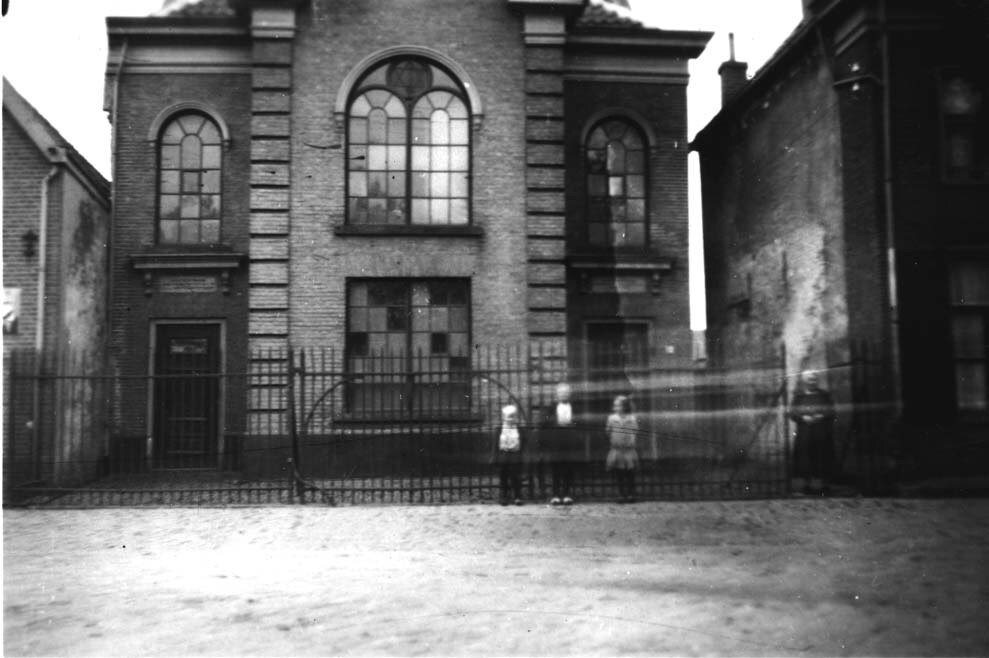
The only known photograph shows the synagogue's street front as a two-storey brick facade of three bays, divided by broad pilaster strips of banded brickwork and finished with a projecting cornice. The centre bay has a large round-arched window with a round light in its head above a big rectangular window filled with small leaded panes; each side bay has a smaller round-arched window above a ground-floor door or window under a moulded hood. Tiled roof slopes are visible at the corners. An iron railing with a gate runs along the pavement in front, and the building stands directly between ordinary houses on a cobbled street. Who designed it, how many people it seated and how the interior was arranged are unknown. One window with a Star of David survived the demolition and is now in Museum Veenendaal, which shows that the building had decorated glazing. The photograph is a double exposure, so some details are blurred.
Życie w synagodze
The synagogue was the centre of a small country congregation within the Amersfoort rabbinical district. At the start of the twentieth century the congregation was run by a board of three members, whose names are not recorded in the sources read, and the children received Jewish religious instruction from a teacher who came from Amersfoort. A women's society was founded in 1901. The building held a set of ritual silver of some quality: a pair of Dutch silver filigree Torah finials made about 1870 carries a Hebrew inscription saying that the Ezrat Kodesh society gave them to the holy community of Veenendaal on the Sabbath of Hanukkah, 20 December 1873. These finials later reached the Mercaz Avraham synagogue in Rehovot, Israel, and were sold at Sotheby's in New York in 2007. With membership down to about twenty by 1930, keeping a regular prayer quorum of ten men must have been difficult, but how often services were held in the last decades is unknown.
Zniszczenie
The synagogue was in use until 1940. During the occupation Nazi German occupiers vandalised it and stole or destroyed most of its ritual objects and part of its Torah scrolls; three scrolls had been taken to Amsterdam beforehand and were recovered after the war. The building then stood empty. In 1951 the congregation was formally dissolved and merged into the Jewish community of Utrecht, and in the same year, according to the memorial stone, the former synagogue was given a different purpose. The Jewish Cultural Quarter's encyclopedia says that it was sold soon after the war, and both it and a local school resource state that it was pulled down in 1967. None of the sources read names the buyer, the later use of the building, or who ordered and carried out the demolition.
Los społeczności
When Nazi Germany occupied the Netherlands in May 1940, only about twenty Jews still lived in Veenendaal. Under the anti-Jewish measures of the occupiers their shops had to close. Some of the town's Jews went into hiding; the others were deported and murdered. Individual fates recorded locally include the parents of Gerda Renée Pinto, who were killed in the gas chambers of Sobibor, and her brother, who died in Auschwitz; Joseph van Praagh died of illness in hiding in June 1943. At the same time about one hundred Jews, most of them from Amsterdam, found hiding places in and around Veenendaal. After the liberation eight survivors settled in the town, but they later left. The congregation was too small to continue, and in 1951 it was officially dissolved and placed under the Jewish community of Utrecht. The exact number of Veenendaal Jews murdered is unknown from the sources read.
Miejsce dzisiaj
The synagogue stood at Verlaat 2 in the centre of Veenendaal, near today's Cultuurfabriek cultural centre and public library. The site was redeveloped after the demolition, and the small street beside it was named Synagogestraat, the only street name in the town that recalls the building. A memorial stone stating that the synagogue stood on that spot until 1967 was placed there. The only surviving part of the building, a window with a Star of David, is kept in Museum Veenendaal. The Jewish cemetery on the Parallelweg, opened in 1900, survives and is maintained by the municipality, and its gravestones have been recorded in the Stenen Archief database.
Czy masz coś do przekazania?
Zdjęcia, dokumenty, historie rodzinne lub wspomnienia o tej synagodze i jej społeczności pomagają zachować jej historię.
Share a memory or thought
No comments yet. Be the first to add one.