
הסיפור של Veľké Kapušany Synagogue
Veľké Kapušany, known in Hungarian as Nagykapos and in Yiddish as Kapos, is a small town in the Michalovce district of eastern Slovakia, close to the Ukrainian border at Uzhhorod. Jews were recorded there from 1768, and the community grew quickly after the town became a district seat in the mid-nineteenth century; by 1910 Jews made up more than a quarter of the population. The community was Orthodox, and from the late nineteenth century its rabbis came from the Hasidic Fried family.
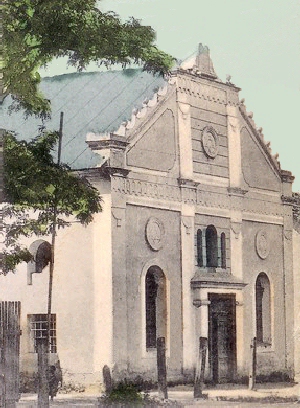
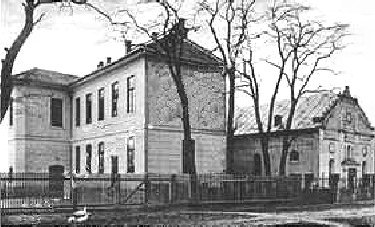
The synagogue was dedicated in 1891, according to Pinkas Hakehillot, and Maroš Borský's survey of Slovak synagogue architecture gives the same year (the Museum of the Jewish People gives 1890). It stood on the main street, next to the elementary school, and its courtyard held the Talmud Torah and the houses of the rabbi and the cantor, with a ritual bath and slaughterhouse nearby. Two early twentieth-century postcards show a rendered hall with a stepped, pilastered gable facing the street. Jews from neighbouring Kiskapos and Csepely also prayed there. The building fell empty in April 1944 and was later pulled down; Borský dates the demolition only to after the Second World War, while the town's KehilaLinks site places it in the 1960s.
Where it stood
Historic: main street of Nagykapos (Veľké Kapušany), next to the elementary school; house number unknown. Today: centre of Veľké Kapušany, near Zoltána Fábryho street, Michalovce district (approximate).
פתיחת מפה גדולה ←הקהילה היהודית
Pinkas Hakehillot records three Jewish families with 18 people in Veľké Kapušany in 1768. The figures rose to 34 in 1828, 81 in 1840 and 268 in 1869, when Jews formed about a fifth of the inhabitants, and reached 333 in 1910, 447 in 1930 and 464 in 1941, about 17 per cent of the town. KehilaLinks describes about 120 Jewish families in 1940-41 and calls the town fairly integrated: Jews owned 42 businesses and 10 workshops in 1921, as well as the only bakery, the cinema, the power plant and the flour mill, and some sat on the municipal council. Besides the synagogue, the community kept two batei midrash, a mikveh, a slaughterhouse and an old and a new cemetery, and employed a cantor and a shochet. Before the First World War it ran a cheder, a Talmud Torah and a four-grade Hungarian-language elementary school. Between the wars Agudat Israel, the Zionist movement, Betar, Hashomer Hatzair and Beit Yaakov were active, alongside a women's association, Bikur Cholim and study societies.
אדריכלות ועיצוב
Borský describes the synagogue as a free-standing building under a saddleback roof with a traditional interior arrangement. The entrance vestibule lay on the western side, with the women's gallery above it, reached by a separate side entrance in the northern façade. The western façade faced the street and was accented by a gable; the portal was flanked by round-arched windows and the front carried historicist decoration. A colour postcard of about 1903 matches this description: it shows a rendered front with a tall stepped gable framed by pilasters, a round medallion in the gable, two round blind panels and a pair of narrow round-arched windows above the doorway, a small projecting porch, and tall round-arched windows to each side. A second postcard shows the synagogue's gable rising behind the two-storey school building. Pinkas Hakehillot calls the style classic. The architect, builder, seating capacity and the appearance of the ark and interior are unknown.
החיים בבית הכנסת
The congregation was Orthodox and closely tied to Hasidic rabbis. Pinkas Hakehillot names Abraham Yaakov Reinitz as apparently the first rabbi, followed by Yehoshua (Cohen) Fried, an Admor, and then three further generations of the Fried family: Yechiel Michel Fried, Yaakov Meir Fried, who served from after the First World War until his death in the 1930s, and Mordechai David (Cohen) Fried, the last rabbi. The rabbis at times kept a yeshiva with a few dozen students, and the rabbi's son Naftali Fried edited the religious publication Har Zvi. In 1944 Yaacov Lefkovics served as dayan. Between the wars there was no Jewish day school, so children attended the Hungarian school and studied at the Talmud Torah in the synagogue courtyard in their free time. KehilaLinks says the town had two synagogues, one Hasidic and one Orthodox, and remembers the Nagykapos cantor, the grandfather of the later cantor Ladislav (Mo) Blum, who taught the boy the liturgy.
הרס
No source found records damage to the synagogue during the Second World War. Its courtyard was used one last time at Passover 1944, when Hungarian gendarmes ordered the Jews to assemble there before their removal to the Uzhhorod ghetto; after mid-April 1944 the building stood empty. About 200 Jews returned after the town's liberation on 23 November 1944 and restored some community institutions, but whether the synagogue was used again is not recorded. Borský's catalogue of demolished Slovak synagogues says only that it was demolished after the Second World War, and the Slovak heritage gazetteer pamiatkynaslovensku.sk repeats this. The KehilaLinks site for the town states that the synagogue was demolished in the 1960s, which would place it in the period of Communist rule in Czechoslovakia, when the remaining congregation had shrunk to a few dozen people. No source names who ordered or carried out the demolition, or whether the building was first sold.
גורל הקהילה
Veľké Kapušany was annexed to Hungary in November 1938 and anti-Jewish laws followed. In 1940-41 dozens of Jewish men were drafted into Hungarian forced-labour units; most were sent to the eastern front and nearly all died. At the end of 1941 several families without Hungarian citizenship were expelled to Kamenets-Podolsk in occupied Ukraine, where they were murdered by the Nazi SS and police. After the Nazi German occupation of Hungary, Hungarian gendarmes gathered the Jews in the synagogue courtyard at Passover 1944, and on 16 April they and the Jews of nearby villages were taken to the ghetto in the brick factory at Uzhhorod (Ungvár). In mid-May 1944 they were deported to Auschwitz, where most were murdered; the Hungarian Wikipedia article gives about three hundred deportees. The last rabbi, Mordechai David Fried, died in the Holocaust. About 200 Jews returned, 224 lived in the town in 1948, and after emigration in 1949 about 70 remained. Isidor Grünfeld led a small community into the 1970s; most then moved to Košice.
האתר כיום
The synagogue stood on the town's main street beside the elementary school, but the exact plot has not been identified in the sources consulted, and what stands on it today is unknown. Pinkas Hakehillot notes that a few former community buildings survive and serve as storehouses and workplaces, without saying which; the synagogue is not among them. Both Jewish cemeteries survive, and the new cemetery contains the ohel of the Fried rabbinic family. A Holocaust memorial stands in the town. The map pin uses the coordinates published by the heritage gazetteer pamiatkynaslovensku.sk, which fall in the town centre on the main street and should be read as approximate.
שמות בולטים
Mordechai David (Cohen) Fried
died 1944Last rabbi of Veľké Kapušany, 1930s-1944Mordechai David Fried succeeded his father Yaakov Meir Fried as rabbi of Veľké Kapušany in the 1930s and led the congregation and its synagogue until the community was destroyed in 1944. He belonged to the Hasidic Fried dynasty that had served the town for several generations; his son Naftali edited the religious publication Har Zvi. The Museum of the Jewish People records that Rabbi David Fried, the last rabbi, died in the Holocaust.
ביוגרפיה או מקור ←Yaakov Meir Fried
died 1930sRabbi of Veľké Kapušany, after the First World War until the 1930sYaakov Meir Fried, grandson of the Admor Yehoshua (Cohen) Fried and son of Yechiel Michel Fried, served as rabbi of Veľké Kapušany from after the First World War until his death in the 1930s, so he led the congregation in the 1891 synagogue during the interwar years. The rabbis of the family at times ran a yeshiva of a few dozen students in the town. He was succeeded by his son Mordechai David Fried.
ביוגרפיה או מקור ←Yehoshua (Cohen) Fried
UnknownRabbi and Hasidic Admor of Veľké Kapušany, late nineteenth centuryAccording to Pinkas Hakehillot, Yehoshua (Cohen) Fried, a Hasidic Admor, led the Veľké Kapušany community after its apparently first rabbi, Abraham Yaakov Reinitz, and founded the rabbinic line that served the town until 1944: his son Yechiel Michel, grandson Yaakov Meir and great-grandson Mordechai David Fried. His exact years of office, and whether he led the congregation when the synagogue was dedicated in 1891, are not stated.
ביוגרפיה או מקור ←יש לכם משהו לתרום?
תמונות, מסמכים, סיפורי משפחה וזיכרונות מבית הכנסת ומהקהילה שלו עוזרים לשמור על ההיסטוריה שלו בחיים.
- Veľké Kapušany (Pinkas Hakehillot Slovakia, English translation)
- Synagogue Architecture in Slovakia: Towards Creating a Memorial Landscape of Lost Community (catalogue entry S0K2001, p. 202, fig. 472)
- Veľké Kapušany – synagóga
- Vel'ké Kapušany, Slovakia (KehilaLinks home page)
- Vel'ké Kapušany Religious
- Vel'ké Kapušany Holocaust
- Velke Kapusany (place record)
- Nagykapos
- List of synagogues in Slovakia
- Veľké Kapušany, reverse geocoding of the published coordinates
Share a memory or thought
No comments yet. Be the first to add one.