
Die Geschichte von Veľký Meder Synagogue
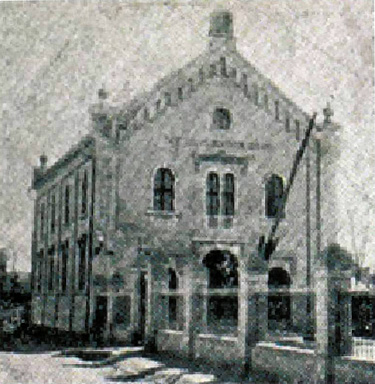
Veľký Meder, called Nagymegyer in Hungarian and Čalovo between 1919 and 1948, is a market town on the Rye Island (Csallóköz) south-east of Dunajská Streda; until 1918 it belonged to Komárom county in Hungary. Jews are recorded there from the mid-eighteenth century, and by the Second World War they formed an Orthodox congregation of about 100 families. The Hungarian Wikipedia article on the town says the Jewish community built a synagogue in 1828 and that it was pulled down in 1955. Elek Fényes's description of Komárom county, published in 1848, already lists 'the synagogue of the Jews' among the town's notable buildings, beside the Reformed and Catholic churches. The list of synagogues in Slovakia on the English Wikipedia instead dates the building to the 1870s, giving 1875, and records it simply as destroyed after the Second World War. The only photograph found shows a tall gabled hall with round-arched windows, which may be a rebuilding of the earlier synagogue, though no source says so. A town map drawn from memory by Alexander Gerhát places the synagogue just east of the main square (Fő tér). The congregation also had a beit midrash, a Talmud Torah and a school. The building stood empty after June 1944 and was demolished under Communist rule.
Where it stood for 127 years
Historic: Nagymegyer (Komárom county), south side of Komáromi utca, the street leading east from Fő tér towards Komárom, landmark 101 on Gerhát's 1944 map; house number unknown. Today: probably Komárňanská, Veľký Meder, Dunajská Streda district; exact plot unknown (approximate).
Größere Karte öffnen →Die jüdische Gemeinde
According to the KehilaLinks history of Nagymegyer, Jews settled in the town in the middle of the eighteenth century, and in the nineteenth century the community had its own synagogue, cemetery and schools. Fényes counted 181 Jews among 2,380 inhabitants in 1848. Later figures given by KehilaLinks are 217 Jews in 1869 (7.7 per cent of the population), 354 in 1877, 416 in 1919 and a peak of 522 in 1941. By the end of the First World War Jews owned most of the town's businesses. The memorial list of 1944 families records tailors, butchers, grocers, shopkeepers, physicians, a teacher and a synagogue attendant. The congregation was Orthodox, strictly observant but described by Yehoshua Weiss, a grandson of one of its rabbis, as moderate. It employed a rabbi, a cantor, a ritual slaughterer, two teachers, two melamdim and a synagogue attendant, and kept a beit midrash, a Talmud Torah with two classrooms, an elementary school with two classrooms, a slaughterhouse and a mikveh. Its chairman and committee were elected every year in the beit midrash by the taxpaying members. After Hungary annexed the town in November 1938, Jews were conscripted for forced labour and their businesses were confiscated.
Architektur und Gestaltung
No plan, description or record of an architect has been found, so the building is known only from a single undated photograph published on the KehilaLinks site for Nagymegyer with the caption 'Nagymegyer Synagogue'. It shows a free-standing, rendered hall seen from a front corner. The entrance front ends in a tall stepped gable outlined with a band of small arches, flanked by slender corner pinnacles, with a small round window high in the gable. Below are paired round-arched windows on the upper level and large round-arched openings on the ground floor. The long side wall has a row of tall round-arched windows divided by pilasters. A low fence runs along the street in front. The round-arched, gabled design is typical of the Romantic historicist synagogues built in Hungary in the middle and later nineteenth century, which fits the 1870s date better than 1828; it is possible that the synagogue recorded by Fényes in 1848 was rebuilt or replaced, but that is an inference from the photograph, not a documented fact. Seating capacity, the builder and the interior arrangement are unknown.
Leben in der Synagoge
The synagogue was the centre of an Orthodox congregation whose first known rabbi, Yoseph Dov Lock, served from 1860 to 1880; he had studied under Moshe Schreiber, the Chatam Sofer of Pressburg, and his tombstone in Nagymegyer calls him a peacemaker. He was followed by his son-in-law Yehoshua-Heshl Weiss from 1880 to 1920, and Weiss by his own son-in-law Shimon Shatin from 1920 to 1938. Charity, Talmud Torah, burial (Chevra Kaddisha) and women's associations were funded mainly by pledges made by men called up to the Torah. Yehoshua Weiss's memoir describes recurring arguments over cutting the rabbi's salary. From about the mid-1930s a group of young Chareidim stopped attending services in the synagogue and prayed separately in the Talmud Torah classrooms, rejecting the rabbi's authority. The dispute ended Shatin's tenure; his successor, Pinkhas Asher Goldberger, was chosen only by the part of the community that had stayed loyal, and he was the rabbi when the community was deported.
Zerstörung
No source found records damage to the synagogue during the Second World War. It stood empty after the deportation of the congregation in June 1944, and the survivors who came back did not form a lasting community. The Hungarian Wikipedia article on Nagymegyer states that the synagogue was demolished in 1955. By then the town was again part of Czechoslovakia and under Communist rule, which had nationalised most property, but no source read says who ordered or carried out the demolition, whether the building had first been sold or handed over by a Jewish body, or what happened to its furnishings and materials. The English Wikipedia list of synagogues in Slovakia gives only 'Destroyed after WW II', with a round date of 1950 that probably stands for 'unknown'. The 1955 date therefore rests on one secondary source and should be checked against local records.
Das Schicksal der Gemeinde
Nagymegyer was annexed by Hungary in November 1938 under the First Vienna Award. After the Nazi German occupation of Hungary in March 1944, the Hungarian authorities deported all the Jews of the town and of the surrounding villages to Auschwitz in June 1944; the town's annual commemoration is held on 15 June, the anniversary of the deportation. The memorial list compiled after the war records about 110 families, and KehilaLinks gives 418 townspeople who were murdered. Rabbi Pinkhas Asher Goldberger was deported with his wife and three children, his brother-in-law and three sisters-in-law; only he and his youngest sister-in-law, Adele, survived. About 100 Jews returned. They met an unfriendly reception from the local population and gradually left; most had emigrated to Israel by 1949. No Jews live in Veľký Meder today. The walled Jewish cemetery survives and is looked after by a caretaker.
Der Ort heute
The exact plot of the synagogue has not been identified in any source read. Alexander Gerhát's map of Jewish homes in 1944 marks it as landmark 101, a rectangular building with a Star of David on the south side of the street running east from the main square (Fő tér) towards Komárom, but the map is a sketch without house numbers. What stands on the site today is unknown, and no surviving fragment is recorded. The street is probably today's Komárňanská, and the map pin is placed on it, but it marks the street, not the plot. Since June 2004 a trilingual memorial plaque in Slovak, Hebrew and Hungarian has recalled the deported Jews of the town. The Jewish cemetery, with an estimated 100 to 500 gravestones, is walled and maintained.
Bedeutende Namen
Yoseph Dov Lock
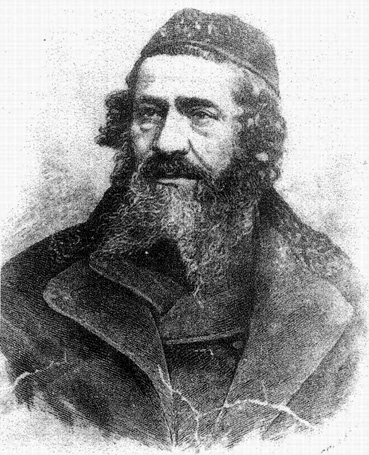
rabbi 1860-1880First rabbi of Nagymegyer, 1860-1880Lock is named in Yehoshua Weiss's memoir as the first rabbi of the Nagymegyer congregation, serving from 1860 to 1880. He had been a pupil of Moshe Schreiber, the Chatam Sofer of Pressburg, and his tombstone in the Nagymegyer Jewish cemetery describes him as a mediator and peacemaker. His son-in-law Yehoshua-Heshl Weiss succeeded him, beginning a line of rabbis related by marriage that led the synagogue until 1938.
Biografie oder Quelle →Yehoshua-Heshl Weiss
rabbi 1880-1920Rabbi of Nagymegyer, 1880-1920Weiss, son-in-law of Rabbi Lock, led the Nagymegyer congregation for forty years, from 1880 to 1920, the longest tenure recorded. He was the grandfather of Yehoshua Weiss, who wrote the KehilaLinks memoir of the community. His remains were later moved from the Nagymegyer cemetery to Har HaMenuchot in Jerusalem. His son-in-law Shimon Shatin succeeded him.
Biografie oder Quelle →Shimon Shatin
rabbi 1920-1938Rabbi of Nagymegyer, 1920-1938Shatin married Beile Haye, daughter of Rabbi Yehoshua-Heshl Weiss, and followed him as rabbi of Nagymegyer from 1920 to 1938. In his last years a group of young Chareidim broke away from services in the synagogue and prayed in the Talmud Torah classrooms, rejecting rabbinic authority; according to the memoir his tenure ended as this dispute intensified. His later life is not recorded in the sources read.
Biografie oder Quelle →Pinkhas Asher Goldberger
UnknownLast rabbi of Nagymegyer, from c. 1938 to 1944Goldberger succeeded Shatin, chosen only by the part of the congregation that had remained loyal to the synagogue, and was the rabbi when the community was deported to Auschwitz in June 1944. His wife, three children, brother-in-law and two of his sisters-in-law were murdered. He and his youngest sister-in-law, Adele, survived, married and emigrated to the United States, where he founded a small synagogue in Forest Hills, New York. He is buried on Har HaMenuchot in Jerusalem.
Biografie oder Quelle →Haben Sie etwas beizutragen?
Fotos, Dokumente, Familiengeschichten oder Erinnerungen an diese Synagoge und ihre Gemeinde halten ihre Geschichte lebendig.
- Nagymegyer (Hungarian Wikipedia)
- List of synagogues in Slovakia
- Our Shtetl: Nagymegyer, Hungary, now Veľký Meder, Slovakia
- Nagymegyer, Hungary (KehilaLinks main page)
- Jewish Homes in Nagymegyer in 1944 (map by Alexander Gerhát)
- Helping to Remember Jewish Nagymegyer
- The tragic list of the Jewish families of Nagymegyer in 1944
- Veľký Meder Jewish cemetery (US Commission No. SLCE000303)
- Komárňanská, Veľký Meder (OpenStreetMap way 321892804)
Share a memory or thought
No comments yet. Be the first to add one.