
הסיפור של Simmering Synagogue, Vienna (Simmeringer Tempel)
Simmering, an industrial district on the south-eastern edge of Vienna, had a small Jewish population from the nineteenth century, organised first in a prayer association founded in 1863. On 19 August 1891 local Jews founded the Israelitischer Tempelverein Simmering, whose main aim was to build a proper synagogue for the district. The association commissioned Jakob Gartner, a Moravian-born architect who designed many synagogues across the Habsburg lands and four in Vienna. The foundation stone was laid on 2 December 1898, timed to the fiftieth jubilee of Emperor Franz Joseph I's reign, and the building was inaugurated on 24 August 1899; the historian Herbert Exenberger corrected Hugo Gold's later date of 1904.
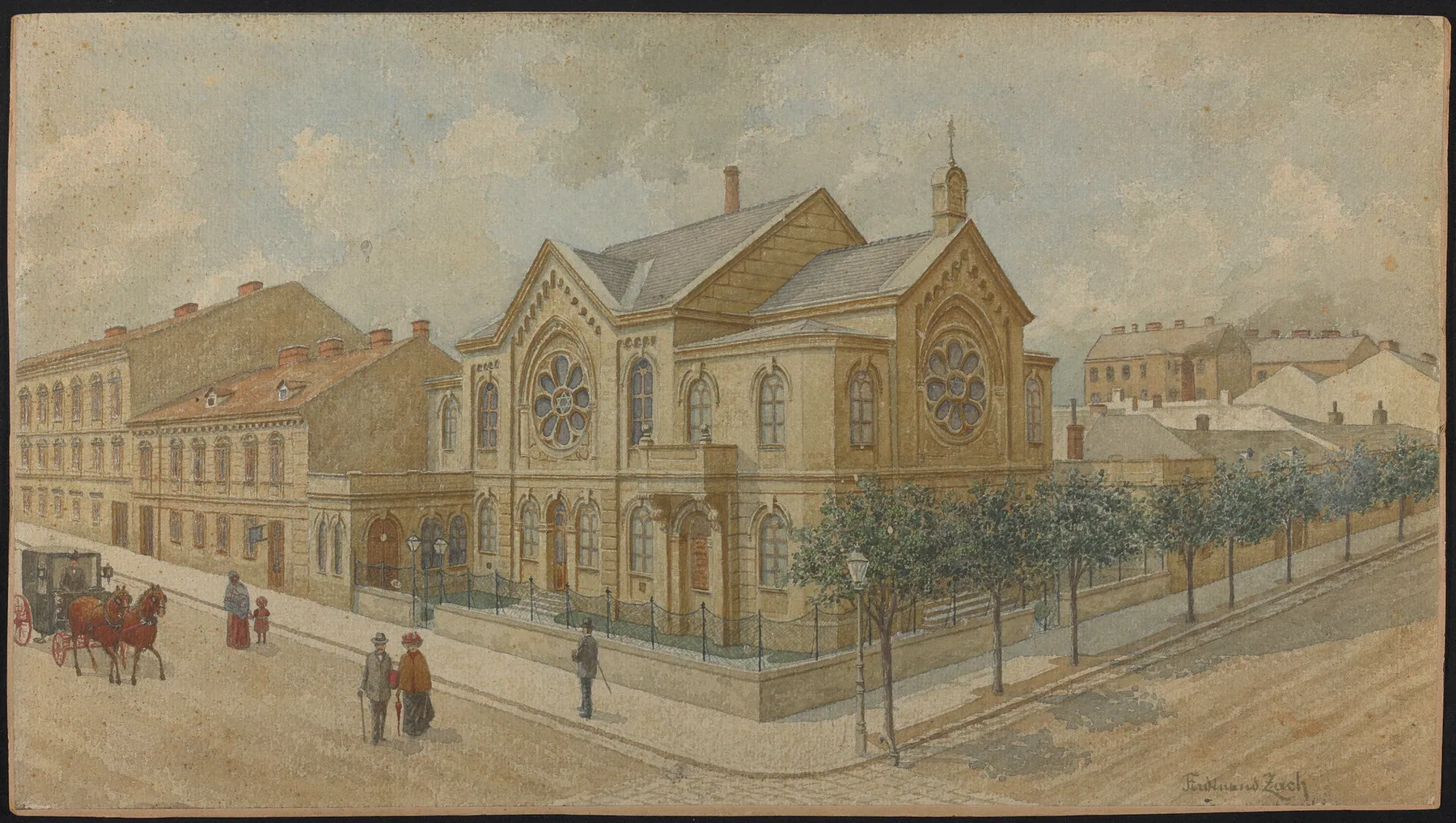
The synagogue stood at Braunhubergasse 7, on the corner of Hugogasse, set back behind a forecourt and railings. It was a square, two-storey hall with about 380 seats, with a small winter synagogue and a caretaker's flat attached, and it also housed a Hebrew and Bible school. During the November Pogrom of 10 November 1938 it was looted and wrecked, and in 1939 the shell was demolished. The plot passed through Nazi asset companies to a local builder and is now occupied by a residential building.
Where it stood for nearly 40 years
Historic: Braunhubergasse 7, corner of Hugogasse, Wien XI (Simmering). Today: residential building at Braunhubergasse 7, 1110 Vienna (exact).
פתיחת מפה גדולה ←הקהילה היהודית
Jews are recorded in the Simmering area as early as 1308, when a Viennese Jew named Lebmann received a rent on the mill at Ebersdorf in pledge, but the modern community grew only in the nineteenth century as Simmering industrialised. An Israelite prayer association (Israelitische Betgenossenschaft) was founded in 1863, and a Jewish religious school was set up in 1875. The Israelitischer Tempelverein Simmering, founded on 19 August 1891, was a private synagogue association within the Vienna Jewish community (Israelitische Kultusgemeinde Wien); building the Braunhubergasse synagogue was its first goal. The association also ran a women's charity. No membership figures or list of officers were found in the sources read. The association served Simmering until 1938; the Nazi Stillhaltekommissar dissolved its women's charity in 1939, sending half its assets to the Nazi party in Vienna, and dissolved the association itself in 1940.
אדריכלות ועיצוב
Jakob Gartner designed a square, two-storey building, free-standing on three sides and set back from the street in a forecourt, at the corner of Braunhubergasse and Hugogasse. Its two street fronts, to the west and south, each had a projecting central bay (risalit) under a triangular gable. Unlike several of Gartner's other synagogues it had no dome and no towers. Ferdinand Zach's drawing of about 1900 shows a pale rendered building with a large rose window in each gable above a group of round-arched windows, round-arched doors, a pitched roof with a small turret at the ridge, and low railings and young trees around the forecourt. Inside, four cast-iron columns carried the women's galleries. The plans provided 249 seats for men and 133 for women. A smaller winter synagogue was attached on the Hugogasse side and the caretaker's flat on the Braunhubergasse side. The ANU Museum notes that Gartner liked Romanesque elements, which the round arches and rose windows reflect.
החיים בבית הכנסת
Services were led by rabbis and cantors employed by the Tempelverein. The Wien Geschichte Wiki names the rabbis Armin Abeles and S. Margulies, and a succession of cantors: Adolf Schäfer from 1896, Moritz Harendorf and J. Pordes until 1924, and Max Schidlo as chief cantor from 1926. The building was more than a prayer hall. A Hebrew language and Bible school was set up in the building, in a district that had had a Jewish religious school since 1875, and on 7 October 1904 a regular youth service was introduced. Besides the main hall, the congregation had a smaller winter synagogue attached on the Hugogasse side, and the association supported a women's charity. No description of the festival services or of the furnishings of the ark has been found in the sources read, and no photograph of the interior is known.
הרס
The synagogue was looted and destroyed on 10 November 1938, during the November Pogrom, by the Nazis; neither the Wien Geschichte Wiki nor Exenberger names the individual party members or units who carried it out. Demolition followed at the end of 1938. An official of the Nazi Stillhaltekommissar, the agency that seized and liquidated Jewish associations, agreed with the builder Franz Kabelac that he would take the building down to the ground-floor walls by 15 January 1939. Kabelac was paid 1,000 Reichsmarks and kept the materials; the bricks went to the local Nazi party group (NSDAP Ortsgruppe Herderplatz) and the firewood to the Nazi welfare organisation, the NS-Volkswohlfahrt. By December 1939 the city building authority reported the synagogue as demolished. The plot was valued at 7,650 Reichsmarks in January 1939, transferred in March 1939 to the Aufbaufonds Vermögensverwaltungs GmbH and sold in January 1940 to the builders Anton and Julie Duraz for 8,000 Reichsmarks, who used it as a storage yard.
גורל הקהילה
After the Anschluss of March 1938 the Jews of Simmering were pushed out of public life step by step. A police decree of 5 August 1938 banned them from the Braunhuberpark beside the synagogue, and on 16 May 1938 a Jewish pupil of the Braunhuberschule was transferred to a segregated Jewish school, his principal writing 'transfer to the race school' on his record. That boy, Erich Sicher, born in 1928, was deported with his mother from Vienna to Riga on 3 December 1941 and murdered. The Simmering doctor Leopold Abelles died a day after being interrogated by the Gestapo. Rosa Fischer, a Hungarian Jewish forced labourer at the Simmering gasworks, died on 24 August 1944. The total number of Simmering Jews murdered is unknown. Whether any Simmering Jews returned after 1945 is unknown.
האתר כיום
In 1946 the property passed to the Austrian Federal Railways, and the Israelitische Kultusgemeinde waived restitution in a settlement with the builder Duraz, recorded in 1948 by the Geschichte Wiki and in 1952 by Exenberger. In 1977 a residential building with owner-occupied flats was built on the plot, and it occupies Braunhubergasse 7 today. Nothing of the synagogue is visible. A memorial stone was unveiled on 9 November 2003 in the park at the corner of Braunhubergasse and Hugogasse, opposite the former synagogue.
שמות בולטים
Jakob Gartner
1861-1921Architect of the synagogueGartner, born in Přerov in Moravia, set up his own practice in Vienna in 1888 and became one of the most prolific synagogue architects of the late Habsburg monarchy, building synagogues from Pilsen and Olomouc to Debrecen and Târgu Mureș. In Vienna he designed four, including the Simmering synagogue of 1898-99 for the Israelite Temple Association of Simmering; all four were destroyed in 1938. He died in Vienna in 1921.
ביוגרפיה או מקור ←Armin Abeles
UnknownRabbi of the Simmering synagogueThe Wien Geschichte Wiki names Armin Abeles as one of the two rabbis of the Simmering Temple Association, with S. Margulies, who preached and taught in the Braunhubergasse synagogue. The dates of his service and the details of his life and fate were not found in the sources read in this research.
ביוגרפיה או מקור ←Max Schidlo
UnknownChief cantor from 1926According to the Wien Geschichte Wiki, Max Schidlo became chief cantor (Oberkantor) of the Simmering synagogue in 1926, succeeding the cantors Moritz Harendorf and J. Pordes, who served until 1924. He was therefore the cantor during the synagogue's last twelve years, up to its destruction in November 1938. Nothing further about his life or fate was found.
ביוגרפיה או מקור ←יש לכם משהו לתרום?
תמונות, מסמכים, סיפורי משפחה וזיכרונות מבית הכנסת ומהקהילה שלו עוזרים לשמור על ההיסטוריה שלו בחיים.
- Simmeringer Tempel
- Gleich dem kleinen Häuflein der Makkabäer: Die jüdische Gemeinde in Simmering 1848-1945 (publisher's excerpt)
- Ansicht der Synagoge in der Braunhubergasse 7 in Wien XI. (Simmering), Inv. Nr. 4215
- Momentaufnahmen einer ausgelöschten Welt
- Jewish Communities of Austria (synagogue architecture page)
- Jakob Gartner
- Braunhubergasse 7, Simmering (OpenStreetMap way 200599604)
Share a memory or thought
No comments yet. Be the first to add one.