
История Döbling Synagogue (Dollinergasse, Vienna)
Döbling, Vienna's 19th district, had a Jewish temple association from 1888, first organised as a Chewra Kadischa under the district rabbi David Brüll and reformed in 1893 as the Israelite Temple Association for the 19th District. It worshipped in rented rooms in Vormosergasse and, from 1904, in Gatterburggasse. A plan to build an expensive new temple failed for lack of money, and the association came close to breaking up. A new committee formed around Julius Lederer instead bought the existing house at Dollinergasse 3 in Oberdöbling, and the Israelitische Kultusgemeinde Wien contributed 40,000 Kronen.
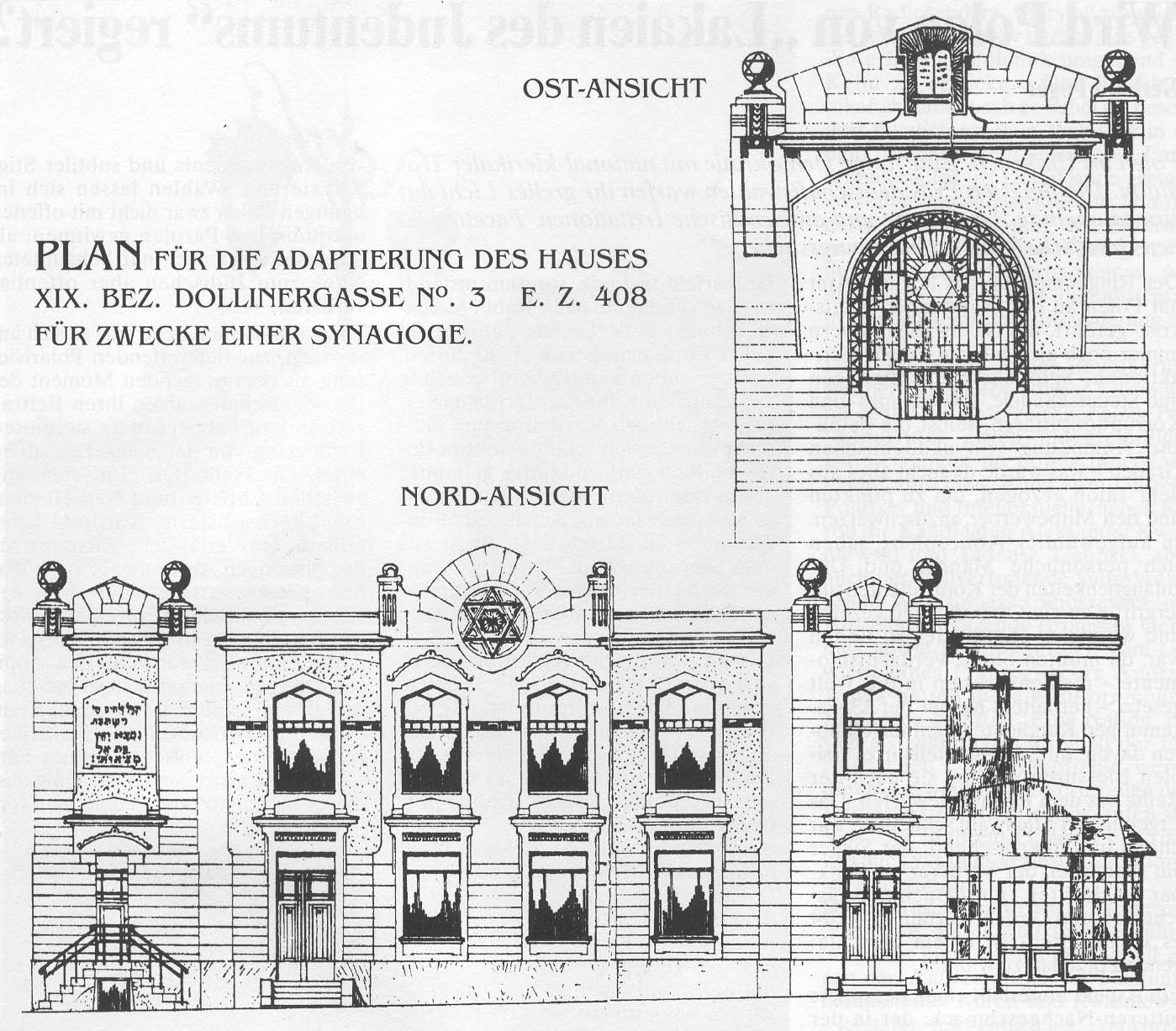
The young local architect Julius Wohlmuth turned the two-storey house, which stood free on three sides, into a synagogue with women's galleries, and it was consecrated on 5 September 1907. Besides the prayer hall it housed a Hebrew and Bible school and the rooms of district charities. Arnold Frankfurter preached there from 1919 and David Bohomolny was cantor. On 10 November 1938 the interior was devastated but the walls survived. The Nazi liquidation authority sold the building in 1939; after a 1953 restitution settlement the buyers kept it, stripped of every Jewish feature, as a factory. It was demolished in 1995 and an apartment building now stands on the site.
Where it stood for 88 years
Historic: Dollinergasse 3, XIX. Bezirk (Döbling, Oberdöbling), Vienna. Today: Dollinergasse 3, 1190 Wien; apartment building on the same plot (exact).
Открыть большую карту →Еврейская община
The Jews of Döbling were a small district congregation within the Israelitische Kultusgemeinde Wien, the unified community of the capital, which numbered more than 200,000 people in 1938. Döbling was a prosperous villa district on the northern edge of the city, and its Jewish residents organised themselves through voluntary associations rather than a separate community. The Temple Association grew out of a burial society registered in 1888 by the district rabbi David Brüll and four other founders, and took its lasting name in 1893; Jakob Kohn filed a revision of its statutes in 1911. Its last chairman was Béla Fränkl. Other bodies met in the same building: a Women's Charity Association for the 19th District, a separate Chewra Kadischa for the district founded in 1924, and the League of Jewish Parents for the 19th District. Two marble tablets in the entrance hall honoured Julius Lederer, whose initiative had saved the association in 1904, and quoted Isaiah 56:7, 'My house shall be called a house of prayer for all peoples'. The association was dissolved in 1939 and its assets passed to the Kultusgemeinde.
Архитектура и дизайн
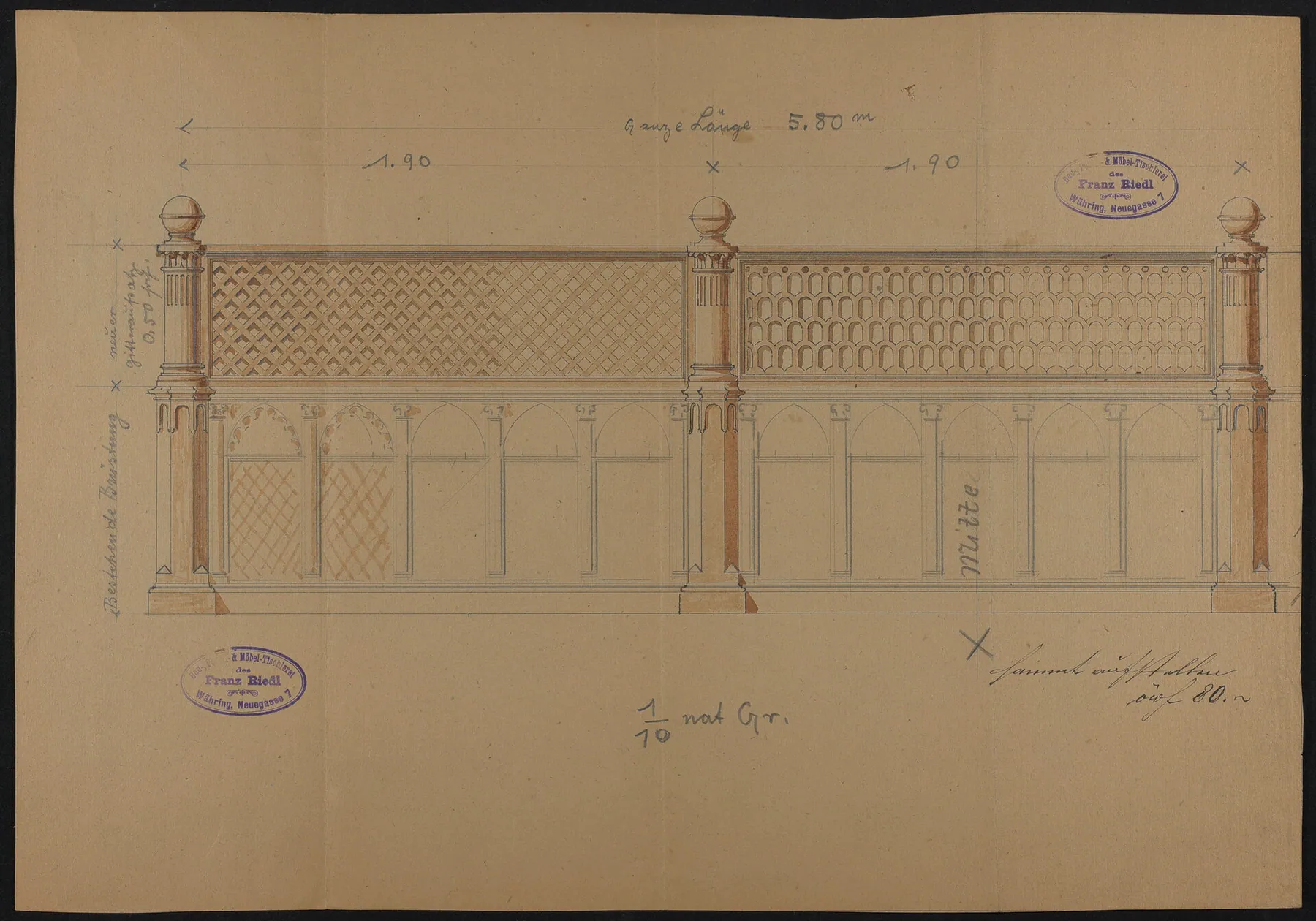
The synagogue was not purpose-built. It was a two-storey residential house of 1897 that stood free on three sides, converted in 1907 to plans by Julius Wohlmuth. His published plan shows a long north front of five bays to Dollinergasse, with two projecting end bays ending in small curved gables crowned by pairs of Stars of David on posts. The middle gable carried a large Star of David framed by stylised rays, and the windows had shaped Jugendstil heads. The east front had a great round-arched window filled with a Star of David, and a Hebrew inscription panel marked the entrance. Sources describe the treatment as Jugendstil, reminiscent of Otto Wagner's buildings. Inside, the prayer hall had women's galleries; a surviving 1907-era joiner's design from Franz Riedl of Währing shows a new lattice grille to be set on the existing gallery parapet. The Wien Geschichte Wiki gives 162 men's and 106 women's seats; another study gives 460 seats. The Jewish Museum Vienna also holds ten drawings by Alexander Neumann titled 'Synagoge für Döbling' showing a much larger domed building with a rose window, which do not match the converted house.
Жизнь в синагоге
The synagogue served as the religious centre of Jewish Döbling for thirty-one years. It was run by the Temple Association, which engaged its own preacher and cantor. From 1919 the association's preacher was Dr Arnold Frankfurter, an army rabbi who had headed the Jewish military chaplaincy in Vienna during the First World War and who also ran the language and Bible school in the building. The cantor was David Bohomolny. The house was more than a prayer hall: it contained classrooms for Hebrew and Bible teaching and gave space to the district's Women's Charity Association and to the League of Jewish Parents, so that worship, schooling and welfare work met under one roof. In 1919 a memorial tablet for members killed in the First World War was set up. The marble tablets in the entrance hall recalled the role of Julius Lederer in creating the synagogue and carried the verse from Isaiah calling the house a house of prayer for all peoples.
Разрушение
During the November Pogrom, on 10 November 1938, the synagogue was devastated. The Wien Geschichte Wiki records that the interior was completely wrecked but the building was not destroyed; it was not burned, and its walls stood. No source read names the men who wrecked this building; across Vienna, according to the same wiki, the synagogues were attacked chiefly by Nazi SS units, with Nazi SA formations and party offices looting Jewish property. The Nazi Stillhaltekommissar, the office that liquidated Jewish associations, then sold the property to Emil and Stefanie Polese for 23,000 Reichsmarks. Every architectural feature that marked it as a synagogue was removed, and the building became a factory making mayonnaise, aspic and pickled herring; a later study noted a textile business there. In a restitution settlement of 20 March 1953 the owners paid the Kultusgemeinde 147,000 Schilling and kept the building. It was demolished in 1995; who carried out the demolition is not recorded in the sources read.
Судьба общины
After the Anschluss of March 1938 about 206,000 Jews lived in Vienna. During the November Pogrom more than 6,500 were seized, and between 3,500 and 4,800 men were sent to Dachau. Under Nazi persecution around 130,000 Viennese Jews emigrated by the end of 1941, forced to leave their property behind and pay the Reich Flight Tax. Most of those who remained were deported from 1941-42 onwards; according to the City of Vienna more than 65,000 Viennese Jews were murdered. The Döbling Temple Association was dissolved in 1939 and absorbed by the Kultusgemeinde. Its preacher Arnold Frankfurter was taken by the Nazis in 1938 and died in Buchenwald concentration camp on 14 February 1942. The fates of the cantor David Bohomolny, the last chairman Béla Fränkl and the members of the congregation were not traced in this research. In 1946 only about 4,000 Jews were living in Vienna, and no congregation was re-established at Dollinergasse.
Место сегодня
The converted synagogue building was demolished in 1995, and a modern apartment building now occupies the plot at Dollinergasse 3 in Oberdöbling. No part of the 1897 house or of the synagogue survives. The site lies in a quiet residential street of villas and apartment houses north of Döblinger Hauptstraße. A plaque on the present building, installed in 1997 to replace an earlier one of 1990, records the synagogue. Since 2018 the address has also been one of the Vienna sites marked by an illuminated symbol remembering the synagogues destroyed in or after November 1938.
Значимые имена
Julius Wohlmuth
c. 1874-1931Architect of the 1907 conversionWohlmuth drew the plans that turned the 1897 house at Dollinergasse 3 into a synagogue in 1907. According to the Jewish Museum Vienna he had just finished his training at the Staatsgewerbeschule and lived in Döbling himself; he died in 1931 at the age of 57. His Jugendstil design added curved gables, Stars of David and a great round-arched window to an ordinary residential building.
Биография или источник →Julius Lederer
UnknownFounder; leader of the committee that bought Dollinergasse 3When the Döbling Temple Association's plan for an expensive new temple collapsed in 1904 and the association seemed about to dissolve, Lederer gathered a new committee that bought the house at Dollinergasse 3 so that the district would at least have a modest synagogue. Two marble tablets in the entrance hall honoured his work. The Jewish Museum Vienna describes a donor of 2017 as the great-grandson of the synagogue's founder.
Биография или источник →Arnold Frankfurter
1881-1942Preacher of the Temple Association from 1919Dr Arnold Frankfurter, born in Szobotist in 1881 and educated at Vienna and Berlin, served as an army rabbi and headed the Jewish military chaplaincy in Vienna during the First World War. From 1919 he was the Döbling Temple Association's preacher in the Dollinergasse synagogue and ran its language and Bible school. The Nazis took him in 1938, and he died in Buchenwald concentration camp on 14 February 1942.
Биография или источник →David Bohomolny
UnknownCantorBohomolny is named by the Wien Geschichte Wiki as the cantor of the Dollinergasse synagogue, where he led the sung liturgy for the Döbling Temple Association alongside the preacher Arnold Frankfurter. The years of his service, his origins and his fate after the association was dissolved in 1939 were not found in the sources read.
Биография или источник →Béla Fränkl
UnknownLast chairman (Obmann) of the Temple AssociationFränkl was the last chairman of the Israelite Temple Association for the 19th District, the body that owned and ran the Dollinergasse synagogue, and so its lay head when the building was wrecked in November 1938 and the association was dissolved in 1939. He is named both by the Wien Geschichte Wiki and by the 2003 David study; nothing further about him was found.
Биография или источник →Вам есть чем поделиться?
Фотографии, документы, семейные истории и воспоминания об этой синагоге и её общине помогают сохранить её историю.
- Dollinertempel
- Döbling Synagogue
- Jüdische Andachtsstätten in Wien vor dem Jahre 1938
- Out and about in our city: Döbling
- Zehn Pläne von Alexander Neumann für die Synagoge in der Dollingergasse 3, Wien XIX., Döbling (Inv. Nr. 12398)
- File:Synagoge Doebling.jpg
- Arnold Frankfurter
- Novemberpogrom
- History of the Jews in Vienna
- Dollinergasse 3 (OpenStreetMap way 100962742)
Share a memory or thought
No comments yet. Be the first to add one.