
Historia Hietzing Synagogue (Neue Welt Tempel), Vienna
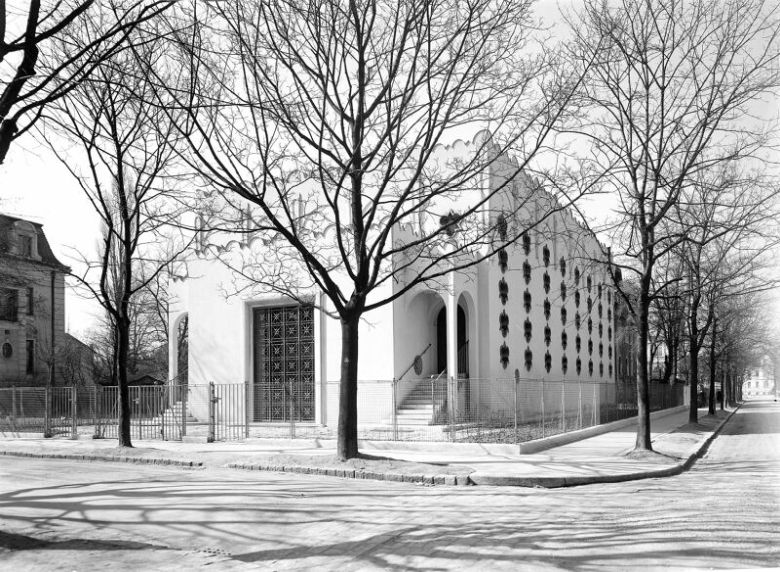
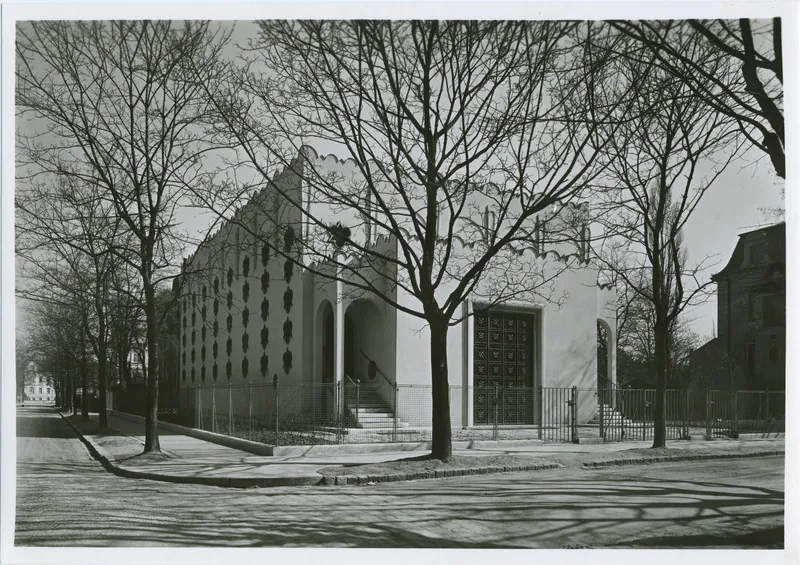
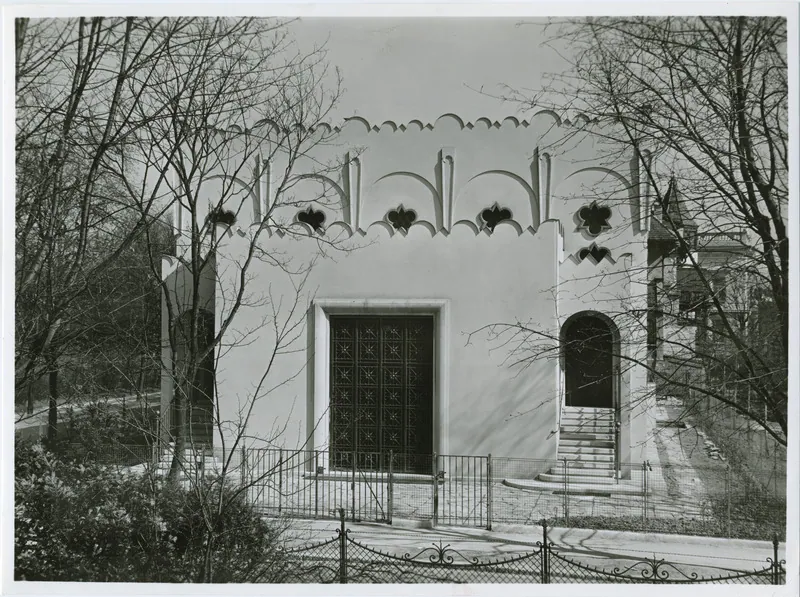
Hietzing, Vienna's 13th district, is a leafy residential quarter on the city's western edge. Its Jews belonged to the Vienna Israelitische Kultusgemeinde but from 1904 at the latest had their own association, the Tempelverein of the 13th district, which prayed in a converted room at Penzinger Straße 132 with 130 seats. The room was cramped, and for the High Holidays the congregation rented a hall in the Gasthof Weißer Engel on Hietzinger Platz. A design competition in 1912 came to nothing because of the First World War. In January 1924 the association bought a corner plot at Eitelbergergasse 22 and Neue-Welt-Gasse 7 and held a second competition, won by Arthur Grünberger, who submitted his entry with Adolf Jelletz. The permit was granted on 2 August 1928, Jelletz supervised the building, and the use permit followed on 23 September 1929, when the synagogue was consecrated. With its white walls, star-shaped window clusters and battlemented parapet it served the district for only nine years. On 10 November 1938 it was set on fire; the ruin was pulled down during 1939 and the plot sold to the demolition contractor's wife. After restitution to the Jewish community in 1950 the land was sold in 1968 and built over with flats.
Where it stood for nearly 10 years
Historic: Eitelbergergasse 22 / Neue-Welt-Gasse 7, Wien XIII (Hietzing). Today: residential building at Eitelbergergasse 22, 1130 Wien, on the corner of Neue-Welt-Gasse (exact plot; pin on the present house number).
Otwórz większą mapę →Społeczność żydowska
Roland Müller's study of the synagogue gives 3,244 Jewish residents in Hietzing in 1910. They were members of the Vienna Israelitische Kultusgemeinde, which ran the large city synagogues, but like many Viennese districts they organised a local temple association for everyday worship. The Tempelverein Wien-Hietzing was approved by the Lower Austrian governor's office in 1904 and kept a permanent prayer room at Penzinger Straße 132. That room had been planned as a coffee house: it had 130 seats, 40 of them for women, a centre aisle only 90 cm wide, and only the front row of women could see the cantor. The association's long effort to build a proper synagogue, through competitions in 1912 and 1924 and a building campaign in 1928-29, shows a prosperous and settled congregation. Its members included families such as those of Otto Fleming, Valerie Klimt and Henry Tamar, whose later recollections were collected by Müller. The association's last chairman was its chief cantor, Samuel Einhorn.
Architektura i projekt
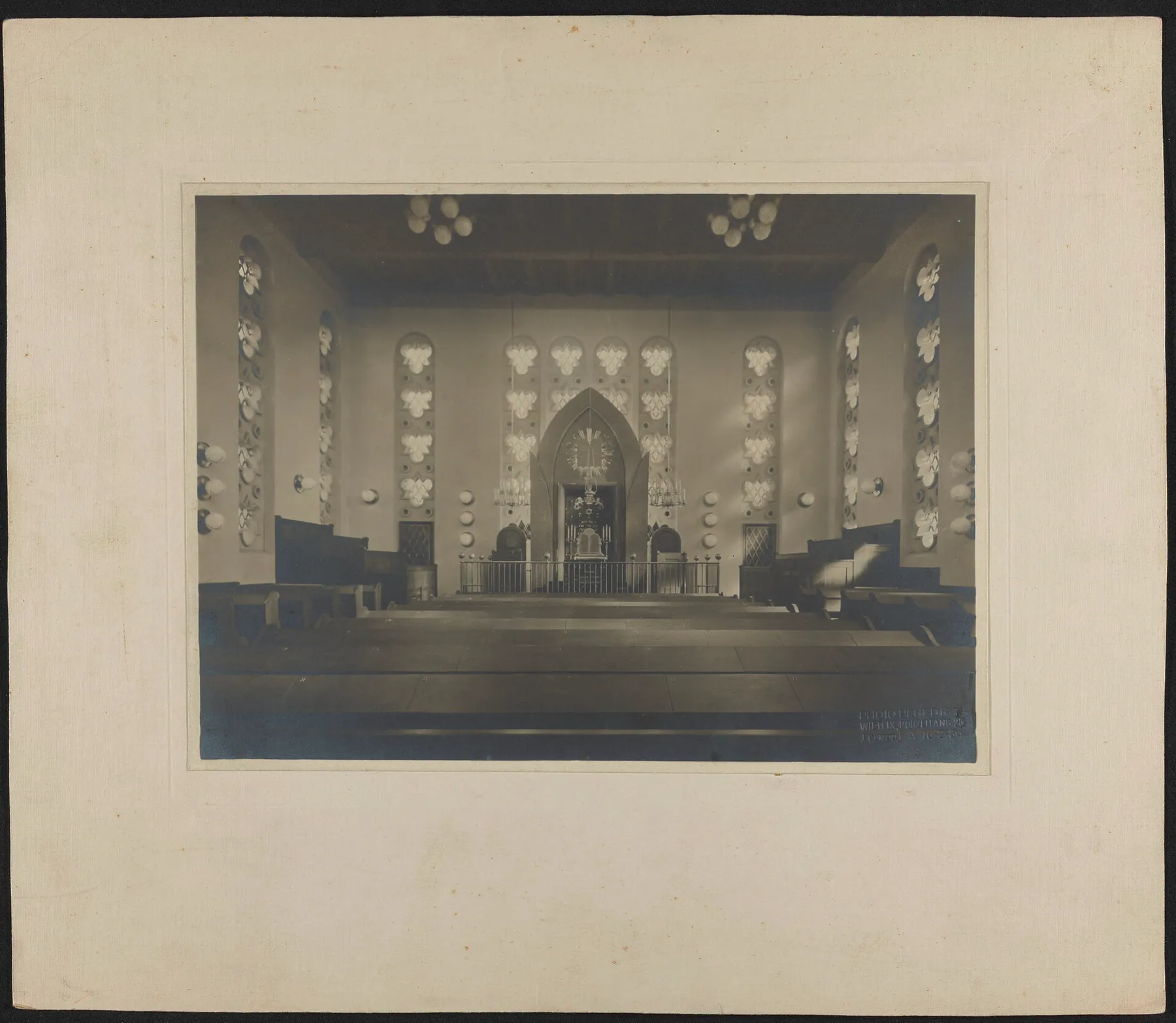
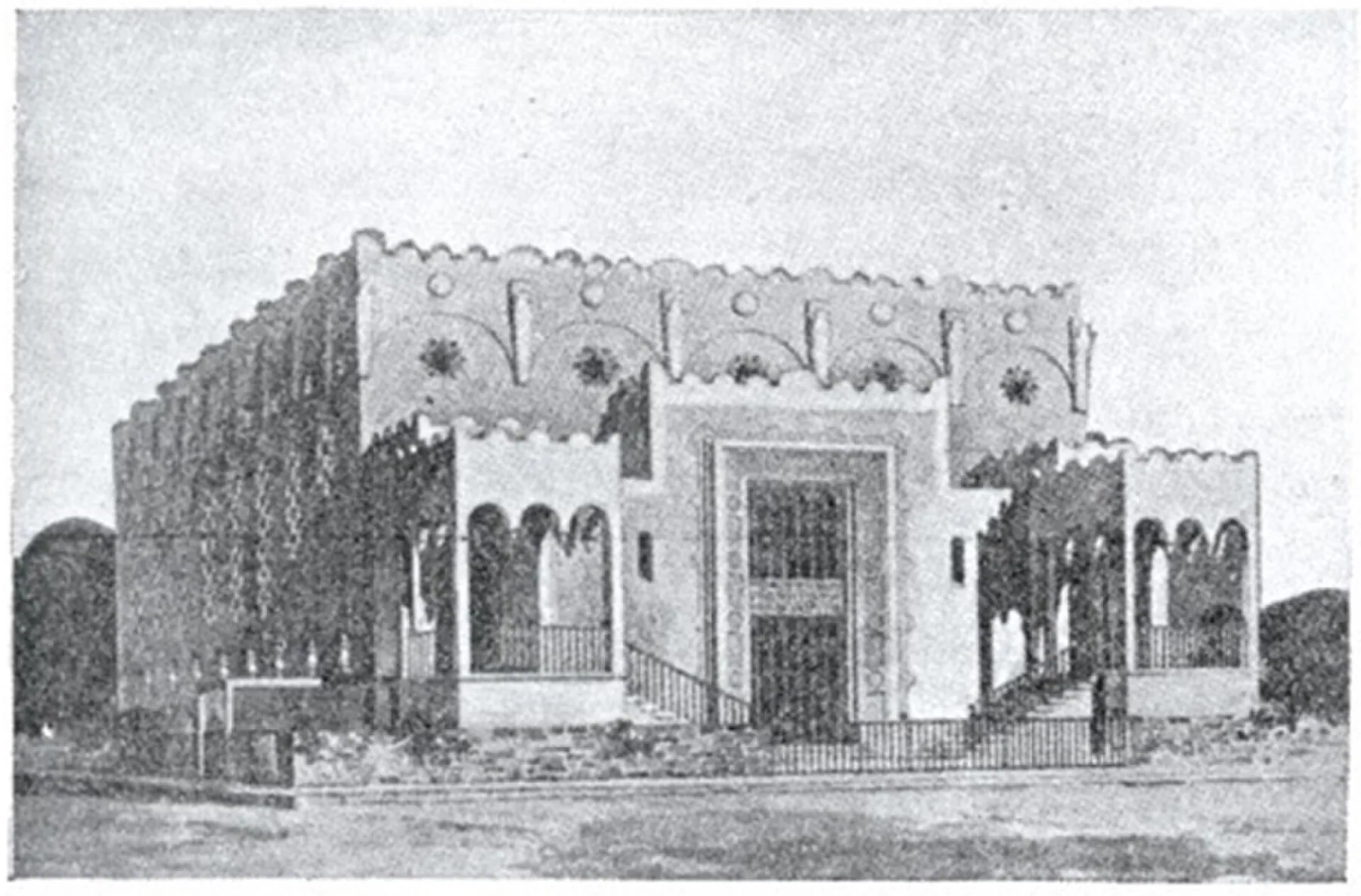
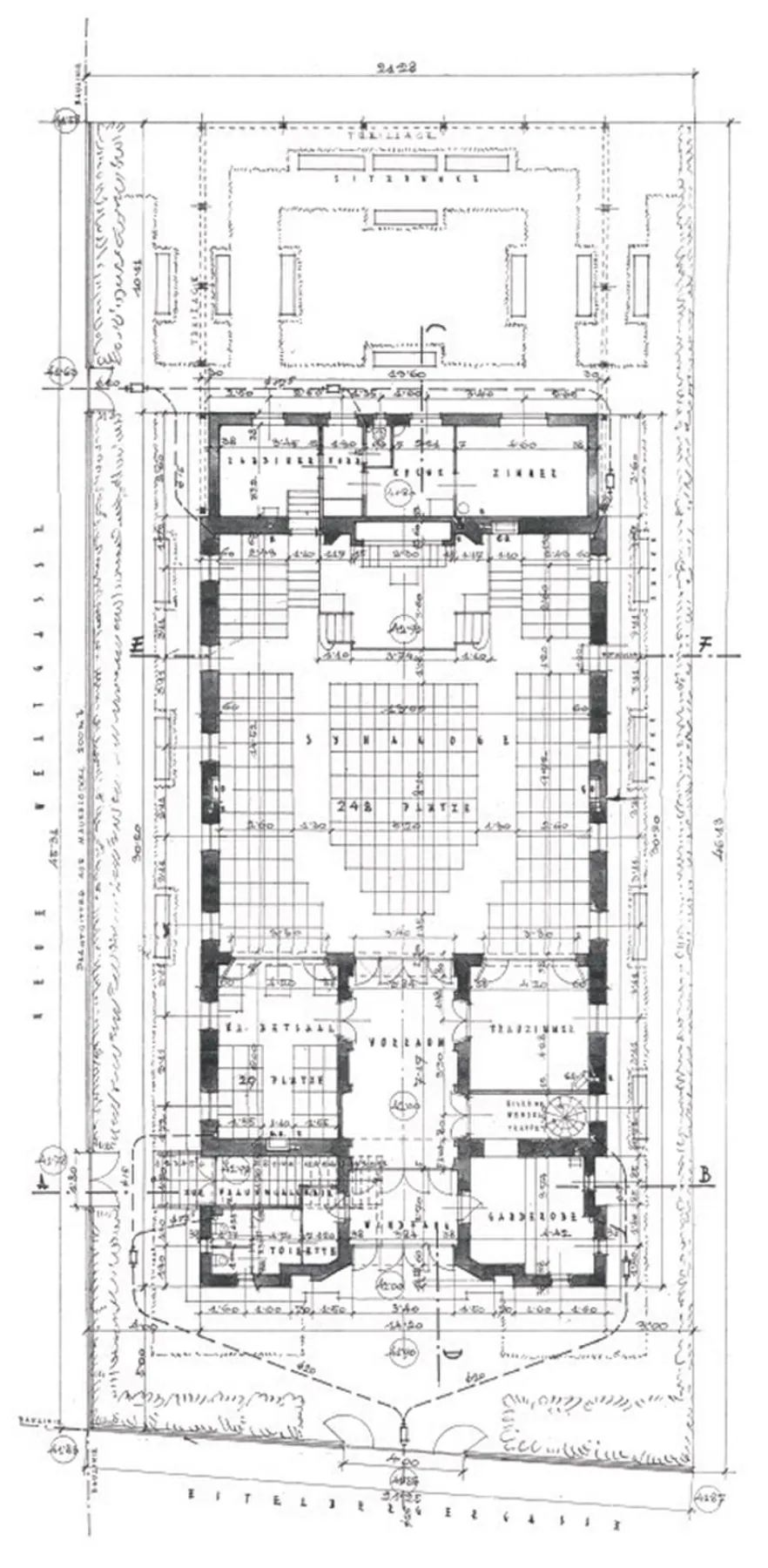
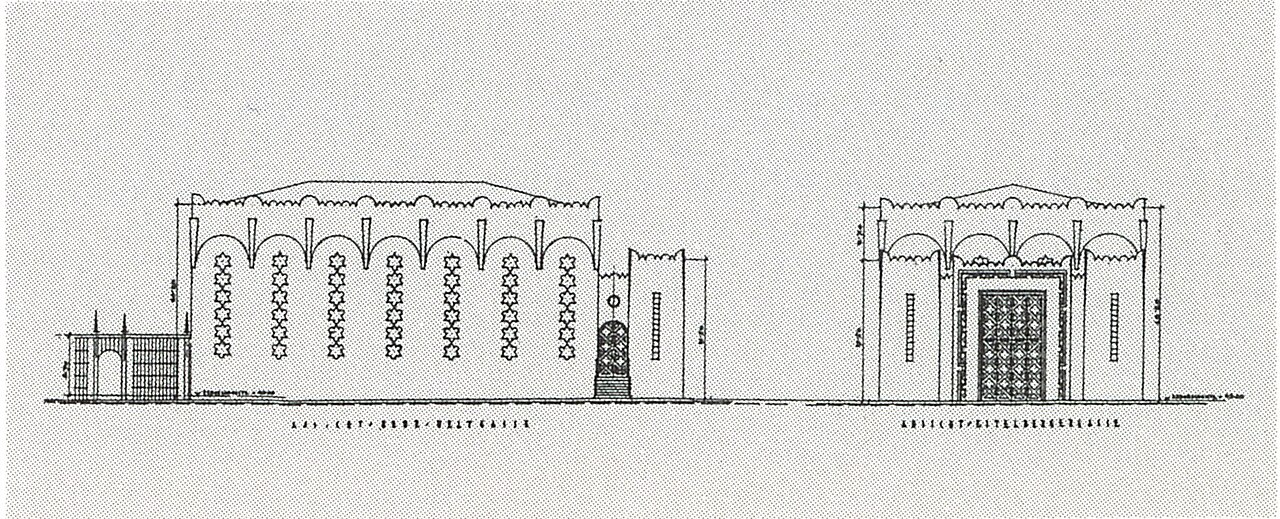
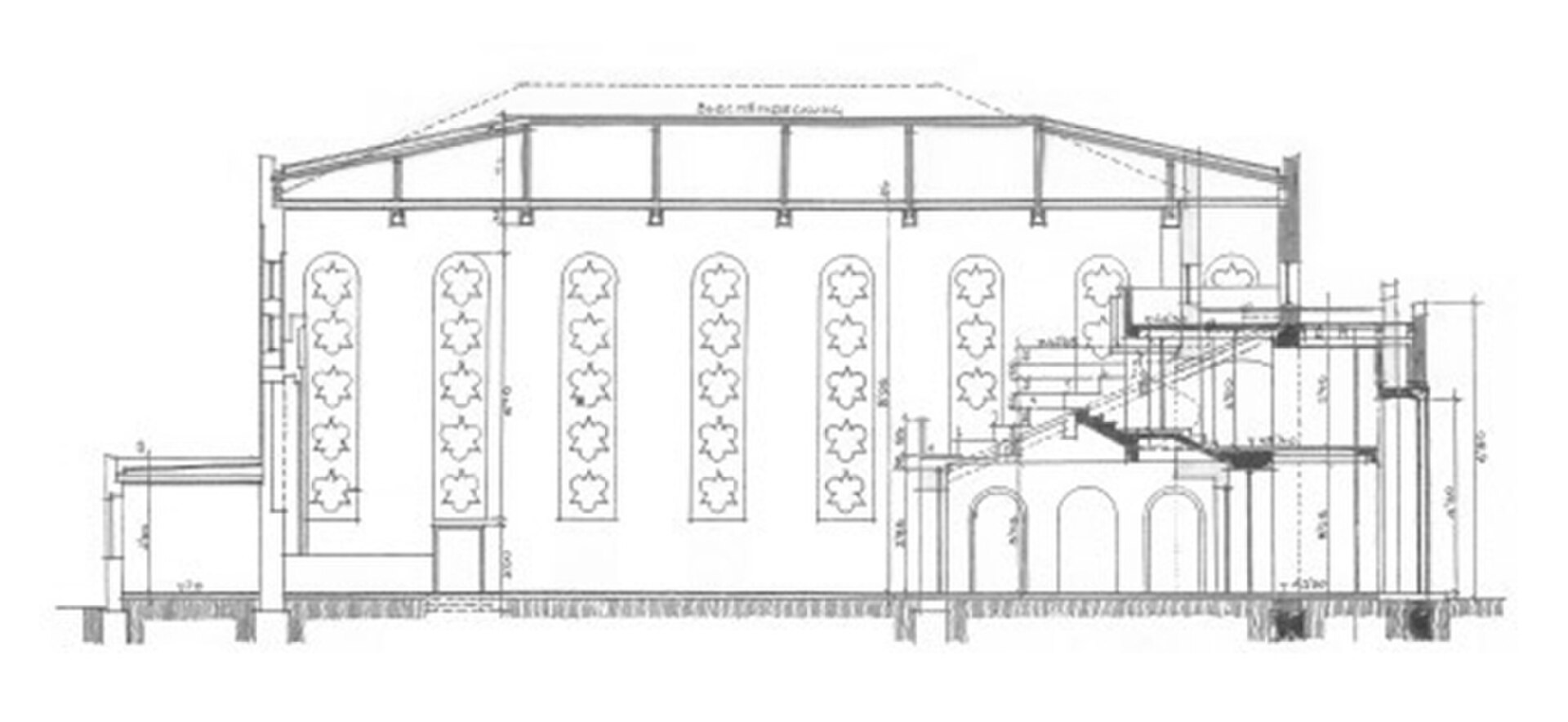
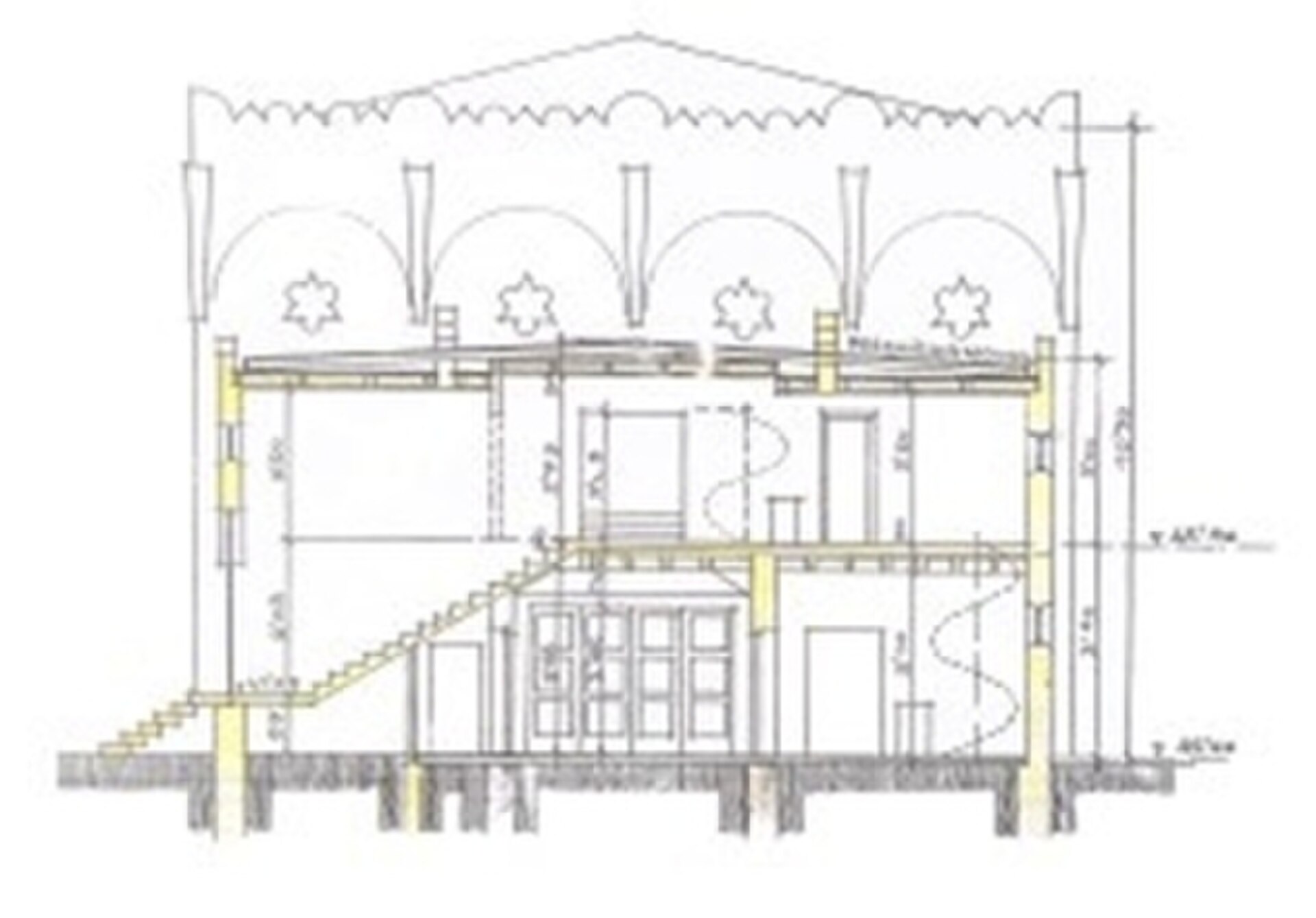
Grünberger's winning design of 1924 provided for a larger building across two plots; only one was built on, and the executed synagogue was a free-standing rectangular block on the corner of Eitelbergergasse and Neue-Welt-Gasse. The Wien Geschichte Wiki gives its footprint as about 30.20 by 14.20 m; Müller gives 23.70 by 14.20 m and a height of 10.20 m. Its hipped roof was hidden behind a parapet of scalloped battlements, which gave the cube the look of a fortress; the critic Max Eisler compared it with the fortified synagogues of Podolia and Volhynia, and Carol Krinsky likened its curved and pointed rhythms to Arabic script. The plastered walls were painted white and pierced by clusters of small star-shaped and lobed windows set in tall bays. Men entered through a large dark wooden portal on the street front; women climbed side stairs under arched canopies to two galleries. The men's hall had 244 seats, the galleries 136, and a weekday prayer room 34; there was also a wedding room on the ground floor. Inside, white walls contrasted with dark wooden benches and the dark wooden Torah ark, which carried the tablets of the Law framed by a gilded sun wreath.
Życie w synagodze
The congregation had one rabbi throughout the building's short life, Moses (Moriz) Lewin, and two cantors, the chief cantor Samuel Einhorn and Franz Stern. Einhorn also chaired the association in its final years. Former members interviewed by Roland Müller remembered the services above all for Einhorn's singing and recalled the synagogue's stained-glass windows. The building was designed for a full communal life: besides the main hall with its men's floor and two women's galleries, it had a small weekday prayer room for daily services and a wedding room, so that marriages could be held in the synagogue itself. Before 1929 the association had held its High Holiday services in a rented inn hall, so the new synagogue for the first time allowed the whole congregation to pray together under its own roof. In April 1938, a month after the Anschluss, the association's savings books and cash were seized, and from then on it worked under growing pressure until the building was burned in November.
Zniszczenie
The synagogue was set on fire on the morning of 10 November 1938, during the November Pogrom. The Vienna fire brigade's log records a call-out at 9:35 a.m.; the crews did not save the building but protected the neighbouring houses with six hose lines, three pumps and three hydrants. The sources for this building do not name the arsonists. The Wien Geschichte Wiki's account of the pogrom in Vienna states that the city's synagogues were wrecked and burned mainly by Nazi SS units between early morning and midday on 10 November, and that SS squads kept the fire brigade from putting out synagogue fires. Clearing of the ruin began early in 1939. In May 1939 the city building office gave a demolition permit to the Nazi Stillhaltekommissar, the official who dissolved Jewish associations, and the demolition firm of Walter Gauf, with Eduard Brandstetter as site foreman, removed the remains; the authorities reported the synagogue demolished in December 1939. The association itself was struck off the register at the end of March 1939, and on 13 October 1939 Gauf's wife Franziska bought the 969 square-metre plot for 10,800 Reichsmark, below its assessed value.
Los społeczności
The congregation was scattered and destroyed in the years after the Anschluss of March 1938. During the November Pogrom more than 6,500 Viennese Jews were seized and between 3,500 and 4,800 men were sent to the Dachau concentration camp. Those who could, emigrated: by the end of 1941 about 130,000 of Vienna's roughly 200,000 Jews had left the city. Among the Hietzing congregation, the cantor Franz Stern fled to Hungary, Otto Fleming emigrated to Palestine in 1938, Valerie Klimt left in 1939 and Henry Tamar escaped through a Brith Shalom rescue scheme. In December 1938 Rabbi Moses Lewin wrote to Chief Rabbi Hertz in London asking for entry permits for himself, his wife and his son Egon, who was then held in Nazi protective custody; whether they escaped is unknown. Those who stayed were deported from 1941 onwards: over 65,000 Viennese Jews were murdered in the Holocaust. How many members of the Hietzing congregation were among them is unknown. The Tempelverein was not re-founded after 1945.
Miejsce dzisiaj
The plot at Eitelbergergasse 22, on the corner of Neue-Welt-Gasse, was returned to the Israelitische Kultusgemeinde Wien by a restitution commission on 5 April 1950, after the community paid back a small sum. On 19 December 1968 the community sold it, and a residential block of owner-occupied flats was built on the site, which it still occupies. Nothing of the synagogue survives above ground. A memorial installation stands at the street corner opposite the building, and a commemorative plaque has stood at Eitelbergergasse 22 since 1990.
Ważne postacie
Arthur Grünberger
UnknownArchitect of the synagogue (competition winner, 1924)Grünberger won the Hietzing temple association's 1924 competition with a design he submitted together with Adolf Jelletz, and the synagogue was built to his plans in 1928-29, reduced to one of the two plots originally planned. His design, a white crenellated block with clusters of star-shaped windows, was compared by Max Eisler with the fortified synagogues of Podolia and Volhynia, and made the building the only free-standing synagogue erected in interwar Vienna.
Biografia lub źródło →Adolf Jelletz
UnknownCo-architect and site architectJelletz submitted the winning 1924 competition entry together with Arthur Grünberger and then directed the construction of the synagogue from the building permit of August 1928 until the use permit of September 1929. The Leo Baeck Institute's photograph records name the building as designed by Arthur Gruenberger and Adolf Jelletz. Nothing further about his life was found in the sources read.
Biografia lub źródło →Moses (Moriz) Lewin
UnknownRabbi of the Hietzing temple associationLewin, also written Levin, was the only rabbi of the Hietzing congregation in the new synagogue, serving from its consecration in 1929 until its destruction in November 1938. In December 1938 he wrote to Chief Rabbi Hertz in London, asking for entry permits for himself, his wife and his son Egon, who was then held in Nazi protective custody. What became of him and his family was not found.
Biografia lub źródło →Samuel Einhorn
UnknownChief cantor (Oberkantor) until 1938 and last chairman of the associationEinhorn was chief cantor of the Hietzing synagogue until 1938 and also the last chairman of the Tempelverein of the 13th district, so he led both its worship and its administration in the years of the Anschluss. Former members remembered the services above all for his singing. His later fate was not found in the sources read.
Biografia lub źródło →Franz Stern
UnknownCantorStern served as the second cantor of the Hietzing synagogue alongside the chief cantor Samuel Einhorn. Roland Müller's study, based partly on the recollections of former members, records that after the Anschluss and the destruction of the synagogue Stern fled from Vienna to Hungary. Nothing further about his life or later fate was found in the sources read for this entry.
Biografia lub źródło →Czy masz coś do przekazania?
Zdjęcia, dokumenty, historie rodzinne lub wspomnienia o tej synagodze i jej społeczności pomagają zachować jej historię.
- Neue Welt Tempel
- Virtuelle Rekonstruktion der Synagoge Wien Hietzing (diploma thesis, 2008)
- Hietzinger Synagogue
- Novemberpogrom
- History of the Jews in Vienna
- Innenansicht der Synagoge in Wien 13, Eitelbergergasse 22 (Inv. Nr. 1231)
- Eitelbergergasse synagogue, Vienna (F 17858 and record 229153)
- Synagogue Eitelbergergasse, Vienna (record 229153)
- Eitelbergergasse 22, 1130 Wien (OpenStreetMap node 2400481809)
Share a memory or thought
No comments yet. Be the first to add one.