
Historia Neudegger Tempel (Neudeggergasse Synagogue), Vienna
The temple association of Vienna's 8th district commissioned Max Fleischer in 1897 to design a synagogue. The core of the money came from Baron Moriz von Königswarter, whose foundation gave 70,000 crowns; the plot at Neudeggergasse 12, 23 by 35 metres and enclosed on three sides by neighbouring houses, cost 100,000 crowns. The old house 'Zur goldenen Sonne' of 1777 was pulled down to make room.
The city building office approved the plans, but the city council, still wary of large gathering places after the Ringtheater fire of 1881, blocked them. A six-year legal battle went twice through every court until the Administrative Court ruled that the theatre law did not apply to houses of worship. The authorities still limited attendance to about 580 people and made the association raise the number of exits from seven to thirteen. Building began in February 1903 (the foundation stone is dated 10 February), and the synagogue was consecrated on 16 September 1903 in the presence of leading religious and municipal figures.
For 35 years it was the religious, social and cultural centre of the Jews of the Josefstadt. The famous cantor Zavel Kwartin began his career here in 1903. On 10 November 1938 Nazis desecrated the synagogue, threw its books into the street and set it on fire; the whole interior burned. The ruin was demolished in 1939–1940 and in 1955–1956 the City of Vienna built a housing block on the site.
Where it stood for 35 years
Historic: Neudeggergasse 12, 1080 Vienna (Josefstadt). Present day: council housing block, Neudeggergasse 12, Vienna, Austria.
Otwórz większą mapę →Społeczność żydowska
The synagogue belonged to the Israelitischer Tempelbauverein des 8. Bezirkes der Stadt Wien, later the Israelitischer Tempelverein des 8. Bezirkes, the association of the Jews of the Josefstadt district. Rabbi Moritz Bauer, born in 1868 in what is now Slovakia, served as its rabbi and religion teacher from the opening until 1938; contemporaries remembered him as an imposing figure who gave special Saturday sermons for young people. Its cantors included Zavel Kwartin, who became internationally famous through his recordings, and later Jakob Landau and Josef Grob. Worshippers who could not afford the expensive seats held High Holiday services in the large hall of the nearby restaurant 'Zum Grünen Tor'.
Architektura i projekt
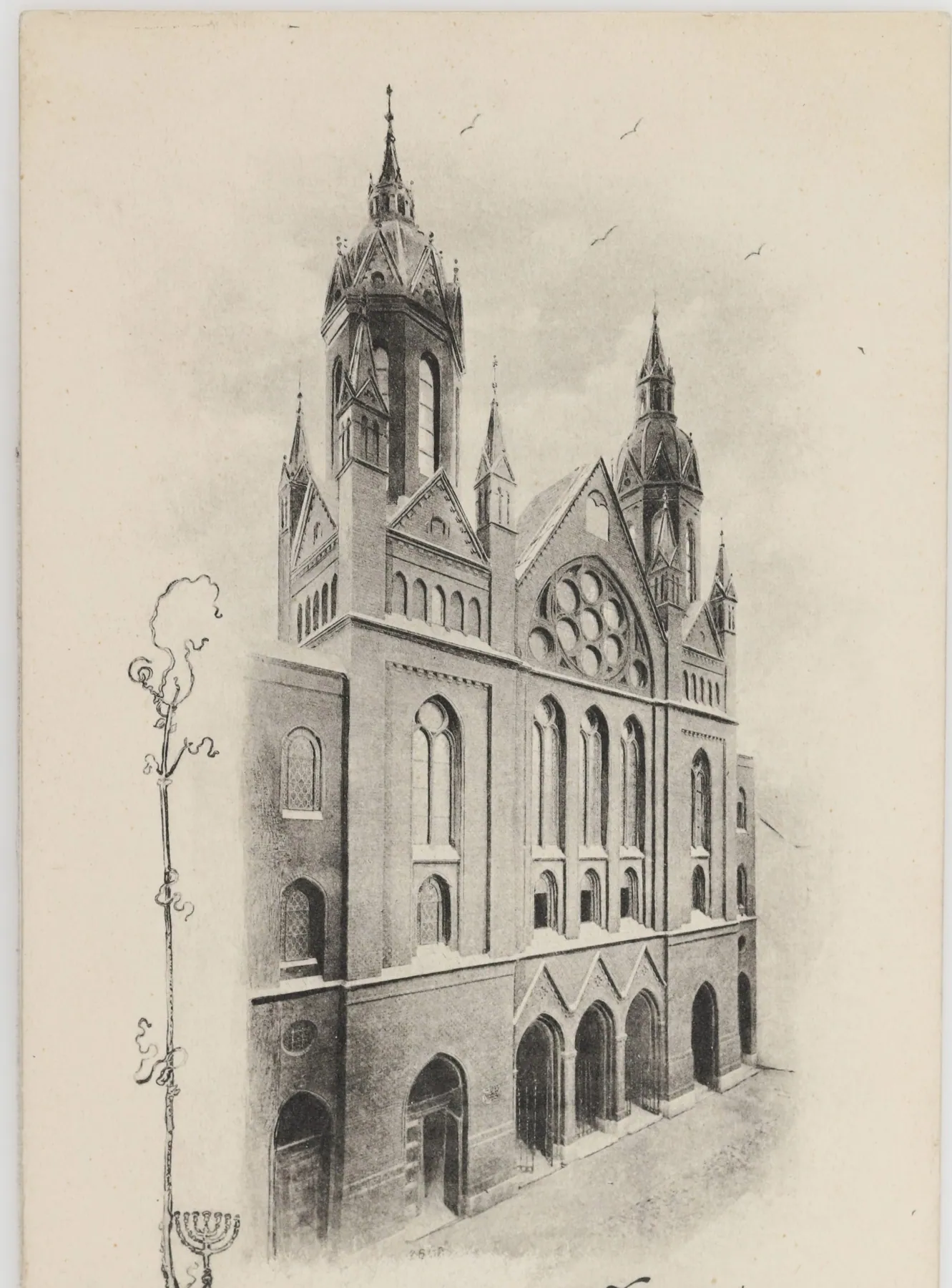
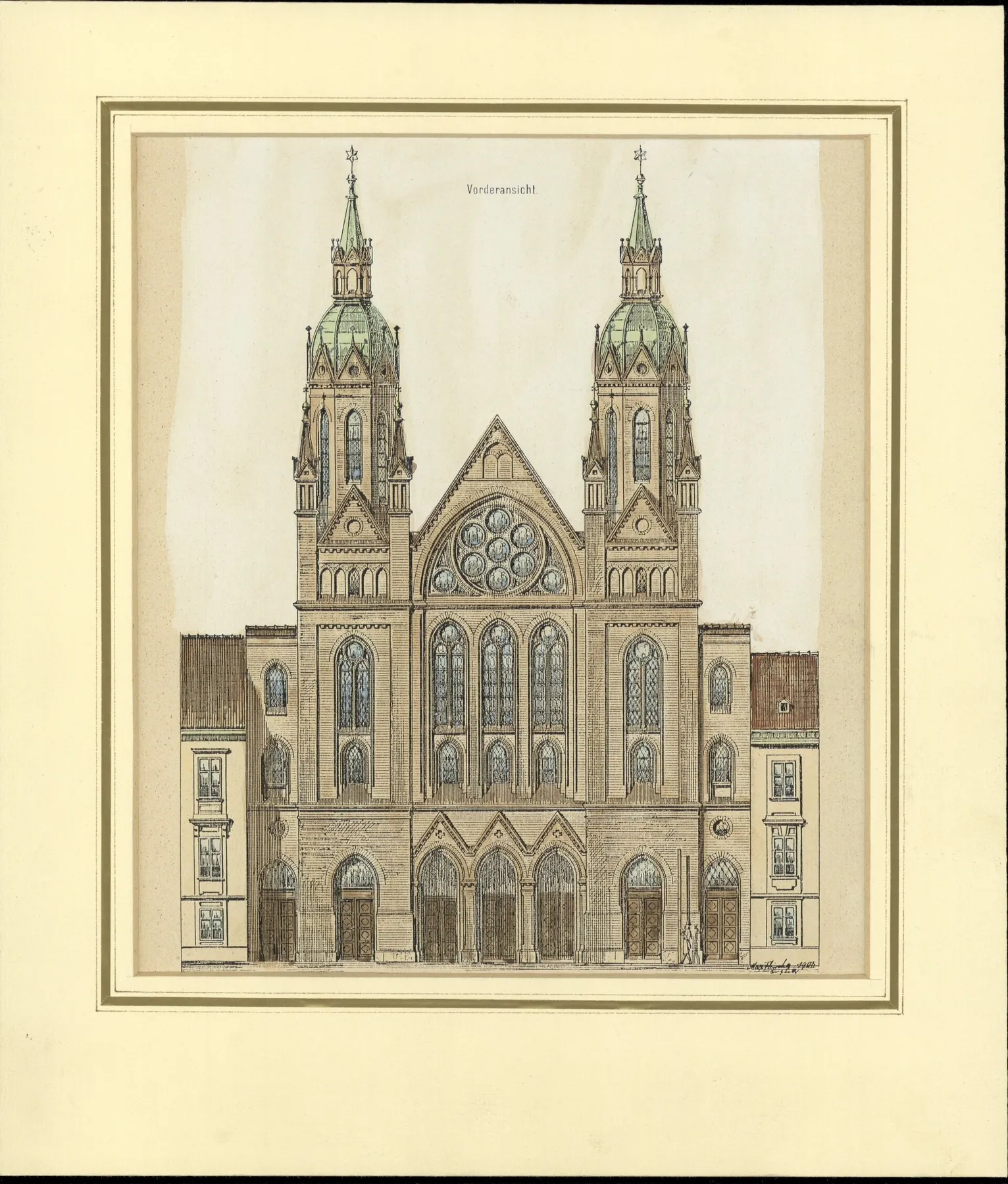
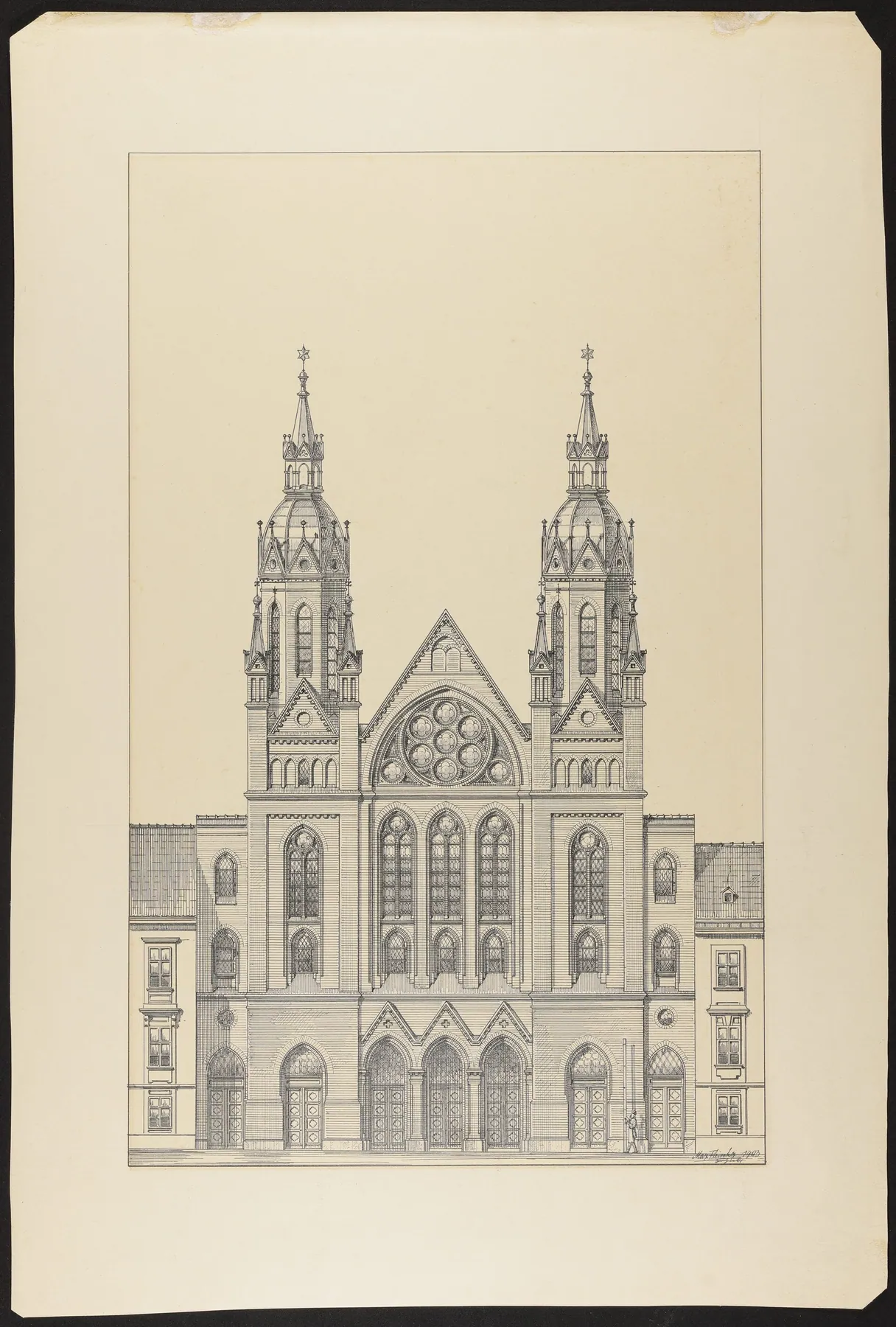
Max Fleischer, the leading Gothic Revival synagogue architect of Vienna, designed a three-aisled brick hall in the style of North German brick Gothic. The seven-bay street front had seven portals, nine small and five tall pointed windows, a triangular gable with a rose window topped by the Tablets of the Law, and two 40-metre towers each crowned by a Star of David. A three-metre gap separated the building from its neighbours, giving it daylight, ventilation and thirteen exits.
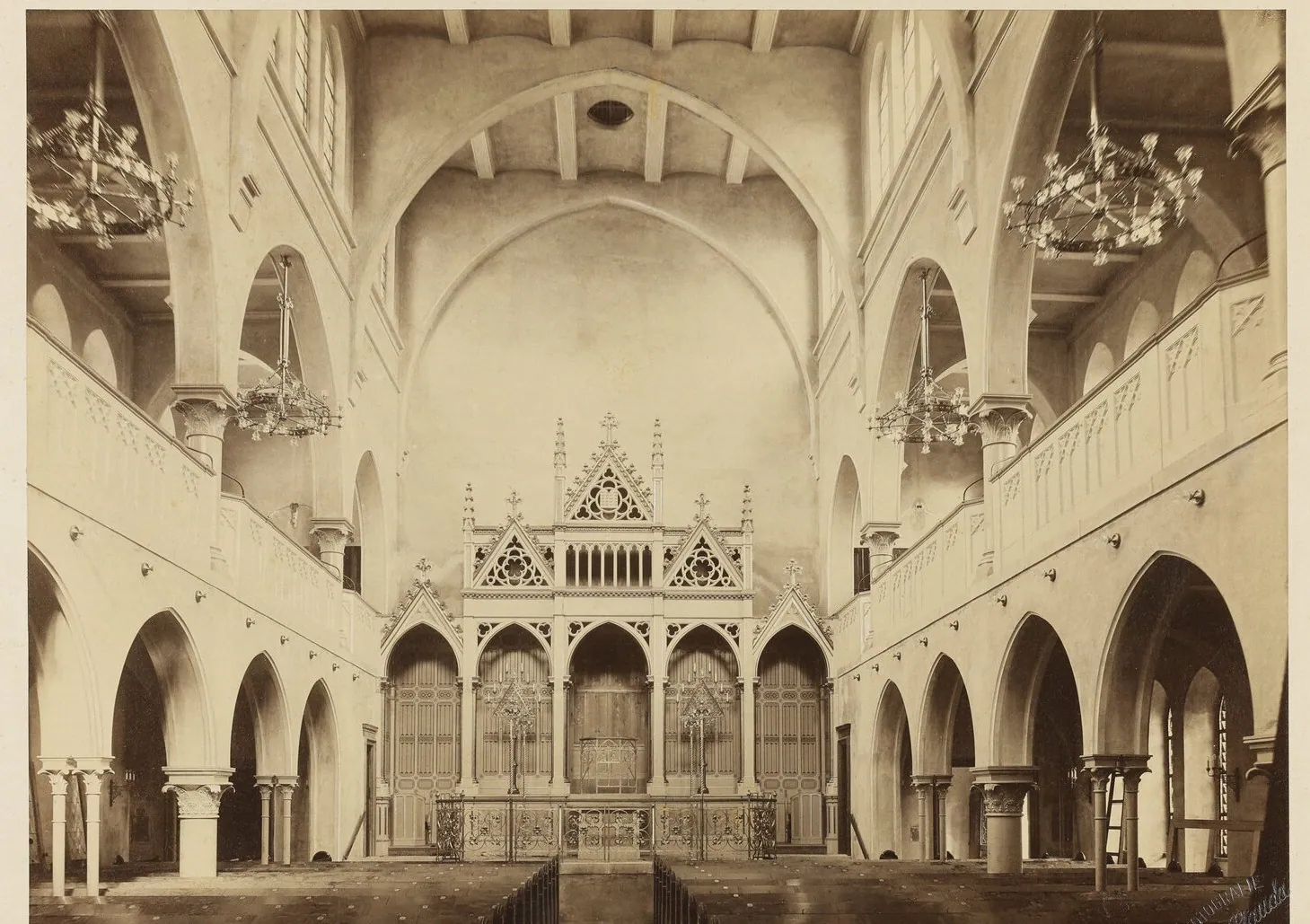
A vestibule on the street side, also used for weekday prayers, meetings and weddings, led into the prayer hall, which was 15 metres high to its stuccoed ceiling and carried on cast-iron columns. The men's seats (338) were divided by a central aisle; on a raised platform sat the board members, with the rabbi's seat on one side and the cantor's on the other. The bimah and pulpit stood before the gilded Torah ark, which filled the whole width of the nave; above it hung a memorial tablet to Empress Elisabeth. Women (239 seats) sat in stepped galleries on three sides. Above the west gallery were a conference room and an organ.
Życie w synagodze
The synagogue was the centre of Jewish life in the 8th district, used for Sabbath and festival services, weekday prayers in the vestibule, weddings and meetings. Zavel Kwartin was offered the post of cantor at the newly opened synagogue in 1903, and from 1906 his recordings with the synagogue's choir, such as a 'Kol Nidre', sold hundreds of thousands of copies. Rabbi Moritz Bauer was known for his sermons for young people.
Zniszczenie
During the November pogrom, on 10 November 1938, Nazis desecrated the synagogue, threw its books into the street and set it on fire. The fire brigade's log records a 'major fire' from 11.50: the whole interior and the timber structure burned, apart from the roof truss and the two corner towers. After the war a man tried before the People's Court boasted, 'Now I've shown them', of his part in the arson. On 25 November 1938 a city inspector found that the outer walls still stood, but the iron supports had been so weakened by the heat and water that the walls and arches were cracked, and demolition was recommended. The city approved demolition on 13 January 1939. The demolition firm Walter Gauf worked so slowly that the new owner complained in March 1939, and in December 1939 the building police reported the synagogue gone; German Wikipedia dates the final levelling to 1940.
Los społeczności
The Stillhaltekommissar seized the property without compensation in 1938 and on 15 December 1938 sold it for 33,723.69 Reichsmarks to the Mautner Markhof brewery, which owned the neighbouring restaurant 'Zum Grünen Tor' and wanted the plot to enlarge its beer garden. The association's assets of 31,555 Reichsmarks were confiscated as a 'reconstruction levy'. Rabbi Moritz Bauer fled to the United States in 1939; the synagogue's porter of 35 years lost his home and livelihood. Most of the Jews of the Josefstadt were forced to emigrate or were deported and murdered. In 1948 a restitution commission returned the plot to the Israelitische Kultusgemeinde, which sold it to the City of Vienna in 1953.
Miejsce dzisiaj
Nothing of the synagogue survives. The City of Vienna built a council housing block designed by Franz O. Böhm on the site in 1955–1956 (Wohnhausanlage Neudeggergasse 12).
Ważne postacie
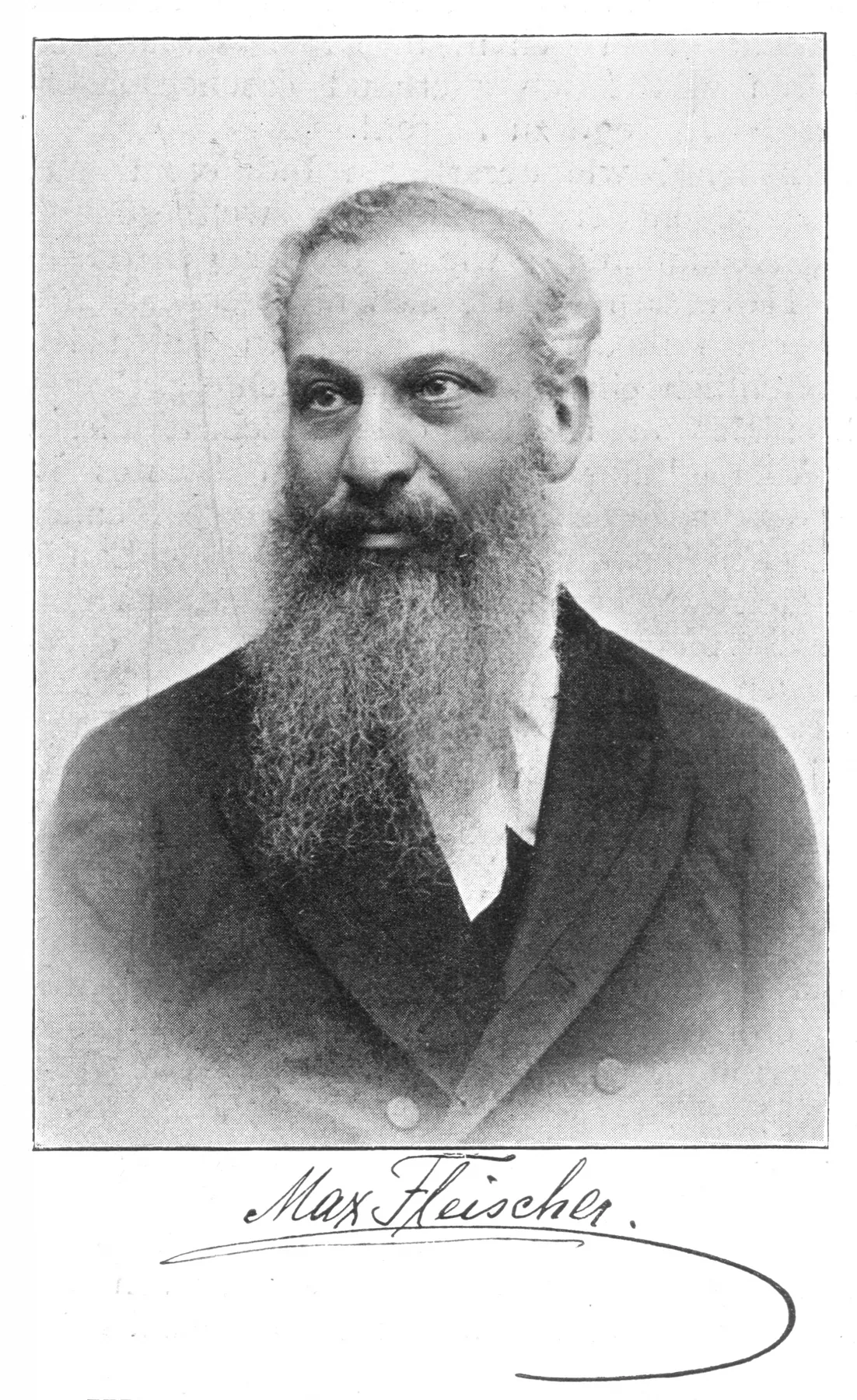
Max Fleischer
1841–1905ArchitectThe Viennese architect Max Fleischer, commissioned in 1897, designed the synagogue in brick Gothic style.
Biografia lub źródło →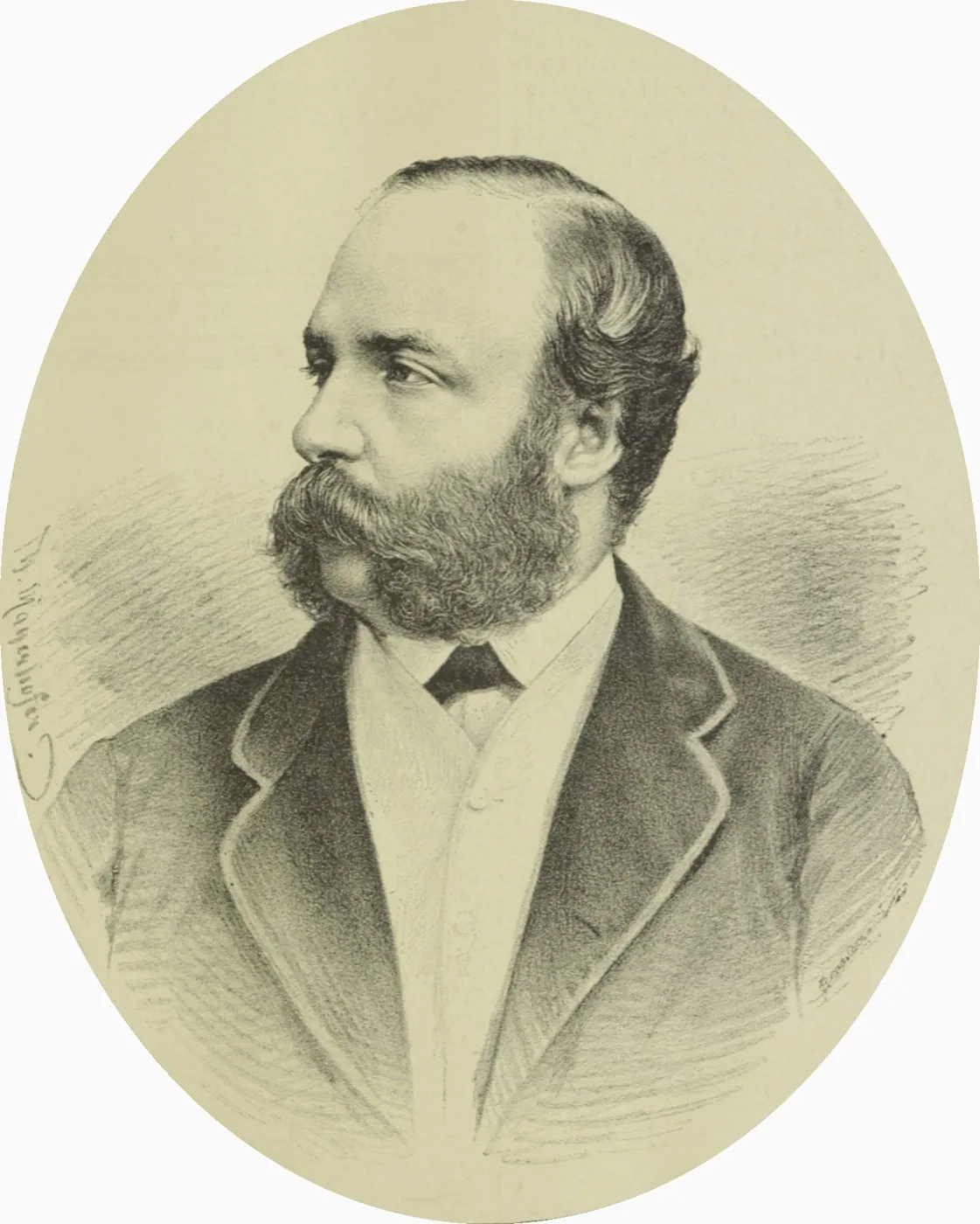
Moriz von Königswarter
1837–1893BenefactorThe banker Baron Moriz von Königswarter provided the core funding for the synagogue; German Wikipedia says it came from his estate.
Biografia lub źródło →
Zavel Kwartin
1874–1952Cantor, from 1903The renowned cantor began at the newly opened Neudeggergasse synagogue in 1903 and recorded with its choir before moving to Budapest in 1910.
Biografia lub źródło →Moritz Bauer
Born 1868Rabbi, 1903–1938Rabbi and religion teacher of the synagogue from its opening; he fled to the United States in 1939.
Biografia lub źródło →Jakob Landau
Dates unknownCantorOne of the later cantors of the synagogue.
Biografia lub źródło →Josef Grob
Dates unknownCantorOne of the later cantors of the synagogue.
Biografia lub źródło →Czy masz coś do przekazania?
Zdjęcia, dokumenty, historie rodzinne lub wspomnienia o tej synagodze i jej społeczności pomagają zachować jej historię.
Share a memory or thought
No comments yet. Be the first to add one.