

The story of Währing Synagogue (Währinger Tempel), Vienna
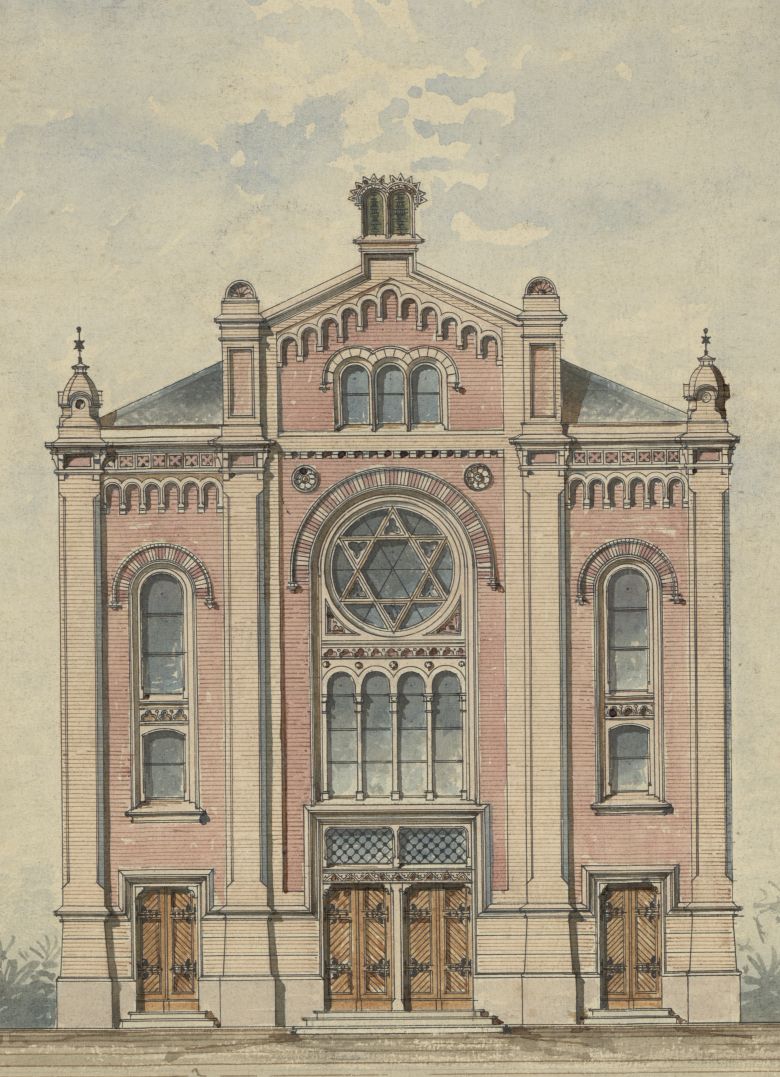
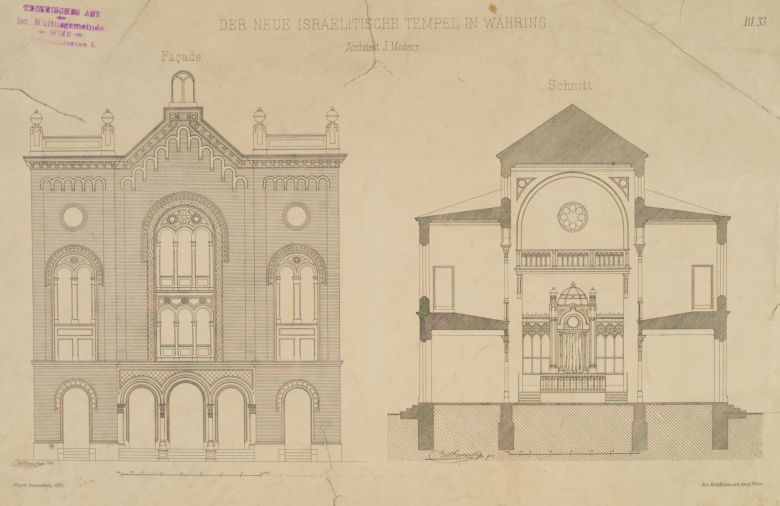
Währing was still a separate suburban municipality outside Vienna when its Jewish community, the Israelitische Cultusgemeinde Währing, decided to build a synagogue of its own. In 1888-89 it put up a free-standing building in the courtyard behind the house at Schopenhauerstraße 39, facing into the yard rather than onto the street. The architect was Jakob Modern, a Bratislava-born architect working in Vienna, and the surviving construction drawings of October 1888 carry the stamp of the architect Ludwig Schöne. The building was a basilica with a flat roof, raw brick façades, large round windows and four small onion-domed turrets, crowned by the tablets of the Ten Commandments. Inside it seated 328 men and 176 women.
After Währing and the neighbouring suburbs of Weinhaus, Gersthof and Pötzleinsdorf were incorporated into Vienna as the 18th district, the Währing community merged into the Vienna Kultusgemeinde, which owned the property from 1909. The synagogue remained the religious, social and cultural centre of the district's Jews and the seat of several Jewish associations, among them a burial society, a women's charity and a Talmud Torah school. Its rabbis included David Feuchtwang, later Chief Rabbi of Vienna. On 10 November 1938 the synagogue was set on fire in the November Pogrom, and the ruin was pulled down in 1939-40.
Where it stood for nearly 50 years
Historic: Wien XVIII, Schopenhauerstraße 39 (courtyard building). Today: residential complex, Schopenhauerstraße 39, 1180 Wien (Währing). Pin is on the plot; exact position of the vanished building within the courtyard approximate.
Open larger map →The Jewish community
The Jewish community of Währing grew up in the late nineteenth century in the villa suburbs on Vienna's north-western edge. Before the suburbs were incorporated into the city, the Jews of Währing formed their own body, the Israelitische Cultusgemeinde Währing, which owned the synagogue site from 1888 until 1909, when ownership passed to the Israelitische Kultusgemeinde Wien. The synagogue served the Jews of the former suburbs of Währing, Weinhaus, Gersthof and Pötzleinsdorf, which together became the 18th district. Several associations had their seat at the same address: the Chewra Kadischa in Währing, founded in 1891, which visited the sick, prayed for the dead and supported mourners; the charity Gemilas Chesed, founded in 1893 and merged with it; the Israelite Women's Association of the 18th district, founded in 1894 by Ernestine Wilhelm to clothe poor Jewish schoolchildren each November; and from 1921 an association maintaining a Talmud Torah school, proposed by Leopold Subak and Rabbi David Feuchtwang. In 1934 the district had 5,061 Jewish residents, a comparatively small community by Viennese standards.
Architecture and design
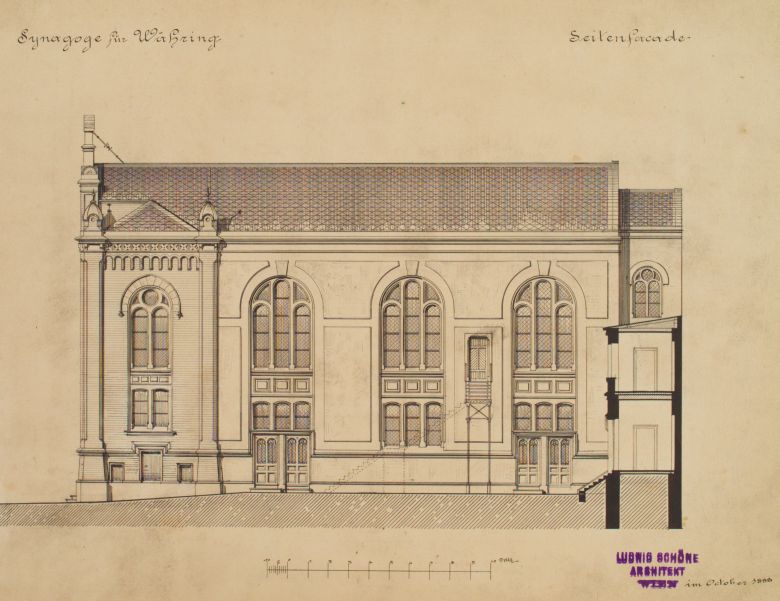
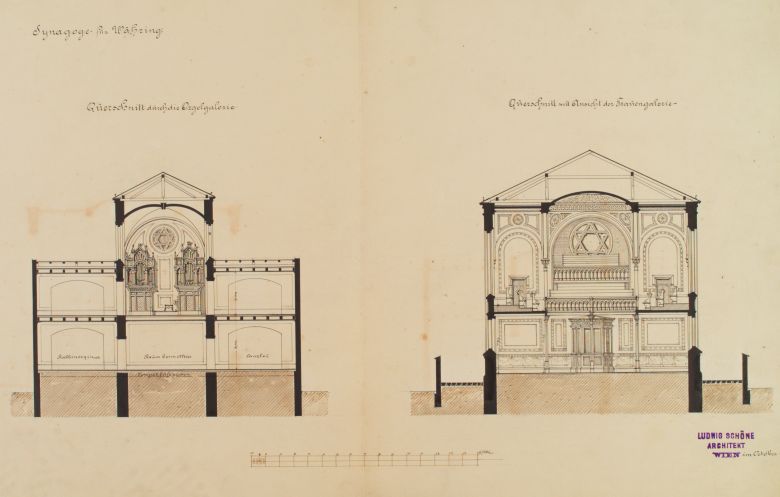
The synagogue stood free in the courtyard of Schopenhauerstraße 39, its entrance front turned towards the yard. The architect Jakob Modern combined Romanesque and Renaissance motifs; Pierre Genée called it a typical example of a Western-Oriental stylistic synthesis. A watercolour drawing of about 1889 shows a symmetrical brick front with stone dressings: three arched doors, a large central window with a Star of David rose and tracery, narrow side bays, and corner turrets topped by small onion domes, with the tablets of the Law on the gable. The building was laid out as a basilica with a flat roof and large round windows in the upper storey. The drawings of October 1888 show a nave and side aisles on slender cast-iron columns carrying women's galleries, a choir and organ gallery, and a richly painted interior. Visitors entered through a vestibule into the men's hall, with staircases on either side to the galleries. The Torah ark was rectangular, richly decorated, crowned by a dome and flanked by two minaret-like turrets, with the choir platform above it and rooms for the rabbi and cantors to either side.
Life inside the synagogue
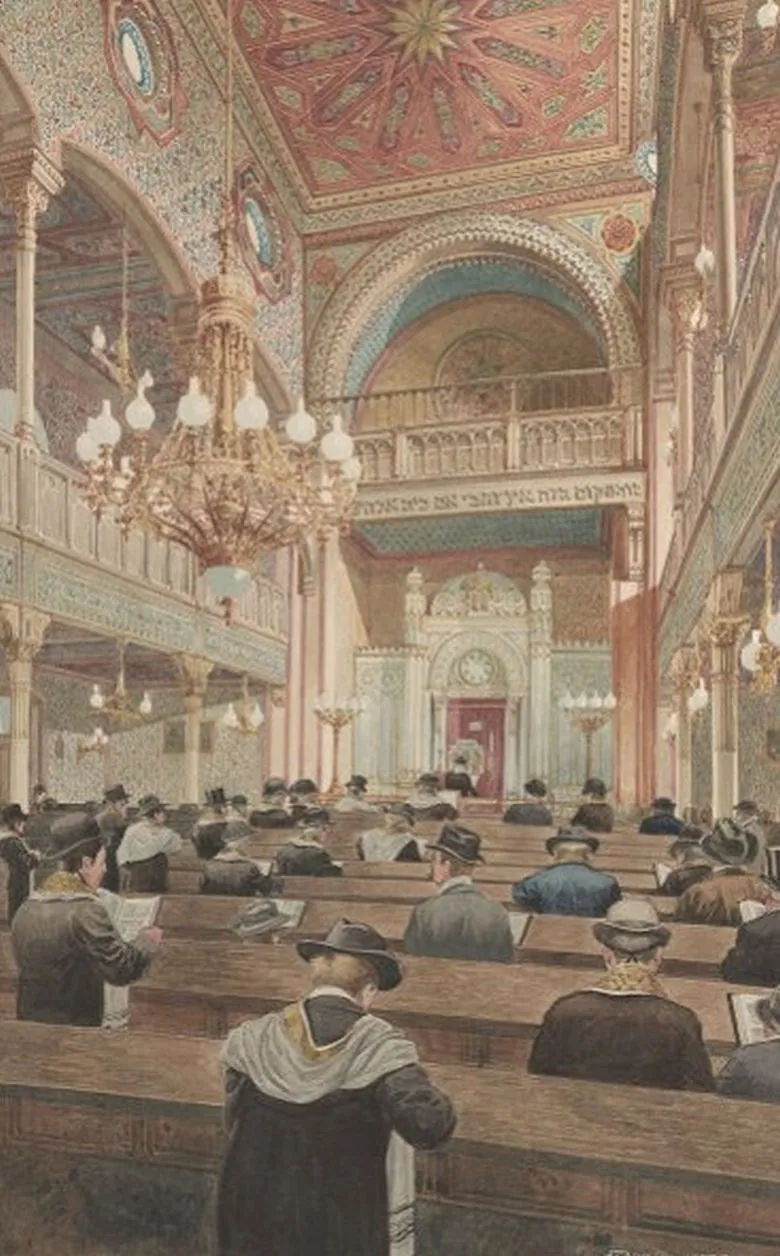
Emil Ranzenhofer's view of the interior in 1902 shows a full congregation of men in hats and prayer shawls in long rows of pews, under a ceiling and walls covered in Oriental-style painted ornament, with brass chandeliers and the galleried aisles leading the eye to the domed Torah ark. The 1888 plans include an organ gallery. Wilhelm Sor was the first rabbi elected by the Währing community. David Feuchtwang, a scholar from Nikolsburg, served as rabbi of the 18th and 19th districts from 1903 to 1927 and lived at Schopenhauerstraße 39; he later became Chief Rabbi of Vienna. Arthur Zacharias Schwarz, a noted cataloguer of Hebrew manuscripts, was rabbi here from 1927. The cantors named in the Gedenkbuch are Leopold Screbenik, Gerson Margulies and Davis Gross. The building also housed the community's charities and its religious school: in August 1938 the Kultusgemeinde still asked the city school board for permission to continue the Bible school in Schopenhauerstraße.
Destruction
During the November Pogrom of 1938 the synagogue was set on fire by the Nazis. The log of the Vienna fire brigade records that its crews were called out at 12:35 on 10 November 1938 to a fire in which the temple was burning over an area of about 10 by 25 metres; they protected the surrounding houses with three hose lines and stayed until 14:30 on 11 November, extinguishing the fire in the synagogue itself only in part. The individual arsonists are not named. In December 1938 the Nazi Gau auditor (Gaurevisor) Engeburg reported that a safe on the first floor, under the rubble of the burnt-out synagogue, held 500 to 600 Reichsmarks of the school association, and the association's cash was confiscated. In December 1939 the building-police office of the Nazi Reichsgau Vienna administration reported that the synagogue had been demolished, but the Kultusgemeinde, still the owner, had to pay for the demolition, and on 1 May 1940 it told the Nazi Special Commissioner for its property that the temple was largely demolished, work having stopped for lack of workers and carts. In September 1940 the plot was sold to the merchant Robert Ritter von Meissl.
The community’s fate
After the Anschluss of March 1938 the Jews of Währing, about 5,000 people in the mid-1930s, were stripped of their rights and property. In 1938 and 1939 the Nazi Stillhaltekommissar dissolved the associations that met at Schopenhauerstraße 39, deleting them from the register and taking 20 percent of their assets as a 'reconstruction levy' and a further 5 percent as a fee before handing the remainder to the Kultusgemeinde. Rabbi Arthur Zacharias Schwarz was arrested and tortured after the Anschluss; he reached Palestine in broken health and died in Jerusalem in February 1939. Many of the district's Jews were forced to emigrate. Of those who remained, many were deported: between 1939 and 1945, 48,953 Jews were deported from Vienna to ghettos and camps, and only 1,734 of them, about 3.5 percent, survived. Local research in Währing has documented individual deportations from the district's addresses, and in the Weinhaus parish alone well over seventy victims have been named. None of the Währing associations was refounded after 1945.
The site today
Nothing of the synagogue survives. After the war the property was the subject of a restitution case, and on 5 March 1948 the restitution commission at the Vienna civil court returned it to the Israelitische Kultusgemeinde in a partial settlement. The Kultusgemeinde sold the plot on 10 November 1977 to the Salzburger Wohnungseigentumsbau, a non-profit housing company, which built the residential complex that now stands at Schopenhauerstraße 39 in Vienna's 18th district. A commemorative plaque on the housing block and, since November 2018, a five-metre star stele mark the site. The Währing district museum at Währinger Straße 124 includes the synagogue's history in its permanent exhibition.
Notable names

Jakob Modern
1838-1912ArchitectJakob Modern, born in Pressburg (Bratislava) in 1838 and active as an architect in Vienna until his death in 1912, designed the Währing synagogue, built in 1888-89 for the then independent Israelitische Cultusgemeinde Währing. The 1890 published sheet of façade and section names him as architect of 'the new Israelite temple in Währing'. His design combined Romanesque and Renaissance motifs with Oriental turrets and a richly painted interior.
Biography or source →
David Feuchtwang
1864-1936RabbiBorn in Nikolsburg (Mikulov) in 1864 and trained in classical and Oriental philology in Vienna and Berlin, David Feuchtwang was rabbi in Nikolsburg before being called to Vienna in 1903. He served as rabbi of the 18th and 19th districts at the Währing synagogue, living at Schopenhauerstraße 39, and in 1921 co-founded the association for its Talmud Torah school. He later became Chief Rabbi of Vienna at the Stadttempel and died in 1936.
Biography or source →Ludwig Schöne
UnknownArchitect (stamp on construction drawings)The construction drawings of the Währing synagogue dated October 1888, held by the Jewish Museum Vienna, carry the stamp of the architect Ludwig Schöne, and the Wien Geschichte Wiki records him as their author. They show the side elevation, longitudinal section and cross-sections through the organ gallery and women's gallery. His exact role beside the designer Jakob Modern, perhaps as executing architect, is not explained in the sources read.
Biography or source →Wilhelm Sor
UnknownRabbiWilhelm Sor was the first rabbi elected by the Israelitische Cultusgemeinde Währing, and so the first rabbi of the synagogue in Schopenhauerstraße after its completion in 1889. The Gedenkbuch der Synagogen und Jüdischen Gemeinden Österreichs, as cited in the Wien Geschichte Wiki, names him among the notable rabbis of the congregation. His dates and later career were not found in the sources read.
Biography or source →Arthur Zacharias Schwarz
1880-1939RabbiArthur Zacharias Schwarz, born in Karlsruhe in 1880, son of Rabbi Adolf Schwarz, was a rabbi and religion teacher in Vienna from 1914 and a leading cataloguer of Hebrew manuscripts in Austrian libraries. According to the Gedenkbuch cited by the Wien Geschichte Wiki he was rabbi at the Schopenhauerstraße synagogue from 1927. After the Anschluss he was arrested and tortured; he reached Palestine and died in Jerusalem in February 1939.
Biography or source →Leopold Screbenik
UnknownCantorLeopold Screbenik is listed in the Gedenkbuch der Synagogen und Jüdischen Gemeinden Österreichs, as cited by the Wien Geschichte Wiki, as one of the cantors who served at the Währing synagogue in Schopenhauerstraße. The building's plans provided rooms for the cantors beside the Torah ark and a choir platform above it. His years of service were not found in the sources read.
Biography or source →Gerson Margulies
UnknownCantorGerson Margulies is named in the Gedenkbuch der Synagogen und Jüdischen Gemeinden Österreichs, as cited by the Wien Geschichte Wiki, among the cantors of the Währing synagogue at Schopenhauerstraße 39. He led the services from the reader's place in front of the domed Torah ark, with the choir in the gallery above. His years at the synagogue and his later fate were not found in the sources read.
Biography or source →Davis Gross
UnknownCantorDavis Gross is the third cantor of the Währing synagogue named in the Gedenkbuch der Synagogen und Jüdischen Gemeinden Österreichs, as cited by the Wien Geschichte Wiki. Like his predecessors he led prayer in the synagogue at Schopenhauerstraße 39, the religious centre of the 18th district's Jews. His dates of service and his fate after 1938 were not found in the sources read.
Biography or source →Josef Nossig
UnknownLast chairman of the Chewra Kadischa in WähringJosef Nossig was the last chairman of the Chewra Kadischa in Währing, the burial and welfare society that had its seat at the synagogue, and in 1938 he lived at Schopenhauerstraße 39 itself. In the course of 1938 the Nazi Stillhaltekommissar dissolved the society, deleted it from the register of associations and transferred its remaining assets, after deductions, to the Kultusgemeinde.
Biography or source →Do you have something to contribute?
Photographs, documents, family stories or memories of this synagogue and its community help keep its history alive.
- Währinger Tempel
- Währinger Tempel
- Währinger Tempel (file pages: Zeichnung, Schnitt, Seitenfassade, Querschnitt, Fassade Schnitt, Synagoge Schopenhauerstraße)
- David Feuchtwang
- Jakob Modern
- Jakob Modern
- Arthur Zacharias Schwarz
- Steine der Erinnerung in Währing, Broschüre 2
- Nominatim search: Schopenhauerstraße 39, 1180 Wien
Share a memory or thought
No comments yet. Be the first to add one.