
Die Geschichte von New Synagogue of the Vienna Judenstadt (Unterer Werd)
In 1624, on the order of Emperor Ferdinand II, the Jews of Vienna were assigned an area in the Unterer Werd, the flood-prone land across the Danube arm from the walled city, and they moved there in 1625. The settlement, known as the Judenstadt, began with 14 houses and had 104 by 1632. It had its own court, land register and community house, two guarded gates and three synagogues that were recognisable from outside. The first, the 'old' synagogue near today's Große Pfarrgasse 12, was built under Rabbi Yom Tov Lipmann Heller, who left for Prague in 1627. As the community grew, Zacharias Mayer Halewi endowed a second, larger building after 1650, the 'new' synagogue, which served as the main synagogue of the ghetto. It stood on the plot now occupied by the parish church of St. Leopold on Große Pfarrgasse. In 1669 and 1670 Emperor Leopold I expelled the Jews of Vienna, and in August 1670 he laid the foundation stone of a church on the site of the synagogue. Whether the church incorporated the synagogue's walls or replaced a building already pulled down is disputed in the sources. The suburb was renamed Leopoldstadt after the emperor. Jews were not allowed to build a synagogue in Vienna again until 1823.
Where it stood
Historic: New Synagogue in the Judenstadt im Unteren Werd, near the Tabor road, Vienna (house number unknown). Today: site of the parish church of St. Leopold, Alexander-Poch-Platz 6 / Große Pfarrgasse 15, 1020 Wien (approximate; the church stands on the synagogue's site).
Größere Karte öffnen →Die jüdische Gemeinde
The Jews who moved to the Unterer Werd in 1625 came from the inner city, where crowding was given as the reason for the move; the privilege of 6 December 1624 was granted by Count Rombald Collalto on behalf of Ferdinand II. The ghetto lay along today's Große Sperlgasse between Tandelmarktgasse and Kleine Pfarrgasse. From 14 houses it grew to 104 by 1632 and 132 by the expulsion, when the Jewish Virtual Library gives 136 houses housing 500 families. It was a self-governing community with its own Jewish court and land register. Its rabbis included Yom Tov Lipmann Heller in its first years, Shabbetai Sheftel Horowitz, who came as a refugee from the Chmielnicki massacres of 1648, and Gershon Ashkenazi, rabbi for about five years until the expulsion. The community lost its privileges and judicial autonomy in 1638 under Ferdinand III, and no new court Jews were appointed after that. Leo Winkler was head of the community at the time of the expulsion.
Architektur und Gestaltung
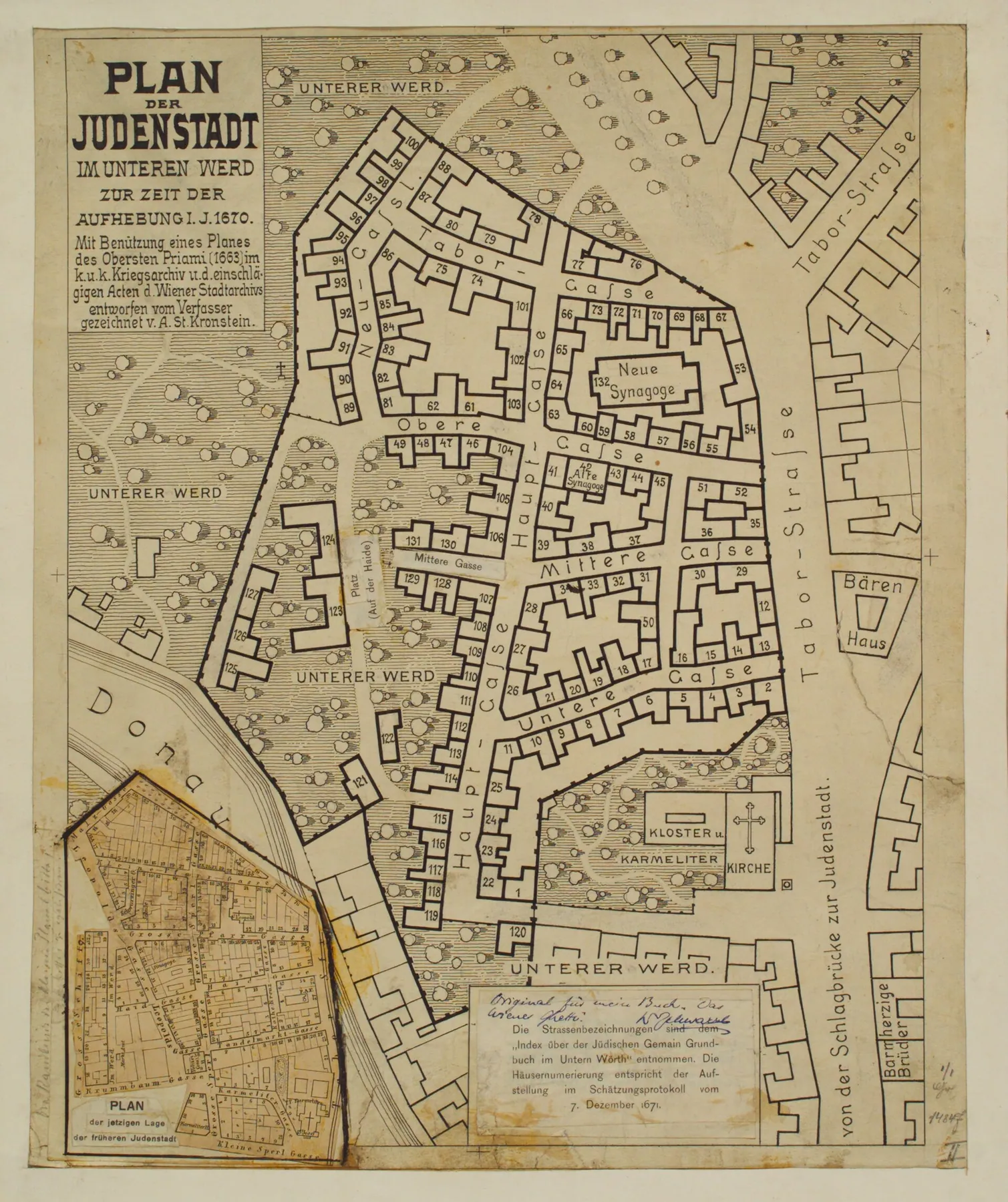
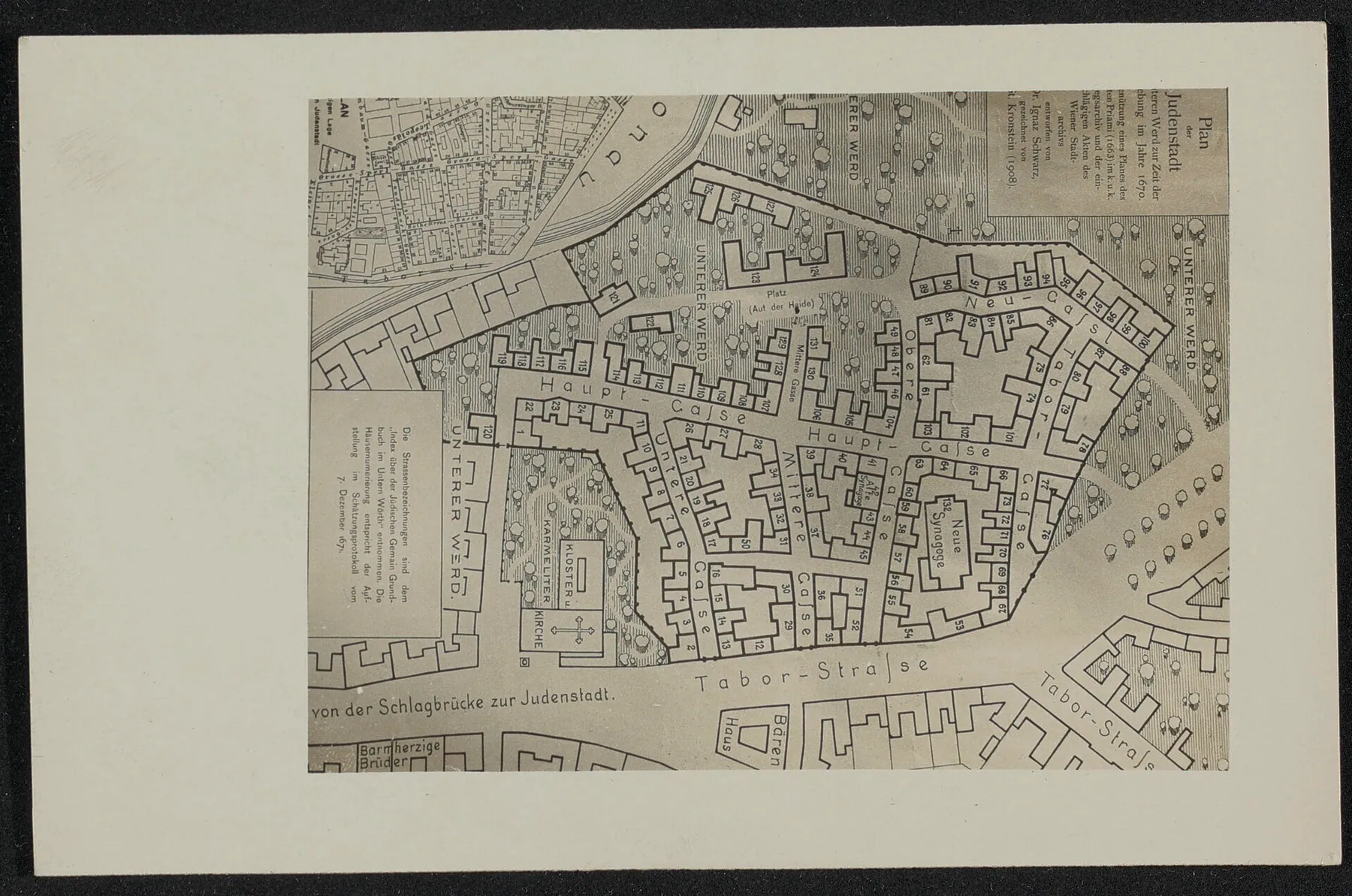
Almost nothing is known of the building's appearance. No view, drawing or description of the New Synagogue has been found, and its architect, builder, capacity and interior arrangement are unknown. What can be said rests on two kinds of evidence. First, two plans of the Judenstadt drawn in the early twentieth century from the plan of Colonel Priami of 1663 in the imperial war archive and from the community's land register mark the 'Neue Synagoge' as a free-standing building inside a block of houses in the north-east part of the ghetto, near the Tabor road. Second, the Wien Geschichte Wiki states that the square ground plan of the Leopoldskirche was taken over from the synagogue, so the synagogue was apparently a square hall. The Geschichte Wiki also notes that the synagogues of the ghetto were recognisable as such from outside, which suggests a dedicated building rather than a room in a house. Its style is unknown.
Leben in der Synagoge
No source read describes services, customs or furnishings in the New Synagogue. It was endowed by Zacharias Mayer Halewi; the Anu Museum names him together with his wife, whose name is not given. It was built because the old synagogue had become too small for the growing community, and the Geschichte Wiki calls it the main synagogue of the ghetto, so it was presumably where the community's principal services took place in its last two decades. The rabbis of Vienna in those years were Shabbetai Sheftel Horowitz, who arrived after 1648, and Gershon Ashkenazi, who came to Vienna after serving at Nikolsburg from 1661 to 1664 and stayed for five years until the expulsion. Besides the three synagogues the Judenstadt had private prayer rooms. Which rabbi preached in which of the three synagogues is not recorded in the sources consulted.
Zerstörung
The synagogue was taken from the community by the expulsion ordered by Emperor Leopold I. A fire in the Leopoldine wing of the Hofburg on the night of 24 February 1668 was wrongly blamed on Jews; antisemitic riots by students, agitation by clergy and Bishop Leopold Karl von Kollonitsch, the hostility of the Empress Margarita Teresa, burghers' fear of competition and a favourable imperial commission all fed the decision. The poor were expelled in 1669 and the remaining Jews had to leave by the summer of 1670; the Geschichte Wiki dates the expulsion to 14 February 1670 and the final evacuation to 28 July. On 18 August 1670 Leopold I and his wife laid the foundation stone of the Leopoldskirche on the site. The sources disagree on what happened to the synagogue. The Geschichte Wiki's church article says the 'Neue Jüdische Synagoge' had by then been demolished, though the church kept its square plan; its Synagogen article, the Austria-Forum encyclopaedia and the Anu Museum say the building was converted into the church, consecrated on 6 September 1671. Either way, that church burned in the Ottoman siege of 1683 and was pulled down in 1722.
Das Schicksal der Gemeinde
About 3,000 to 4,000 Jews, from 132 or 136 houses, were driven out of Vienna. The poorer families were expelled in 1669 and the rest by the summer of 1670, and their property was taken. An offer of 100,000 florins to limit the expulsion was refused, and an intervention by Queen Christina of Sweden, arranged by the community head Leo Winkler, failed. According to a Swedish ambassador some Jews converted to avoid exile. The exiles settled in other European cities and in small towns and villages; Rabbi Gershon Ashkenazi went to Metz. The city of Vienna undertook to make up the Jewish tax revenue the emperor lost. The Jewish cemetery in the Seegasse was handed to a bleacher to look after. The former ghetto was merged with the rest of the Unterer Werd and named Leopoldstadt. No new Jewish quarter was founded, but Jews returned to Vienna in small numbers in the following decades, and Leopoldstadt became the city's main Jewish district until 1938.
Der Ort heute
The site of the New Synagogue is occupied by the Catholic parish church of St. Leopold, Alexander-Poch-Platz 6 and Große Pfarrgasse 15, in Vienna's second district. Nothing of the synagogue survives above ground. The church built in 1670-71 burned in 1683, was pulled down in 1722 and replaced in 1722-24 by the present building to plans by Anton Ospel; it was badly damaged on 12 March 1945 and restored by 1961. The Geschichte Wiki says the square plan goes back to the synagogue, but whether any of its foundations remain is unknown. A Baroque inscription and a plaque of 1996 recall the synagogue and the expulsion.
Bedeutende Namen
Zacharias Mayer Halewi
UnknownFounder and donor of the New Synagogue, after 1650Zacharias Mayer Halewi (also given as Zacharias Meyer) endowed the 'new' synagogue of the Vienna Judenstadt after 1650, when the growing community had outgrown the old synagogue. The Anu Museum says the building was made possible by a donation from him and his wife, whose name it does not give. His gift became the main synagogue of the ghetto until the expulsion of 1670. Nothing further about his life was found in the sources read.
Biografie oder Quelle →Gershon Ashkenazi
died 1693 (or 1691)Rabbi of Vienna for about five years until the expulsion of 1670Gershon Ashkenazi studied in Cracow and was rabbi at Prossnitz, Hanau and, from 1661 to 1664, Nikolsburg. He then served for five years as rabbi of Vienna, the last rabbi of the Judenstadt while the New Synagogue was its main house of prayer, and was forced to leave by the banishment of the Jews. In 1670 he went to Metz, where he remained until his death; the Jewish Encyclopedia gives his death as 20 March 1693, but also 1691.
Biografie oder Quelle →Shabbetai Sheftel Horowitz
UnknownRabbi of the Vienna community after 1648The Encyclopaedia Judaica article on Vienna names Shabbetai Sheftel Horowitz as a rabbi of the renewed community in the Unterer Werd. He came to Vienna as a refugee from the Chmielnicki massacres of 1648 and so served the community in the years when the New Synagogue was endowed and became its main synagogue. His exact years of office and his death date were not given in the source read.
Biografie oder Quelle →Leo Winkler
UnknownHead of the Vienna Jewish community at the expulsion, 1670Leo Winkler headed the Jewish community of the Judenstadt when Emperor Leopold I ordered its expulsion. According to the Encyclopaedia Judaica he arranged for Queen Christina of Sweden to intervene with the emperor on the Jews' behalf, but the attempt failed and the community, with its New Synagogue, was dissolved in 1670. Nothing further about him was found in the sources read.
Biografie oder Quelle →Haben Sie etwas beizutragen?
Fotos, Dokumente, Familiengeschichten oder Erinnerungen an diese Synagoge und ihre Gemeinde halten ihre Geschichte lebendig.
- Leopoldskirche (2, Alexander-Poch-Platz)
- Judenstadt (2, Unterer Werd)
- Synagogen
- Synagogen (AEIOU)
- 350 Jahre Vertreibung der Juden aus Wien
- Synagogues in Vienna
- Vienna
- Vienna
- Ashkenazi, Gershon
- Plan der Judenstadt im Unteren Werd zur Zeit der Aufhebung im Jahre 1670 (Inv. Nr. 4204)
- Plan des Judenviertels im Unteren Werd (Inv. Nr. 333)
- St. Leopold, Große Pfarrgasse 15 (OpenStreetMap way 97571689)
Share a memory or thought
No comments yet. Be the first to add one.