
La historia de Vimperk Synagogue
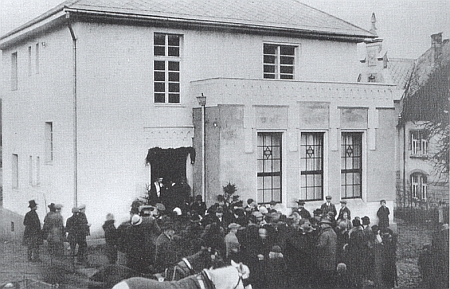
Vimperk, known in German as Winterberg, lies in the Bohemian Forest in the Prachatice district of South Bohemia. For centuries its Jews belonged to the older community of nearby Čkyně (Kieselhof), which had its own synagogue and cemetery. As Čkyně declined in the later nineteenth century, the centre of Jewish life moved to Vimperk. According to Jüdische Gemeinden, the seat of the community was moved there in 1897 and this was confirmed in 1900; the Vimperk local news site gives 1899 as the year the community became independent and the Čkyně synagogues closed. For about three decades the congregation had no building of its own. From the mid-1890s it held services in rented rooms, including the Hotel Habsburg. Only in the 1920s did it raise enough money for a purpose-built synagogue, partly by selling the former Čkyně synagogue in 1922, and partly from donations and a public collection. The new building, on the corner of today's 1. máje and Johnova streets in a district of villas, was finished at the end of 1925 and dedicated on 3 January 1926 by the rabbi of Plzeň, Max Hoch. It was in use for less than thirteen years. After the Munich Agreement Vimperk was annexed to Nazi Germany, and on 10 November 1938 local Nazis burned the synagogue's furnishings. The gutted building stood until 1941, when it was sold and demolished.
Where it stood for nearly 15 years
Historic: corner of Prager Straße and Kinostraße (Bartholomäusfeld), Winterberg. Today: corner of 1. máje and Johnova streets, Vimperk; site of house čp. 361/3, next to the Šumava National Park administration building, 1. máje 260/19 (approximate).
Abrir mapa ampliado →La comunidad judía
Jews are recorded in the Vimperk area from the time of the Thirty Years' War, settled under the protection of the local lords. The main settlement was at Čkyně, whose community reached its peak in the 1840s with more than 200 members and had an Empire-style synagogue of 1828 and a cemetery with about 500 graves. After 1850 many Jews left or died out there, while Vimperk grew. Newcomers from Galicia and other parts of the Habsburg monarchy enlarged the Vimperk congregation, and in the autumn of 1914 about fifty families of Jewish war refugees, some 300 people, arrived in the town. Around 1900 most Jewish men were merchants and shop employees. Jüdische Gemeinden counts 76 Jews in Vimperk and 119 in the judicial district in 1923, about twenty families around 1930 and 57 Jews in 1934. Around 1930 the community covered the judicial districts of Vimperk and Volary (Wallern). The same source notes that antisemitic currents grew in the town in these years.
Arquitectura y diseño
The plot was bought from the town in 1924 for 11,430 crowns. The building was put up by the local builder Josef Schmidt under the supervision of the architect Louis Wolt of České Budějovice, at a cost of about 105,000 crowns. Contemporary description calls it a modern two-storey building that suited the surrounding villa quarter. The prayer hall and the community office were on the ground floor and a flat for the rabbi on the upper floor. The hall had a richly decorated ceiling and walls and both traditional and electric lighting, and seated about 70 to 80 people on benches. The one photograph found, taken in the late 1920s, shows a plain rendered block with a shallow hipped roof and tall windows. A lower front wing holds three tall windows with Stars of David in their glazing, framed by flat pilaster strips under a simple cornice, and the entrance stands in a recessed corner beside it.
La vida dentro de la sinagoga
The synagogue was dedicated on 3 January 1926 in the presence of representatives of neighbouring Jewish communities, district and town officials and almost the whole town council. Rabbi Max Hoch of Plzeň performed the dedication; Jüdische Gemeinden also names the rabbis Julius Löwenbein and Arnold Flaschner of Strakonice as taking part, and says the music was directed by Heinrich Schlattner, choirmaster in Vimperk. The congregation brought two objects from the closed synagogue at Čkyně: a candelabrum and a Torah curtain (parochet), both then nearly a hundred years old. The building also served as the community's administrative seat, with its office on the ground floor, and was planned with a flat for a rabbi upstairs. No resident rabbi, cantor or community president of the years 1926 to 1938 is named in the sources consulted, and nothing is recorded of the order of services or of particular events held in the building during its short life.
Destrucción
After the Munich Agreement of September 1938, Vimperk was annexed to Nazi Germany as part of the Sudetenland, and most of the town's Jewish and Czech inhabitants fled inland. During the November Pogrom, on 10 November 1938, local Nazis set fire to the synagogue and burned all of its furnishings, as both the Vimperk local history article and Jüdische Gemeinden state; a commemorative plaque on the site also says the Nazis destroyed it on that date. The walls survived the fire and the burnt-out shell stood empty for several years. In 1941 Dr. Erich Finger, a Vimperk physician, bought the ruin, on condition that it be demolished according to the Czech Institute of Art History's memorial database, and had it pulled down at once to gain the building plot. No source consulted records what happened to the candelabrum and Torah curtain brought from Čkyně.
El destino de la comunidad
Most of Vimperk's Jews left the town in the autumn of 1938, when the Sudetenland was annexed, and moved into the remaining Czech lands. There they came under Nazi rule again after the occupation of March 1939. Those who could not emigrate in time were later deported. Jüdische Gemeinden records that deportations of Jews from the Prachatice district began in November 1942, with two large transports leaving Klatovy for the Theresienstadt ghetto, and that most of the deportees were murdered. The memorial plaque on the site states that most members of the Vimperk Jewish community were killed by the Nazis. The exact number of Vimperk Jews who died, and how many survived, was not found in the sources consulted. No Jewish community was re-established in Vimperk after the war. The old cemetery near Čkyně and the restored former synagogue there remain as reminders of the area's Jewish past.
El lugar hoy
The synagogue stood on the corner of today's 1. máje and Johnova streets in Vimperk. After the war a residential house, now numbered 361/3, was built on its plot, and nothing of the synagogue survives above ground. A granite memorial plaque, unveiled in June 2003 and commissioned by the town, is set in the stone retaining wall of the neighbouring building of the Šumava National Park administration, because the owners of the new house did not want it on their building. The pin for this entry marks that neighbouring park administration building, not the exact footprint of the synagogue.
Nombres destacados
Max Hoch
UnknownRabbi of Plzeň; dedicated the Vimperk synagogue in 1926Dr. Max Hoch, rabbi of Plzeň, led the dedication of the new Vimperk synagogue on 3 January 1926, in the presence of representatives of neighbouring Jewish communities, district and town officials and almost the entire town council. Jüdische Gemeinden names the rabbis Julius Löwenbein and Arnold Flaschner of Strakonice as taking part alongside him. Nothing further on his ties to the Vimperk congregation was found in the sources consulted.
Biografía o fuente →Louis Wolt
UnknownArchitect from České Budějovice who supervised the building, 1924-1925Louis Wolt, an architect from České Budějovice, supervised the construction of the Vimperk synagogue in 1924-1925, after the community bought the plot from the town. The building, a modern two-storey house with a decorated prayer hall for 70 to 80 people, the community office and a flat for a rabbi, was completed at the end of 1925 at a cost of about 105,000 crowns. No other works by him were identified in this research.
Biografía o fuente →Josef Schmidt
UnknownLocal builder (městský stavitel) who built the synagogue, 1924-1925Josef Schmidt, a builder in Vimperk, erected the synagogue in 1924-1925 under the supervision of the České Budějovice architect Louis Wolt. The building was finished at the end of 1925 and dedicated on 3 January 1926. Nothing further about Schmidt, his other buildings or his life was found in the sources consulted.
Biografía o fuente →¿Tiene algo que aportar?
Fotografías, documentos, historias familiares o recuerdos de esta sinagoga y su comunidad ayudan a mantener viva su historia.
Share a memory or thought
No comments yet. Be the first to add one.