
הסיפור של Visoko Synagogue
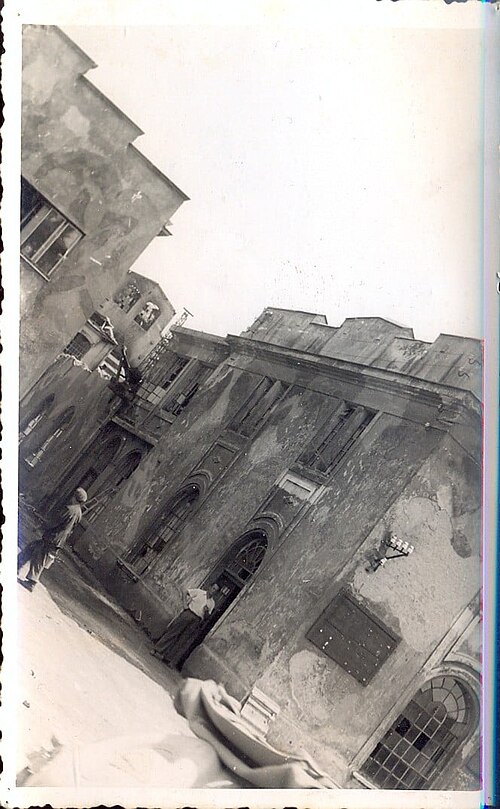
Visoko, a market town on the Bosna river north-west of Sarajevo, had a small Sephardic community whose ancestors came mostly from Sarajevo in the eighteenth century. Soon after the Austro-Hungarian occupation of 1878 the Jewish community bought a plot from Ismet Salihbegović and built a synagogue there in 1885-1886; the Sarajevo chronology on elmundosefarad gives 1886. The street on which it stood is still called Jevrejska ulica, Jewish Street, but the museum historian Mirna Malić points out that it was named after the synagogue, not after Jewish residents, who lived mostly along the main road. Town plans from before and after the great fire of 1911 place the building roughly in the middle of the street, behind the houses of the Saračević family, with its entrance in a courtyard on the east side. The synagogue served the community until 1941. One photograph, probably taken in 1941 or 1942 and kept by the Zavičajni muzej Visoko, shows it already damaged. During the war the Nazis used it as a military warehouse, and by 1945 it had been largely destroyed and looted. After the war the plot was sold and the ruins were cleared; no physical trace of it remains today.
Where it stood for nearly 60 years
Historic: Jevrejska ulica, Visoko, behind the Saračević houses, entrance from a courtyard on the east side; house number unknown. Today: Jevrejska ulica, 71300 Visoko, Zenica-Doboj Canton; private houses on the plot (approximate).
פתיחת מפה גדולה ←הקהילה היהודית
Jews settled in Bosnia under Ottoman rule from the early sixteenth century, and according to Mirna Malić of the Zavičajni muzej Visoko they reached Visoko in the eighteenth century, coming mainly from Sarajevo. The community was Sephardic. Its members were chiefly merchants and craftsmen, among them tinsmiths, leatherworkers and shoemakers, and Eli Tauber of the Jewish Community of Bosnia and Herzegovina credits them with an important share in the town's leather trade. Malić names the Danon, Kabiljo and Demajo families as the most prominent. Elijas Kabiljo, who came from Sarajevo, built a brickyard and houses for rent that are still known as Kabiljo's houses; the Danons ran a printing shop; and Avram Demajo was a leading teacher at the leather-crafting school. Malić's 2020 study, based on unprocessed archives in the museum, describes Jews taking part in every area of public life, holding their own seat in local government and owning or sharing in many businesses. According to N1, 199 Jews lived in Visoko up to 1941.
אדריכלות ועיצוב
Mirna Malić, citing the geographer M. Filipović in the Glasnik of the Belgrade Geographical Society (1924), describes the synagogue as a single-storey building of stone and brick with high ceilings and no ornament outside or inside; its walls were rendered and given a rose colour that Filipović called Sephardic. The front faced a courtyard that surrounded the building, while its back turned towards the street, and the entrance was on the east side. The museum's single photograph, probably of 1941-1942 and taken at a steep angle, shows a rendered wall with peeling plaster, tall round-arched doors and windows, a stepped parapet along the top and an iron fixture with upright arms on the wall. An undated pencil drawing in the museum, which Malić thinks was made from memory or oral tradition, shows a gabled block with two rows of arched windows behind a walled yard with a gate, and a small plan marked about 8 m by roughly 10 m. The drawing and the photograph do not match closely. Architect, builder and capacity are unknown.
החיים בבית הכנסת
Very little is recorded about worship in the Visoko synagogue. It was the only synagogue in the town and served a Sephardic congregation of merchants and craftsmen numbering about two hundred by 1941. A rabbi's house stood close by. According to Esad Durajlić, a forestry engineer from Visoko who remembered the building and whose account Mirna Malić recorded for the Zavičajni muzej Visoko, the last rabbi of Visoko came from the Kabiljo family; his first name, and the names of any earlier rabbis, cantors or community presidents, were not found in the sources read. The plan on the museum drawing marks the entrance at one short end of a simple rectangular hall, which suggests a single prayer room, but nothing is recorded about the position of the ark and bimah, a women's section or the furnishings. Malić's article on the Jews of Visoko, published in the museum's journal in 2020, and the municipal archive documents held by the museum may contain more on the congregation's religious life but could not be read in this run.
הרס
After the German invasion of Yugoslavia in April 1941 the synagogue lost its congregation. According to the Zavičajni muzej Visoko, the Nazis turned the building into a military warehouse during the Second World War. The museum's one photograph of it, probably taken in 1941 or 1942, already shows damage: patched and peeling render, broken glazing in the arched windows and debris in front of the walls. Towards the end of the war the synagogue was, in the museum's words, largely destroyed and looted, together with the rabbi's house that stood nearby. The sources do not say who carried out the looting and wrecking in 1944-1945. After the war, because no Jews remained in Visoko, the Jewish community of Zagreb was given authority over the land. It sold the plot to two private individuals from Visoko, who pulled down what was left of the synagogue and the rabbi's house and built two houses on the site. Durajlić remembered the buyer as Fadil Frtuna. The year of the sale and of the final clearance is not recorded in the sources read.
גורל הקהילה
In April 1941 Bosnia and Herzegovina was placed under the Independent State of Croatia, a Nazi puppet state led by the Ustaše, who began deporting the Jews of Bosnia in September 1941 to Kruščica, Jasenovac and other camps and later to Auschwitz. About 10,000 of the roughly 14,000 Bosnian Jews were murdered. Visoko's Jews shared this fate: Mirna Malić's study describes the community ending with its deportation to concentration camps. N1 reports that of 199 Jews living in Visoko up to 1941 only three remained in the town during the occupation, a pharmacist and two elderly women too ill to travel, and that 18 Visoko Jews survived the war in all. The exact dates, the camps to which they were taken and the names of the victims were not found in the sources read. The few survivors did not settle again in Visoko, and Eli Tauber of the Jewish Community of Bosnia and Herzegovina told N1 that the last Jews of the town died in the 1970s.
האתר כיום
Nothing of the synagogue survives. It stood roughly in the middle of Jevrejska ulica, behind the houses of the Saračević family, on a plot reached from the east through a courtyard. After the war two private houses were built on the site, and according to Esad Durajlić the house of Fadil Frtuna, who bought the land, still stands there. The exact plot can be identified on the Austro-Hungarian town plans kept in the cadastral archive of the Municipality of Visoko, which were not consulted for this entry. The street name, a pencil drawing and a single photograph in the Zavičajni muzej Visoko are what remain of the building. The Jewish cemetery lies outside the town on the road to Kiseljak.
יש לכם משהו לתרום?
תמונות, מסמכים, סיפורי משפחה וזיכרונות מבית הכנסת ומהקהילה שלו עוזרים לשמור על ההיסטוריה שלו בחיים.
- Mirna Malić: Visočka sinagoga
- File:Visoko synagogue, ca. 1941-42.jpg
- The last traces of the once thriving Jewish community in Visoko
- Jevreji Visokog (Radovi Zavičajnog muzeja - Visoko 1, 2020, pp. 262-285), abstract
- Sarajevski pinkas (chronology)
- History of the Jews in Bosnia and Herzegovina
- List of synagogues in Bosnia and Herzegovina
- Jevrejska, Visoko (OpenStreetMap way 204594644)
Share a memory or thought
No comments yet. Be the first to add one.