
Die Geschichte von Synagogue of Vítkovice (Ostrava)
Vítkovice was a poor farming village near Ostrava until 1843, when Salomon Mayer Rothschild bought its ironworks and turned it into one of the great industrial centres of the Habsburg monarchy. Workers and Jewish families from Galicia, Bukovina, Subcarpathian Ruthenia, Silesia, Bohemia, Moravia and Austria moved there in large numbers. By the early twentieth century the Jewish community had outgrown the small prayer house in neighbouring Zábřeh, and the synagogues of Moravská Ostrava were up to an hour's walk away. In spring 1909 the Jewish Temple Association in Vítkovice applied for permission to build a synagogue at the corner of today's Halasova and Kutuzovova streets. The Vítkovice Mining and Iron Works, owned by the Rothschilds, donated the plot and 20,000 crowns towards the building. The design came from Felix Neumann, a leading Jewish architect of Moravská Ostrava and a pupil of Wilhelm Stiassny. The synagogue, completed in 1911, served a congregation that followed the Reform rite. After the German occupation of March 1939 it was set on fire on 24 May 1939. The community could not pay for repairs, and the building was demolished in 1941.
Where it stood for 28 years
Historic: corner of today's Halasova and Kutuzovova streets, Witkowitz. Present day: Halasova / Kutuzovova, Vítkovice, Ostrava, Czech Republic. Approximate.
Größere Karte öffnen →Die jüdische Gemeinde
Vítkovice's Jewish community grew with the ironworks. After Salomon Mayer Rothschild bought the works in 1843, mines, factories and streets spread rapidly, and newcomers arrived from across the monarchy: poor rural labourers and a Jewish lower and middle class, particularly from Galicia, Bukovina and Subcarpathian Ruthenia, but also from Silesia, Bohemia, Moravia, Germany and Austria. Separate population figures for Vítkovice alone are not known, because the census covered the wider Ostrava area. A simple prayer house was built in neighbouring Zábřeh in 1894 on land bought by Leopold Rufeisen. By the early twentieth century the community wanted its own representative temple, reflecting its higher social standing and its adherence to the Reform rite, and in 1908 Vítkovice itself was raised to the status of a town.
Architektur und Gestaltung
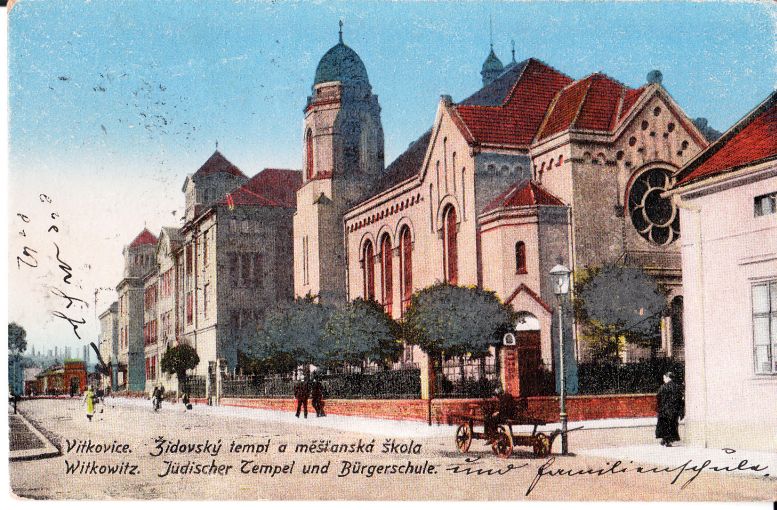
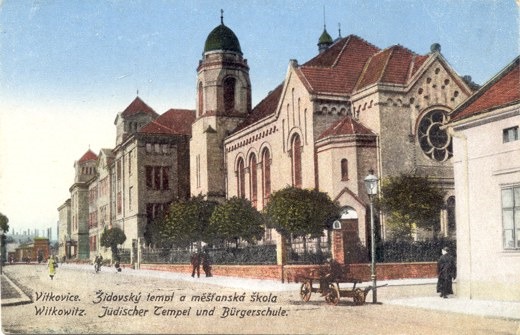
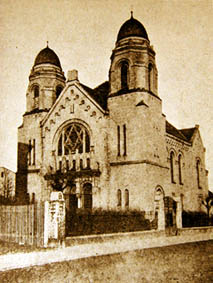
The synagogue was designed by Felix Neumann, a prominent Jewish architect and builder of Moravská Ostrava who had trained under Wilhelm Stiassny and had already built many residential, commercial and public buildings in the Ostrava region. He conceived it as a free-standing two-storey hall building measuring 26 by 17 metres. Its dominant south-western front had two towers and a large semicircular window with a six-pointed star. According to the Ostrava City Archive, the facade lost some of its impact when a German primary and secondary school was built very close to the synagogue. Surviving postcards show the twin-towered front facing the street. The plot, worth 3,000 crowns, stood at the crossing of today's Halasova and Kutuzovova streets.
Leben in der Synagoge
The synagogue gave Vítkovice's Jews a place of worship in their own town, sparing them the long walk to Moravská Ostrava. The congregation belonged largely to the Reform rite of Judaism, and the building was meant to represent the community's standing in a town dominated by the Rothschild ironworks, which funded much of the construction. It served the Jews of Vítkovice for less than three decades, from 1911 until the German occupation in 1939. The names of its rabbis and cantors are not recorded in the sources consulted for this entry. Its large star window over the entrance and its two towers made it one of the recognisable buildings of the growing industrial town.
Zerstörung
German troops occupied Ostrava on 14 March 1939. The synagogues of the Ostrava region soon became targets of antisemites and members of the Nazi SA: according to the Ostrava City Archive, the Vítkovice synagogue was set on fire on 24 May 1939, before those of Zábřeh, Přívoz and Moravská Ostrava. The building authority then ordered the Jewish association to submit a proposal for reconstruction. Its members hoped to pay for repairs with their fire insurance, but the insurance was never paid out. In November 1939 the association was threatened with seizure of its assets. Demolition was eventually contracted to the Ostrava firm Kolář & Rubý, and the burned building was finally removed in the summer of 1941.
Das Schicksal der Gemeinde
Of the more than 10,000 Jews of Greater Ostrava, including Vítkovice, more than 8,000 were murdered in the concentration and extermination camps during the Holocaust, and others fell as soldiers of the Czechoslovak armies in exile. The Ostrava region saw the first deportations of Jews from the Protectorate in October 1939, to Nisko in occupied Poland. After the war about 500 Jews returned to Ostrava, but almost all of them emigrated after 1948 and 1968, to Israel, Britain, Australia, the United States and West Germany. Today's Jewish community in Ostrava has just over a hundred members, while many Jews from Ostrava and their descendants live in Israel, Germany and the United States.
Der Ort heute
Nothing of the synagogue survives. It stood at the corner of today's Halasova and Kutuzovova streets in Vítkovice, now a district of Ostrava, close to the school building whose construction had once partly hidden its facade. Its appearance is known from postcards of the 1910s and 1920s. The smaller prayer house in neighbouring Zábřeh, burned on 7 June 1939, stood on today's Ruská street, where a small school park now occupies its site. No memorial to the Vítkovice synagogue is mentioned in the sources consulted.
Bedeutende Namen
Felix Neumann
1860–1942ArchitectFelix Neumann, born in Radvanice in 1860, was a leading Jewish architect and builder of Moravská Ostrava and a pupil of Wilhelm Stiassny. He designed the Vítkovice synagogue as a free-standing hall with two towers and a great star window. He died in Moravská Ostrava in June 1942, during the Nazi occupation, three years after his synagogue was burned.
Biografie oder Quelle →Haben Sie etwas beizutragen?
Fotos, Dokumente, Familiengeschichten oder Erinnerungen an diese Synagoge und ihre Gemeinde halten ihre Geschichte lebendig.
Share a memory or thought
No comments yet. Be the first to add one.