
הסיפור של Vlissingen Synagogue (Gravenstraat)
Vlissingen, the port town known in English as Flushing, had Jewish settlers from the late sixteenth century, but a lasting congregation dates from the eighteenth century, when Ashkenazi Jews were allowed in 1738 to buy two houses in the Lange Noordstraat, now the Molenstraat, and fit them out as a synagogue. A separate Jewish community, independent of Middelburg, was formed around 1845. It worshipped in the Rioolstraat until 1861 and then in the Beursstraat, and in 1867 began building a synagogue on the Peperdijk with a state subsidy; that building was consecrated a year later and remained in use until 1920.
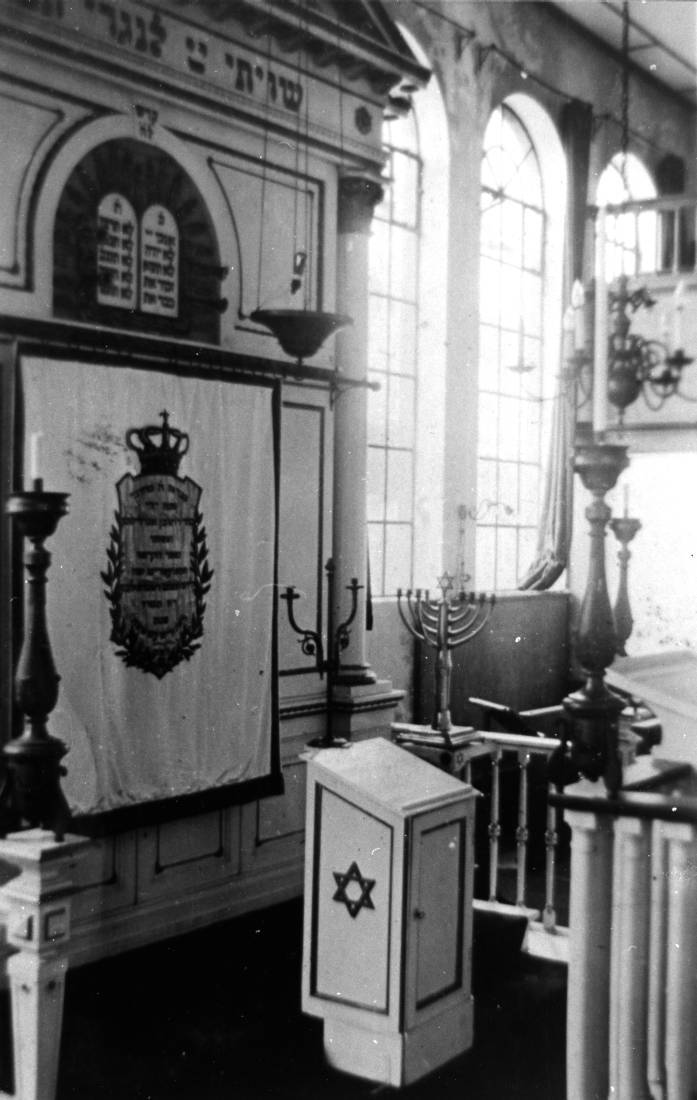
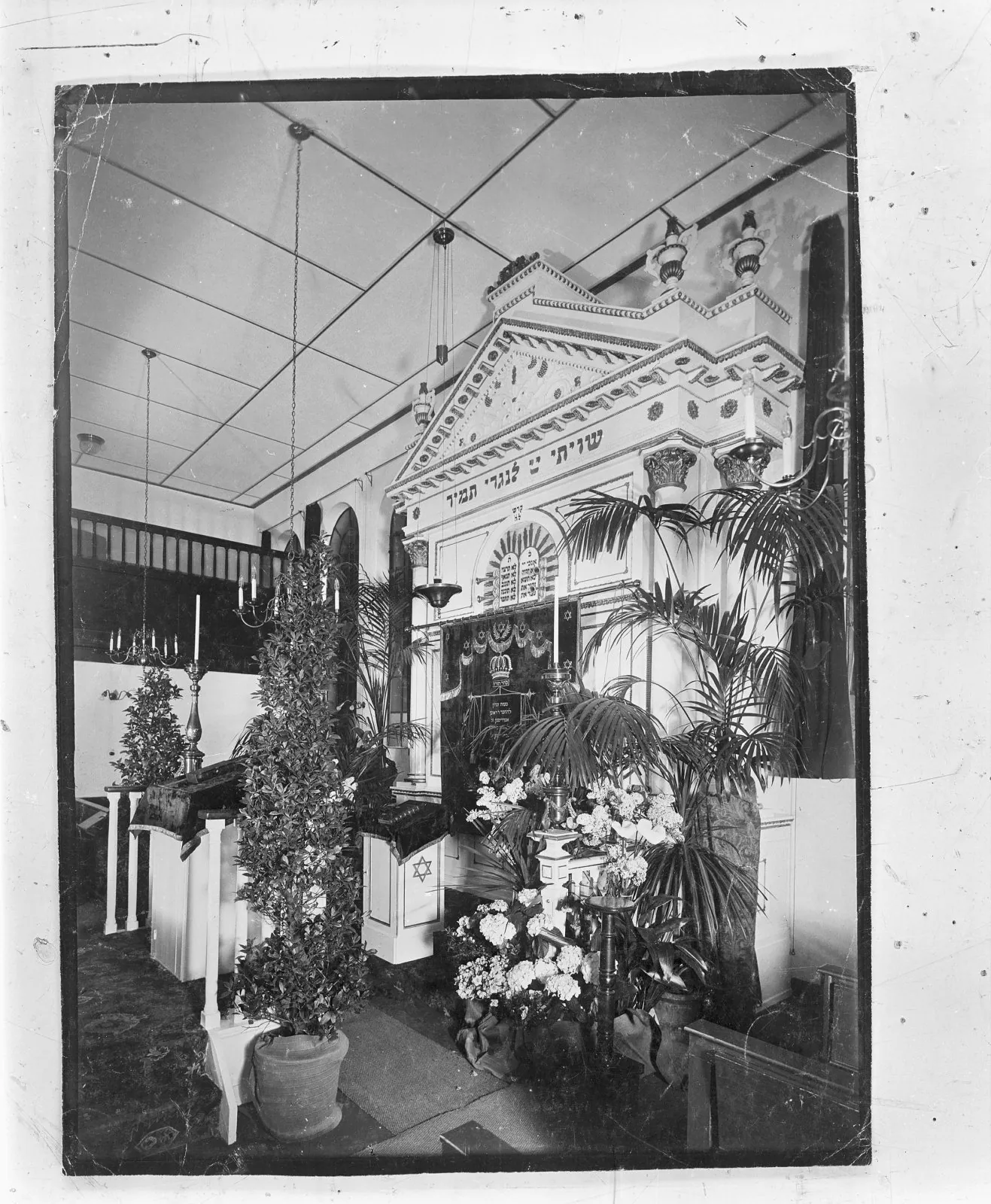
In 1921 the congregation set up a new synagogue at the corner of the Gravenstraat and the Paardenstraat in the old town centre. By then members were leaving for the larger cities, and the community history notes that within a few years the new synagogue was used only on the holidays. Two photographs of its prayer hall survive, showing a white classical Torah ark under a flat panelled ceiling, with tall arched windows and a women's gallery. During the occupation the Nazis looted the building in 1940, after the Torah scrolls and ritual objects had been taken to Amsterdam. It was almost wholly destroyed in an Allied bombing raid in November 1944 and its remains were demolished in 1945. The congregation was never re-formed.
Where it stood for nearly 25 years
Historic: corner of Gravenstraat and Paardenstraat, Vlissingen (Zeeland). Today: Paardenstraat, 4381 Vlissingen; exact plot unknown; pin approximate (middle of the Paardenstraat).
פתיחת מפה גדולה ←הקהילה היהודית
The Jewish population of Vlissingen and its surroundings was always small. The community history records 9 Jews in 1809, 67 in 1840, 90 in 1869 and a peak of 125 in 1899, falling to 55 by 1930. Before about 1845 the Vlissingen Jews belonged to the congregation of Middelburg; the German Jews who bought the Lange Noordstraat houses in 1738 and opened a cemetery on the present Julianalaan the same year left again after a few years. Around 1845 the Vlissingen Jews formed their own community. About 1900 it had the full set of institutions of a Dutch Jewish congregation: a church board, a church council and a poor-relief board, together with several societies that looked after burials, the upkeep of the synagogue and support for needy members. New burial ground was bought on the Julianalaan in 1870, and part of the municipal Vredehof cemetery was set aside for Jews. In the early twentieth century the community shrank as members moved to the larger cities, and in 1948 it was merged into the congregation of Middelburg. The names of its rabbis, cantors and presidents were not found in the sources read.
אדריכלות ועיצוב
No exterior view of the Gravenstraat synagogue was found, and its architect, builder, size and outward appearance are unknown. The community history says the synagogue was set up in 1921, which may mean that an existing building on the corner plot was fitted out for worship rather than built new, but no source confirms either way. Two interior photographs show the prayer hall. Against the east wall stood a large white Torah ark in classical style: fluted pilasters with Corinthian capitals carried a stepped entablature and a pediment decorated with garlands and rosettes, topped by urn finials. Across the frieze ran the Hebrew verse 'I have set the Lord always before me', and above the ark doors, in a round-headed niche, were the tablets of the Ten Commandments. A dark curtain embroidered with a crown and a Hebrew inscription hung before the ark. In front stood a reading desk marked with a Star of David, tall candlesticks and a menorah. The hall had a flat ceiling divided into panels, hanging lamps and chandeliers, tall round-arched windows, and a wooden women's gallery with a balustrade along one side.
החיים בבית הכנסת
By the time the Gravenstraat synagogue opened in 1921 the congregation had already lost much of its membership to the larger cities, and the community history states that in the following years the building was used only on the Jewish holidays. One photograph, kept by the Cultural Heritage Agency of the Netherlands as a 1969 reproduction, shows the prayer hall decorated with potted palms, laurel trees, hydrangeas and other flowers in front of the Torah ark, which the agency's catalogue suggests was done for Shavuot, the Feast of Weeks, when synagogues were traditionally decked with greenery. The other photograph, dated about 1930 to 1940 by the Jewish Cultural Quarter, shows the hall in everyday order, with the reading desk, candlesticks and menorah before the ark. No account of individual services, rabbis or cantors at this synagogue was found.
הרס
When Nazi Germany occupied the Netherlands in May 1940, the Torah scrolls and other ritual objects of the Vlissingen synagogue had already been taken to safety in Amsterdam. According to the Jewish Cultural Quarter's community history, the Nazi German occupiers looted the synagogue in 1940. After the forced removal of the town's Jews in March 1942 the building stood empty. In November 1944 it was, in the words of the Dutch text, almost completely destroyed in a bombing raid by the Allies; the English version of the same history says it was heavily damaged during an Allied bombardment in 1944. Which air force carried out the raid, and on which day, is not stated in the sources read. What remained of the building was demolished in 1945. Who ordered or carried out the clearance of the ruins is not recorded, and no wartime or postwar photograph of the damaged building was found.
גורל הקהילה
In March 1942 the occupation authorities forced the Jews still living in Vlissingen to move to Amsterdam. From Amsterdam they were deported and murdered in Nazi camps. According to the Jewish Cultural Quarter, only two Vlissingen Jews, who had gone into hiding, survived the occupation. After the war Jewish life in the town was not resumed. In 1948 the Vlissingen community, by then existing only on paper, was formally placed under the congregation of Middelburg, and today all Jews in the province belong to the Jewish Community of Zeeland. In 1954 a memorial stone for the murdered Jews of Zeeland was unveiled at the Jewish cemetery in Vlissingen. The municipality restored the cemetery, including its small purification house and a tile panel, in 2004, and in September 2012 handed the cemetery over to the Jewish Community of Zeeland.
האתר כיום
The synagogue stood at the corner of the Gravenstraat and the Paardenstraat in the old town of Vlissingen. The Paardenstraat still exists, but no present-day street of the name Gravenstraat could be found in OpenStreetMap, so the exact corner and what now stands on the plot could not be established from the sources consulted. The map pin for this entry marks the middle of the southern section of the Paardenstraat and should be read as approximate. No marker at the site of the synagogue is recorded in the sources read. The Jewish cemetery of Vlissingen, with its restored purification house, survives and is cared for by the Jewish Community of Zeeland, and a memorial stone there recalls the murdered Jews of the province.
יש לכם משהו לתרום?
תמונות, מסמכים, סיפורי משפחה וזיכרונות מבית הכנסת ומהקהילה שלו עוזרים לשמור על ההיסטוריה שלו בחיים.
- Vlissingen (Joodse gemeenten)
- Vlissingen (Jewish communities, English version)
- Interieur van de vermoedelijk vanwege het Wekenfeest met bloemen en planten versierde voormalige synagoge te Vlissingen naar het oosten, reproductie
- Joodse gemeenten in Zeeland
- Paardenstraat, Vlissingen (OpenStreetMap way 7626112)
Share a memory or thought
No comments yet. Be the first to add one.