
La historia de Vrbas Synagogue
Vrbas lies in the centre of Bačka, in the South Bačka district of Vojvodina. Under Hungarian rule it was two villages, Óverbász and Újverbász, in the Kula district of Bács-Bodrog county. Jews were among the town's population from at least the eighteenth century: a study of Jewish heritage in Bačka by Aleksandra Terzić and Željko Bjeljac lists Vrbas among the places where small prayer houses served as the first gathering places of Bačka's Jews. A Jewish cemetery in Vrbas holds about thirty visible gravestones dating from 1869 to 1936.
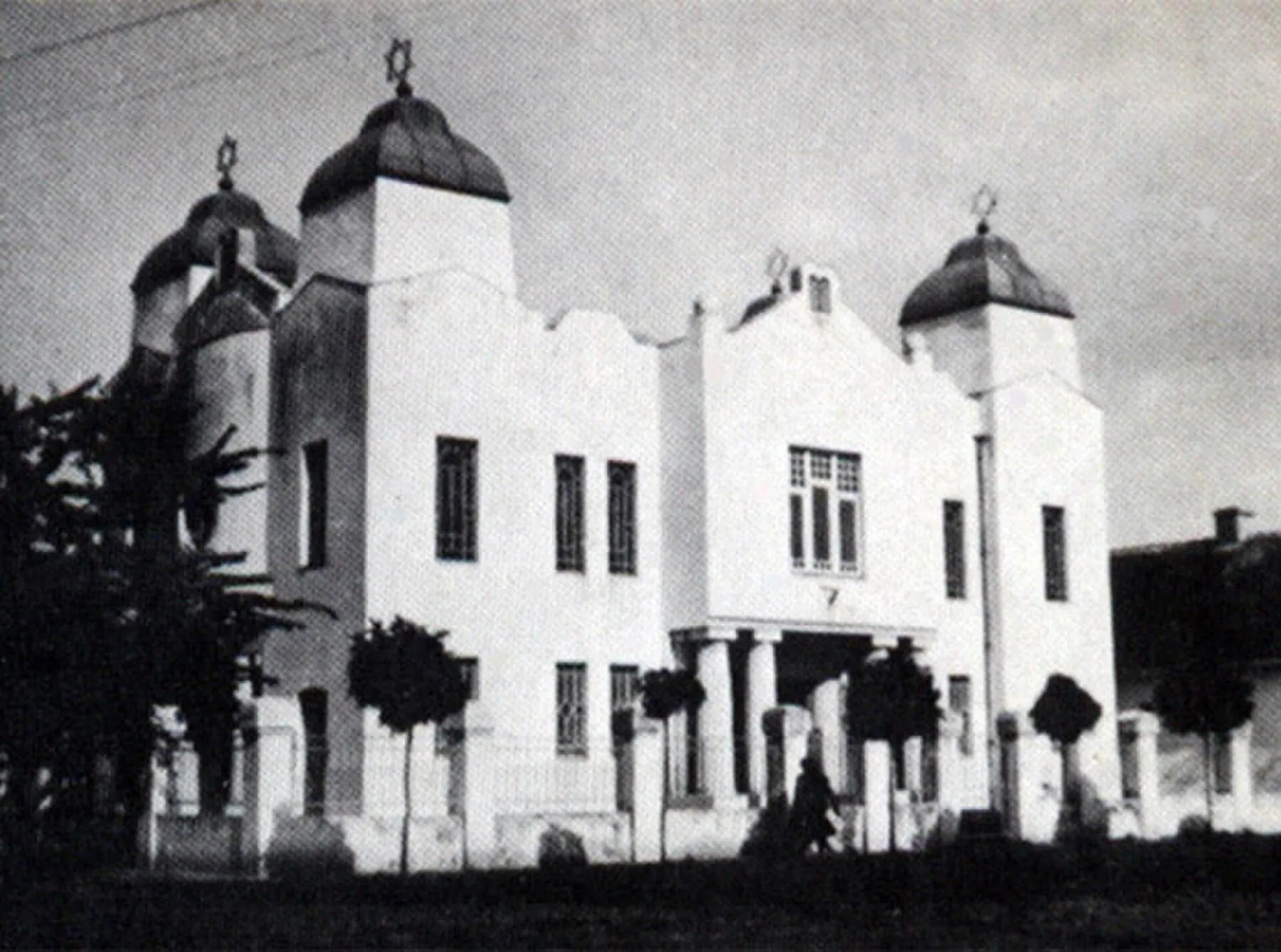
The synagogue that is the subject of this entry was completed in 1914, on the eve of the First World War, according to Terzić and Bjeljac and to the list of Serbian synagogues drawn from Goran Levi's 2016 catalogue. It stood at what is now Narodnog fronta 51. A photograph kept by the Museum in Vrbas shows a large, white, free-standing building with domed towers and a columned entrance porch. The building outlived its congregation, which was destroyed during the Second World War. Three sources date its end to 1948, in the first years of Communist Yugoslavia, while the regional tourist board says it was destroyed during the war. Its two marble tablets of the Ten Commandments were taken to Israel and installed in a new synagogue in Karmiel.
Where it stood for 34 years
Historic: Újverbász (Novi Vrbas), Bács-Bodrog county; street name before 1945 unknown. Today: Narodnog fronta 51, 21460 Vrbas, Serbia (address given by the Vojvodina tourist board; pin approximate).
Abrir mapa ampliado →La comunidad judía
Very little about the Jewish community of Vrbas could be read for this entry. Terzić and Bjeljac record that Jews were accepted early in this part of Bačka, at Kula, the neighbouring district town, as early as 1709, and they list Vrbas among the eighteenth-century settlements where Jews met for prayer in modest houses of worship before synagogues were built. The Jewish cemetery on Oktobarska street, described by the European Jewish cemetery survey as fenced, overgrown and owned by the local community, has gravestones from 1869 to 1936, so a settled community with its own burial ground existed by the second half of the nineteenth century. Terzić and Bjeljac also date a cemetery at Novi Vrbas to 1901. The building of a substantial new synagogue in 1914 suggests a congregation of some means at that time. The size of the community, its religious orientation, its rabbis, its lay leaders, its school and its institutions are unknown from the sources consulted.
Arquitectura y diseño
The only view found is a photograph donated to Wikimedia Commons by the Museum in Vrbas and described there as the synagogue of Vrbas destroyed in 1948. It shows a large, white, rendered building seen from the front corner, set behind a low wall with railings and a row of small clipped trees. The front is broken into several parts: tall corner towers rise above the eaves and are capped with dark, bulbous domes, each crowned by a Star of David, and a smaller domed turret appears at the back left. Between the towers the walls end in curved and stepped gables, one of them also topped by a star. A porch of round columns shelters the main entrance, above which is a large window divided into small panes; the walls are pierced by tall, narrow rectangular windows on two levels. The architect, the builder, the seating capacity, the interior layout and the position of the women's gallery are unknown.
La vida dentro de la sinagoga
No description of services, rabbis, cantors or communal activities inside the Vrbas synagogue was found in the sources consulted, and its religious orientation is unknown. The only furnishings of the building whose later history is recorded are its two marble tablets bearing the Ten Commandments. According to the list of Serbian synagogues based on Levi's catalogue, they were moved to Israel and installed in a new synagogue in Karmiel in Galilee, and the regional tourist board adds that in Israel they serve as a memorial to the Jewish families of Vrbas who were victims of Nazi terror. Where they stood in the building is not recorded. Photographs of the interior, of the ark and of any women's gallery were not found.
Destrucción
The sources disagree on when and how the synagogue was lost. The heritage study by Terzić and Bjeljac (2014) gives 1914 as the year of construction and 1948 as the year it was demolished; the English-language list of Serbian synagogues based on Levi's catalogue says it was demolished in 1948; Robert Čoban's 2023 article in Vreme lists Vrbas, 1948, among the synagogues of Vojvodina pulled down; and the photograph donated by the Museum in Vrbas is described as showing the synagogue destroyed in 1948. Only the regional tourist board, vojvodina.travel, says that it was destroyed during the war. No source read describes any wartime damage, and the weight of the evidence is that the building survived the war and was demolished in 1948, when Yugoslavia was under Communist rule. Who ordered or carried out the demolition, and whether the building was first sold or handed over, is not recorded. Terzić and Bjeljac write that most synagogues in Bačka were demolished between 1948 and 1962 and attribute the postwar destruction of Jewish heritage generally to the communist authorities, but they do not name the actor in Vrbas.
El destino de la comunidad
Hungary joined the attack on Yugoslavia on 11 April 1941 and occupied Bačka, including Vrbas, until 1944. In January 1942, after fighting between Šajkaška partisans and the Hungarian army, Hungarian forces carried out the so-called Raid across southern Bačka, in which, according to Terzić and Bjeljac, about 870 Jews were killed; whether Jews of Vrbas were among them is unknown. In the last phase of the occupation the Jews of Bačka, regardless of age and sex, were deported to Nazi concentration camps; Terzić and Bjeljac count 7,934 Jews of the region who died in camps, mostly in Germany and Ukraine, and only 3,572 who survived the war, of whom 2,482 later emigrated to Israel. The number of Vrbas Jews killed and the date and route of their deportation are unknown from the sources read. The regional tourist board describes the tablets taken from the synagogue to Israel as a memorial to the Jewish families of Vrbas who were victims of Nazi terror. No organised Jewish community is recorded in Vrbas after the war.
El lugar hoy
The tourist board of Vojvodina gives the synagogue's address as Narodnog fronta 51, in the part of Vrbas that was formerly Novi Vrbas (Újverbász). Today that address carries commercial premises, including a furniture shop and a pharmacy, according to OpenStreetMap; no source consulted says whether the present building stands on the synagogue's footprint or beside it. A hexagonal column that belonged to the synagogue stands on the former site as a sign of its existence. The Jewish cemetery of Vrbas, on Oktobarska street, survives, fenced but badly overgrown. Old photographs, of which one is known online, are the only record of the building's appearance.
¿Tiene algo que aportar?
Fotografías, documentos, historias familiares o recuerdos de esta sinagoga y su comunidad ayudan a mantener viva su historia.
- The extermination of Jewish population and heritage in Bačka region of AP Vojvodina (Serbia), TRAMES 18 (68/63), 1 (2014), pp. 39-55
- List of synagogues in Serbia
- Synagogue - Vrbas
- Veliki, nevidljivi kamen spoticanja
- File:Muzej u Vrbasu, Sinagoga.jpg
- Vrbas New Jewish Cemetery
- Bács-Bodrog vármegye községei (Magyarország vármegyéi és városai: Bács-Bodrog vármegye I)
- Narodnog fronta 51, Vrbas (OpenStreetMap node 11524763513)
Share a memory or thought
No comments yet. Be the first to add one.