
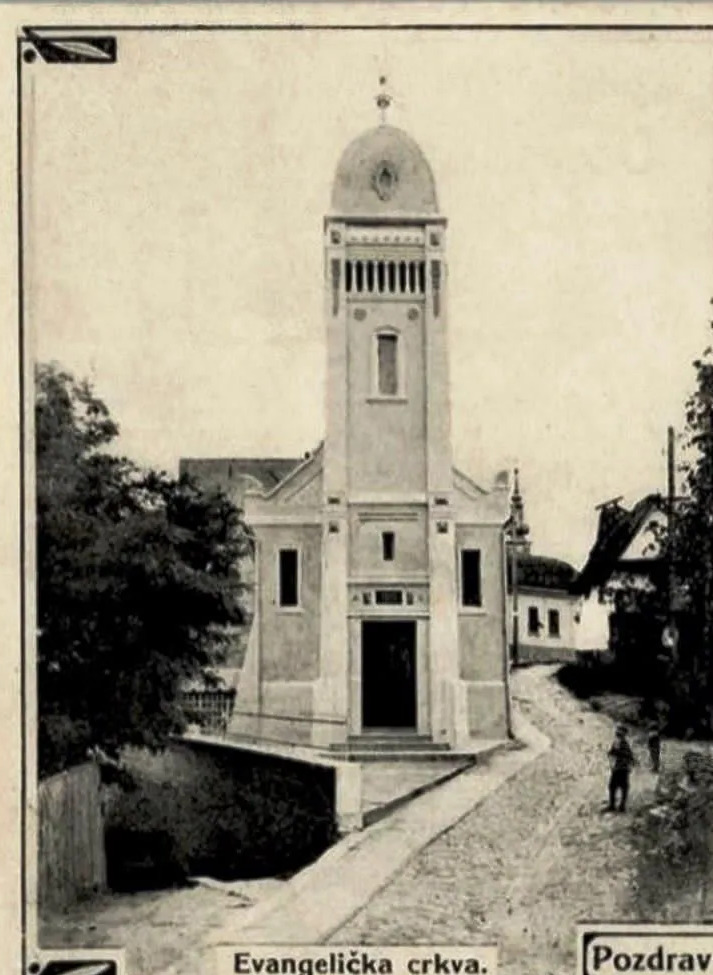
The story of First Synagogue of Vukovar
Vukovar's Jews began to organise as a community in the late 1830s, in a market town of the Eltz estate whose merchants had long tried to keep them out. In the summer of 1845 the community put up its first synagogue on a sloping plot in Gajeva ulica, Stari Vukovar, about halfway between the town centre and the Franciscan monastery. The art historian Dragan Damjanović, who reconstructed its history from the Srijem county files in the Croatian State Archives, calls it the first purpose-built synagogue in Civil Croatia as far as present research shows. Construction met protests from neighbours and from Catholic and Orthodox townspeople, and the county approved it only after the community described it as a prayer house and the facade was redesigned to look like an ordinary house. It served the congregation until 1889, when Ludwig Schöne's domed synagogue was finished a few plots away on the same street; that building has its own entry. In 1894 or 1895 the old synagogue was sold to the young Hungarian Calvinist congregation and became its church. In 1910 the Calvinists added a reinforced-concrete bell tower designed by Fran Funtak, said to be the first in Croatia. The building was demolished in the late 1960s, after the 1965 flood had weakened its foundations.
Where it stood
Historic: Gajeva ulica, Stari Vukovar, cadastral plot 89 (1863 survey). Today: Ulica Ljudevita Gaja, Stari Vukovar, 32000 Vukovar; exact plot not identified (approximate).
Open larger map →The Jewish community
Organised Jewish life in Vukovar lasted, in Damjanović's words, little more than a hundred years, from the late 1830s to 1945. The town belonged to the Eltz family's estate, and the local merchants' association had for years campaigned without success against Jewish settlement. Hungarian laws of 1790/91 and 1840 let Jews settle in most towns but did not allow them to build synagogues, which is why the 1845 building was presented to the authorities as a prayer house. The plot was leased for 32 years by Salomon Spitzer, a surgeon who had been the first Jew employed by Srijem county and who had converted to Catholicism by then. The community's reply to the county in August 1845 was signed first by Friedrich Singer (Szinger), with Jacobus Borovitz, Benedictus Tander and Abraham Shmuczer. The community then grew quickly: JewishGen gives about 200 Jews in 1900 and some 600 in 1925/26, and by the end of the century it was among the largest and wealthiest in Croatia. It also kept an old cemetery used from about 1830 and a new one opened in 1850.
Architecture and design
Two versions of the 1845 design survive in the Srijem county file in the Croatian State Archives; both are unsigned, so the designer is unknown. Damjanović suggests the county surveyor Eugen Jeroslavsky drew the second version, and that the first may have come from Vienna or Pest. The front had plain Doric pilasters on a high plinth, a shallow frieze, a central portal and a semicircular thermal window above it. The long side facing Gajeva ulica had three large semicircular windows high in the wall, and its pylon-like massing recalls an Egyptian temple. The first project had no visible roof; the revised one added a hipped roof and a chimney. Three doors led to the men's hall, to a stair for the women's gallery above the entrance, and to a side room. Two more windows flanked the Torah ark on the rear wall. A small dwelling, perhaps for the ritual slaughterer, was attached and was removed in the 1850s. The building stood on a slope, oriented north-west to south-east, on cadastral plot 89. Capacity is unknown.
Life inside the synagogue
Very little is recorded about worship in the building. The congregation was Ashkenazi, and the plan followed Ashkenazi practice: men prayed in the main rectangular hall, entered through a vestibule from the central door, while women used a gallery reached by a separate stair from the right-hand door. The left-hand door opened into a small room that Damjanović identifies as a place for latecomers. The 1845 drawings show no Torah ark, so the ark was probably provisional at first and a more representative one may have been installed later; nothing is known of it. The attached dwelling with a kitchen and living room was reportedly meant for the shochet, the ritual slaughterer, though Damjanović notes it may also have helped the claim that the building was a house rather than a temple. No rabbi, cantor or teacher who served in the building between 1845 and 1889 is named in the sources read. The building was used for worship until the new synagogue opened in 1889.
Destruction
The building survived the Second World War as a Calvinist church, so its end is not part of the Holocaust. After the community moved into its new synagogue in 1889, it decided in 1894 or 1895 to sell the old one to the Hungarian Calvinist congregation, which kept the facade but probably walled up the side doors. In 1910 the firm Banheyer i sin built Funtak's Secession-style concrete bell tower in front of the main facade, with a new choir inside. The Danube flood of 1965 partly undermined the foundations and left the ground unstable, and by then emigration and assimilation had reduced the Calvinist congregation so that the church was rarely used. In 1965 Vukovar was part of Communist Yugoslavia. Damjanović writes that the damage alone did not make the building impossible to save and blames the decision to pull it down on a negative attitude to nineteenth- and early twentieth-century heritage and a radical modernist approach to town planning. He dates the demolition to the end of the 1960s and illustrates it with a photograph of the demolition in the Vukovar City Museum. No source read names the authority that ordered it.
The community’s fate
The congregation that had built the synagogue was destroyed in 1941, after Vukovar became part of the Ustaše-ruled Independent State of Croatia. JewishGen records about 289 Jews in 1937/38 and says that in late 1941 the community of about 500 was deported to various camps, mainly Jasenovac; another note on the same page says Jewish property was confiscated and that few returned. The last rabbi, Dr Izrael (Izidor) Scher, and his wife Klara, a doctor, were murdered at Jasenovac in July 1941 according to the Kraus history and CENDO records cited by Wikipedia. Only 24 Jews were counted in Vukovar in 1947. Alfred Pal, a Vukovar survivor, told the JTA in 2002 that he was the only survivor of his family. The sources read do not give a full death toll. The great synagogue of 1889 was sold and demolished in 1958, and no Jewish community remains in the town; the Jewish cemetery survives.
The site today
The synagogue stood on cadastral plot 89 of the 1863 survey on Gajeva ulica, now Ulica Ljudevita Gaja, a sloping street in Stari Vukovar between the town centre and the Franciscan monastery; the great synagogue of 1889 stood on plot 92 of the same street. Damjanović states only that the church no longer exists and does not describe what occupies the plot today. No surviving fragment of the building or of Funtak's tower is recorded, and no marker on the site was found. The nearby Hungarian school that Funtak also designed now serves as a police station. The map pin marks the midpoint of Ulica Ljudevita Gaja and not the exact plot.
Notable names
Friedrich Singer (Szinger)
UnknownLeading member of the Vukovar Jewish community, 1845Singer was the first signatory of the Jewish community's reply to Srijem county on 26 August 1845, written when townspeople and the bishop of Đakovo opposed the new building. The reply argued that it was only a prayer house, a domus oratorium or Betthaus, not a temple, and the county assembly approved it the same day on condition that its facade look like an ordinary house. Jacobus Borovitz, Benedictus Tander and Abraham Shmuczer also signed. Damjanović does not give his formal office.
Biography or source →Salomon Spitzer
UnknownSurgeon; leaseholder of the synagogue plot, 1845Spitzer, a surgeon, was the first Jew employed by Srijem county and later an honorary county surgeon. He leased the Gajeva ulica plot on which the synagogue was built for 32 years. By the time building began he had converted to Catholicism, which Damjanović suggests may have given the project legal cover, since the laws of the time did not allow Jews to build synagogues. His role is known from the 1845 complaints and county commission files.
Biography or source →Do you have something to contribute?
Photographs, documents, family stories or memories of this synagogue and its community help keep its history alive.
- O gradnji i stilu prve vukovarske sinagoge iz 1845. godine (Povijesni prilozi 32, 2007, pp. 241-257)
- Zvonik kalvinske crkve u Vukovaru iz 1910. godine (Građevinar 60, 2008, no. 5, pp. 403-410)
- Židovske vjerske građevine vukovarskog inženjera Frana Funtaka (Prostor 12, 2004, no. 2, pp. 129-140)
- Vukovar Synagogue
- Vukovar (Cemetery Discovery Project)
- Vukovar Great Synagogue (TSP entry)
- File:Vukovar. Crkva, Sinagoga.jpg
- Ulica Ljudevita Gaja, Vukovar (OpenStreetMap way 289023128)
Share a memory or thought
No comments yet. Be the first to add one.