
Historia Waalwijk Synagogue
Waalwijk, a leather and shoemaking town in the Langstraat district of Noord-Brabant, had a small Jewish community from the eighteenth century. Its members first prayed in a private house in Besoijen, the village at the western end of the town. From 1847 they rented one of the three so-called 'tempeliershuizen' in Besoijen, houses associated by local tradition with the Knights Templar, and in 1869 the congregation bought the building. After rebuilding work it was inaugurated as a synagogue in 1884.
In 1901 a fire badly damaged this first synagogue. The community rebuilt it on the same spot, and the new synagogue was consecrated in February 1902. This is the building described here: a plain rendered hall on the Grotestraat at the corner of the Tempelierstraat, with its gable to the street. It served a congregation that never numbered more than about seventy-five people and had dwindled to seventeen by 1930.
At the beginning of the occupation in 1940 the Nazi German authorities confiscated the synagogue and sold its furnishings at public auction. The Torah scrolls survived the war. After 1945 no congregation was re-established, and the building passed through secular uses before it was demolished in 1965. A plaque has marked the site since 1969.
Where it stood for 63 years
Historic: Grotestraat, Besoijen (Waalwijk), at the corner of the Tempelierstraat; house number unknown. Today: corner of Grotestraat and Tempelierstraat, 5141 Waalwijk, Noord-Brabant, where a memorial stone marks the site (approximate).
Otwórz większą mapę →Społeczność żydowska
Jews lived in Waalwijk from at least the eighteenth century, when a small community held services in a private house. A quarrel split the group in 1795, after which it ceased to exist as a congregation. When Dutch Jewish communities were reorganised in 1814, Waalwijk was placed under the ring synagogue of Tilburg and attached to the congregation of Capelle. In 1835 it became an independent branch congregation (bijkerk). A second split followed in 1878, and the two factions were reunited only in 1904. Numbers were always small: 41 Jews in 1809, 72 in 1840, 59 in 1869, 75 in 1899 and only 17 in 1930. The dead were buried successively in a cemetery near the Boschhuysje on the grounds of the former Besoijen castle (in use until 1805), at Horst in Loon op Zand (until 1825), in a ground between the Loint, the Besoijense Steeg and the Rigtpad (around 1850), and later at Oisterwijk. All three local burial grounds have disappeared, probably cleared without the community's consent.
Architektura i projekt
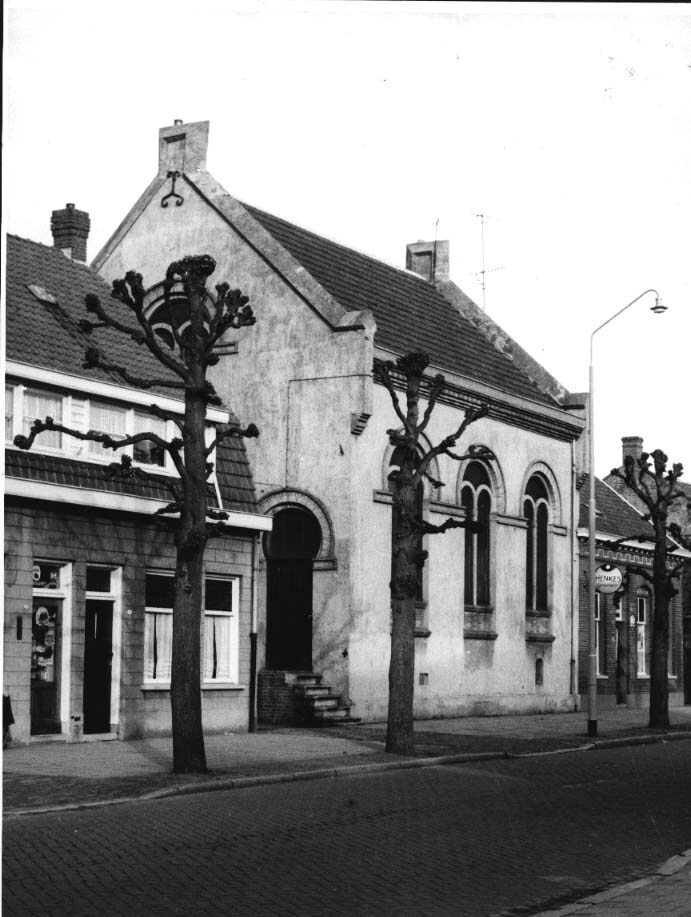
Only one photograph of the 1902 building has been found, an undated view published by the Jewish Cultural Quarter with the caption 'Synagoge in de Grotestraat te Besoijen'. It shows a free-standing, rendered brick hall set between low houses, with its steep tiled gable roof running back from the street. The street gable is finished with a projecting coping and a chimney at its peak, and carries a decorative iron anchor below the apex and a round window in the upper wall. A round-arched doorway with a moulded surround, reached by a short flight of steps, opens at the left of the long street side. To its right are tall round-arched windows, apparently three, each with a moulded arch, set below a plain cornice. A low plinth runs along the base. The design is a modest round-arched hall typical of small Dutch village synagogues of the period. Whether any walls of the 1884 building were reused after the fire of 1901 is unknown, as are the architect, builder, seating capacity and interior arrangement.
Życie w synagodze
The congregation was a small branch community within the Dutch Israelite organisation, first under the ring synagogue of Tilburg and the Capelle congregation, independent from 1835. Besides its board it maintained a burial society (chevra kadisha) and a women's society. Its internal life was unsettled: it divided in 1795 and again in 1878, and the reconciliation of 1904 came only two years after the new synagogue was consecrated, so for its first years the 1902 building may have served a divided membership. No rabbi, teacher or cantor of the congregation is named in the sources consulted. The Torah scrolls kept in the synagogue survived the war and were sent to Israel afterwards.
Zniszczenie
In 1940, at the start of the occupation, the Nazi German occupiers confiscated the synagogue. Its furnishings were sold at a public auction and the building was then used as an office; for whom is not recorded in the sources read. The Torah scrolls were saved. After the liberation the community was not revived, and in 1947 it was merged into the Jewish community of 's-Hertogenbosch. The former synagogue was used first as a gymnasium and then as a storage building for a shoe factory. The surviving photograph, which shows a television aerial on a neighbouring roof, may date from this late phase. The building was demolished in 1965. A council inventory of Waalwijk's monuments likewise dates the synagogue's presence on the site from 1884 to 1965. Who owned the building at the time and who ordered or carried out the demolition is not recorded in any source found.
Los społeczności
About thirty Jews lived in Waalwijk during the Second World War. According to the Jewish Cultural Quarter, about half of them were murdered; a municipal inventory of Waalwijk's war memorials states that ten members of the community were killed, young and old. The difference may reflect people who had moved away before deportation, but the sources do not explain it. The Waalwijk memorial was erected to commemorate the Jews of the town who were deported and killed under the Nazi German occupation. The names, dates and places of death of the victims were not found in this research. The few survivors did not re-establish a congregation. In 1947 the Waalwijk community was formally merged with that of 's-Hertogenbosch, and its Torah scrolls were sent to Israel. No Jewish community has existed in Waalwijk since.
Miejsce dzisiaj
The synagogue stood in the Grotestraat in Besoijen, at its corner with the Tempelierstraat, in the western part of Waalwijk. Nothing of the building survives. The site lies in the old ribbon of houses along the Grotestraat, but what now occupies the exact plot is not described in the sources read. A memorial stone of travertine on a basalt base, bearing a Star of David, was placed in 1969 at the corner of the Grotestraat and Tempelierstraat because the synagogue had stood there. None of the community's three former Jewish burial grounds in and around Waalwijk survives either; burials after about 1850 took place in Oisterwijk.
Czy masz coś do przekazania?
Zdjęcia, dokumenty, historie rodzinne lub wspomnienia o tej synagodze i jej społeczności pomagają zachować jej historię.
Share a memory or thought
No comments yet. Be the first to add one.