
La storia di Wadi Hamam Synagogue
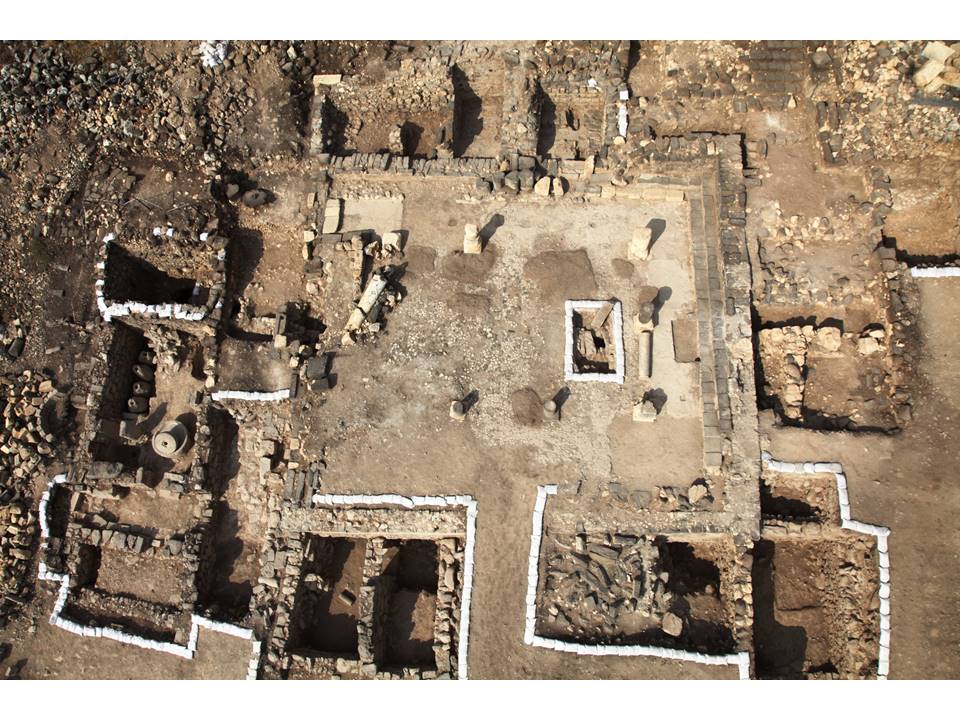
Khirbet Wadi Hamam is the ruin of a Jewish village on a slope at the foot of Mount Nitai, opposite Mount Arbel and about two kilometres west of the Sea of Galilee. Its ancient name is unknown. A Hebrew University of Jerusalem expedition directed by Uzi Leibner excavated it in six seasons between 2007 and 2012 and uncovered houses, alleys, two olive presses and a monumental synagogue in the village centre.
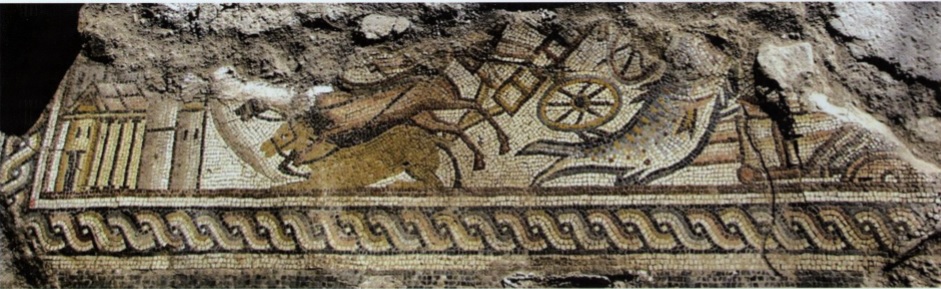
The village was founded in the Hasmonean period and was destroyed violently between about 125 and 135 CE. It was resettled around 200 CE. According to the excavators, a synagogue of the 'Galilean' type, with carved white limestone elements, was built in the first half of the third century on the platform of an earlier public building that may itself have been a synagogue. It was badly damaged later that century and restored around 300 CE, when its floor was laid with a mosaic of biblical scenes, described by its excavators as the earliest figural mosaic yet identified in an ancient synagogue.
The mosaic was damaged in the fourth century, possibly in the earthquake of 363 CE, and patched with plaster. The village declined from the mid-fourth century and was deserted around 400 CE. Leibner concluded that the empty building probably collapsed in an earthquake early in the fifth century, perhaps in 419 CE. Jodi Magness has disputed his dating of the building.
Where it stood
Khirbet Wadi Hamam (Horvat Veradim), at the foot of Mount Nitai above the village of Hamam, Arbel National Park, Lower Galilee, Israel; an archaeological site with no street address. Exact: the pin is the synagogue's position as given by the Kinneret College ancient synagogues database.
Apri la mappa grande →La comunità ebraica
Nothing is known of the community from written sources: the ancient name of the village is lost, and an identification with the Arbel of Josephus and rabbinic literature, proposed in 1991, is not the common view. What is known comes from the excavation. The excavators describe the settlement as one of the largest villages of the eastern Galilee in the Roman period, covering some 30 to 40 dunams beside a perennial spring and the route through Wadi Arbel. Its houses were well built, and Leibner remarked that their quality testifies to the economic level of the residents. Two olive presses show that oil was pressed in the village. After the destruction of about 125 to 135 CE the village was resettled around 200 CE and prospered into the early fourth century. Aramaic inscriptions in the synagogue mosaic name its donors: Samuel the scribe, Simon son of Dama, and the son or sons of a man called Simon. An amulet of the first half of the fourth century, a thin metal sheet in a copper case, was found in one of the houses.
Architettura e design
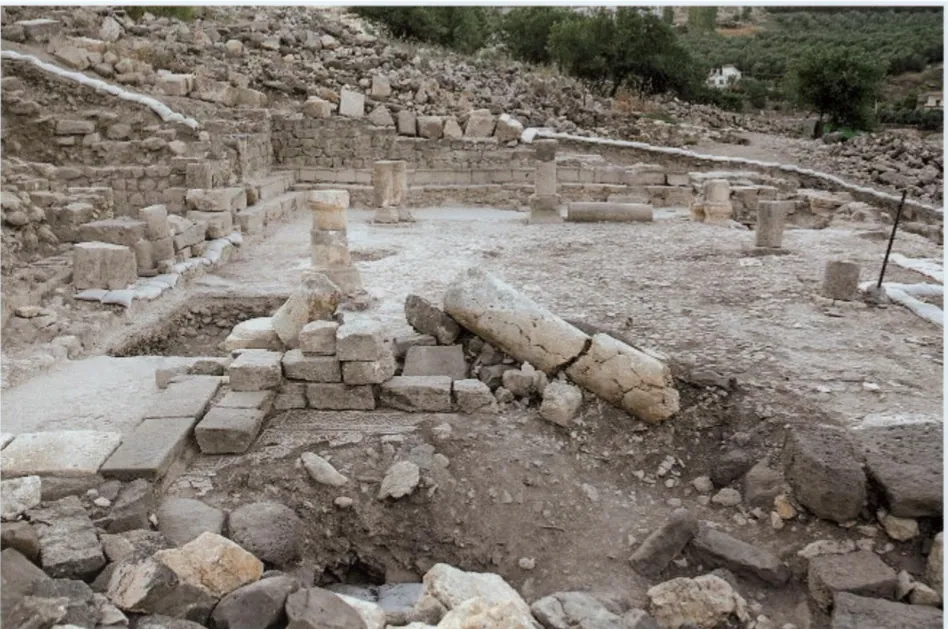
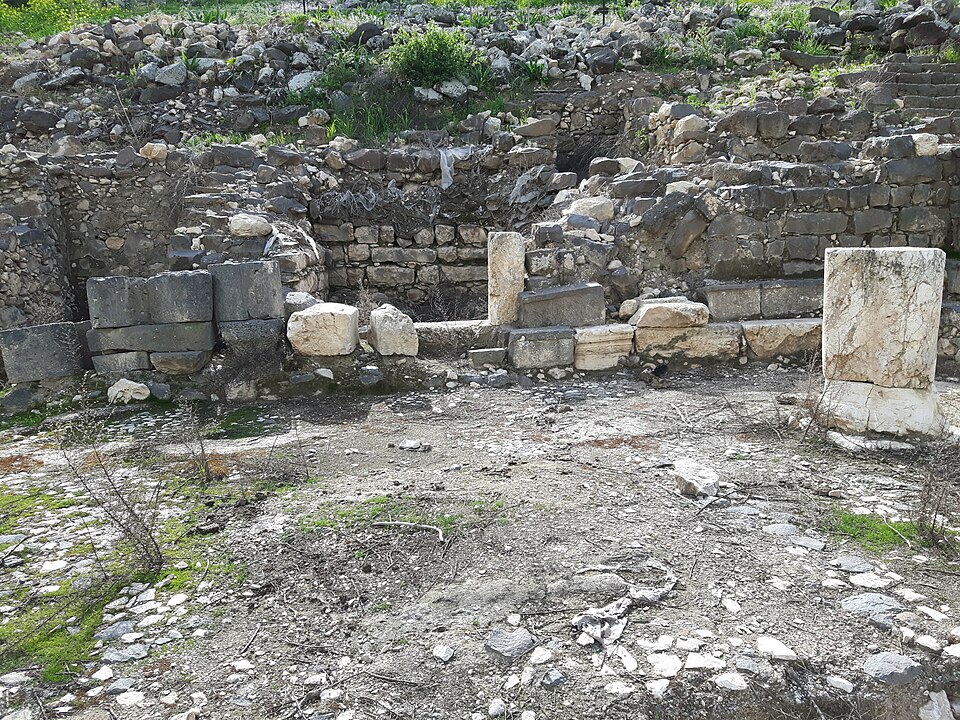
The synagogue was a roughly rectangular basilica with its long axis running north to south, measuring 17.2 by 14.7 metres outside and on average 15.4 by 12.8 metres inside. Its walls, 0.7 to 0.8 metres thick, were built of two faces of trimmed basalt blocks with a core of rubble and mortar, which surprised the excavator because the carved elements were of hard white limestone, as is usual in Galilean synagogues. Many of those elements were reused from an earlier monumental building. The single main doorway was in the southern façade; a door in the north wall was probably added later, and one in the west wall led to a small vaulted room. Rows of four columns on the east and west, joined by a transverse row on the north, divided the hall into a nave and three aisles. Two tiers of benches lined the west, north and east walls. The roof was tiled. A lintel fragment carved with two eagles flanking a wreath was found. The floor mosaic had a central carpet in the nave, perhaps a zodiac, and ten to twelve narrative panels in the aisles, facing the nave.
La vita nella sinagoga
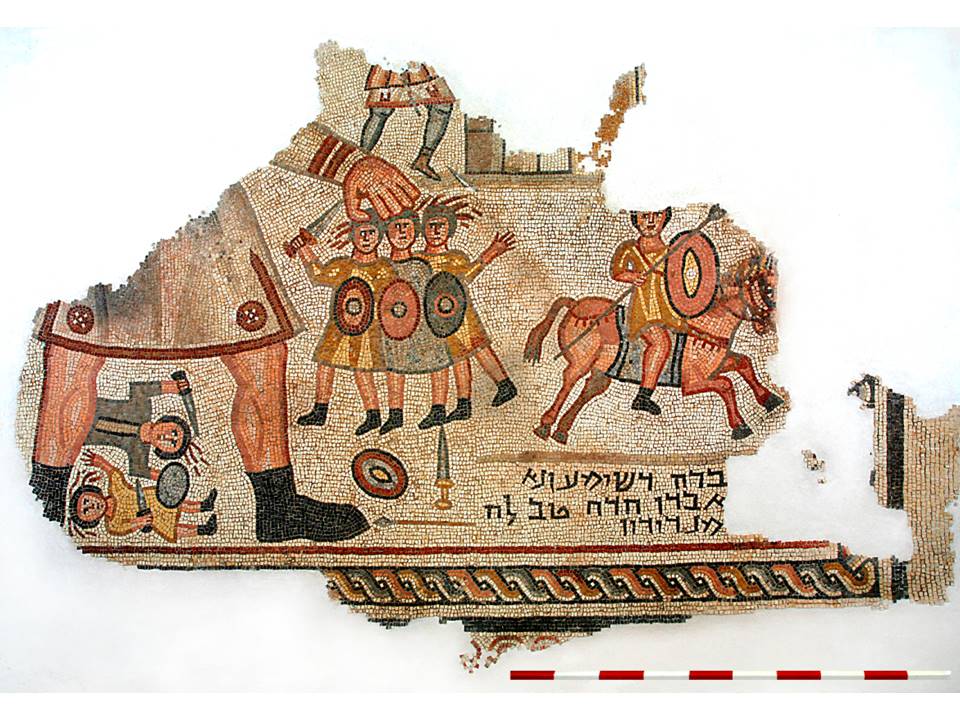
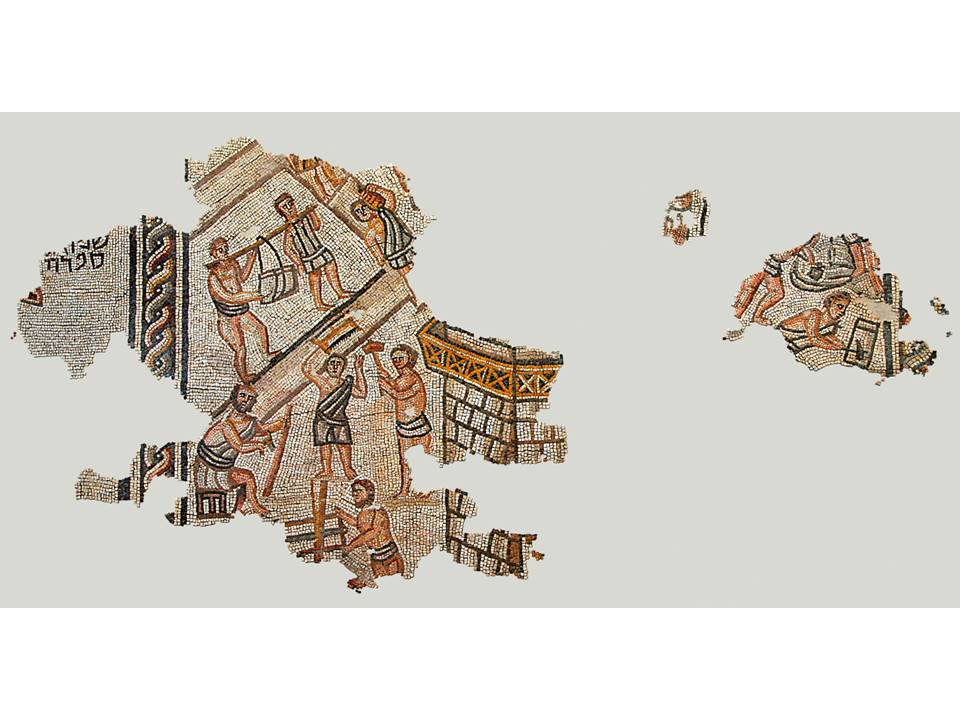
No text describes worship in this building, so what can be said comes from its fittings. The congregation sat on two tiers of stone benches along three walls, which the excavator estimated could seat about 180 people, and looked across a floor that told biblical stories in tiny coloured stones about four millimetres across. Three aisle panels can be read. One shows craftsmen with saws, adzes, hammers and ladders building a large stone structure, which the signage at the site calls the Tower of Babel; Leibner also considered Noah's ark and the Temple. A second shows a giant figure seizing smaller soldiers, most likely Samson striking the Philistines. A third shows a chariot overturned in waves beside a great fish, the drowning of Pharaoh's army in the Red Sea. Aramaic inscriptions beside the panels record gifts: one says that the son or sons of Simon made the panel from their own means. No platform belongs to the earlier phases; a stone bema, probably topped with wood, was built against the southern wall only in the late fourth century, directly on the damaged mosaic.
Distruzione
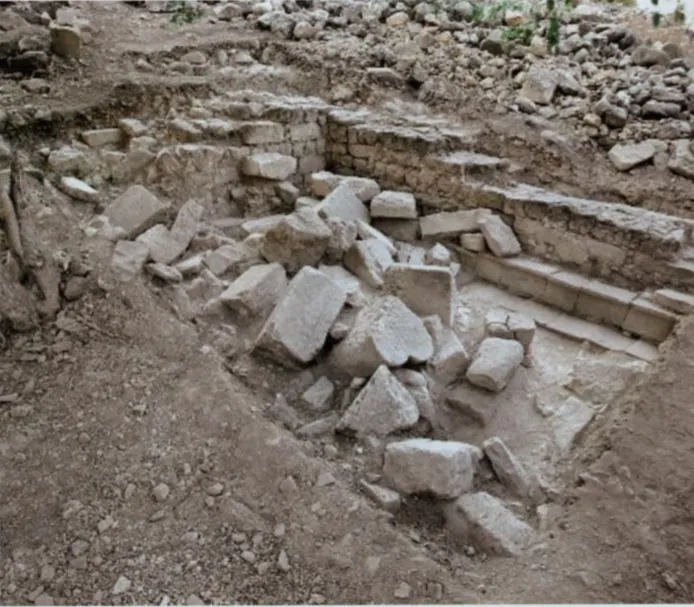
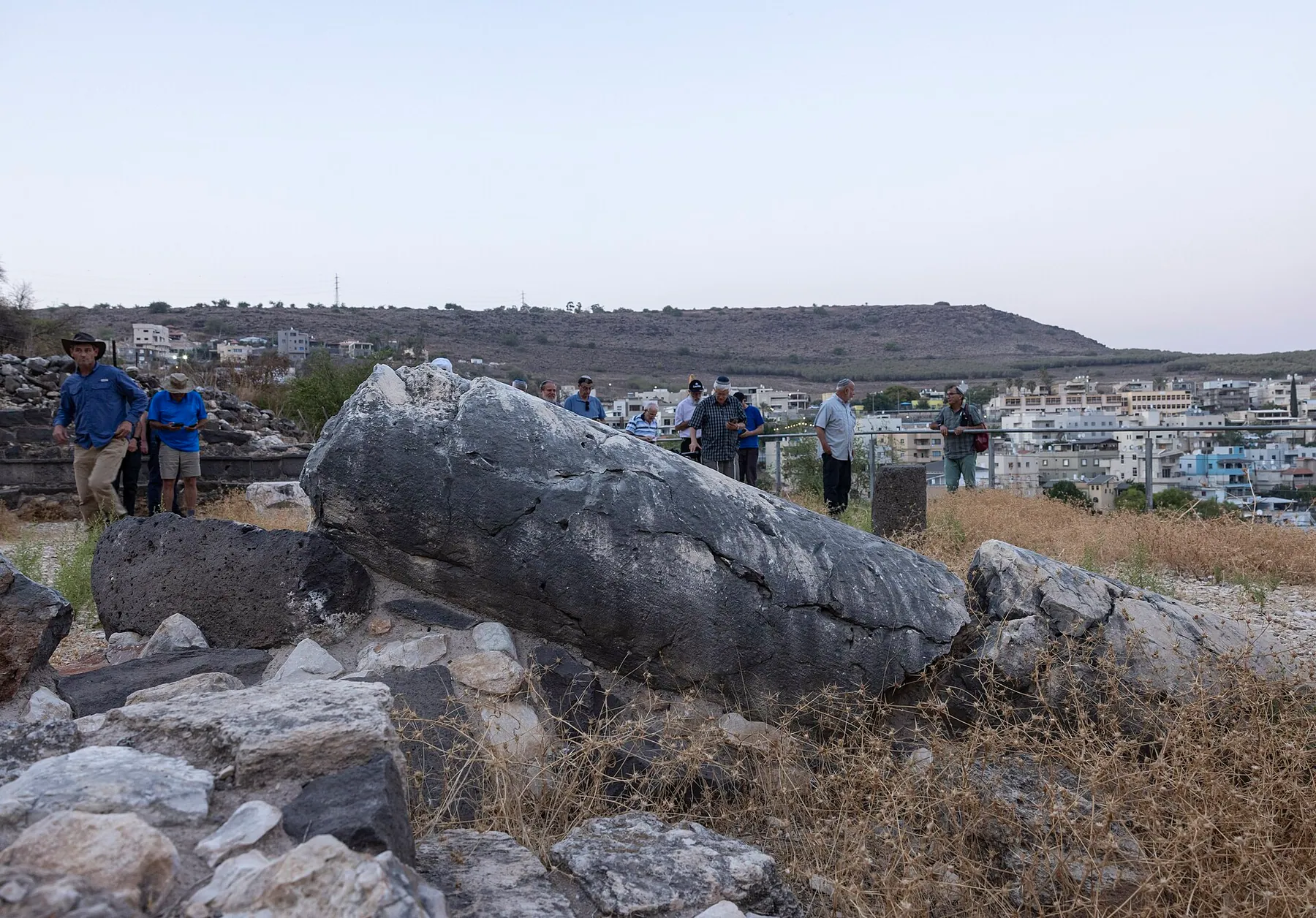
No source read attributes the end of the synagogue to any human attack. According to the excavation report, its mosaic was badly damaged in the fourth century, most plausibly in the earthquake of 363 CE, and the repairs that followed were poor: plaster in place of lost mosaic in the northern and western aisles, a low bench, and a stone bema set straight on the old floor. Four coins in the bema fill date to the last decades of the fourth century. Most of the village had by then been abandoned, and the building went out of use around 400 CE. Finds on the floor seem to have washed in after it was abandoned but before it fell. The debris, up to about 2.2 metres deep in the north-western quarter, held hundreds of roof tiles, dozens of large nails, column parts thrown to the south-west and courses of wall lying on their sides still bound by mortar. Leibner concluded that the building probably collapsed in an earthquake early in the fifth century, perhaps that of 419 CE. Later, stone robbers took masonry; an eighth-century coin and one of 1949 mark such visits.
Il destino della comunità
The village did not end in a single event. The excavators found that the farmland and many houses around the synagogue were given up by the middle of the fourth century: the latest coins in two of the excavated residential areas were struck under Constantius II, between 337 and 361 CE, and the report links the abandonment of those buildings to the earthquake of 363 CE. A reduced population stayed on for another generation and repaired the synagogue cheaply. The latest stratified remains belong to the last decades of the fourth century, and village life seems to have ended by the early fifth century. Where the inhabitants went is unknown; no source read names a destination, and the reasons for the village's decline in the early Byzantine period were one of the questions the excavation set out to study. After the collapse only squatters, passers-by and stone robbers used the ruin: ovens were built on the fallen stones using the synagogue's roof tiles, and Umayyad lamps and a Mamluk jar were left in a side room.
Il luogo oggi
The ruin lies on the slope above the present-day village of Hamam, inside Arbel National Park, and is open to the public. The synagogue is an excavated shell: at the north-western corner its basalt walls still stand about two metres above the floor, but elsewhere, especially on the east, only the floor level or foundations remain. Benches, column pedestals and fallen column shafts can be seen, and photographs taken in 2025 show railings and visitors at the site. About six per cent of the mosaic survived, in some thirty fragments, which were lifted for conservation; the signage at the site says the Samson panel and the builders panel are on display at the Israel Museum in Jerusalem.
Nomi importanti
Samuel the scribe (Shmuel Safra)
active c. 300 CEDonor named in the synagogue's mosaic floorAn Aramaic inscription in black tesserae beside the construction scene in the eastern aisle reads 'Shmuel Safra', that is Samuel the scribe, or possibly Samuel son of Safra. It appears to be the end of a dedicatory text, and he is recorded as a benefactor of the mosaic floor laid when the synagogue was restored around 300 CE. The inscription is dated between 275 and 325 CE. Nothing else is known of him.
Biografia o fonte →Simon son of Dama
active c. 300 CEDonor named in the synagogue's mosaic floorAn Aramaic inscription on the broad band around the nave reads 'Simon son of Dama son of [A]ti', the grandfather's name being partly restored. It is one of three dedicatory texts in the mosaic floor of about 300 CE, all in the same black lettering on a white ground, and he is recorded as a donor. Whether he is the Simon whose son or sons paid for the Samson panel in the western aisle is unknown.
Biografia o fonte →Hai qualcosa da condividere?
Fotografie, documenti, storie di famiglia o ricordi di questa sinagoga e della sua comunità aiutano a mantenerne viva la storia.
- Excavations at Khirbet Wadi Hamam (Lower Galilee): the Synagogue and the Settlement, Journal of Roman Archaeology 23 (2010), pp. 220-237
- Khirbet Wadi Hamam Excavations
- Wadi Hamam (Horvat Veradim)
- Khirbet Wadi Hamam (archaeoseismic site page, with extracts from Leibner et al. 2018, Qedem Reports 13)
- Khirbet Wadi Hamam (site 117) and Synagogue (building 164)
- Inscription 247: 'Samuel Safra/scribe' (panel 5)
- Inscription 248: 'Simon son of Dama son of [A]ti'
- Inscription 249: dedication of the son(s) of Simon (panel 11)
- Khirbet Wadi Hammam
- Ancient Synagogue's Floor Mosaic Found In Israel
- File:140379 remains of the ancient synagogue in khirbet hamam PikiWiki Israel.jpg (photograph of the explanatory sign at the site)
- File:Ancient synagogue ruins.jpg
- File:140381 remains of the ancient synagogue in khirbet hamam PikiWiki Israel.jpg
Share a memory or thought
No comments yet. Be the first to add one.