
הסיפור של Synagogue of Zalău
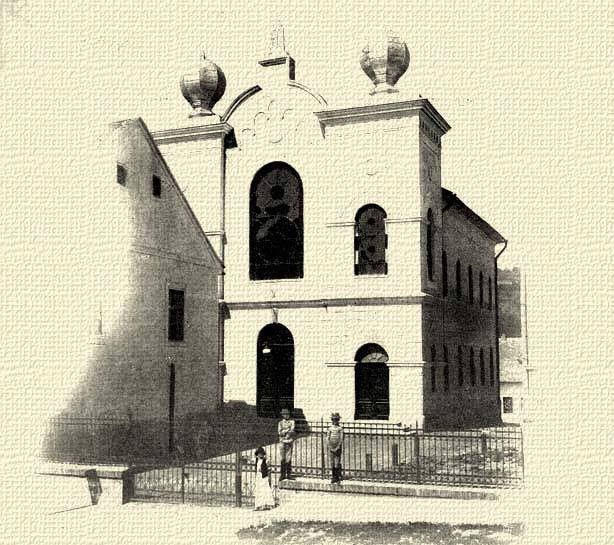
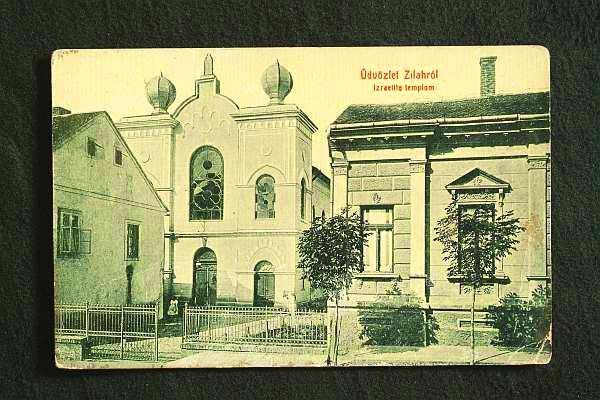
Zalău, the seat of Sălaj county in north-western Transylvania, had only a handful of Jews before the 1870s, but its community grew quickly: 150 in 1880, 326 in 1900, 432 in 1910 and 818 in 1928. The community held services in a minyan from 1870 and in a first synagogue from 1880. In 1903 it built a new synagogue measuring about 19 by 15 metres, with the rabbi's house, a ritual bath and a kosher butcher's shop beside it. A postcard titled 'Üdvözlet Zilahról — Izraelita templom' shows its front: a tall central bay with an arched window and doorway, framed by two short towers topped with onion domes, set back behind railings beside a neighbouring villa. Jewish merchants and industrialists played a large part in the town's economy between the wars. In May 1944, under Hungarian rule, the Jews of Zalău were taken to the ghetto at Cehei and Șimleu Silvaniei and deported to Auschwitz. About 145 survivors returned, but almost all left for Israel between 1950 and 1955. The synagogue was abandoned from 1955, and in 1970, under the Communists, it was sold and demolished.
Where it stood for 67 years
Historic: Zilah town centre, Szilágy county. Present day: Zalău town centre, Sălaj county, Romania. Approximate.
פתיחת מפה גדולה ←הקהילה היהודית
Jews were few in Zalău until the later nineteenth century: the census counted 7 in 1850 and 8 in 1857. The community then grew to 150 in 1880, 326 in 1900, 432 in 1910, 552 in 1920 and 818 in 1928. It was active in the town's social life, with charitable societies such as the Israelite Women's Association and the Israelite Girls' Association. Between the wars Jewish landowners and industrialists, among them Isac Jakabffy, László Löw, Ferenc Friedmann and Dezideriu Fried, owned a brickworks, a mill and oil press, a distillery and a tile factory; in 1930 there were 147 Jewish traders, a quarter of all traders in the town, and the firm Zuckermann & Schwartz was the largest clothing and footwear business. Jewish citizens were active in mainstream parties such as the National Peasant Party.
אדריכלות ועיצוב
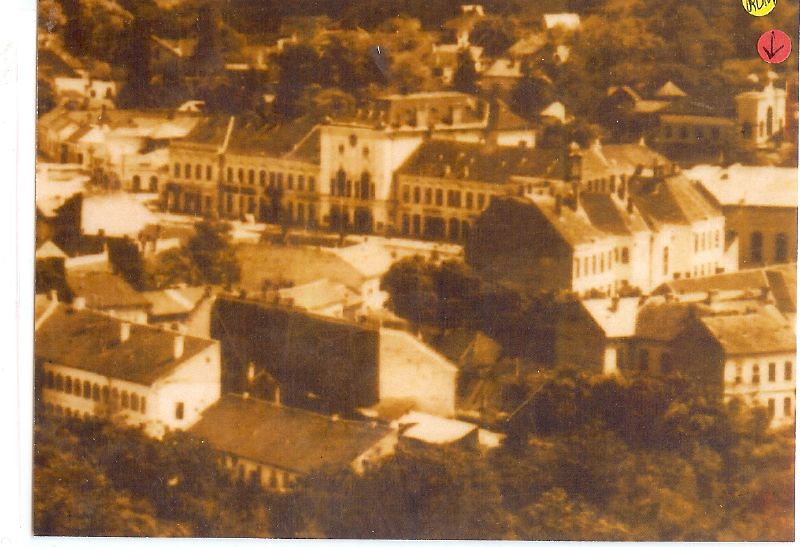
The synagogue built in 1903 measured about 19 by 15 metres. Photographs and a postcard show a rendered front of three bays: a tall central section with a large round-arched window over the arched main door, crowned by a small gable, and two flanking towers with arched windows, each topped with an onion dome and finial. A low railing and gate separated the forecourt from the street. The rabbi's house, a ritual bath and a kosher butcher's stood beside the synagogue. An aerial photograph of the town centre marks the building among the houses near the main square.
החיים בבית הכנסת
The synagogue served a mid-sized Transylvanian community of several hundred people, with its rabbi's house, mikveh and kosher butcher forming a small communal complex around it. Women's and girls' associations ran charitable work, and the community took part in the town's civic life. After the war the tiny surviving community kept up some activity; its last notable event was a Talmud Torah class and a choir led by Emil Rosenfeld, set up in 1985.
הרס
After the deportations of 1944 and the emigration of most survivors in 1950–1955, the synagogue stood unused and was left to fall into ruin from 1955. In 1970, under the Communists, the building was sold and demolished.
גורל הקהילה
Northern Transylvania was annexed by Hungary in 1940. In 1941 Jewish men from Zalău were sent to forced labour on the Soviet front. In May 1944, 92 Jewish families, 541 people, were ordered to take provisions for fifteen days, stripped of their property and marched to Zalău railway station; they were held in the ghetto at Cehei near Șimleu Silvaniei and deported to Auschwitz on 31 May and 3 and 6 June 1944, where most were murdered. After 1945 about 145 Jews returned, and almost all left for Israel between 1950 and 1955. A small community association still exists and looks after the Jewish cemetery on Strada Traian.
האתר כיום
The synagogue has gone and its exact site was not identified in the sources consulted. The Jewish cemetery at Strada Traian 120, with 162 graves, survives. In 2017 the small Jewish community of Zalău bought land for a new prayer house and memorials.
יש לכם משהו לתרום?
תמונות, מסמכים, סיפורי משפחה וזיכרונות מבית הכנסת ומהקהילה שלו עוזרים לשמור על ההיסטוריה שלו בחיים.
Share a memory or thought
No comments yet. Be the first to add one.