
הסיפור של Zandvoort Synagogue
Zandvoort, a fishing village on the North Sea coast west of Haarlem, grew into a seaside resort in the late nineteenth century, and with the resort came Jewish residents and many Jewish summer visitors from Amsterdam. Until the 1920s the local Jews belonged to the Jewish community of Haarlem and had no building of their own. In November 1919 they founded the society Elia to obtain one. A plan for a villa with a prayer hall on its upper floor proved too expensive, and in May 1921 the society chose a simple hall of 7.5 by 10 metres on a plot on the Dr. Johan G. Mezgerstraat, a street of villas and hotels near the boulevard. The Amsterdam branch of Elia helped pay for it. The cornerstone was laid on 22 June 1922 and the building was opened on 17 August 1922 by the Amsterdam chief rabbi A.S. Onderwijzer. A year later Zandvoort became an independent congregation of the Nederlands-Israëlitisch Kerkgenootschap. The synagogue served it for less than twenty years. Weeks after the Nazi German invasion of May 1940 an SS detachment was stationed in the town, which also had an unusually strong NSB following, and in the night of 4 to 5 August 1940 the synagogue was blown up. It was never rebuilt on this site.
Where it stood for 18 years
Historic: Dr. Johan G. Mezgerstraat (Metzgerstraat), Zandvoort, house number unknown. Today: Doctor Johannes G. Mezgerstraat, 2041 Zandvoort, Noord-Holland; pin at the middle of the street (approximate).
פתיחת מפה גדולה ←הקהילה היהודית
Jews were few in Zandvoort before the resort era: the community encyclopedia of the Jewish Cultural Quarter counts six in 1840. Their number grew from the last quarter of the nineteenth century, and by 1930 it had reached 372. The resort was popular with Amsterdam Jews, many of them working people, and the Clarastichting, a seaside home for sick children from poor Jewish families, stood in Zandvoort. From 20 September 1920 the local Jews formed part of the Haarlem community, but on 12 September 1923 Zandvoort was inaugurated as an independent congregation, with A. Krouwer as chairman until 1930. In 1927 it counted 325 members in about 90 families. According to the community history on Dutchjewry.org most were not religious, and attendance outside the bathing season was low. Finances were weak in the 1920s but recovered after 1930; by 1939 the congregation had money in hand and was discussing the purchase of its own cemetery, a plan the war prevented. In the 1930s several dozen German Jewish refugees settled in the town, and some Jews sat on the town council. At the same time the NSB, the Dutch National Socialist movement, won 23.35 percent of the local vote in 1935.
אדריכלות ועיצוב
The building was modest. The community history on Dutchjewry.org records that the society Elia first planned a villa with the synagogue on its upper floor, dropped the idea for lack of money, and in May 1921 decided on a simpler building measuring 7.5 by 10 metres that could hold 120 people. No architect is named in any source read, and no plan or interior view was found. The only image of it located in this research is a coloured postcard of about 1928 captioned 'Dr. Joh. G. Metzgerstraat, Zandvoort', which the Jewish Cultural Quarter publishes as a postcard of the synagogue. It shows a street in the dunes with, on the left, a low, flat-roofed, box-like building faced in pale brick or render, with a continuous band of windows high in its long side wall, beside a large villa with a green roof. This is presumably the synagogue, a plain modern hall, but the caption does not point to a particular building, so the style is given as unknown. A NIOD photograph of the ruins shows that a column-like section of the front facade survived the explosion.
החיים בבית הכנסת
Zandvoort's congregation was small and largely secular, and the synagogue was fullest in summer, when Jewish holidaymakers from Amsterdam filled the resort. Two societies looked after it, one caring for the interior of the synagogue and one organising social activities. Religious services and teaching were led by a cantor who was also the community's teacher: S. de Jong held the post from 1923 until he left for Manchester about eighteen months later, and M. Frank Azn of Kampen succeeded him. Zandvoort never had its own rabbi; the rabbi of Haarlem, S.Ph. de Vries, attended the laying of the cornerstone and sat on the education commission. The board was chaired by A. Krouwer from 1923 to 1930 and then by L.J. Elte, with L. Anderson as treasurer from 1925 to 1930 and Z.L. Blok among the board members; from 1933 to 1939 M. Spijer chaired the synagogue council. The opening on 17 August 1922 was performed by the chief rabbi of Amsterdam and North Holland, A.S. Onderwijzer, in the presence of the burgomaster.
הרס
After the Nazi German invasion of May 1940 an SS detachment was stationed in Zandvoort, and many non-Jewish inhabitants were NSB members, which the Jewish Cultural Quarter says made the position of the local Jews precarious. In the night of 4 to 5 August 1940, less than three months into the occupation, the synagogue on the Dr. J.G. Mezgerstraat was blown up. The Jewish Cultural Quarter does not name the perpetrators. The NIOD image collection describes its photograph of the building as the synagogue 'destroyed by NSB members during the war', and the community history on Dutchjewry.org states that it was blown up 'not by the Germans but by Dutch Nazis'. No court case or police report naming individuals was found. A photograph by Vreman in the NIOD collection shows the ruin the morning after: only a column-like section of the front facade still stood, and the wall of the neighbouring house on the left was scorched. According to the photographer, the Nazi German authorities tried to destroy this picture. A second NIOD image is catalogued as showing the synagogue being blown up. The remains were cleared at an unknown date, and the building was not rebuilt.
גורל הקהילה
In March 1942 the Nazi German authorities expelled the Jews of Zandvoort to Amsterdam. From there they were deported to the Nazi extermination camps and murdered. The Jewish Cultural Quarter states that only a few survived and returned to Zandvoort after the war; the exact number of victims from the town was not found in the sources read. With 372 Jews in 1930 and several dozen refugees arriving afterwards, the losses were heavy for a small resort. The community did not recover its independence: in 1947 it was merged into the Jewish community of Haarlem. Jewish life returned on a small scale through the summer visitors. A new synagogue on the Verlengde Haltestraat was inaugurated on 14 July 1965, and in the 1970s summer services were held in a building on the Korte Haltestraat.
האתר כיום
The synagogue stood on the Dr. J.G. Mezgerstraat (also written Dr. Johan G. Metzgerstraat), a residential street close to the boulevard and the dunes of Zandvoort. No source read gives its house number, and its exact plot was not identified, so the map pin marks the middle of the street. A plaque of 1991 on the site was replaced in 2021 by a memorial wall in the shape of the synagogue. Nothing of the building survives above ground.
שמות בולטים
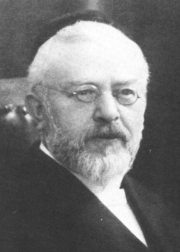
Abraham Samson Onderwijzer
1862-1934Chief Rabbi of Amsterdam and North Holland; opened the synagogue in 1922Onderwijzer, born in Muiden in 1862, was appointed chief rabbi of Amsterdam and North Holland in March 1917 and held the office until his death in November 1934. In that capacity he performed the official opening of the Zandvoort synagogue on 17 August 1922, in the presence of the burgomaster, crowning three years of effort by the local society Elia; the following year Zandvoort became an independent congregation within the Dutch Israelite church.
ביוגרפיה או מקור ←Simon Philip de Vries
1870-1944Religious teacher and secretary of the Haarlem Jewish community, styled rabbi; present at the laying of the cornerstone in 1922De Vries, born in Neede in 1870, taught religion in Haarlem from 1892 and was secretary of its Jewish community; the chief rabbi allowed him the title rabbi. Zandvoort's Jews belonged to the Haarlem community from 1920, and he attended the laying of the synagogue's cornerstone on 22 June 1922 with Mayor Beekman and sat on the Zandvoort education commission. He died in Bergen-Belsen in 1944.
ביוגרפיה או מקור ←A. Krouwer
UnknownChairman of the Zandvoort congregation, 1923-1930Krouwer was the first chairman of the independent Jewish congregation of Zandvoort and spoke at its inauguration on 12 September 1923. He led the board for seven years, during which the community struggled with the cost of its new synagogue and with low attendance outside the summer season, and he handed over the chairmanship to L.J. Elte in 1930.
ביוגרפיה או מקור ←L.J. Elte
UnknownChairman of the Zandvoort congregation from 1930Elte succeeded A. Krouwer as chairman of the Zandvoort congregation in 1930. The community history on Dutchjewry.org notes that its finances improved from that year onward, so that by 1939 the congregation had money in hand instead of debts and was considering buying a cemetery of its own, a plan the war prevented.
ביוגרפיה או מקור ←M. Spijer
UnknownChairman of the synagogue council, 1933-1939Spijer chaired the synagogue council of the Zandvoort congregation from 1933 to 1939, the last years in which the synagogue on the Dr. J.G. Mezgerstraat functioned normally before the Nazi German occupation. These were also the years in which German Jewish refugees settled in the town and the local NSB grew strong.
ביוגרפיה או מקור ←S. de Jong
UnknownCantor and teacher, from 1923 for about eighteen monthsDe Jong was appointed cantor and religious teacher when Zandvoort became an independent congregation in 1923, and so was the first official to lead services in the new synagogue on a regular basis. After about a year and a half he left Zandvoort for a post in Manchester, England, and was succeeded by M. Frank Azn of Kampen.
ביוגרפיה או מקור ←M. Frank Azn
UnknownCantor and teacher, from about 1925Frank came to Zandvoort from Kampen to replace S. de Jong as cantor and teacher of the congregation, a combined post typical of small Dutch communities. He led services in the synagogue on the Dr. J.G. Mezgerstraat and gave the children religious instruction. How long he served and what became of him were not found in the sources read.
ביוגרפיה או מקור ←יש לכם משהו לתרום?
תמונות, מסמכים, סיפורי משפחה וזיכרונות מבית הכנסת ומהקהילה שלו עוזרים לשמור על ההיסטוריה שלו בחיים.
- Zandvoort (Joodse gemeenten)
- Zandvoort (Jewish communities, English)
- The Jewish community of Zandvoort
- Nieuwbouw-synagoge in de Dr. Johan Mezgerstraat in Zandvoort (NIOD image collection 96623)
- In de nacht van 4 op 5 augustus werd de Synagoge van ... (NIOD image collection 69674)
- Synagoge te Zandvoort opgeblazen (NIOD image collection 69666)
- Monument Synagoge / Memorial Synagogue
- Start bouw van waardiger monument voor omgekomen Joodse Zandvoorters
- Doctor Johannes G. Mezgerstraat, Zandvoort (OpenStreetMap way 7411321)
- Chief Rabbi Abraham Samson Onderwijzer
- Simon Philip de Vries
Share a memory or thought
No comments yet. Be the first to add one.