
История Zevenaar Synagogue
Zevenaar lies in the Liemers, the strip of Gelderland east of Arnhem along the German border. Jews lived in the town from the 1630s and had a cemetery outside the Bleeckse Poort from 1640, but for a long time they had no house of prayer of their own and walked to services in neighbouring Didam, where a small synagogue existed in a house on the Weemstraat from about 1770. The Zevenaar community organised itself in the early nineteenth century, and in 1833 it opened its own synagogue on the Grietsestraat, one of the streets of the old town centre. According to the Amsterdam Jewish heritage site joodsamsterdam.nl it was inaugurated by Rabbi Hartog Josua Hertzveld. In August 1893 the congregation celebrated the building's sixtieth anniversary with the dedication of a new Torah scroll, given by its synagogue society Bigdei Kodesh. The synagogue served a community of around a hundred people through the nineteenth century, which shrank after 1900. During the occupation the building lost its congregation. On 8 February 1945 it was badly damaged in an American bombing raid on Zevenaar, and it was pulled down soon after the town was liberated in April 1945. Its Torah scrolls and ritual silver had been taken to Amsterdam beforehand and survive.
Where it stood for 112 years
Historic: Grietsestraat, Zevenaar, opposite the present No. 16 (approximate). Today: Grietsestraat, 6901 GT Zevenaar, Gelderland; pin at Grietsestraat 14, where a marker tile is set in the pavement.
Открыть большую карту →Еврейская община
The first Jews of Zevenaar, recorded from the 1630s, were butchers and hay dealers, and trade, butchery and the transport of livestock remained the main Jewish occupations. The community numbered 10 people in 1716 and 31 in 1809, when Marcus David Rosenberg settled in the town and was described as director of the Israelite community. Numbers rose to 117 in 1840 and stayed above a hundred for the rest of the century: 113 in 1869 and 106 in 1899, counting the Jews of the surrounding villages. The congregation kept a board that also handled poor relief, a burial society, a society for Torah study, a society for the upkeep of the synagogue, a women's society and a youth association, and it opened a Jewish school in 1875. From 1861 to 1891 it buried its dead in a section of the general cemetery on the J. Perkstraat, and in 1891 it bought its own cemetery on the Arnhemseweg. Jacob Levie Gans, an export butcher, was its treasurer for more than fifty years. By 1930 the community had fallen to 75. In the 1930s refugees from Nazi Germany arrived, and a local committee helped them move on.
Архитектура и дизайн
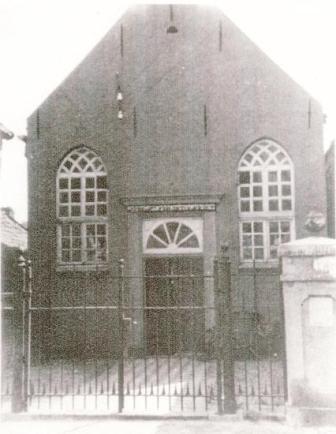
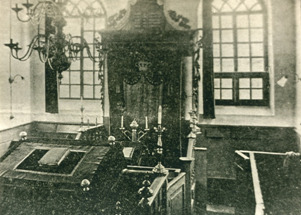
The only known exterior photograph shows a small, free-standing brick hall facing the street with its gable end. The front is symmetrical: a central doorway with a classical surround and a semicircular fanlight with radiating glazing bars, flanked by two tall round-headed windows whose upper sashes are divided by curved tracery. A small opening sits near the top of the plain triangular gable. In front lay a forecourt closed by an iron railing with a double gate between square stone posts. The Werkgroep 4 mei Zevenaar gives the building's size as about 6 by 12.5 metres, with a forecourt of 6 by 6 metres, and records a Hebrew text above the door, which is not visible in the photograph. An interior view shows the Torah ark against the end wall between two tall windows, framed by columns and crowned with a carved top and a crown, with candlesticks before it, a brass chandelier hanging from the ceiling, and the reading desk with its railing and wooden benches in the foreground. The architect, the builder and the number of seats are unknown.
Жизнь в синагоге
Besides services, the synagogue was the centre of a congregation that maintained a burial society, a Torah study society, a society for the upkeep of the synagogue itself, a women's society, a youth association and, from 1875, a Jewish school. No rabbi of its own is named in the sources consulted; the synagogue was inaugurated in 1833 by Rabbi Hartog Josua Hertzveld, rabbi at Zwolle. The one surviving document of a celebration in the building is a printed programme for Thursday 3 August 1893, when the society Bigdei Kodesh presented a new Torah scroll to the Nederlandsche Israëlitische Gemeente of Zevenaar to mark the sixtieth anniversary of the synagogue. The programme was printed by Jacob Frankfort in Arnhem; a scan is published by the Jewish Cultural Quarter in Amsterdam. The Werkgroep 4 mei Zevenaar writes that the synagogue was inaugurated on Friday 2 August 1918, which may record a rededication after renovation, but no source consulted explains the date. Jacob Levie Gans served as treasurer for more than half a century.
Разрушение
The synagogue stood empty of worshippers after the deportations of 1943, and its Torah scrolls and ritual objects had been taken to Amsterdam for safekeeping before the end of the war. On 8 February 1945 Zevenaar was bombed. The Jewish Cultural Quarter and the Werkgroep 4 mei Zevenaar say the raid was American; the information sign on the Grietsestraat and joodsamsterdam.nl call it an Allied bombing, and joodsamsterdam.nl says it killed ten people in the town. The sign says the synagogue was completely destroyed; the Jewish Cultural Quarter says it was badly damaged. Zevenaar was liberated on 3 April 1945, and the remains of the synagogue were demolished shortly afterwards. Who decided on and carried out the demolition, and in what month, is not recorded in the sources consulted. The entrance gate of the forecourt was saved and moved to a farm on the Zuiderlaan, and some furnishings were taken away in time.
Судьба общины
Zevenaar had 75 Jews in 1930, besides the refugees who passed through. On 10 April 1943, on Nazi orders, many of them were taken from the town. They were deported through the camps of Westerbork and Vught to occupied Poland, and 32 Jews from Zevenaar were murdered there; among them were the Rosenberg family, whose parents and young son died at Sobibor in 1943 and whose daughters Wieke and Alie were killed there later that year. Letters the two girls wrote are kept at the Liemers Museum. The others, fourteen people according to joodsamsterdam.nl, survived by going into hiding. Only a handful returned, too few to keep a congregation going, and in 1947 the Jewish community of Zevenaar was dissolved and merged into that of Arnhem. Its surviving Torah scrolls and silver went to the Arnhem synagogue, which still uses some of them, and a Zevenaar silver Torah crown and scrolls are in the Jewish Museum in Amsterdam. The municipality maintains the two Jewish cemeteries.
Место сегодня
The synagogue stood on the Grietsestraat in the centre of old Zevenaar, on the side of the street opposite the house now numbered 16. The Grietsestraat is today a pedestrianised shopping street, and no part of the building survives on the site; what was built on the plot after the demolition is not recorded in the sources consulted. The forecourt gate survives on a farm on the Zuiderlaan, and ritual silver and Torah scrolls from the synagogue are in Arnhem and in the Jewish Museum in Amsterdam. A tile in the pavement in front of Grietsestraat 14 and an information sign on Grietsestraat 16 mark the spot.
Значимые имена
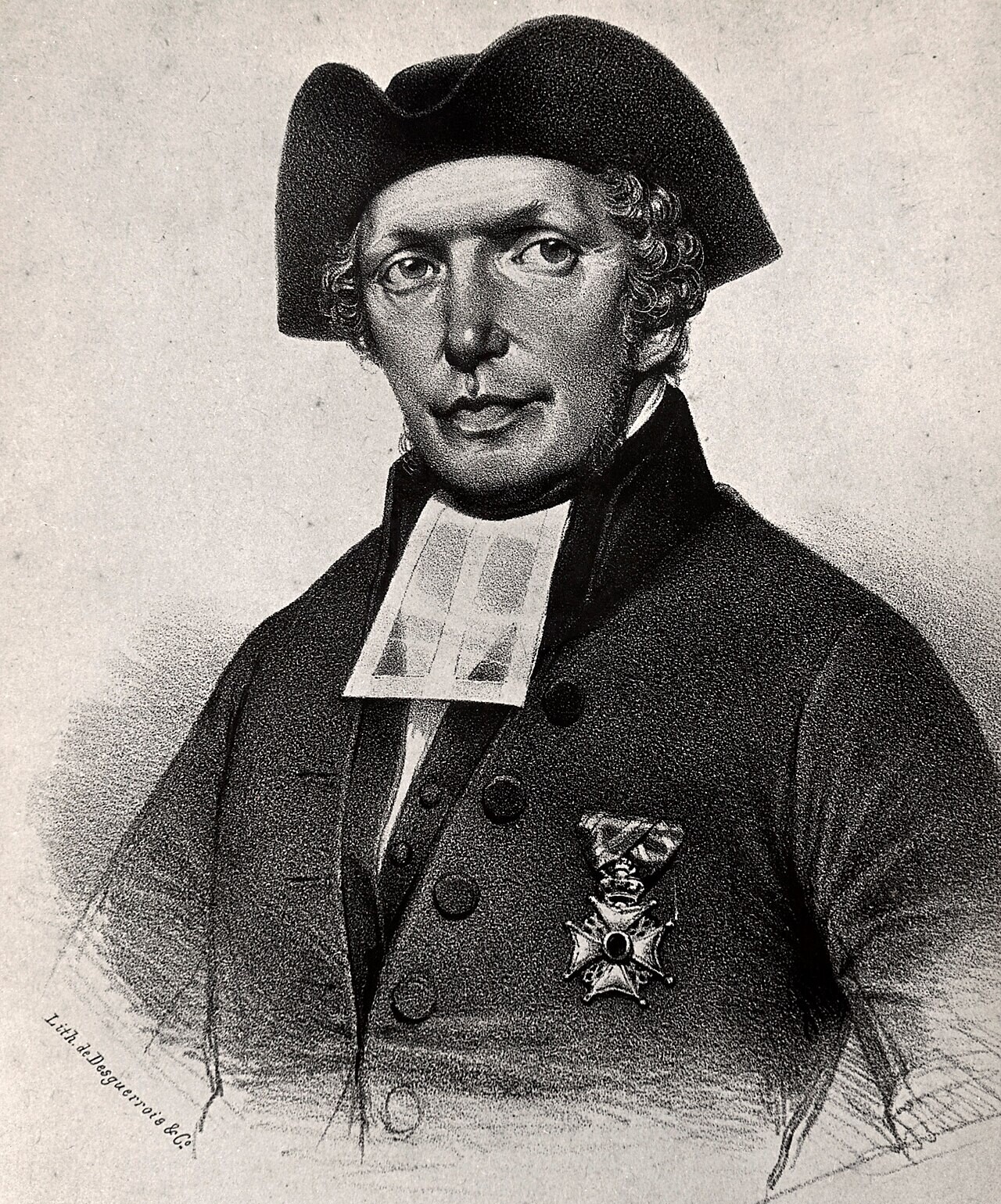
Hartog Josua Hertzveld
1781-1846 or 1864Rabbi who inaugurated the synagogue in 1833According to joodsamsterdam.nl, Rabbi Hartog Josua Hertzveld inaugurated the Zevenaar synagogue in 1833. The Jewish Encyclopedia says he was born at Glockau on 19 November 1781, served first as rabbi of Nijkerk and was called to Zwolle in 1808. A photograph of his portrait on Wikimedia Commons calls him chief rabbi (opperrabbijn). His death is given as 1846 by some sources and as 30 January 1864 at Zwolle by the Jewish Encyclopedia.
Биография или источник →Jacob Levie Gans
UnknownTreasurer of the Zevenaar Jewish community for more than fifty yearsDodenakkers.nl records that Jacob Levie Gans, an export butcher in Zevenaar, served the Jewish community as treasurer (penningmeester) for more than fifty years. As one of the board's officers he was responsible for the finances of the congregation and of its synagogue on the Grietsestraat. The years of his service and his dates of birth and death were not found in the sources consulted.
Биография или источник →Вам есть чем поделиться?
Фотографии, документы, семейные истории и воспоминания об этой синагоге и её общине помогают сохранить её историю.
- Zevenaar (Joodse gemeenten)
- Zevenaar (Jewish communities, English version)
- Programma van de inwijding eener nieuwe heilige wetsrol ... Zevenaar, 3 Aug. 1893
- Synagoge (wandeling)
- Zevenaar
- Informatiebord 10 Synagoge
- Zevenaar - Joodse begraafplaatsen
- Hertzveld, Hartog
- File:Godsdiensten, religies, Jodendom, SFA008000072.jpg
- Grietsestraat 14, Zevenaar (OpenStreetMap node 2762299825)
Share a memory or thought
No comments yet. Be the first to add one.